



Israel Probes Flydubai Cockpit Incident for Possible Terror Motive
42 sourcesUpdated Sep 30, 2026
Sponsored
Screams carried out of the flight deck. When the cockpit door opened, passengers saw blood and an injured pilot.
Noam, one of those aboard, described the aircraft beginning to descend rapidly after the confrontation. Passengers realised something serious had happened and began screaming once they learned that one of the pilots had been stabbed and seriously hurt. Yasmin Abukasis said her daughter Miriam, who was on the flight, had told her she had heard screaming and that a man holding a knife had forced one of the pilots onto the floor, and that there was blood everywhere.
In a video from the cabin, an Israeli passenger said, “We were attacked and are guarding the pilot.” Another passenger, recording a message to his family, said, “There’s a pilot who’s seriously wounded, they evacuated him.”
Flightradar24 showed the Boeing dropping nearly 14,000 feet in under 30 seconds. Other tracking reports put the loss closer to 17,000 feet across one to two minutes, from 34,000 feet down to roughly 15,000–17,000. Speed rose from 411 knots to nearly 600. The aircraft briefly recovered to 21,725 feet, then fell again below 15,000. Analysts said passengers may have felt near-zero gravity for 15 to 25 seconds.
The plunge came roughly two and a half to three hours into FZ1073, near the Jordanian–Saudi border. The flight was flydubai’s scheduled service from Dubai International to Ben Gurion in Tel Aviv, listed for 06:45 and out around 07:05, twenty minutes late. It briefly entered Jordanian airspace before turning back. It transmitted squawk 7700, the general emergency code, then 7500 for unlawful interference, then 7700 again as it neared Tabuk. Israeli warplanes were scrambled.
Passengers near the front of the cabin were already moving on the cockpit. They pushed into the flight deck, took the attacker down, and tied him. On the cabin floor outside, the injured pilot lay covered in blood while a second crewmember lay bound beside him. “They tried to murder the pilot. We subdued [the attacker],” one passenger said. Another pointed to the bound man: “This is the man who… stabbed him.” In a cabin video a passenger said, “We're here during the hijacking of an airplane. At this point, we've subdued the terrorists.”
Two deadheading off-duty pilots came forward from the rear and took the controls. A medical professional among the passengers gave the wounded pilot lifesaving care. Adam later described the cabin’s response to Channel 13. The aircraft, now under new hands, still had to reach the ground.

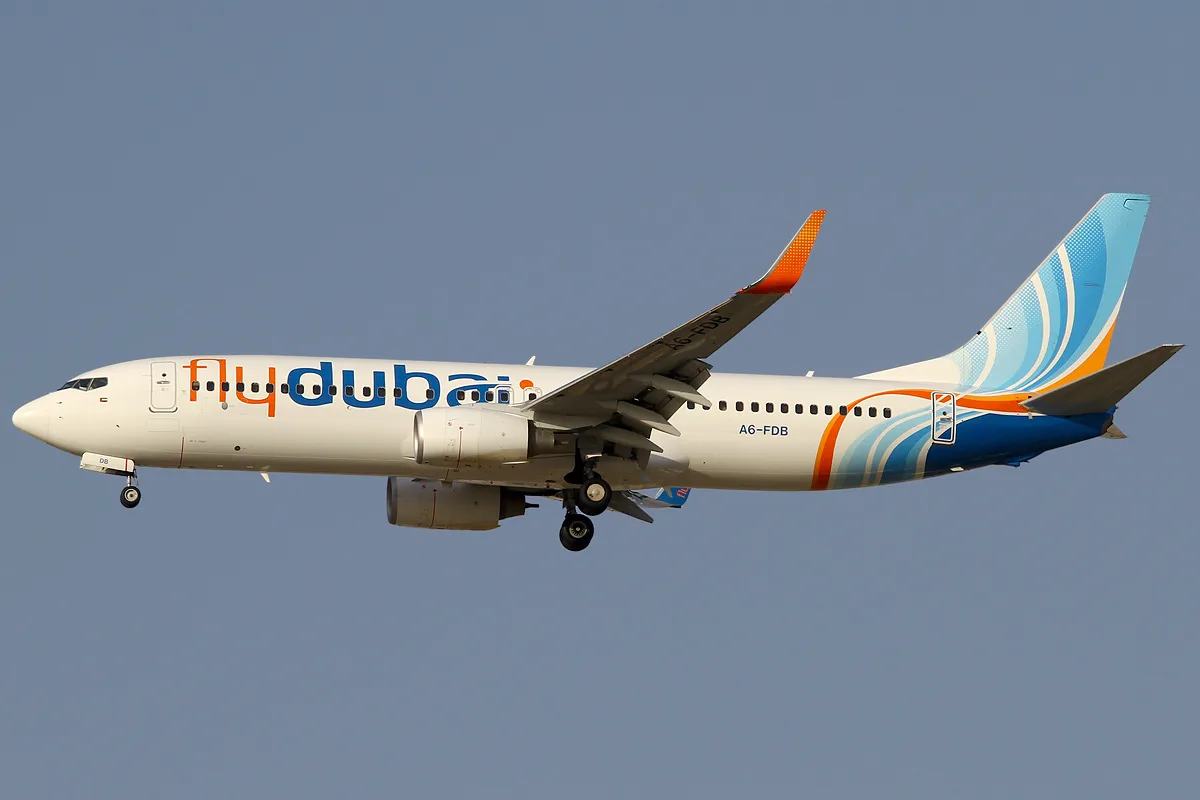
It landed safely at Tabuk Airport in northwestern Saudi Arabia around 07:00 UTC, roughly an hour after the incident began. The aircraft was a Boeing 737 MAX 8, registration A6-FKF, 3.8 years old and delivered to flydubai in December 2022. About 180 people were aboard; some reports put the number at 174, with roughly 150 of them Israeli nationals. The airline confirmed the landing and said all passengers were safe and accounted for, its teams working closely with the relevant authorities.
Photographs from the ground showed damage to the rudder and vertical stabilizer. A section was missing. The rudder is the hinged surface at the tail that turns an aircraft left or right. Arik Zer, a former Shin Bet head of flight security, told Channel 12 that the rapid plunge, not any outside object, had likely caused that damage.
Tabuk Airport stated that both pilots had been hospitalized. It was coordinating with flydubai to secure a replacement aircraft.
An official told Channel 12, “One pilot stabbed the other and tried to do 9/11.” Amit Segal of N12 News relayed a senior official’s account that the co-pilot was under questioning and that indications were mounting he had intended to take control of the plane and crash it with the passengers on board. Two Israeli officials said the current assessment was an attempted terror attack, not a mental-health episode involving either pilot. Earlier, Doron Spielman, a spokesperson for the prime minister’s office, had described the event as not a hijacking but a “different incident.”
Who occupied the two seats remained unsettled in the first accounts. The Times of Israel identified the captain as an Emirati citizen and the co-pilot as Omani. Other reports named the pilots as Russian and Ukrainian. The probe was still open. Other explanations had not been fully closed. A regional official said, “The crew have been questioned as part of the investigation,” and did not say if anyone had been detained.
The Prime Minister’s Office said, “The situation is under control, and all measures are currently being taken to bring the Israeli passengers back to Israel safely.” Israeli civilian airlines offered to fly the passengers home from Tabuk. An air-force retrieval was also under discussion; that option would require Saudi approval. Passengers reported a heavy presence of Saudi security forces surrounding them at the aircraft.
One passenger recorded a video to his family. “It was rough,” he said. “It was rough. Surely, in a few minutes we’ll return home — I need to change clothes.” He explained why: “These are covered in blood.”
How it spread
Israel calling this a terror attack early on might push Saudi Arabia to share more details about what happened on board.
If the co-pilot really tried to take over that Flydubai flight it shows how vulnerable cockpits still are despite all the rules.