


North Korea Reports Successful Large-Scale Missile and Artillery Drill
The full story · 4 min read
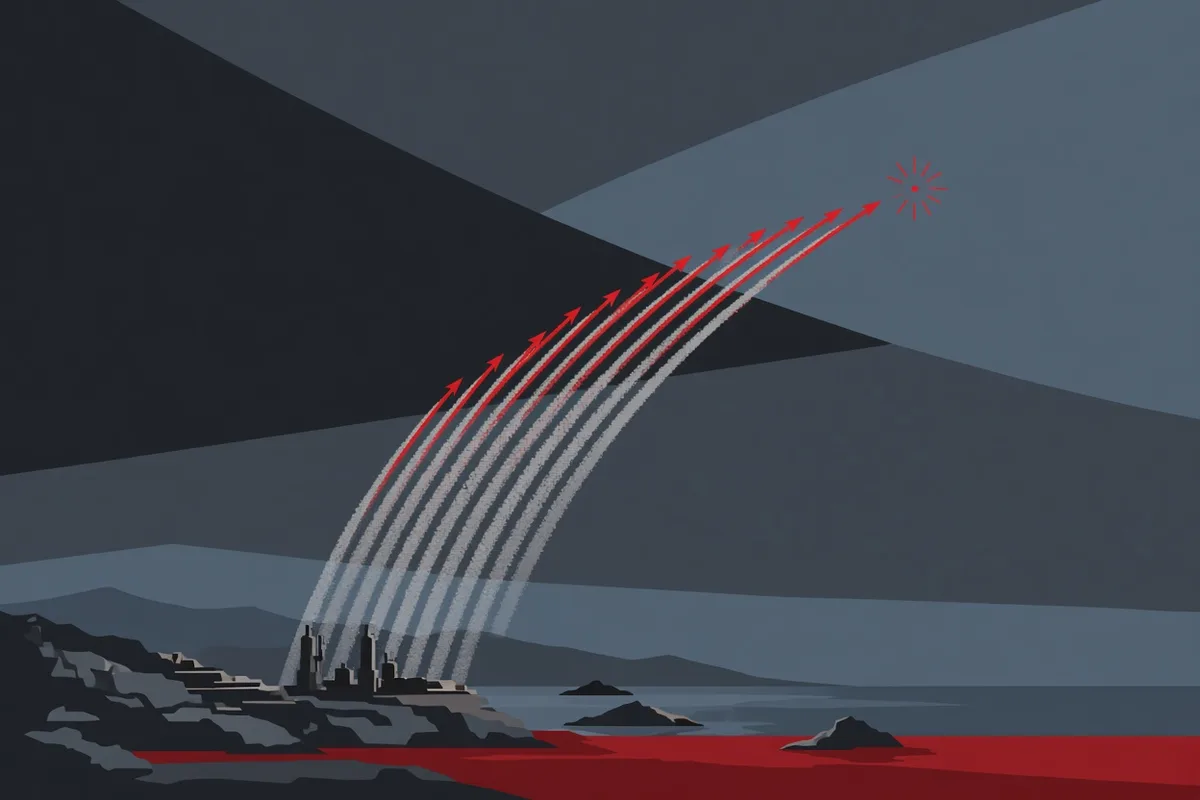
Multiple launches left the ground near Wonsan, Kangwon Province, at around 5:20 a.m. on Saturday, September 12, 2026. South Korea’s Joint Chiefs of Staff detected the flights and assessed them as short-range ballistic missiles believed to be from the Hwasong-11 series, together with 600-millimeter multiple rocket launchers. Each missile travelled about 250 kilometres toward waters off North Korea’s eastern coast, the East Sea.
Marshal Pak Jong Chon was present as of the simultaneous joint firepower attack drill that brought artillery and missile units into coordinated fire from the Wonsan area. Selected subunits from five artillery and missile joint units across all levels of the Korean People’s Army took part. Major General Yu Chang Son, director of the Artillery Bureau of the Korean People’s Army General Staff, observed and directed the exercise alongside him.
New combat systems went into the exercise: attack drones of various kinds, tactical cruise missiles, tactical ballistic missiles, and large-caliber thermal-pressure multiple rocket launchers. A thermal-pressure warhead disperses fuel as an aerosol and then ignites it, creating a blast of extreme pressure across a wide area. The systems struck with both precision and simultaneity. North Korea claimed 100 percent hit accuracy.
On Monday, September 14, the Korean Central News Agency issued its report on the Saturday exercise and released photographs of the drill. The agency described a joint firepower attack drill of long-range artillery and missile units. It reported Marshal Pak Jong Chon saying the weapons had demonstrated “the huge destructive power of concentration fire.” Citing an artillery director, the agency said the drill would improve the units’ capabilities to “completely collapse the enemy” anytime an order is placed.
Major General Yu Chang Son set the purpose in plain terms. The objective, he said, was “to master the procedures for operating the integrated fire command system, a component of the strategic weapons comprehensive management system, and to enhance expertise in achieving integrated and automated fire control among various combat systems.” An integrated fire command system is the software and communications layer that lets separate weapons—drones, cruise missiles, ballistic missiles, rocket artillery—be aimed and fired as one coordinated network rather than as individual platforms.

Marshal Pak Jong Chon pressed the same point from the command side. The exercise, he said, would “improve the level of specialisation to bring down the enemy's armed forces organisationally and structurally once an order is issued.” Kim Jong Un did not attend.
Im Eulchul, a professor at the Institute for Far Eastern Studies at Kyungnam University, described what the exercise had assembled. “Unlike before, this drill did not involve launching a single weapon system, but rather demonstrated automated firepower control and a complex strike network based on C4I,” he said. C4I is the combined layer of command, control, communications, computers and intelligence that joins sensors and weapons into one shared operating picture, so fire orders can move across platforms as a single sequence rather than as separate launches.
He gave the result its sharpest name. “It can be seen as the emergence of a 'North Korean-style Kill Chain,' where drones, cruise missiles, and ballistic missiles are simultaneously controlled via a C4I network,” Im said. A kill chain is the linked sequence that runs from detecting a target to destroying it. “This reflects a tactical development to paralyze the South Korea-U.S. air defense network's target calculation and interception capability by operating weapons systems with completely different flight characteristics and speeds at the same time,” he said.
The five-day trilateral naval and military exercise Freedom Edge, run by South Korea, the United States and Japan, had ended on September 11. The joint firepower attack drill followed one day later. It was North Korea’s fourth missile launch in about a month. Earlier flights had gone out on August 6, August 12 and August 20. On August 20, during the South Korea–United States Ulchi Freedom Shield exercise, around 10 short-range ballistic missiles left the Pyongyang area. The September 12 work was also the first publicly reported ballistic missile activity in about three weeks.
Kim Yeolsoo, Director of Security Strategy at the Korea Institute for Military Affairs, put the purpose this way: “I believe North Korea conducted this drill to advertise its substantial deterrence via demonstrations with rocket launchers, cruise missiles, and drones, and to exercise deterrence toward South Korea and the United States for regime maintenance.” North Korea rejected an unspecified overture to shorten military drills, saying that shortening would not change their “provocative, aggressive nature.”
The full account of the joint firepower attack drill went out on Monday through the external-facing Korean Central News Agency alone. Rodong Sinmun carried no report. The Korean Central Broadcasting Station broadcast none. Those two outlets are the ones North Korean residents see and hear each day. The photographs KCNA released entered circulation among readers and newsrooms outside the country. Inside North Korea the same frames never appeared on a domestic page or over a domestic airwave.