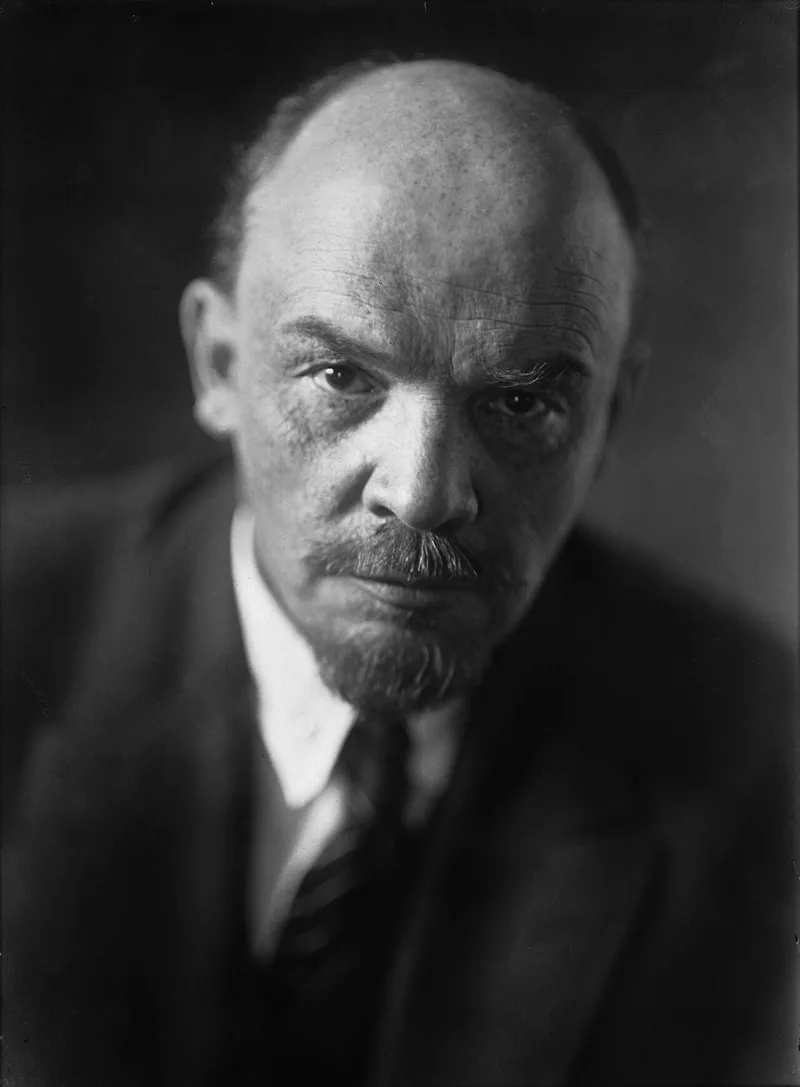
Vladimir Ilyich Ulyanov (22 April [O.S. 10 April] 1870 – 21 January 1924), better known as Vladimir Lenin, was a Russian revolutionary, politician, and political theorist. He served as the first and founding head of government of Soviet Russia from 1917 to 1924 and of the Soviet Union from 1922 to 1924. Ideologically a Marxist, his developments to the ideology are called Leninism.
Born to an upper-middle-class family in Simbirsk, Lenin embraced revolutionary socialist politics following his brother's 1887 execution. Expelled from Kazan Imperial University for protesting against the Tsarist government, he devoted the following years to a law degree. He moved to Saint Petersburg in 1893 and became a senior Marxist activist. In 1897, he was arrested for sedition and exiled to Shushenskoye in Siberia, where he married Nadezhda Krupskaya. After his exile, he moved to Western Europe, where he became a prominent theorist in the Marxist Russian Social Democratic Labour Party (RSDLP). In 1903, he took a key role in the RSDLP ideological split, leading the Bolshevik faction. Following Russia's failed Revolution of 1905, he campaigned for the First World War to be transformed into a Europe-wide proletarian revolution, which, as a Marxist, he believed would cause the overthrow of capitalism and its replacement with socialism. After the 1917 February Revolution ousted the Tsar and established a Provisional Government, he returned to Russia to play a leading role in the October Revolution in which the Bolsheviks overthrew the new regime.
Lenin's Bolshevik government initially shared power with the Left Socialist Revolutionaries, elected soviets, and a multi-party Constituent Assembly, although by 1918 it had centralised power in the new Communist Party. Lenin's administration redistributed land among the peasantry and nationalised banks and large-scale industry. It withdrew from the First World War by signing a treaty conceding territory to the Central Powers, and promoted world revolution through the Communist International. Opponents were suppressed in the Red Terror, a violent campaign administered by the state security services; tens of thousands were killed or interned in concentration camps. His administration defeated right and left-wing anti-Bolshevik armies in the Russian Civil War from 1917 to 1922 and oversaw the Polish–Soviet War of 1919–1921. Responding to wartime devastation, famine, and popular uprisings, in 1921 Lenin encouraged economic growth through the New Economic Policy. Several non-Russian nations had secured independence from the Russian Republic after 1917, but five were forcibly re-united into the new Soviet Union in 1922, while others repelled Soviet invasions. With his health failing, Lenin died in Gorki, and Joseph Stalin succeeded him as the pre-eminent figure in the Soviet government.
Widely considered one of the most significant and influential figures of the 20th century, Lenin was the posthumous subject of a pervasive personality cult within the Soviet Union until its dissolution in 1991. He became an ideological figurehead behind Marxism–Leninism and a prominent influence over the international communist movement. A controversial and highly divisive historical figure, Lenin is viewed by his supporters as a champion of socialism and the working class. Meanwhile, Lenin's critics accuse him of establishing a totalitarian dictatorship which oversaw mass killings and political repression.
Contents
Early life
Childhood: 1870–1887
Lenin was born Vladimir Ilyich Ulyanov in Streletskaya Ulitsa, Simbirsk, now Ulyanovsk, on 22 April 1870, and baptised several days later; as a child he was known as Volodya, the common nickname of Vladimir. He was the third of eight children, having two older siblings, Anna and Aleksandr. They were followed by three more children, Olga, Dmitry, and Maria. Two later siblings died in infancy. His father, Ilya Nikolayevich Ulyanov, was a member of the Russian Orthodox Church and baptised his children into it, although his mother, Maria Alexandrovna Ulyanova (née Blank), was largely indifferent to Christianity, a view that influenced her children.
Ilya Ulyanov was from a family of former serfs; Ilya's father's ethnicity remains unclear, with suggestions that he was of Russian, Chuvash, Mordvin, or Kalmyk ancestry. Despite a lower-class background, he had risen to middle-class status, studying physics and mathematics at Kazan University before teaching at the Penza Institute for the Nobility. In mid-1863, Ilya married Maria, the well-educated daughter of a wealthy Swedish Lutheran mother and a Russian Lutheran father who worked as a physician. After Lenin's death, researchers also claimed evidence that Lenin's maternal great-grandfather was a Jewish convert to Christianity. Previous researchers have argued the family was of German Lutheran origin, and were invited to Russia by Catherine the Great. According to historian Petrovsky-Shtern, Lenin was unaware of his mother's possible Jewish ancestry.
Soon after their wedding, Ilya obtained a job in Nizhny Novgorod, rising to become Director of Primary Schools in Simbirsk six years later. In 1874, he was promoted to Director of Public Schools for the province and simultaneously attained the rank of State Councillor, which granted him the status of hereditary nobleman. As the regional school director, Ilya oversaw the foundation of over 450 schools as a part of the government's plans for modernisation. In 1882, his dedication to education earned him the Order of Saint Vladimir.
Lenin's parents were monarchists and liberal conservatives, committed to the emancipation reform of 1861 introduced by the reformist Tsar Alexander II; they avoided political radicals and there is no evidence that the police ever put them under surveillance for subversive thought. Every summer they holidayed at a rural manor in Kokushkino. Among his siblings, Lenin was closest to his sister Olga, whom he often bossed around; he was extremely competitive and could be destructive, but usually admitted his misbehaviour. A keen sportsman, he spent much of his free time outdoors or playing chess, and excelled at school, the disciplinarian and conservative Simbirsk Classical Gymnasium.
University and political radicalisation: 1887–1893
Upon entering Kazan University in August 1887, Lenin moved into a nearby flat. While there, he joined a revolutionary cell run by the militant agrarian socialist Lazar Bogoraz, composed of leftists seeking to revive the Narodnaya Volya (People's Will). At the same time, he joined a zemlyachestvo, a form of university society that represented the men of a particular region. The group elected him as its representative to the university's zemlyachestvo council, and he took part in a December demonstration against government restrictions that banned student societies. The police arrested Lenin and accused him of being a ringleader in the demonstration; he was expelled from the university, and the Ministry of Internal Affairs exiled him to his family's Kokushkino estate. He read voraciously, becoming enamoured with Nikolay Chernyshevsky's 1863 pro-revolutionary novel What Is to Be Done?
Lenin's mother was concerned by her son's radicalisation, and was instrumental in convincing the Interior Ministry to allow him to return to Kazan, but not the university. Soviet historiography would later claim that, on his return to Kazan, Lenin became involved with Nikolai Fedoseev's Marxist revolutionary circle, through which he would discover Karl Marx's 1867 book Das Kapital. However, it was not until 1888 that Fedoseev founded a Marxist study group, at which time Lenin had already left the city; this meant that Lenin and Fedoseev did not meet.
In September 1889, the Ulyanov family moved to Samara, where Lenin joined Alexei Sklyarenko's socialist discussion circle. Wary of his political views, his mother had previously bought a country estate in Alakaevka village, Samara Oblast, in the hope that her son would turn his attention to agriculture. He had little interest in farm management, and his mother soon sold the land, keeping the house as a summer home.
While in Samara, Lenin began to embrace Marxism, producing a Russian translation of Marx and Friedrich Engels' 1848 political pamphlet, The Communist Manifesto. He began to read the works of the Russian Marxist Georgi Plekhanov, agreeing with Plekhanov's argument that Russia was moving from feudalism to capitalism and so socialism would be implemented by the proletariat, or urban working class, rather than the peasantry. This Marxist perspective contrasted with the view of the agrarian-socialist Narodnik movement, which held that the peasantry could establish socialism in Russia by forming peasant communes, thereby bypassing capitalism. This Narodnik view developed in the 1860s with the Narodnaya Volya and was then dominant within the Russian revolutionary movement. Lenin rejected the premise of the agrarian-socialist argument but was influenced by agrarian-socialists like Pyotr Tkachev and Sergei Nechaev and befriended several Narodniks.
Revolutionary activity
Early activism and imprisonment: 1893–1900
In late 1893, Lenin moved to Saint Petersburg. There, he worked as a barrister's assistant and rose to a senior position in a Marxist revolutionary cell that called itself the Social-Democrats after the Marxist Social Democratic Party of Germany. Championing Marxism within the socialist movement, he encouraged the founding of revolutionary cells in Russia's industrial centres. By late 1894, he was leading a Marxist workers' circle, and meticulously covered his tracks to evade police spies. He began a romantic relationship with Nadezhda "Nadya" Krupskaya, a Marxist school teacher. He also authored a political tract criticising the Narodnik agrarian-socialists, What the "Friends of the People" Are and How They Fight the Social-Democrats; around 200 copies were illegally printed in 1894.
Hoping to cement connections between his Social-Democrats and Emancipation of Labour, a group of Russian Marxists based in Switzerland, Lenin visited the country to meet group members Plekhanov and Pavel Axelrod. He proceeded to Paris to meet Marx's son-in-law Paul Lafargue and to research the Paris Commune of 1871, which he considered an early prototype for a proletarian government. Financed by his mother, he stayed in a Swiss health spa before travelling to Berlin, where he studied for six weeks at the Staatsbibliothek and met the Marxist Wilhelm Liebknecht. Returning to Russia with illegal revolutionary publications, he travelled to various cities distributing literature to striking workers. While involved in producing a news sheet, Rabochee delo (Workers' Cause), he was among 40 activists arrested in St. Petersburg and charged with sedition.
Refused legal representation or bail, Lenin denied all charges but remained imprisoned for a year before sentencing. He spent this time theorising and writing. In this work he noted that the rise of industrial capitalism in Russia had caused large numbers of peasants to move to the cities, where they formed a proletariat. Lenin argued that this Russian proletariat would develop class consciousness, which would lead them to violently overthrow Tsarism, the aristocracy, and the bourgeoisie and to establish a dictatorship of the proletariat that would move toward socialism.
In February 1897, Lenin was sentenced without trial to three years' exile in eastern Siberia. He was granted a few days in Saint Petersburg to put his affairs in order and used this time to meet with the Social-Democrats, who had renamed themselves the League of Struggle for the Emancipation of the Working Class. His journey to eastern Siberia took 11 weeks, for much of which he was accompanied by his mother and sisters. Deemed only a minor threat to the government, he was exiled to Shushenskoye, Minusinsky District, where he was kept under police surveillance; he was nevertheless able to correspond with other revolutionaries, many of whom visited him, and permitted to go on trips to swim in the Yenisei River and to hunt duck and snipe.
Munich, London, and Geneva: 1900–1905
After his exile, Lenin settled in Pskov in early 1900. There, he began raising funds for a newspaper, Iskra (Spark), a new organ of the Russian Marxist party, now calling itself the Russian Social Democratic Labour Party (RSDLP). In July 1900, Lenin left Russia for Western Europe; in Switzerland he met other Russian Marxists, and at a Corsier conference they agreed to launch the paper from Munich, where Lenin relocated in September. Containing contributions from prominent European Marxists, Iskra was smuggled into Russia, becoming the country's most successful underground publication since the 1850s. He first adopted the pseudonym Lenin in December 1901, possibly based on the Siberian Lena River; he often used the fuller pseudonym of N. Lenin, and while the N did not stand for anything, a popular misconception later arose that it represented Nikolai. Under this pseudonym, in 1902 he published his most influential publication to date, the pamphlet What Is to Be Done?, which outlined his thoughts on the need for a vanguard party to lead the proletariat to revolution. He also used the name "Jacob Richter" to get a reader's ticket at the British Museum Reading Room.
Nadya joined Lenin in Munich and became his secretary. They continued their political agitation, as Lenin wrote for Iskra and drafted the RSDLP programme, attacking ideological dissenters and external critics, particularly the Socialist Revolutionary Party (SR), a Narodnik agrarian-socialist group founded in 1901. Despite remaining a Marxist, he accepted the Narodnik view on the revolutionary power of the Russian peasantry, accordingly penning the 1903 pamphlet To the Village Poor. To evade Bavarian police, Lenin moved to London with Iskra in April 1902, where he befriended fellow Russian-Ukrainian Marxist Leon Trotsky. Lenin fell ill with erysipelas and was unable to take such a leading role on the Iskra editorial board; in his absence, the board moved its base of operations to Geneva.
The second RSDLP Congress was held in London in July 1903. At the conference, a schism emerged between Lenin's supporters and those of Julius Martov. Martov argued that party members should be able to express themselves independently of the party leadership; Lenin disagreed, emphasising the need for a strong leadership with complete control over the party. Lenin's supporters were in the majority, and he termed them the "majoritarians" (bol'sheviki in Russian; Bolsheviks); in response, Martov termed his followers the "minoritarians" (men'sheviki; Mensheviks). Arguments between Bolsheviks and Mensheviks continued after the conference; the Bolsheviks accused their rivals of being opportunists and reformists who lacked discipline, while the Mensheviks accused Lenin of being a despot and autocrat. Enraged at the Mensheviks, Lenin resigned from the Iskra editorial board and in May 1904 published the anti-Menshevik tract One Step Forward, Two Steps Back. The stress made Lenin ill, and to recuperate he holidayed in Switzerland. The Bolshevik faction grew in strength; by spring 1905, the whole RSDLP Central Committee was Bolshevik, and in December they founded the newspaper Vperyod (Forward).
Revolution of 1905 and its aftermath: 1905–1914
In January 1905, the Bloody Sunday massacre of protesters in St. Petersburg sparked a spate of civil unrest in the Russian Empire known as the Revolution of 1905. Lenin urged Bolsheviks to take a greater role in the events, encouraging violent insurrection. In doing so, he adopted SR slogans regarding "armed insurrection", "mass terror", and "the expropriation of gentry land", resulting in Menshevik accusations that he had deviated from orthodox Marxism. In turn, he insisted that the Bolsheviks split completely with the Mensheviks; many Bolsheviks refused, and both groups attended the Third RSDLP Congress, held in London in April 1905. Lenin presented many of his ideas in the pamphlet Two Tactics of Social Democracy in the Democratic Revolution, published in August 1905. Here, he predicted that Russia's liberal bourgeoisie would be sated by a transition to constitutional monarchy and thus betray the revolution; instead, he argued that the proletariat would have to build an alliance with the peasantry to overthrow the Tsarist regime and establish the "provisional revolutionary democratic dictatorship of the proletariat and the peasantry".
In response to the revolution of 1905, which had failed to overthrow the government, Tsar Nicholas II accepted a series of liberal reforms in his October Manifesto. In this climate, Lenin felt it safe to return to Saint Petersburg. Joining the editorial board of Novaya Zhizn (New Life), a radical legal newspaper run by Maria Andreyeva, he used it to discuss issues facing the RSDLP. He encouraged the party to seek out a much wider membership, and advocated the continual escalation of violent confrontation, believing both to be necessary for a successful revolution. Recognising that membership fees and donations from a few wealthy sympathisers were insufficient to finance the Bolsheviks' activities, Lenin endorsed the idea of robbing post offices, railway stations, trains, and banks. Under the lead of Leonid Krasin, a group of Bolsheviks began carrying out such criminal actions, the best-known taking place in June 1907, when a group of Bolsheviks acting under the leadership of Joseph Stalin committed an armed robbery of the State Bank in Tiflis, Georgia.
Although he briefly supported the idea of reconciliation between Bolsheviks and Mensheviks, Lenin's advocacy of violence and robbery was condemned by the Mensheviks at the Fourth RSDLP Congress, held in Stockholm in April 1906. After Lenin escaped to Finland from Russia, he was involved in setting up a Bolshevik Centre in Kuokkala, Grand Duchy of Finland, which was at the time an autonomous state controlled by the Russian Empire, before the Bolsheviks regained dominance of the RSDLP at its Fifth Congress, held in London in May 1907. As the Tsarist government cracked down on opposition, both by disbanding Russia's legislative assembly, the Second Duma, and by ordering its secret police, the Okhrana, to arrest revolutionaries, Lenin fled Finland for Switzerland. There, he tried to exchange those banknotes stolen in Tiflis that had identifiable serial numbers on them.
First World War: 1914–1917
Lenin was in Galicia when the First World War broke out. The war pitted the Russian Empire against the Austro-Hungarian Empire, and due to his Russian citizenship, Lenin was arrested and briefly imprisoned until his anti-Tsarist credentials were explained. Lenin and his wife returned to Bern, before relocating to Zurich in February 1916. Lenin was angry that the German Social Democratic Party was supporting the German war effort, which was a direct contravention of the Second International's Stuttgart resolution that socialist parties would oppose the conflict and saw the Second International as defunct. He attended the Zimmerwald Conference in September 1915 and the Kienthal Conference in April 1916, urging socialists across the continent to convert the "imperialist war" into a continent-wide "civil war" with the proletariat pitted against the bourgeoisie and aristocracy. In July 1916, Lenin's mother died, but he was unable to attend her funeral. Her death deeply affected him, and he became depressed, fearing that he too would die before seeing the proletarian revolution.
In September 1917, Lenin published Imperialism, the Highest Stage of Capitalism, which argued that imperialism was a product of monopoly capitalism, as capitalists sought to increase their profits by extending into new territories where wages were lower and raw materials cheaper. He believed that competition and conflict would increase and that war between the imperialist powers would continue until they were overthrown by proletariat revolution and socialism established. He spent much of this time reading the works of Georg Wilhelm Friedrich Hegel, Ludwig Feuerbach, and Aristotle, all of whom had been key influences on Marx. This changed Lenin's interpretation of Marxism; whereas he once believed that policies could be developed based on predetermined scientific principles, he concluded that the only test of whether a policy was correct was its practice. He still perceived himself as an orthodox Marxist, but he began to diverge from some of Marx's predictions about societal development; whereas Marx had believed that a "bourgeoisie-democratic revolution" of the middle classes had to take place before a "socialist revolution" of the proletariat, Lenin believed that in Russia the proletariat could overthrow the Tsarist regime without an intermediate revolution.
February Revolution and the July Days: 1917
In February 1917, the February Revolution broke out in Saint Petersburg, renamed Petrograd at the beginning of the First World War, as industrial workers went on strike over food shortages and deteriorating factory conditions. The unrest spread to other parts of Russia, and fearing that he would be violently overthrown, Tsar Nicholas II abdicated. The State Duma took over control of the country, establishing the Russian Provisional Government and converting the Empire into a new Russian Republic. When Lenin learned of this from his base in Switzerland, he celebrated with other dissidents. He decided to return to Russia to take charge of the Bolsheviks but found that most passages into the country were blocked due to the ongoing conflict. He organised a plan with other dissidents to negotiate a passage for them through Germany, with which Russia was then at war. Recognising that these dissidents could cause problems for their Russian enemies, the German government agreed to permit 32 Russian citizens to travel by train through their territory, among them Lenin and his wife. For political reasons, Lenin and the Germans agreed to a cover story that Lenin had travelled by sealed train carriage through German territory, but in fact the train was not truly sealed, and the passengers were allowed to disembark to, for example, spend the night in Frankfurt. The group travelled by train from Zurich to Sassnitz, proceeding by ferry to Trelleborg, Sweden, and from there to the Haparanda–Tornio border crossing and then to Helsinki before taking the final train to Petrograd.
Arriving at Petrograd's Finland Station in April, Lenin gave a speech to Bolshevik supporters condemning the Provisional Government and again calling for a continent-wide European proletarian revolution. Over the following days, he spoke at Bolshevik meetings, lambasting those who wanted reconciliation with the Mensheviks and revealing his "April Theses", an outline of his plans for the Bolsheviks, which he had written on the journey from Switzerland. He publicly condemned both the Mensheviks and the Social Revolutionaries, who dominated the influential Petrograd Soviet, for supporting the Provisional Government, denouncing them as traitors to socialism. Considering the government to be just as imperialist as the Tsarist regime, he advocated immediate peace with Germany and Austria-Hungary, rule by soviets, the nationalisation of industry and banks, and the state expropriation of land, all with the intention of establishing a proletariat government and pushing toward a socialist society. By contrast, the Mensheviks believed that Russia was insufficiently developed to transition to socialism and accused Lenin of trying to plunge the new Republic into civil war. Over the coming months Lenin campaigned for his policies, attending the meetings of the Bolshevik Central Committee, prolifically writing for the Bolshevik newspaper Pravda, and giving public speeches in Petrograd aimed at converting workers, soldiers, sailors, and peasants to his cause.
October Revolution: 1917
In August 1917, while Lenin was in Finland, General Lavr Kornilov, the commander-in-chief of the Russian Army, sent troops to Petrograd in what appeared to be a military coup attempt against the Provisional Government. Premier Alexander Kerensky turned to the Petrograd Soviet, including its Bolshevik members, for help, allowing the revolutionaries to organise workers as Red Guards to defend the city. The coup petered out before it reached Petrograd, but the events had allowed the Bolsheviks to return to the open political arena. Fearing a counter-revolution from right-wing forces hostile to socialism, the Mensheviks and Socialist-Revolutionaries who dominated the Petrograd Soviet had been instrumental in pressuring the government to normalise relations with the Bolsheviks. Both the Mensheviks and Socialist-Revolutionaries had lost much popular support because of their affiliation with the Provisional Government and its unpopular continuation of the war. The Bolsheviks capitalised on this, and soon the pro-Bolshevik Marxist Trotsky was elected leader of the Petrograd Soviet. In September, the Bolsheviks gained a majority in the workers' sections of both the Moscow and Petrograd Soviets.
Recognising that the situation was safer for him, Lenin returned to Petrograd. There he attended a meeting of the Bolshevik Central Committee on 10 October, where he again argued that the party should lead an armed insurrection to topple the Provisional Government. This time the argument won with ten votes against two. Critics of the plan, Zinoviev and Kamenev, argued that Russian workers would not support a violent coup against the regime and that there was no clear evidence for Lenin's assertion that all of Europe was on the verge of proletarian revolution. The party began plans to organise the offensive, holding a final meeting at the Smolny Institute on 24 October. This was the base of the Military Revolutionary Committee (MRC), an armed militia largely loyal to the Bolsheviks that had been established by the Petrograd Soviet during Kornilov's alleged coup.
In October, the MRC was ordered to take control of Petrograd's key transport, communication, printing and utilities hubs, and did so without bloodshed. Bolsheviks besieged the government in the Winter Palace and overcame it and arrested its ministers after the cruiser Aurora, controlled by Bolshevik seamen, fired a blank shot to signal the start of the revolution. During the insurrection, Lenin gave a speech to the Petrograd Soviet announcing that the Provisional Government had been overthrown. The Bolsheviks declared the formation of a new government, the Council of People's Commissars, or Sovnarkom. Lenin initially turned down the leading position of Chairman, suggesting Trotsky for the job, but other Bolsheviks insisted and ultimately Lenin relented. Lenin and other Bolsheviks then attended the Second Congress of Soviets on 26 and 27 October and announced the creation of the new government. Menshevik attendees condemned the illegitimate seizure of power and the risk of civil war. In the early days of the regime, Lenin adjusted his rhetoric so as not to alienate Russia's population, and spoke about having a country controlled by the workers and power to the Soviets. Lenin and many other Bolsheviks expected proletariat revolution to sweep across Europe in days or months.
Lenin's government
Organising the Soviet government: 1917–1918
The Provisional Government had planned for a Constituent Assembly to be elected in November 1917; despite Lenin's objections, Sovnarkom allowed the vote as scheduled. In the election, the Bolsheviks gained about a quarter of the vote, losing to the agrarian-focused Socialist-Revolutionaries. Lenin argued that the election did not reflect the people's will, claiming the electorate was unaware of the Bolsheviks' programme, and that candidacy lists were outdated, having been drawn up before the Left Socialist-Revolutionaries split from the Socialist-Revolutionaries. Nevertheless, the newly elected Russian Constituent Assembly convened in Petrograd in January 1918. Sovnarkom claimed it was counter-revolutionary because it sought to remove power from the soviets, but the Socialist-Revolutionaries and Mensheviks denied this. The Bolsheviks presented a motion to strip the Assembly of most of its legal powers; when the Assembly rejected this, Sovnarkom declared it counter-revolutionary and forcibly disbanded it.
Lenin rejected repeated calls, including from some Bolsheviks, to establish a coalition government with other socialist parties. Though Sovnarkom refused a coalition with the Mensheviks or Socialist-Revolutionaries, it allowed the Left Socialist-Revolutionaries five cabinet posts in December 1917. This coalition lasted only until March 1918, when the Left Socialist-Revolutionaries left the government over disagreements about the Bolsheviks' approach to ending the First World War. At their 7th Congress in March 1918, the Bolsheviks changed their name from the Russian Social Democratic Labour Party to the Russian Communist Party, as Lenin wanted to distance his group from the increasingly reformist German Social Democratic Party and emphasize its goal of a communist society.
Although ultimate power officially rested with Sovnarkom and the Executive Committee (VTSIK) elected by the All-Russian Congress of Soviets (ARCS), the Communist Party was de facto in control of Russia, as acknowledged by its members at the time. By 1918, Sovnarkom began acting unilaterally, citing a need for expediency, with the ARCS and VTSIK becoming increasingly marginalized, so the soviets no longer had a role in governing Russia. During 1918 and 1919, the government expelled Mensheviks and Socialist-Revolutionaries from the soviets. Russia had become a one-party state.
Within the party, a Political Bureau (Politburo) and Organisation Bureau (Orgburo) were established to accompany the existing Central Committee; decisions of these bodies had to be adopted by Sovnarkom and the Council of Labour and Defence. Lenin was the most significant figure in this governance structure, being Chairman of Sovnarkom and sitting on the Council of Labour and Defence, the Central Committee, and the Politburo. The only individual with comparable influence was Lenin's right-hand man, Yakov Sverdlov, who died in March 1919 as a result of the Spanish flu pandemic. In November 1917, Lenin and his wife took a two-room flat within the Smolny Institute; the following month, they went on a brief holiday in Halila, Finland. In January 1918, he survived an assassination attempt in Petrograd; Fritz Platten, who was with Lenin at the time, shielded him and was injured by a bullet.
Social, legal, and economic reform: 1917–1918
Upon taking power, Lenin's regime issued several decrees. The first was the Decree on Land, nationalizing the landed estates of the aristocracy and the Orthodox Church for redistribution to peasants by local governments. This contrasted with Lenin's preference for agricultural collectivisation but acknowledged the widespread peasant land seizures that had already taken place. In November 1917, the government issued the Decree on the Press, closing opposition media outlets deemed counter-revolutionary. Although claimed to be temporary, the decree faced criticism, including from Bolsheviks, for undermining freedom of the press.
In November 1917, Lenin issued the Declaration of the Rights of the Peoples of Russia, granting non-Russian ethnic groups the right to secede and form independent nation-states. Many declared independence (Finland, Lithuania in December 1917, Latvia and Ukraine in January 1918, Estonia in February 1918, Transcaucasia in April 1918, and Poland in November 1918). The Bolsheviks then promoted communist parties in these new states, while at the Fifth All-Russian Congress of the Soviets in July 1918, a constitution reformed the Russian Republic into the Russian Soviet Federative Socialist Republic. The government also switched from the Julian calendar to the Gregorian calendar, aligning Russia with Europe.
In November 1917, Sovnarkom abolished Russia's legal system, replacing it with "revolutionary conscience". Courts were replaced by Revolutionary Tribunals for counter-revolutionary crimes, and People's Courts for civil and criminal cases, instructed to follow Sovnarkom decrees and a "socialist sense of justice". November also saw the military restructured with egalitarian measures, abolition of previous ranks, titles, and medals, and the establishment of soldiers' committees to elect commanders.
In October 1917, Lenin decreed an eight-hour workday for all Russians. He also issued the Decree on Popular Education, guaranteeing free, secular education for all children, and a decree establishing state orphanages. A literacy campaign was launched to combat mass illiteracy, with an estimated 5 million people enrolling in courses from 1920 to 1926. Embracing gender equality, laws were passed to emancipate women, giving them economic autonomy and easing divorce restrictions. The Zhenotdel was established to promote these aims. Lenin's Russia became the first country to legalize first-trimester abortion on demand. The regime was militantly atheist, seeking to dismantle organized religion. In January 1918, the government decreed the separation of church and state and banned religious instruction in schools.
Treaty of Brest-Litovsk: 1917–1918
Upon taking power, Lenin believed that a key policy of his government must be to withdraw from the First World War by establishing an armistice with the Central Powers of Germany and Austria-Hungary. He believed that ongoing war would create resentment among war-weary Russian troops, to whom he had promised peace, and that these troops and the advancing German Army threatened both his own government and the cause of international socialism. By contrast, other Bolsheviks, in particular Nikolai Bukharin and the Left Communists, believed that peace with the Central Powers would be a betrayal of international socialism and that Russia should instead wage "a war of revolutionary defence" that would provoke an uprising of the German proletariat against their own government.
Lenin proposed a three-month armistice in his Decree on Peace of November 1917, which was approved by the Second Congress of Soviets and presented to the German and Austro-Hungarian governments. The Germans responded positively, viewing this as an opportunity to focus on the Western Front and stave off looming defeat. In November, armistice talks began at Brest-Litovsk, the headquarters of the German high command on the Eastern Front, with the Russian delegation being led by Trotsky and Adolph Joffe. Meanwhile, a ceasefire until January was agreed. During negotiations, the Germans insisted on keeping their wartime conquests, which included Poland, Lithuania, and Courland, whereas the Russians countered that this was a violation of these nations' rights to self-determination. Some Bolsheviks had expressed hopes of dragging out negotiations until proletarian revolution broke out throughout Europe. On 7 January 1918, Trotsky returned from Brest-Litovsk to Saint Petersburg with an ultimatum from the Central Powers: either Russia accept Germany's territorial demands or the war would resume.
In January and again in February, Lenin urged the Bolsheviks to accept Germany's proposals. He argued that the territorial losses were acceptable if it ensured the survival of the Bolshevik-led government. The majority of Bolsheviks rejected his position, hoping to prolong the armistice and call Germany's bluff. On 18 February, the German Army launched Operation Faustschlag, advancing further into Russian-controlled territory and conquering Dvinsk within a day. At this point, Lenin finally convinced a small majority of the Bolshevik Central Committee to accept the Central Powers' demands. On 23 February, the Central Powers issued a new ultimatum: Russia had to recognise German control not only of Poland and the Baltic states but also of Ukraine or face a full-scale invasion.
Anti-Kulak campaigns, Cheka, and Red Terror: 1918–1922
By early 1918, many cities in western Russia faced famine as a result of chronic food shortages. Lenin blamed this on the kulaks, or wealthier peasants, who allegedly hoarded the grain that they had produced to increase its financial value. In May 1918, he issued a requisitioning order that established armed detachments to confiscate grain from kulaks for distribution in the cities, and in June called for the formation of Committees of Poor Peasants to aid in requisitioning. This policy resulted in vast social disorder and violence, as armed detachments often clashed with peasant groups, helping to set the stage for the civil war. A prominent example of Lenin's views was his August 1918 telegram to the Bolsheviks of Penza, which called upon them to suppress a peasant insurrection by publicly hanging at least 100 "known kulaks, rich men, [and] bloodsuckers".
The requisitions disincentivised peasants from producing more grain than they could personally consume, and thus production slumped. A booming black market supplemented the official state-sanctioned economy, and Lenin called on speculators, black marketeers and looters to be shot. Both the Socialist-Revolutionaries and Left Socialist-Revolutionaries condemned the armed appropriations of grain at the Fifth All-Russian Congress of Soviets in July 1918. Realising that the Committees of the Poor Peasants were also persecuting peasants who were not kulaks and thus contributing to anti-government feeling among the peasantry, in December 1918 Lenin abolished them.
Lenin repeatedly emphasised the need for terror and violence in overthrowing the old order and ensuring the success of the revolution. Speaking to the All-Russian Central Executive Committee of the Soviets in November 1917, he declared that "the state is an institution built up for the sake of exercising violence. Previously, this violence was exercised by a handful of moneybags over the entire people; now we want [...] to organise violence in the interests of the people." He strongly opposed suggestions to abolish capital punishment. Fearing anti-Bolshevik forces would overthrow his administration, in December 1917 Lenin ordered the establishment of the Emergency Commission for Combating Counter-Revolution and Sabotage, or Cheka, a political police force led by Felix Dzerzhinsky.
In September 1918, Sovnarkom passed a decree that inaugurated the Red Terror, a system of repression orchestrated by the Cheka secret police. Although sometimes described as an attempt to eliminate the entire bourgeoisie, Lenin did not want to exterminate all members of this class, merely those who sought to reinstate their rule. The majority of the Terror's victims were well-to-do citizens or former members of the Tsarist administration; others were non-bourgeois anti-Bolsheviks and perceived social undesirables such as prostitutes. The Cheka claimed the right to execute anyone whom it deemed to be an enemy of the government, without recourse to the Revolutionary Tribunals. Accordingly, throughout Soviet Russia the Cheka carried out killings, often in large numbers. There are no surviving records to provide an accurate figure of how many perished in the Red Terror; later estimates of historians have ranged between 10,000 and 15,000, and 50,000 to 140,000.
Civil War and the Polish–Soviet War: 1918–1920
Lenin expected Russia's aristocracy and bourgeoisie to oppose his government but believed that the numerical superiority of the lower classes, coupled with the Bolsheviks' organizational skills, would ensure a swift victory. He did not anticipate the intensity of the violent opposition that ensued. The resulting Russian Civil War (1917–1923) pitted the Bolshevik Red Army against the anti-Bolshevik Whites, with the Reds ultimately emerging victorious. The conflict also included ethnic clashes and anti-Bolshevik peasant and left-wing uprisings across the former Empire. Historians often view the civil war as two conflicts: one between revolutionaries and counter-revolutionaries, and another among different revolutionary factions.
The White armies were formed by former Tsarist officers, including Anton Denikin's Volunteer Army in South Russia, Alexander Kolchak's forces in Siberia, and Nikolai Yudenich's troops in the Baltic states. The Whites gained support from 35,000 members of the Czech Legion, who allied with the Committee of Members of the Constituent Assembly (Komuch), an anti-Bolshevik government in Samara. Western governments, angered by the Treaty of Brest-Litovsk and fearing Bolshevik calls for world revolution, also backed the Whites. In 1918, Britain, France, the U.S., Canada, Italy, and Serbia landed 10,000 troops in Murmansk and Kandalaksha, while British, US, and Japanese forces landed in Vladivostok. Western troops soon withdrew, offering only material support, but Japan remained, seeking territorial gains.
Lenin tasked Trotsky with forming the Red Army, with Trotsky organizing a Revolutionary Military Council in September 1918 and serving as chairman until 1925. Lenin allowed former Tsarist officers to serve in the Red Army, monitored by military councils. The Reds controlled Moscow, Petrograd, and most of Great Russia, while the Whites were fragmented and geographically scattered on the peripheries. The Whites' Russian supremacism alienated national minorities. The White Terror was more spontaneous than the state-sanctioned Red Terror. Antisemitism proved to be a major issue during the Civil War, and while both sides attacked Jewish communities (see Pogroms during the Russian Civil War), the Whites successfully used antisemitism in anti-Bolshevik propaganda by blaming the Jews for the revolution and the alleged conspiracy behind it. Lenin, in his turn, blamed capitalists for inflaming antisemitism and condemned it in general.
In July 1918, Sverdlov informed Sovnarkom that the Ural Regional Soviet had overseen the execution of the former Tsar and his family in Yekaterinburg to prevent their rescue by White troops. Some historians believe Lenin sanctioned the killings, while others, like James Ryan, argue there is "no reason" to believe so. Lenin viewed the execution as necessary, likening it to the execution of Louis XVI during the French Revolution.
Comintern and world revolution: 1919–1920
After the Armistice on the Western Front, Lenin believed that the breakout of the European revolution was imminent. Seeking to promote this, Sovnarkom supported the establishment of Béla Kun's Hungarian Soviet Republic in March 1919, followed by the soviet government in Bavaria and various revolutionary socialist uprisings in other parts of Germany, including that of the Spartacus League. During Russia's Civil War, the Red Army was sent into the newly independent national republics on Russia's borders to aid Marxists there in establishing soviet systems of government. In Europe, this resulted in the creation of new communist-led states in Estonia, Latvia, Lithuania, Belarus, and Ukraine, all of which were nominally independent from Russia but in fact controlled from Moscow, while further east it led to the creation of communist governments in Outer Mongolia. Various senior Bolsheviks wanted these absorbed into the Russian state; Lenin insisted that national sensibilities should be respected, but reassured his comrades that these nations' new Communist Party administrations were under the de facto authority of Sovnarkom.
In late 1918, the British Labour Party called for the establishment of an international conference of socialist parties, the Labour and Socialist International. Lenin saw this as a revival of the Second International, which he had despised, and formulated his own rival international socialist conference to offset its impact. Organised with the aid of Zinoviev, Nikolai Bukharin, Trotsky, Christian Rakovsky, and Angelica Balabanoff, the First Congress of this Communist International (Comintern) opened in Moscow in March 1919. It lacked global coverage; most of the delegates resided within the countries of the former Russian Empire, and most of the international delegates were not recognised by any socialist parties in their own nations. Accordingly, the Bolsheviks dominated proceedings, with Lenin subsequently authoring a series of regulations that meant that only socialist parties endorsing the Bolsheviks' views were permitted to join Comintern. During the first conference, Lenin spoke to the delegates, lambasting the parliamentary path to socialism espoused by revisionist Marxists like Kautsky and repeating his calls for a violent overthrow of Europe's bourgeoisie governments. While Zinoviev became the Comintern's president, Lenin retained significant influence over it.
The Second Congress of the Communist International opened in Petrograd's Smolny Institute in July 1920, representing the last time that Lenin visited a city other than Moscow. There, he encouraged foreign delegates to emulate the Bolsheviks' seizure of power and abandoned his longstanding viewpoint that capitalism was a necessary stage in societal development, instead, encouraging those nations under colonial occupation to transform their pre-capitalist societies directly into socialist ones. For this conference, he authored "Left-Wing" Communism: An Infantile Disorder, a short book articulating his criticism of elements within the British and German Communist parties who refused to enter their nations' parliamentary systems and trade unions; instead, he urged them to do so to advance the revolutionary cause. The conference had to be suspended for several days due to the ongoing war with Poland, and was relocated to Moscow, where it continued to hold sessions until August. Lenin's predicted world revolution did not materialise, as the Hungarian Communist government was overthrown, and the German Marxist uprisings suppressed.
Famine and the New Economic Policy: 1920–1922
Within the Communist Party, there was dissent from two factions, the Group of Democratic Centralism and the Workers' Opposition, both of which accused the Russian state of being too centralised and bureaucratic. The Workers' Opposition, which had connections to the official state trade unions, also expressed the concern that the government had lost the trust of the Russian working class. They were angered by Trotsky's suggestion that the trade unions be eliminated. He deemed the unions to be superfluous in a "workers' state", but Lenin disagreed, believing it best to retain them; most Bolsheviks embraced Lenin's view in the 'trade union discussion'. To deal with the dissent, at the Tenth Party Congress in February 1921, Lenin introduced a ban on factional activity within the party, under pain of expulsion.
Caused in part by a drought, the Russian famine of 1921 resulted in around five million deaths. The famine was exacerbated by government requisitioning, as well as the export of large quantities of Russian grain. To aid the famine victims, the US government established the American Relief Administration to distribute food; Lenin was suspicious of this aid and had it closely monitored. During the famine, Patriarch Tikhon called on Orthodox churches to sell unnecessary items to help feed the starving, an action endorsed by the government. In February 1922, Sovnarkom went further by calling on all valuables belonging to religious institutions to be forcibly appropriated and sold. Tikhon opposed the sale of items used within the Eucharist and many clergy resisted the appropriations, resulting in violence.
In 1920 and 1921, local opposition to requisitioning resulted in anti-Bolshevik peasant uprisings breaking out across Russia, which were suppressed. Among the most significant was the Tambov Rebellion, which was put down by the Red Army. In February 1921, workers went on strike in Petrograd, resulting in the government proclaiming martial law in the city and sending in the Red Army to quell demonstrations. In March, the Kronstadt rebellion began when sailors in Kronstadt revolted against the Bolshevik government, demanding that all socialists be allowed to publish freely, that independent trade unions be given freedom of assembly and that peasants be allowed free markets and not be subject to requisitioning. Lenin declared that the mutineers had been misled by the Socialist-Revolutionaries and foreign imperialists, calling for violent reprisals. Under Trotsky's leadership, the Red Army put down the rebellion on 17 March, resulting in thousands of deaths and the internment of survivors in labour camps.
Later life
Declining health and conflict with Stalin: 1920–1923
To Lenin's embarrassment and horror, in April 1920 the Bolsheviks held a large party to celebrate his 50th birthday, which was also marked by widespread celebrations across Russia and the publication of poems and biographies dedicated to him. Between 1920 and 1926, twenty volumes of Lenin's Collected Works were published; some material was omitted. During 1920, several prominent Western figures visited Lenin in Russia; these included the author H. G. Wells and the philosopher Bertrand Russell, as well as the anarchists Emma Goldman and Alexander Berkman. Lenin was also visited at the Kremlin by Inessa Armand, who was in increasingly poor health. He sent her to a sanatorium in Kislovodsk in the Northern Caucasus to recover, but she died there in September 1920 during a cholera epidemic. Her body was transported to Moscow, where a visibly grief-stricken Lenin oversaw her burial beneath the Kremlin Wall.
Lenin became seriously ill by the latter half of 1921, experiencing hyperacusis, insomnia, and regular headaches. At the Politburo's insistence, in July he left Moscow for a month's leave at his Gorki mansion, where he was cared for by his wife and sister. Lenin began to contemplate the possibility of suicide, asking both Krupskaya and Stalin to acquire potassium cyanide for him. Twenty-six physicians were hired to help Lenin during his final years; many of them were foreign and had been hired at great expense. Some suggested that his sickness could have been caused by metal oxidation from the bullets that were lodged in his body from the 1918 assassination attempt; in April 1922 he underwent a surgical operation to successfully remove them. The symptoms continued after this, with Lenin's doctors unsure of the cause; some suggested that he had neurasthenia or cerebral arteriosclerosis. In May 1922, he had his first stroke, temporarily losing his ability to speak and being paralysed on his right side. He convalesced at Gorki and had largely recovered by July. In October, he returned to Moscow; in December, he had a second stroke and returned to Gorki.
Despite his illness, Lenin remained keenly interested in political developments. When the Socialist Revolutionary Party's leadership was found guilty of conspiring against the government in a trial held between June and August 1922, Lenin called for their execution; they were instead imprisoned indefinitely, only being executed during the Great Purge of Stalin's leadership. With Lenin's support, the government also succeeded in virtually eradicating Menshevism in Russia by expelling all Mensheviks from state institutions and enterprises in March 1923 and then imprisoning the party's membership in concentration camps. Lenin was concerned by the survival of the Tsarist bureaucratic system in Soviet Russia, particularly during his final years. Condemning bureaucratic attitudes, he suggested a total overhaul to deal with such problems, in one letter complaining that "we are being sucked into a foul bureaucratic swamp".
Death and funeral: 1923–1924
In March 1923, Lenin had a third stroke and lost his ability to speak; that month, he experienced partial paralysis on his right side and began exhibiting sensory aphasia. By May, he appeared to be making a slow recovery, regaining some of his mobility, speech, and writing skills. In October, he made a final visit to the Kremlin. On 21 January 1924, Lenin fell into a coma and died at age 53. His official cause of death was recorded as an incurable disease of the blood vessels.
The Soviet government publicly announced Lenin's death the following day. On 23 January, mourners from the Communist Party, trade unions, and Soviets visited his Gorki home to inspect the body, which was carried in a red coffin by leading Bolsheviks. Transported by train to Moscow, the coffin was taken to the House of Trade Unions, where the body lay in state. Over the next three days, around a million mourners came to see the body, many queuing for hours in the freezing conditions. On 26 January, the eleventh All-Union Congress of Soviets met to pay respects, with speeches by Kalinin, Zinoviev, and Stalin. Notably, Trotsky was absent; he had been convalescing in the Caucasus, and he later claimed that Stalin sent him a telegram with the incorrect date of the planned funeral, making it impossible for him to arrive in time. Lenin's funeral took place the following day, when his body was carried to Red Square, accompanied by martial music, where assembled crowds listened to a series of speeches before the corpse was placed into the vault of a specially erected mausoleum. Despite the freezing temperatures, tens of thousands attended.
Against Krupskaya's protestations, Lenin's body was embalmed to preserve it for long-term public display in the Red Square mausoleum. During this process, Lenin's brain was removed; in 1925 an institute was established to dissect it, revealing that Lenin had had severe sclerosis. In July 1929, the Politburo agreed to replace the temporary mausoleum with a permanent one in granite, which was finished in 1933. His sarcophagus was replaced in 1940 and again in 1970. For safety amid the Second World War, from 1941 to 1945 the body was temporarily moved to Tyumen. As of 2026, his body remains on public display in Lenin's Mausoleum on Red Square.
Political ideology
Marxism and Leninism
Lenin was a devout Marxist, and believed that his interpretation of Marxism, first termed "Leninism" by Martov in 1904, was the sole authentic and orthodox one. According to his Marxist perspective, humanity would eventually reach pure communism, becoming a stateless, classless, egalitarian society of workers who were free from exploitation and alienation, controlled their own destiny, and abided by the rule "from each according to his ability, to each according to his needs". According to Volkogonov, Lenin "deeply and sincerely" believed that the path he was setting Russia on would ultimately lead to the establishment of this communist society.
Lenin's Marxist beliefs led him to the view that society could not transform directly from its present state to communism, but must first enter a period of socialism, and so his main concern was how to convert Russia into a socialist society. To do so, he believed that a dictatorship of the proletariat was necessary to suppress the bourgeoisie and develop a socialist economy. He defined socialism as "an order of civilized co-operators in which the means of production are socially owned", and believed that this economic system had to be expanded until it could create a society of abundance. To achieve this, he saw bringing the Russian economy under state control to be his central concern, with "all citizens" becoming "hired employees of the state" in his words. Lenin openly endorsed the unlimited issuance of fiat currency to fund the state, stating that "the best way to destroy the Capitalist System is to debauch the currency." He believed it was a necessary step during the revolutionary transition stating that eventually, "even the simplest peasant will realize that it is only a scrap of paper." Lenin's interpretation of socialism was centralised, planned, and statist, with both production and distribution strictly controlled. He believed that all workers throughout the country would voluntarily join to enable the state's economic and political centralisation. In this way, his calls for "workers' control" of the means of production referred not to the direct control of enterprises by their workers, but the operation of all enterprises under the control of a "workers' state". This resulted in what some perceive as two conflicting themes within Lenin's thought: popular workers' control, and a centralised, hierarchical, coercive state apparatus.
Before 1914, Lenin's views were largely in accordance with mainstream European Marxist orthodoxy. Although he derided Marxists who adopted ideas from contemporary non-Marxist philosophers and sociologists, his own ideas were influenced not only by Russian Marxist theory but also by wider ideas from the Russian revolutionary movement, including those of the Narodnik agrarian-socialists. He adapted his ideas according to changing circumstances, including the pragmatic realities of governing Russia amid war, famine, and economic collapse. As Leninism developed, Lenin revised the established Marxist orthodoxy and introduced innovations in Marxist thought.
Democracy and the national question
Lenin believed that the representative democracy of capitalist countries gave the illusion of democracy while maintaining the "dictatorship of the bourgeoisie"; describing the representative democratic system of the United States, he referred to the "spectacular and meaningless duels between two bourgeois parties", both of whom were led by "astute multimillionaires" who exploited the US proletariat. He opposed liberalism, which Dmitri Volkogonov considered "a mark" of his general antipathy toward liberty as a value, and believed that liberalism's freedoms were fraudulent because it did not free labourers from capitalist exploitation.
Lenin declared that "Soviet government is many millions of times more democratic than the most democratic-bourgeois republic", the latter of which was simply "a democracy for the rich". Lenin's belief as to what a proletarian state should look like nevertheless deviated from that adopted by the Marxist mainstream; European Marxists like Kautsky envisioned a democratically elected parliamentary government in which the proletariat had a majority, whereas Lenin called for a strong, centralised state apparatus headed by a supreme state organ of power that excluded any input from the bourgeois. He regarded his dictatorship of the proletariat as democratic because, he claimed, it involved the election of representatives to the soviets, workers electing their own officials, and the regular rotation and involvement of all workers in the administration of the state. However, as the Soviet state faced international isolation by the end of its victory in the Civil War and adopted NEP policies, which were also seen as a source of danger for the regime, Lenin stated that his government could "promise neither freedom nor democracy" until the threat of war or attack on the Soviet state was gone, just as any other government, he said, would act "in war", intending the denial of political freedoms to be provisional.
Lenin was an internationalist and a keen supporter of world revolution, deeming national borders to be an outdated concept and nationalism a distraction from class struggle. He believed that in a socialist society, the world's nations would inevitably merge and result in a single world government. He believed that this state would need to be a centralised, unitary one, and regarded federalism as a bourgeois concept. In his writings, Lenin espoused anti-imperialist ideas and stated that all nations deserved "the right of self-determination". He supported wars of national liberation, accepting that such conflicts might be necessary for a minority group to break away from a communist state, because communist states are not "holy or insured against mistakes or weaknesses".
Personal life and characteristics
Lenin saw himself as a man of destiny, and firmly believed in the righteousness of his cause and his own ability as a revolutionary leader. Biographer Louis Fischer described him as "a lover of radical change and maximum upheaval", a man for whom "there was never a middle-ground. He was an either-or, black-or-red exaggerator". Highlighting Lenin's "extraordinary capacity for disciplined work" and "devotion to the revolutionary cause", Pipes noted that he exhibited much charisma. Similarly, Volkogonov believed that "by the very force of his personality, [Lenin] had an influence over people". Conversely, Lenin's friend Maxim Gorky commented that in his physical appearance as a "baldheaded, stocky, sturdy person", the communist revolutionary was "too ordinary" and did not give "the impression of being a leader".
Historian and biographer Robert Service asserted that Lenin had been an intensely emotional young man, who exhibited strong hatred for the Tsarist authorities. According to Service, Lenin developed an "emotional attachment" to his ideological heroes, such as Marx, Engels, and Chernyshevsky; he owned portraits of them, and privately described himself as being "in love" with Marx and Engels. According to Lenin biographer James D. White, Lenin treated their writings as "holy writ", a "religious dogma", which should "not be questioned but believed in". In Volkogonov's view, Lenin accepted Marxism as "absolute truth", and accordingly acted like "a religious fanatic". Similarly, Bertrand Russell felt that Lenin exhibited "unwavering faith—religious faith in the Marxian gospel". Biographer Christopher Read suggested that Lenin was "a secular equivalent of theocratic leaders who derive their legitimacy from the [perceived] truth of their doctrines, not popular mandates". Lenin was nevertheless an atheist and a critic of religion, believing that socialism was inherently atheistic; he thus considered Christian socialism a contradiction in terms.
Service stated that Lenin could be "moody and volatile", and Pipes deemed him to be "a thoroughgoing misanthrope", a view rejected by Read, who highlighted many instances in which Lenin displayed kindness, particularly toward children. According to several biographers, Lenin was intolerant of opposition, and often dismissed outright opinions that differed from his own. He could be "venomous in his critique of others", exhibiting a propensity for mockery, ridicule, and ad hominem attacks on those who disagreed with him. He ignored facts that did not suit his argument, abhorred compromise, and very rarely admitted his own errors. He refused to change his opinions, until he rejected them completely, after which he would treat the new view as if it was just as unchangeable. Lenin showed no signs of sadism or of personally desiring to commit violent acts, but he endorsed the violent actions of others, and exhibited no remorse for those killed for the revolutionary cause. Adopting a utilitarian stance, in Lenin's view the end always justified the means; according to Service, Lenin's "criterion of morality was simple: does a certain action advance or hinder the cause of the Revolution?"
Legacy
Volkogonov said, while renouncing Leninist ideology, that "there can scarcely have been another man in history who managed so profoundly to change so large a society on such a scale." Lenin's administration laid the framework for the system of government that ruled Russia for seven decades and provided the model for later Communist-led states that came to cover a third of the inhabited world in the mid-20th century. As a result, Lenin's influence was global. A controversial figure, Lenin remains both reviled and revered, a figure who has been both idolised and demonised. Even during his lifetime, Lenin "was loved and hated, admired and scorned" by the Russian people. This has extended into academic studies of Lenin and Leninism, which have often been polarised along political lines.
The historian Albert Resis suggested that if the October Revolution is considered the most significant event of the 20th century, then Lenin "must for good or ill be considered the century's most significant political leader". White described Lenin as "one of the undeniably outstanding figures of modern history", while Service noted that the Russian leader was widely understood to be one of the 20th century's "principal actors". Read considered him "one of the most widespread, universally recognizable icons of the twentieth century", while Ryan called him "one of the most significant and influential figures of modern history". Time named Lenin one of the 100 most important people of the 20th century, and one of their top 25 political icons of all time.
In the Western world, biographers began writing about Lenin soon after his death; some such as Christopher Hill were sympathetic to him, and others such as Richard Pipes and Robert Gellately expressly hostile. Some later biographers such as Read and Lars Lih sought to avoid making either hostile or positive comments about him. Among sympathisers, he was portrayed as having made a genuine adjustment of Marxist theory that enabled it to suit Russia's particular socio-economic conditions. The Soviet view characterised him as a man who recognised the historically inevitable and accordingly helped to make the inevitable happen. Conversely, the majority of Western historians have perceived him as a person who manipulated events to attain and then retain political power, moreover, considering his ideas as attempts to ideologically justify his pragmatic policies. Later, revisionists in both Russia and the West highlighted the impact that pre-existing ideas and popular pressures exerted on Lenin and his policies.
Within the Soviet Union
In the Soviet Union, a cult of personality devoted to Lenin began to develop during his lifetime, but was only fully established after his death. According to historian Nina Tumarkin, it represented the world's "most elaborate cult of a revolutionary leader" since that of George Washington in the United States, and has been repeatedly described as "quasi-religious" in nature. Busts or statues of Lenin were erected in almost every village, and his face adorned postage stamps, crockery, posters, and the front pages of Soviet newspapers Pravda and Izvestia. The places where he had lived or stayed were converted into museums devoted to him. Libraries, streets, farms, museums, towns, and regions were named after him, with the city of Petrograd being renamed "Leningrad" in 1924, and his birthplace of Simbirsk becoming Ulyanovsk. The Order of Lenin was established as one of the country's highest decorations. All of this was contrary to Lenin's own desires and was publicly criticised by his widow.
Biographers have stated that Lenin's writings were treated in a manner akin to religious scripture within the Soviet Union, while Pipes added that "his every opinion was cited to justify one policy or another and treated as gospel". Stalin systematised Leninism through lectures at the Sverdlov University, which were published as Questions of Leninism. Stalin also had much of Lenin's writings stored in a secret archive in the Marx–Engels–Lenin Institute. Material such as Lenin's collection of books in Kraków was also collected from abroad for storage in the institute, often at great expense. During the Soviet era, these writings were strictly controlled and very few had access. All of Lenin's writings that proved useful to Stalin were published, but the others remained hidden, and knowledge of both Lenin's non-Russian ancestry and his noble status was suppressed. In particular, knowledge of his Jewish ancestry was suppressed until the late 1980s, perhaps out of Soviet antisemitism, and so as not to undermine Russification efforts, and perhaps so as not to provide fuel for anti-Soviet sentiment among international antisemites. After the discovery of Lenin's Jewish ancestry, this aspect was repeatedly emphasised by the Russian far-right, who claimed that his inherited Jewish genetics explained his desire to uproot traditional Russian society. Under Stalin's regime, Lenin was portrayed as a close friend of Stalin's. During the Soviet era, five separate editions of Lenin's published works were published in Russian, the first beginning in 1920 and the last from 1958 to 1965; the fifth edition was described as "complete", but had much omitted for political expediency.
After Stalin's death, Nikita Khrushchev became leader of the Soviet Union and began a process of de-Stalinisation, citing Lenin's writings, including those on Stalin, to legitimise this process. When Mikhail Gorbachev took power in 1985 and introduced the policies of glasnost and perestroika, he too cited these actions as a return to Lenin's principles. In late 1991, amid the dissolution of the Soviet Union, Russian president Boris Yeltsin ordered the Lenin archive be placed under the control of a state organ, the Russian Centre for the Preservation and Study of Documents of Recent History, at which it was revealed that over 6,000 of Lenin's writings had gone unpublished. These were made available for scholarly study. Since 1991, there has been some discussion about moving Lenin's body from the mausoleum to the Kremlin Wall Necropolis. President Boris Yeltsin intended to close the mausoleum and bury Lenin next to his mother at the Volkov Cemetery in Saint Petersburg. His successor, Vladimir Putin, opposed this.
In the international communist movement
After Lenin's death, Stalin's administration established Marxism–Leninism, an ideology that came to be interpreted differently within the communist movement. According to Lenin biographer David Shub, writing in 1965, it was Lenin's ideas and example that "constitutes the basis of the Communist movement today". Communist states claiming they followed Lenin's ideas appeared internationally during the 20th century, forming variants such as Stalinism, Maoism, Juche, Ho Chi Minh Thought, and Castroism. Writing in 1972, the historian Marcel Liebman stated that "there is hardly any insurrectionary movement today, from Latin America to Angola, that does not lay claim to the heritage of Leninism." Conversely, many later Western communists expressed the view that Lenin and his ideas were irrelevant to their own objectives.