Critical response
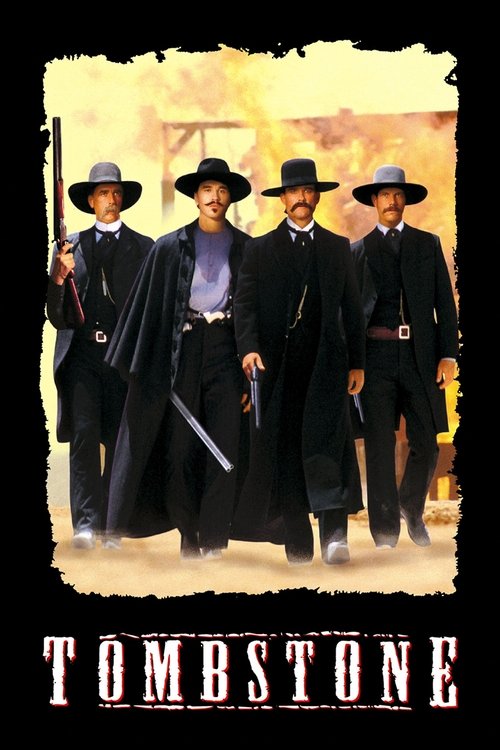
Rotten Tomatoes reports that 76% of 51 sampled critics give Tombstone a positive review, with an average score of 6.30/10. The site's critical consensus reads, "If you're seeking a stylish modern western with a solid story and a well-chosen ensemble cast, Tombstone is your huckleberry." Following its cinematic release in 1993, Tombstone was named "one of the 5 greatest Westerns ever made" by True West Magazine. The film was also called "One of the year's 10 best!" by KCOP-TV in Los Angeles, California. Audiences polled by CinemaScore gave the film an average grade of "A−" on an A+ to F scale.
Gene Siskel and Roger Ebert of Siskel & Ebert originally thought they would have to miss reviewing the film because they could not get a screening, but, as Ebert explained, "a strange thing started to happen. People started telling me they really liked Val Kilmer's performance in Tombstone, and I heard this everywhere I went. When you hear this once or twice, it's interesting, when you hear it a couple of dozen times, it's a trend. And when you read that Bill Clinton loved the performance, you figured you better catch up with the movie." Ultimately, Ebert recommended the movie while Siskel did not.
Ebert would later refer to Tombstone in future reviews, comparing it favorably to Kevin Costner's Wyatt Earp ("It forced the comparison upon me.") and, in his review of Wild Bill, singling out Val Kilmer's portrayal as "the definitive saloon cowboy of our time." In his review of Kurt Russell's Dark Blue, he stated, "Every time I see Russell or Val Kilmer in a role, I'm reminded of their Tombstone, which got lost in the year-end holiday shuffle and never got the recognition it deserved."
In a mixed review, Chris Hicks writing in the Deseret News said, "aside from Russell and Val Kilmer's scene-stealing, sickly, alcoholic Doc Holliday, there are so many characters coming and going, with none of them receiving adequate screen time, that it becomes difficult to keep track of them all." He commented, "some very entertaining moments here, with Russell spouting memorable tough-guy lines". Overall, he felt, "Taken on its own terms, with some lowered expectations, Western fans will have fun." Emanuel Levy of Variety believed the film was a "tough-talking but soft-hearted tale" which was "entertaining in a sprawling, old-fashioned manner." Regarding screenwriter Jarre's dialogue, he noted, "Despite the lack of emotional center and narrative focus, his script contains enough subplots and colorful characters to enliven the film and ultimately make it a fun, if not totally engaging experience." He also singled out Val Kilmer as the standout performance. The film was not without its detractors. James Berardinelli writing for ReelViews offered a negative review, recalling how he thought, "The first half of Tombstone isn't an example of great filmmaking, but it is engaging. There's a sense of growing inevitability as events build to the shoot-out at the OK Corral. The melodramatic "serious" moments are kept to a minimum, and the various gunfights are choreographed with style and tension. Then, at the one-hour ten-minute mark, the Clanton gang and the Earps square off. From there, things get progressively worse. Not only is the last hour anticlimactic, but it's dull. Too many scenes feature lengthy segments of poorly-scripted dialogue, and, in some cases, character motivation becomes unclear. The gunplay is more repetitious than exciting. The result—a cobbled-together morass of silly lines and shoot-outs—doesn't work well."
Stephen Holden writing in The New York Times saw the film as being a "capacious Western with many modern touches, the Arizona boom town and site of the legendary O.K. Corral has a seedy, vaudevillian grandeur that makes it a direct forerunner of Las Vegas." He expressed his satisfaction with the supporting acting, saying, "[the] most modern psychological touch is its depiction of Josephine (Dana Delany), the itinerant actress with whom Wyatt falls in love at first sight, as the most casually and comfortably liberated woman ever to set foot in 1880s Arizona." Critic Louis Black, writing for The Austin Chronicle, viewed Tombstone as a "mess" and that there were "two or three pre-climaxes but no climax. Its values are capitalist rather than renegade, which is okay if it's metaphoric rather than literal. Worse, as much as these actors heroically struggle to focus the film, the director more successfully hacks it apart." Owen Gleiberman of Entertainment Weekly gave the film a C− rating, calling it "preposterously inflated" at "135 minutes long". He observed the film as being a "three-hour rough cut that's been trimmed down to a slightly shorter rough cut" with "all that holds the film together is Kurt Russell's droll machismo." Author Geoff Andrew of Time Out commented, "Kilmer makes a surprisingly effective and effete Holliday". He negatively acknowledged that there was "a misguided romantic subplot and the ending rather sprawls" but ultimately exclaimed the film was "'rootin', tootin' entertainment with lots of authentic facial hair." Richard Harrington of The Washington Post highlighted the film's shortcomings declaring, "too much of Tombstone rings hollow. In retrospect, not much happens and little that does seems warranted. There are so many unrealized relationships you almost hope for redemption in a longer video version. This one is unsatisfying and unfulfilling." Alternately though, columnist Bob Bloom of the Journal & Courier openly remarked that the film "May not be historically accurate, but offers a lot of punch for the buck." He concluded by saying it was "A tough, guilty-pleasure Western."
Although Val Kilmer's performance as Doc Holliday was praised, he did not get an Oscar nomination for Best Supporting Actor. He was nominated for Best Male Performance and Most Desirable Male at the MTV Movie Awards. The film was nominated for Best Classic Film Home Media Release at the Saturn Awards.