


.jpg?width=400)
Tales from the Darkside is an American horror anthology television series created by George A. Romero. A pilot episode written by Romero was first broadcast on October 29, 1983 after which the series was picked up for syndication, with the first season premiering on September 30, 1984. The show would run for a total of four seasons, until its cancelation on July 24, 1988 after a total of 90 episodes. An anthology feature film co-written by Romero and made of three episode-like segments, titled Tales from the Darkside: The Movie, would follow in 1990.
The series spans various genres of speculative fiction, including science fiction and fantasy in addition to horror, and many episodes have darkly comic elements.
Contents
Production
The movie Creepshow was released in 1982. It was based on the EC horror comic books of the 1950s, such as Tales from the Crypt and The Vault of Horror. In light of the film's moderate success, its producer, Laurel Entertainment, decided to explore the potential for a television series based on the feature. However, Warner Bros. allegedly had the rights to some elements of Creepshow. Laurel chose to move forward with a series that omitted aspects of the movie that were owned by Warner Bros. The result was Tales from the Darkside, which explored the same themes as Creepshow, but discarded the framing device and other elements that were based directly on the comics.
Some episodes were adapted from the works of well-known authors, or written by the authors themselves. Stories or teleplays by Clive Barker, Harlan Ellison, Robert Bloch, Fredric Brown, David Gerrold, Ron Goulart, John D. MacDonald, Michael McDowell, Michael Bishop, Lois McMaster Bujold, John Cheever, Charles L. Grant, Barbara Owens, Frederik Pohl, Pamela Sargent, and Jule Selbo were used over the course of the series. Two episodes, "Word Processor of the Gods" and "Sorry, Right Number," were based on short stories by Stephen King. The latter was adapted for television by King himself.
Laurel announced a further 42 episodes to be produced in February 1986, which would bring the total of episodes to 90. In 1987, the International Alliance of Theatrical Stage Employees Local 52 and the National Association of Broadcast Employees and Technicians Local 15 joined together to combat non-union productions like Tales from the Darkside, stating that if the producers would not work with the unions, they would "be forced to deal with public union action."
Filming
Tales from the Darkside was a bi-coastal production, with some episodes being shot in Long Island City and others in Los Angeles. The 1985 season produced twelve episodes in each location.
Ernest Dickerson worked as one of several cinematographers on the series, from 1984 to 1986. Jon Fauer also worked as a cinematographer on the show. Gideon Porath served as the director of photography for the Los Angeles location, where episodes were filmed on 16 mm film, with many special effects being filmed in camera rather than added in post-production to prevent generation loss. Most episodes were filmed in less than four days.
Music
The opening and closing themes are performed by Donald Rubinstein, who co-wrote the music with Erica Lindsay. Ken Lauber was hired to write scores for the second season.
Various composers created the music for the individual episodes. Richard Einhorn wrote the music for "Fear of Floating" (season 2, episode 23) and "Florence Bravo" (season 3, episode 4). Jonathan Elias composed the music in the episode "The Cutty Black Sow" (season 4, episode 14).
John Harrison also composed music for the series that wasn't released until La-La Land Records included it as a bonus track on the American version of the score from Creepshow.
Opening and closing sequences
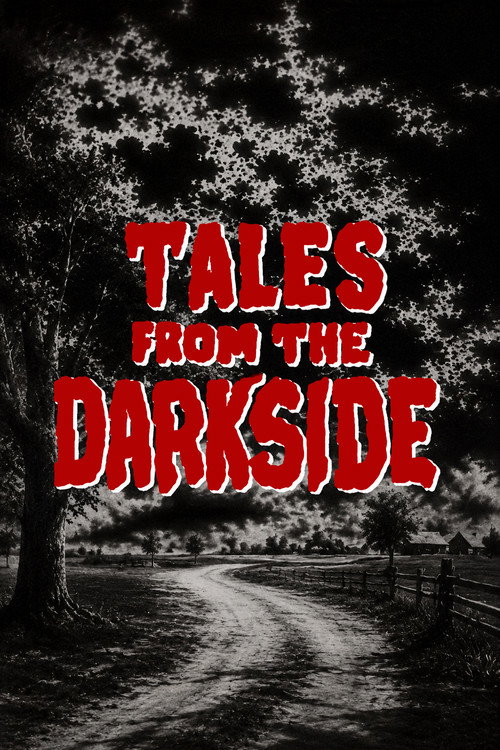
In the vein of previous anthology series The Twilight Zone and The Outer Limits, each episode opens with a montage and an unseen narrator. Several bucolic scenes are shown, followed by a slow pan through a forest filled with barren trees, which in turn yields to a fence-lined path through a meadow. This last shot fades into a black-and-white negative image as the series title appears.
Man lives in the sunlit world of what he believes to be reality. But ... there is, unseen by most, an underworld ... a place that is just as real, but not as brightly lit. A darkside.
The closing credits are displayed against the final, negative image of the opening.
The darkside is always there, waiting for us to enter, waiting to enter us. Until next time, try to enjoy the daylight.
The narration is performed by Paul Sparer, and was written by Romero.
The entire opening sequence of the show was filmed outside of Pittsburgh, Pennsylvania, not far from where George Romero filmed most of his movies in the 1970s and early 1980s. Romero was familiar with the area because he had lived there for many years and scouted numerous filming locations when he went into producing the Tales From the Darkside TV series. The bridge location used to be called Deihls Bridge, but is now known as Turner's Bridge. Some of the forest footage and the creek flowing over the rocks was filmed in Clear Creek State Forest just north of Pittsburgh. Other filming locations such as the farm, the fields, and the road with the old wooden fence were filmed in or around Boswell, Pennsylvania, and Ligonier, Pennsylvania. However, much of that area has changed dramatically since the opening was shot in 1983.
Episodes
Cinefantastique printed in their July 1985 issue that the pilot episode was plagiarized from a 1952 Donald Duck short written by Ralph Wright, also titled Trick or Treat.
Themes
The stories occasionally had a political focus, commenting on gentrification in an episode set in Port Huron, Michigan in 1985, and on the greed of "a Trump-like developer" in a 1987 episode. One episode stated that "politics is a show."
There were also concerns regarding new technology, depicted as a frightening unknown in the series.
Broadcast and rights
The pilot episode was distributed by CBS.
In the series' initial run, LBS Communications, in conjunction with Tribune Entertainment, distributed Tales from the Darkside in first-run syndication through the barter deal method. It aired on both independent stations and local network affiliates, typically being shown in late night timeslots. Despite being a low budget syndicated show with little promotion, it managed to outperform higher profile network anthology shows from this period. These include Steven Spielberg's Amazing Stories and the 1985 Twilight Zone revival, which both debuted on major networks in primetime while Tales from the Darkside was airing in syndication.
Telepictures negotiated international broadcast rights for the series in 1984 at the MIPTV Media Market. Embassy Telecommunications negotiated foreign distribution in 1985 1986. In 1987, Lorimar-Telepictures gained foreign-market distribution rights, and took 90 episodes of Tales from the Darkside to the MIPTV Media Market.
Laurel Productions negotiated distribution rights with Worldvision Enterprises after Aaron Spelling Productions acquired Worldvision and Laurel in 1989. Paramount handled the theatrical distribution of the 1990 Tales from the Darkside movie. This was prior to Paramount inheriting the rights to the show through CBS's absorption of Spelling Productions.
In 2006, CBS Media Ventures signed an agreement with the Sci Fi Channel for eclusive rights to air Tales from the Darkside on cable as part of a package of properties that also included Star Trek: Enterprise. Tales had been a part of the channel's lineup since its inception in 1992. The broadcast rights to Tales were owned by CBS Studios in 2013.
Laurel filed a trademark application for the phrase "Tales from the Darkside" on May 7, 1987, which was granted on April 18, 1989. As of 2020, the trademark was listed as held by Spelling Entertainment LLC, with whom Laurel announced a merger in 1988.
Home video
Overseas Filmgroup presented a 64-episode package of Tales from the Darkside at the American Film Market in 1987. ThrillerVideo and Worldvision Home Video handled VHS releases in the US, with Channel 5 Video distributing in the U.K. Laurel licensed Lorimar-Telepictures to handle home video distribution outside the U.S. in November 1987, in addition to the previous agreement regarding foreign-market television distribution.
In May 1997, the VHS tapes were being distributed in the U.S. under the Republic Entertainment Inc. label. In September 1997, Spelling announced that U.S. distribution for all of their home video titles would be handled through Paramount Home Video.
Each VHS tape included three episodes for the first seven volumes released. The fifth volume VHS release included closed captioning. Though these tapes were unrated in the U.S., at least the first two were rated "General, Parental Guidance" in Nova Scotia. VHS tapes released in Australia through RocVale Film were rated "M" and contained five episodes.
The VHS tapes were released with the episodes' original music.
At least one of the three-episode collections was also released on Betamax. Image Entertainment released four volumes on LaserDisc with digital monaural sound in constant linear velocity format in 1990.
Paramount Home Entertainment, through CBS Home Entertainment (sister company to Spelling Television, the successor to Laurel), released the series on DVD, beginning on February 10, 2009. The company re-released the complete series on Region 1 DVD in 2016.
DVD releases altered or omitted some of the original music. Paramount's first season DVD release included a synthesizer in the opening credits.
British company Revelation Films sublicensed it from CBS/Paramount, and released the entire series on DVD in Region 2 in 2013. In Region 4 (Australia) the show was released on DVD by CBS/Paramount, in association with local distributor Shock. The series has never been released on Blu-ray.
Budget and revenue
CBS partially financed the pilot episode, but passed on purchasing Tales from the Darkside as a series. "Trick or Treat," the pilot, cost US$200,000 to produce, with the budget halved for the subsequent 23 episodes of the first season. When the first season was announced to be aired on Tribune Broadcasting stations, Variety reported that Tribune was expected to pay half the production costs for each episode in exchange for a portion of the ad sales.
The show often utilized only a single set or location throughout entire episodes, similar to a stage play. Special effects for one episode were only allotted a budget of US$188. Each episode aired five half-minute commercials, earning approximately US$20,000 each week for LBS Communications. With successful broadcast in 125 U.S. cities and 25 countries, the show received an increase in budget at the end of the first season to US$124,000 per episode.
Laurel's third quarter earnings for 1985–1986, US$117,780 on US$1,056,480 revenue, and year-to-date losses of US$211,337 on US$2,625,363 revenue were a substantial improvement for the company, which Laurel's vice president, Virginia McGuire, stated the success of Tales from the Darkside was directly responsible for. The 1984–1985 third quarter showed a loss of US$244,796 on a revenue of only US$198,031, with the year-to-date losses for that period at US$604,517 on a revenue of US$264,102.
LBS and Tribune Entertainment made an agreement to pay Laurel US$5,200,000 for the production and distribution costs for seasons three and four.
Reception
Critical reviews
A review in Variety of the pilot, "Trick or Treat," stated that the episode's writing was good for both adults and children. It also praised the acting, in particular Barnard Hughes, Frances Chaney, make-up artist Ed French who also played the devil, and Bill McNulty. The reviewer expected that CBS owned and operated stations would air the series expected to follow.
John J. O'Connor of The New York Times also reviewed the pilot, praising Hughes' performance and saying that the show "is not in the same league as Alfred Hitchcock Presents" but children should be entertained by it.
A review by of the first season Judith P. Harris in Cinefantastique only found the episode "Inside the Closet" to be interesting. Harris also expressed disappointment that Romero didn't seem to have any involvement beyond the pilot, and that the reason for the occult involvement with the characters of the episodes wasn't explained within every episode. Harris called this "laziness," further lambasting the screenwriters for "taking forever to get to the punchline." She found the comedic pieces to be "only slightly better" in execution, and stated that the endings to most of the episodes were dissatisfying, managing to remove the tension that had existed beforehand. Harris found screenwriter Haskell Barkin's explanation of the supernatural in "All a Clone By the Telephone" to be disappointing, as it consisted of repeating "alternate universe" to the viewer. She described the make-up from Ed French in "A Case of the Stubborns" as "especially poor," and only expressed praise for Charles Levin's performance in "Djinn, No Chaser."
Robin Bromley of Twilight Zone Magazine was impressed with the second season's story selection. Bromley did find the special effects "sometimes obvious."
Bill Warren of Twilight Zone Magazine commented very briefly on the third season, saying that the quality varied and the stories were "sometimes incoherent."
VideoHound rated the show with three of four stars. In a brief review of the various VHS volumes, Video Movie Guide stated that the only one worth watching was the first while noting that the low budget for the show decreases watchability. They rated volume one two of four stars.
Viewership
The pilot episode brought in 18 percent viewership in New York City, 16 percent in Los Angeles, 22 percent in Chicago, 16 percent in Philadelphia, and 27 percent in Detroit. By October 14, 1984, the series had a 6.3 Nielsen rating nationally.
The series' Sunday episodes secured nearly 20 percent of viewership in the 1 AM time slot by 1987.
Subsequent series and movie
Tales from the Darkside executive producer Richard P. Rubinstein and his company Laurel would go on to make the horror anthology series Monsters, which premiered in 1988 and ran for three seasons, as well as Tales from the Darkside: The Movie, which was released theatrically in 1990. A sequel to the film was announced, with the script to be written by McDowell and Gahan Wilson, but was put on indefinite hold in 1992.
In November 2013, it was reported that Joe Hill, Alex Kurtzman, and Roberto Orci were developing a reboot of the series for The CW, with CBS Television Studios. Heather Kadin, Mitch Galin and Jerry Golod were listed as executive producing for CBS.
In 2014, Hill said that he would serve as creative director and guide the show.
In February 2015, The CW gave the reboot a pilot order. Originally conceived as a half-hour summer 2015 series, it was changed for episodes to be an hour each. Bradley Buecker directed the pilot. Kris Lemche was cast as the only recurring character, Newman.
Despite Hill's excitement over the completed filming in April 2015, The CW did not pick up the series. It then was offered to other networks unsuccessfully.
In other media
The book Tales from the Darkside: Volume One, published in 1988, consisted of stories and episode novelizations.
Scripts written by Hill for the proposed reboot were adapted into a four-issue comic book series, illustrated by Gabriel Rodriguez and published in June 2016, followed by a collection of scripts in book form, illustrated by Charles Paul Wilson III, published in October 2016. Both the comics and the book were released by IDW Publishing.
A review of the first issue of the comic series in Rue Morgue noted that both the exposition at the beginning and the limit of twenty pages negatively impacted the tale. Svetlana Fedotov of Fangoria, however, said that the story took advantage of the new medium. She compared it to a morality tale in its handling of themes, but noted Hill's original expression as well as how the story addresses a contemporary issue much the way the original Tales do. She also praised Rodriguez's artwork and how he created both a personal and a broader terror.
Used by others
A review of the first issue of Sci-Fi and Fantasy Illustrated in 2010 stated that the story "borrows thematically and literally" from several other properties, including Tales from the Darkside season 3, episode 17: "Everybody Needs a Little Love," which was itself an adaptation.