Filming
Friedkin chose Dick Bush as his director of photography after seeing the film version of the rock opera Tommy, directed by Ken Russell, and after finding out that Bush had filmed Gustav Mahler's biography as well as collaborated with Lindsay Anderson, whom Friedkin regarded highly. Scheider's then-wife, Cynthia Scheider, was an assistant film editor who had previously worked with Bud Smith on The Exorcist. Since shooting the film required a prolonged stay in South America, Scheider asked Friedkin if she could stay with him and have a job in an editing capacity. The director fulfilled his wish and was reportedly "delighted". Sorcerer was filmed during a ten-month production schedule, using approximately 1,200 camera set-ups. The director attempted to complete the picture "without relying on dialogue", and "telling the story through imagery" instead. In the film's pressbook Friedkin states that for him creating a film is multi-faceted experience: "[e]very film is actually three films[.] There is the film you conceive and plan. There is the film you actually shoot. And there is the film that emerges with you in the editing room".
Principal photography commenced on location in Paris and depicted Victor Manzon's backstory. The sequence filmed in Jerusalem was realized with cooperation of Israeli security forces who portrayed themselves in the pursuit scenes. The mock explosion that occurred during the Jerusalem scenes had such power that it broke a window of the city's mayor's house, which was located 6 metres (20 ft) away. The detonation was controlled by Nick Dimitri, a stuntman portraying an Israeli soldier, who positioned himself too close to explosives which resulted in injuries. However, after an hour the director ordered a second take, being adamant about the previous accident. Dimitri praised Friedkin's craftmanship by saying that "when you watch the movie and everything gets obliterated, you can't even tell if it's the first or second take". Moreover, during the realization of the sequence, an actual bombing took place in the vicinity, which prompted Friedkin to capture additional footage which in his opinion added "a documentary reality". The fourth prologue vignette, taking place in Elizabeth, New Jersey, contains a scene involving a car crash. It took twelve takes and approximately ten days to achieve what Friedkin intended. The director recalls the sequence as seemingly "impossible to shoot", having involved several stuntmen from New York, the crew wrecked seven vehicles over the course of a week, without satisfying the director's intent. Friedkin then put himself in the passenger seat to evaluate the negative aspects of the scene's execution. The director became fed up with the situation and decided to listen to David Salven, the line producer, who suggested that they employ a well-known specialist, Joie Chitwood Jr., whom Friedkin described as "short, stocky, part Indian, self-assured, and fearless". After Friedkin supplied him with all the necessary information about the set's infrastracture, Chitwood meticulously analyzed the surroundings himself, and ordered the special effects technicians to construct a 40 feet (12 m) long slanted ramp which would allow him to "drive the car at top speed on two wheels, flip it in midair, and crash into a fire hydrant". The construction took three days, and the stunt was successful during its very first take.
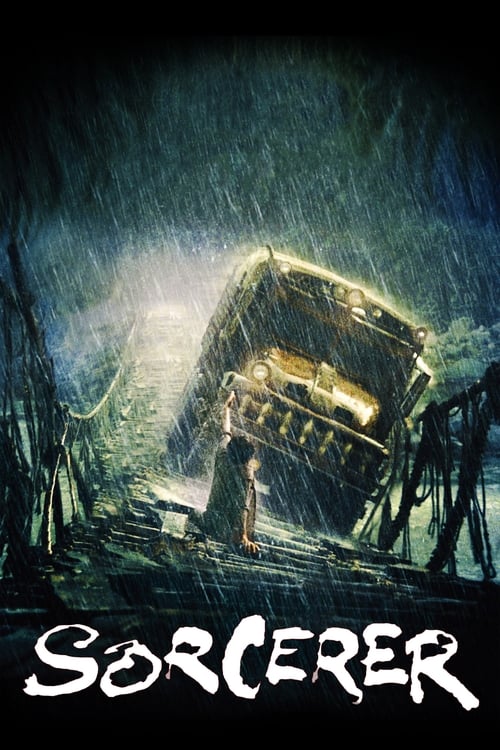
Friedkin said the most important scene in the film was "the bridge-crossing sequence, wherein the two trucks have to separately cross an old wooden suspension bridge that appears completely unstable". He also deemed it the most arduous scene he has ever filmed. The bridge was designed by John Box using carefully hidden hydraulic components allowing control of the movements of the bridge and the trucks alike. Its first iteration was constructed in the Dominican Republic over a period of three months, and it required $1 million to complete. However, as soon as it was finished, Friedkin's crew faced a problem of abnormally low rainfall. During the construction process, the river's water level decreased dramatically, and by the time the bridge was assembled, the river had become completely dry, despite the assurance of local engineers that there had not been any recorded fluctuations in water level during the dry season. Studio executives suggested Friedkin devise a less sophisticated scene, but instead he continued to realize his vision in different locations. Thus, John Box went to scout locations in Mexico and found that the Papaloapan River possessed similar characteristics. The previously constructed bridge had to be disassembled and re-anchored. Friedkin's crew's arrival caused a major disturbance in the vicinity among the locals because of his reputation as a director of The Exorcist. However, a part of the population offered help to finish the structure. Ultimately, this river also became stricken with drought, which forced the application of some practical effects to complete the scene. In order to create artificial rain, Friedkin employed sewage pumps draining water from the river and diverting it to a sprinkler system. This scene alone, which lasts 12 minutes, took several months to complete and cost approximately three million dollars. The director has claimed that during this sequence, the truck teetering against the ropes actually tipped over into the river several times, causing numerous retakes.
The stunt coordinator for the film was Bud Ekins, who was Steve McQueen's stunt double in The Great Escape. He was friends with the film editor, Bud Smith, who recalls Ekins being "as cool as cucumber". In some cases stuntmen were employed throughout the making of the film but generally speaking the principal actors acted as their own doubles and were actual truck drivers. For instance, since Roy Scheider's character Jackie Scanlon was meant to be a mob's wheelman, he had to undertake a special preparation for maneuvering a vintage truck with the purpose of gaining the necessary driving skills. He summarized the experience as "rehearsing to stay alive". Scheider has emphasized that no rear-screen projection or any other kinds of "trick photography" were used, due to the distance between the cameras, the vehicles and the surrounding terrain. In a 1977 interview for The New York Times, Scheider said that shooting Sorcerer "made Jaws look like a picnic." He mentioned that the stuntmen were unhappy because of the fact the leading actors performed their own stunts, and added that the scene involving crossing a suspension rope bridge is "what really happened". Scheider called it the most perilous sequence he has ever taken part in. Amidou, in an interview for the Morocco Times in 2005, stated that out of all movies in his oeuvre, Sorcerer left the most lasting impression on him since he "refused to have a substitute and paid for it physically."
Friedkin antagonized Paramount, using a Gulf and Western corporate photo for a scene that featured the evil board of directors of the fictional company which hired the men to deliver dynamite. Walon Green recalled the experience in the following way:
[Friedkin] put Bluhdorn's picture on the wall in the office in the scene where [the oil company foreman] finds out that the well is blown by terrorists and they can't do anything about it. When Bluhdorn saw his picture on the wall as chairman of the oil company he had a shit hemorrhage!
To create four prologues for the characters' respective backstories, Friedkin shot each of the vignettes on location, respectively in Paris for Victor Manzon, Jerusalem for Kassem, Elizabeth, New Jersey, for Jackie Scanlon, and Veracruz, Mexico, for Nilo. The main part of the film was, on the other hand, originally meant to be shot in Ecuador, which impressed Friedkin tremendously. However, such a diversity of locations caused serious concerns about the budget. After strong opposition from Lew Wasserman, who was the owner of Universal Studios at the time, Friedkin had to opt out from shooting there. The director eventually settled on the Dominican Republic, after receiving a green light from the studio's executives. In a memoir, Infamous Players: A Tale of Movies, the Mob (And Sex), film producer Peter Bart theorized that the owner of Gulf and Western, Charlie Bluhdorn, supported the Dominican Republic financially and intended to create a film-making centre there. Paul Rowlands, a critic, stated that "it's likely the decision to film in the Dominican Republic was one favoured by Bluhdorn."
After scouting locations with Walon Green and John Box, the production designer, they chose Villa Altagracia as the main location. Friedkin described the place as "a prison without walls" with a "sense of timeless poverty and persecution".
Although the majority of the film was filmed in the Dominican Republic, Friedkin did not hesitate to look for other locales to achieve the desired effect. One of the most notable ones is depicted in the film's climax. It features a surrealistic landscape on Navajo Nation lands in the Bisti/De-Na-Zin Wilderness, New Mexico:
The one sequence left to shoot was the last leg of the journey of the surviving truck, the Lazaro, and I wanted it to be different from the other locations… and John Box found it in a place called the Bisti Badlands in northwestern New Mexico, 35 miles (56 km) south of the town called Farmington… It was the landscape we chose for the end of the journey, in which Scanlon embraces madness, abandons his truck, and carries the dynamite 2 miles (3.2 km) to the burning oilfield.
During a sequence involving the detonation of an enormous kaoba tree, Friedkin was faced with a problem of inadequate explosive power. Initially, Marcel Vercoutere, a special effects man who previously worked with the director on The Exorcist, was to be responsible for the explosion. However, it did not achieve the required effect and barely damaged the tree. This prompted Friedkin to reach for the services of an arsonist hailing from Queens, New York, going by the pseudonym "Marvin the Torch", who arrived at the Dominican Republic three days after the call and utilizing flammable materials obliterated the tree in one take the following morning. A week into the shooting in the Dominican Republic, Friedkin and his crew went to Los Angeles to process the film and view dailies. The director described the prologues as "beautifully shot", but he was dissatisfied with the jungle scenes which he deemed "underexposed" and "dark". He told Dick Bush a reshoot would be necessary. Bush, on the other hand, argued that filming should have taken place on a stage where he could have adequately adjusted the lighting. The response reminded Friedkin of his previous problems on the set of The Boys in the Band and offended him, as from the very beginning he had wanted to shoot the entire film on location. Upon seeing the underexposed scenes, Bush reportedly "lost confidence" and was subsequently dismissed, which forced Friedkin to employ a new camera crew. He replaced Bush with John M. Stephens with whom he had worked under David L. Wolper. Stephens applied necessary changes, including the employment of reflectors balancing "the deep shadows of the tall trees", as well as replacing lenses and film stock. This resulted in a leap of cinematographic quality which delighted the director, who has said "the locations looked beautiful to the eye".
Apart from Bush, Friedkin had a feud with the chief Teamsters representative whom he dismissed at some point and which prompted the director to find another trucker crew. The director also fired five production managers, which upset Scheider, who said that he was "tired of going to the airport and saying goodbye to them," as well as adding that he was the only person Friedkin could not drop, as he was the leading actor. David Salven, initially chosen as a line producer, had to quit for personal reasons, as he was facing the possibility of a divorce. Friedkin regretted this situation, as he praised Salven greatly for his previous contributions to his movies. He was replaced by Ian Smith, whom the director described as "experienced and efficient". In Tuxtepec, Mexico, where the suspension bridge scene was filmed, an undercover federal agent informed Friedkin that several of his crew members, including grip crew men, stuntmen and a makeup artist, were in the possession of drugs and were urged to leave the country or face prison sentences. It reportedly took two weeks to replace the crew workers. Besides internal on-set conflicts, Friedkin, cited by Mucci, said that approximately fifty people "had to leave the film for either injury or gangrene," as well as food poisoning and malaria. In The Friedkin Connection he added that "almost half the crew went into the hospital or had to be sent home." Friedkin himself lost fifty pounds (23 kg) and was stricken with malaria, which was diagnosed after the film's premiere. Tim Applegate concluded an account of the troubled film-making of Sorcerer by comparing Friedkin to Francis Ford Coppola during the production of Apocalypse Now: "Friedkin took his camera crew to the jungle and never quite returned."
During the shooting of the film in Villa Altagracia, a lawsuit was filed against Cinema Dominica (a subsidiary of Gulf and Western) by Dominican businessmen for alleged damages. The newspaper El Caribe said that the lawsuit against Cinema Dominica charged that the company had “failed to comply with the rental contract it signed for use of the town's commercial locations.”
Friedkin recalls working with Scheider as difficult, stating the actor had frequent mood swings which did not occur during the filming of The French Connection and theorized that after achieving stardom with Jaws he became "difficult", which contrasted with his attitude from The French Connection, where he "would've lied [sic] down in front of an elevated train" for Friedkin. The director stated Scheider at times was "impossible to talk to" and completely indifferent towards any of his suggestions. He summarized the experience by saying the arduous production schedule and difficult conditions in the Dominican Republic were most likely the reasons behind their difficult relationship. Likewise, Scheider also had his reservations about the work with Friedkin, on the one hand praising him as an "extraordinarily gifted filmmaker, who told stories with pictures and shot beautifully" but despite his erudition, he was marred with a distrusting attitude which made everyone around him very tense. According to Diane Kachmar, Friedkin believed that he inspired others to achieve great results, but Scheider did not favor such working conditions. However, Scheider also admitted that only a director of Friedkin's stature could have persuaded him to perform all the life-threatening scenes he did, and added that upon seeing the dailies he "knew it was worth it". Despite the mutual tensions, the director rated Scheider highly, did not hold any grudges, and regretted he did not receive more recognition for his body of work. However, their relationship eventually "drifted apart".