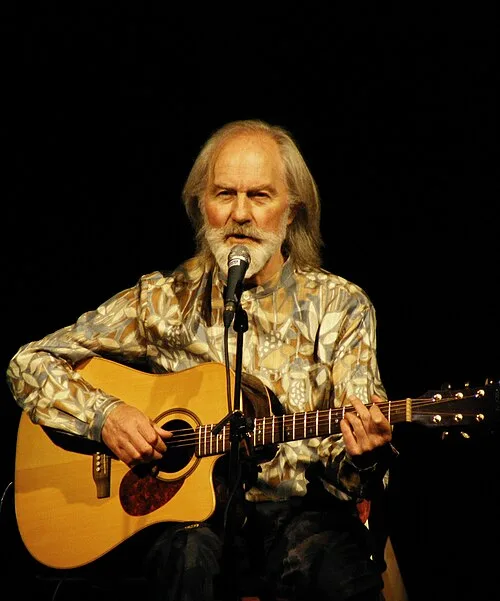
Roy Harper (born 12 June 1941) is an English folk rock singer, songwriter, poet and guitarist. He has released 22 studio albums (and 10 live ones) across a career that stretches back to 1966. As a musician, Harper is known for his distinctive fingerstyle playing and lengthy, lyrical, complex compositions, reflecting his love of jazz and the poet John Keats.
Harper's influence has been acknowledged by Led Zeppelin, Pete Townshend, Kate Bush, Pink Floyd, and Ian Anderson, of Jethro Tull, who said Harper was his "primary influence as an acoustic guitarist and songwriter." Neil McCormick of The Daily Telegraph described him as "one of Britain's most complex and eloquent lyricists and genuinely original songwriters... much admired by his peers". Across the Atlantic, his influence has been acknowledged by Seattle-based acoustic band Fleet Foxes, American musician and producer Jonathan Wilson, and Californian harpist Joanna Newsom, with whom he has also toured.
In 2005, Harper was awarded the MOJO Hero Award, and in 2013 a Lifetime Achievement Award at the BBC Radio 2 Folk Awards. His most recent album, Man and Myth, was released in 2013. In 2016, Harper celebrated his 75th birthday by performing concerts in Clonakilty, Birmingham, Manchester, London, and Edinburgh. He performed additional concerts in 2019 and 2025.
Contents
Early life
Harper was born in 1941 in Rusholme, a suburb of Manchester. His mother, Muriel, died three weeks after he was born. From the age of six, he lived in St Annes-on-Sea, a place he described as being "like a cemetery with bus stops". He was brought up by his father and stepmother, with whom he became disillusioned because of her religious beliefs (although they reconciled in 1980, just before her death). His anti-religious views would later become a familiar theme within his music.
Harper began writing poems when he was 12. At the age of 13, he began playing skiffle music with his younger brother David ("Davey" on the album Flat Baroque and Berserk), as well as becoming influenced by blues music. At 14 he formed his first group (De Boys) with his brothers David and Harry. Harper was educated at King Edward VII School, Lytham St Annes, then a grammar school, and left at the age of 15 (1956) to join the Royal Air Force to follow an ambition to be a pilot. After two years, Harper rejected the rigid discipline and feigned madness to obtain a military discharge, as a result receiving an electroconvulsive therapy treatment at Princess Mary's RAF Hospital, Wendover. After being discharged from there, he spent one day inside the former Lancaster Moor Mental Institute before escaping. These experiences would be recalled in "Committed", a song on Harper's debut album, Sophisticated Beggar. From around 1961, he busked around North Africa, Europe, and London for a few years.
Musically, Harper's earliest influences were American blues musician Lead Belly and folk singer Woody Guthrie and, in his teens, jazz musician Miles Davis. Of the blues musicians Lead Belly, Big Bill Broonzy, and Josh White, Harper said they made music which "...seemed to be from a different planet ...We'd never heard anything like it. It changed our world overnight, a sledge hammer of a cultural change ...an equivalent would be to suddenly hear music from outer space". Harper was also exposed to classical music in his childhood and has pointed to the influence of Jean Sibelius's Karelia Suite. Lyrical influences include the 19th century Romantics, especially Shelley, and Keats's poem "Endymion". Harper has also cited the Beat poets as being highly influential, particularly Jack Kerouac. Harper played his first paid performance at a poetry reading in Newcastle in 1960.
Returning to the UK in 1963 or 1964, Harper started to write more songs than poetry. He obtained a residency at London's famous Soho folk music club Les Cousins in 1965, having been introduced to it by Peter Bellamy of The Young Tradition. Harper's first advertised performance was on 5 October 1965. Within his first week Harper saw John Renbourn, Alexis Korner, Paul Simon, Alex Campbell, and Bert Jansch play, and he would play and associate with other artists later, including John Martyn, Joni Mitchell, and Nick Drake.
Musical career
1966–69: The first record deals
Harper's first album, Sophisticated Beggar, was recorded in 1966 after he was spotted at Les Cousins and signed to Strike Records. The album consisted of Harper's songs and poetry backed by acoustic guitar, recorded with a Revox tape machine by Pierre Tubbs and with contributions from English guitarist Paul Brett. Columbia Records recognised Harper's potential and hired American producer Shel Talmy to produce Harper's second album, Come Out Fighting Ghengis Smith, which was released in 1968. The 11-minute track "Circle", "a soundscape of Harper's difficult youth", was notable for marking a widening of his musical style away from the more traditional side of contemporary folk music heard at the time. Harper had an interest in traditional folk but did not consider himself a bona fide member of the folk scene. He later explained: I was too much of a modernist, really. Just too modern for what was going on in the folk clubs. I wanted to modernise music, but more than that to completely modernise people's attitudes towards life in general. I was involved in trying to bring (more) meat to the (contemporary) folk music...(of the time). Harper's record company had different expectations. 'They wanted me to write commercial pop songs and when they heard the album I made for them, they didn't have a clue. They wanted hits. And I gave them "Circle"'. Bert Jansch contributed sleeve notes for the album and Harper paid tribute to Jansch with the song "Pretty Baby"; the B-side non-album track of his first single (released in March 1966). During this period, Harper was managed by American music entrepreneur Jo Lustig, manager of Pentangle and former agent to Julie Felix.
In June 1968, Harper performed at the first free concert ever held at Hyde Park, acting as compere and sharing the bill with Jethro Tull, Pink Floyd and Tyrannosaurus Rex. At the time, he spoke of co-writing a rock opera with Pink Floyd. No opera resulted, but it was the beginning of a musical relationship. Harper began to attract a following of fans from the underground music scene and tour the UK, performing at numerous venues such as the Lyceum Ballroom, Klooks Kleek and Mothers; venues that would gradually gain recognition for the variety and quality of their musical acts. Mothers in Birmingham was one such venue, and one to which Harper would frequently return. Harper later told Brum Beat magazine:
That was the first club outside London that meant anything at all and that's why there's been this long association with Birmingham. I played there about six times between 1968 and 1970. I have always enjoyed playing here.
1970–80: The Harvest years
With Harper's reputation growing, Pink Floyd's former manager Peter Jenner signed him to a long-term (and at times confrontational) deal with EMI's 'underground' subsidiary, Harvest Records. Over a ten-year period, Harper recorded eight albums at the Abbey Road Studios for the Harvest label and for much of this period was managed and produced by Jenner, initially acting for Blackhill Enterprises. According to Jenner,
Harper is a terrific songwriter, but a bit crazy, like all the best people. The great problem for him was seeing all these people who'd nicked his licks doing so much better than he did. People like Jethro Tull, Led Zeppelin and, to some extent, Roger Waters.
Harper's first tour of the United States followed the release of his fourth studio album, Flat Baroque and Berserk. The album included the track "Another Day", a song destined to be performed live by Harper for many years to come, and covered by several other artists including This Mortal Coil (featuring Elizabeth Fraser on vocals) and Kate Bush. The album also featured the Nice on the track "Hell's Angels"; its ethereal sound achieved by a wah-wah pedal attached to Harper's acoustic guitar.
After the Bath Festival of 1970, Led Zeppelin paid tribute to Harper with their version of the traditional song "Shake 'Em on Down". Retitled "Hats Off to (Roy) Harper", it appeared on the album Led Zeppelin III. According to Jimmy Page, the band admired the way Harper stood by his principles and did not sell out to commercial pressures. In mutual appreciation of their work, Harper would often attend live performances by Led Zeppelin over the subsequent decade and contributed sleeve photography to the album Physical Graffiti.
Harper's critically acclaimed 1971 album was a four-song epic, Stormcock. The album featured Jimmy Page on guitar (credited as "S. Flavius Mercurius" for contractual reasons) and David Bedford's orchestral arrangements (Bedford would also collaborate on some of Harper's future releases). Harper felt the album to be not particularly well promoted by his record label at the time and later stated: They hated Stormcock. No singles. No way of promoting it on the radio. They said there wasn't any money to market it. Stormcock dribbled out. Nevertheless, Stormcock would remain a favourite album of Harper's fans and influence musicians for decades to come. Thirty-five years later (in 2006) fellow Mancunian Johnny Marr of English alternative rock band the Smiths said: If ever there was a secret weapon of a record it would be Stormcock... It's intense and beautiful and clever: Bowie's Hunky Dory's big, badder brother. Joanna Newsom cited Stormcock as an influence upon her 2006 release Ys and in 2011, Robin Pecknold of Seattle, Washington-based folk band Fleet Foxes stated that he took inspiration from Stormcock when recording Fleet Foxes second album Helplessness Blues.
1981–89: Recession and repossession
Harper's 1982 album Work of Heart was released on Public Records, a newly formed record label Harper created with Mark Thompson (son of English historian, socialist and peace campaigner E.P. Thompson). During this period Harper toured with a band consisting of Tony Franklin on Bass, Bob Wilson of the Steve Gibbons Band, George Jackson on drums and Dave Morris on keyboards. The album was chosen by Derek Jewell of The Sunday Times as "Album of the Year" in 1982, but it did not sell well and the short-lived label went under.
During this period Harper lost his home, a farm in the village of Marden, Herefordshire, to the bank. Of this period Harper stated: ...I can proudly say that I was one of the first casualties of the eighties recession!... It was a chaotic period and one that I don't care to remember that often... There is no doubt in my own mind that the early eighties were the nadir of my life in music".
The original demo version of Work of Heart was later released (in 1984) on a limited edition (830 copies) vinyl release entitled Born in Captivity.
Throughout 1984, Harper toured the United Kingdom with Jimmy Page performing a predominantly acoustic set at folk festivals under various guises such as the MacGregors, and Themselves. In 1985, Whatever Happened to Jugula? was released. The album caused a resurgence of interest in Harper and his music. (Tony Franklin, bass player in Harper's group at this time, later joined Page in the Firm). In April 1984, Harper and Gilmour performed "Short and Sweet" (a song they co-wrote) during Gilmour's three-night run at the Hammersmith Odeon. This version later appeared on the David Gilmour Live 1984 concert film. Harper also provided backing vocals on Gilmour's newly released album, About Face.
On 20 June 1984 Harper performed at the last Stonehenge Free Festival, sharing the bill with Hawkwind and the Enid. The concert was videoed and released as Stonehenge 84.
As a result of his continual touring and the popularity of Whatever Happened to Jugula?, Harper re-signed to EMI and in 1986 released a live album, In Between Every Line (containing recordings from his performances at the Cambridge Folk Festival), and in 1988 the studio album, Descendants of Smith. The renewed relationship between Harper and EMI did not last and from 1985 more of his earlier albums were becoming available on the newly formed Awareness Records label.
1990–99: Science Friction
In 1993, Harper established his own record label Science Friction and obtained the rights to all his previously released albums. As a result, from 1994 much of Harper's back catalogue became available on CD once more.
Harper was very productive during the decade, releasing five studio albums: Once (1990), Death or Glory? (1992), Commercial Breaks (1994), The Dream Society (1998), a collection of poetry and spoken word tracks Poems, Speeches, Thoughts and Doodles (1997); two live albums: Unhinged (1993) and Live at Les Cousins (1996; recorded in 1969) and six individual CDs of live concerts and sessions recorded by the BBC (1997). Two official C90 cassette tapes of concerts at the Red Lion in Birmingham (1984 & 1985) were made available from Harper's agency (Acorn Entertainments).
In addition, Harper released a live video, Once (1990), an EP Burn the World (1990), a 4-track CD single Death or Glory? (1992), a limited edition live cassette Born in Captivity II (1992) (featuring cricketer Graeme Fowler and a cricket poem written by Harper: "Three Hundred Words"), a compilation album An Introduction to ..... (1994), and a reissue of Descendants of Smith (his 1988 release) renamed Garden of Uranium (1994).
Once again, Harper collaborated with David Gilmour and Kate Bush on his 1990 release, Once. The album also featured contributions from Nigel Mazlyn Jones, Mark Feltham and Tony Franklin. One of the album tracks, "The Black Cloud of Islam" a song written about Colonel Gaddafi, the Lockerbie bombing, and a despairing castigation of radical Islam, provoked criticism from some of Harper's fans at the time. Whilst religion, Harper's "first and only enemy" has always been a recurring theme in his music, he was 'red-carded by a lot of his 1990 following... who left in substantial numbers'.
In 1992, his second marriage ended and Harper released Death or Glory? an album that (upon its original release) contained a number of songs and spoken word pieces referencing his loss and pain. "She ran off with someone else" said Harper, "a violin player (Nigel Kennedy) I’d been working on an adaptation of Brahms's Violin Concerto with. I was really traumatised by that. Anybody who's been suddenly left like that will know it's very, very traumatic. I managed to come out of it, but it took about five years. It was like a death, a loss, like being told your child's been killed in a war. There's no other way to describe it. When you go through that, it changes your life forever, there's no point in not admitting it. I withdrew, retreated, became an exile".
2000–10: Into the new millennium
In 2000, Harper released an almost entirely acoustic album, The Green Man, accompanied by the Tea Party's Jeff Martin on guitar, hurdy-gurdy and numerous other instruments. The following year (2001) Harper celebrated his 60th birthday with a concert performance at London's Royal Festival Hall and was joined by numerous guest artists including; David Bedford, Nick Harper, Jeff Martin and John Renbourn. The concert was recorded and released shortly after as a double CD, Royal Festival Hall Live – 10 June 2001.
In 2003, Harper published The Passions of Great Fortune, a large format book containing all the lyrics to his albums (and singles) to date, it also contained a wealth of photographs and commentary on his songs.
Harper released his second CD single in April 2005; "The Death of God". The 13-minute song, a critique of the war in Iraq, featured guest guitarist Matt Churchill (who also performed live with Harper during this period). A video of the track, intermixing animation with a live performance, is available in four parts on YouTube. 2003 also saw the release of Counter Culture, a double compilation album featuring songs from Harper's 35-year songwriting period. Counter Culture received a five-star review from Uncut magazine. Harper also contributed a recital of "Jabberwocky" for The Wildlife Album, an 18-track compilation CD to benefit the World Wide Fund for Nature and the Ulster Wildlife Trust.
2005 saw Harper release his first DVD, Beyond the Door. Composed of live footage recorded in 2004 at Irish folk club "De Barra's" in Clonakilty, Cork and "The Death of God" video. The package also includes an additional 10-track audio CD and received a 4-star review from Mojo, Uncut, and Classic Rock magazine, who made it their "DVD of the month".
In September 2007, Harper supported Californian harpist Joanna Newsom at her Royal Albert Hall performance. Newsom, impressed by Harper's 1971 album Stormcock found it served as an inspiration for her similarly expansive second album, Ys. During his Royal Albert Hall appearance with Newsom, Harper played Stormcock in its entirety. At the time, Harper made an announcement on his website that he was "...taking a break from the live scene... retired from gigging..." and just wanted "...the time and space to write..."
2011–present: Man and Myth
On 2 April 2011, Roy Harper played a concert for a small audience at Metropolis Studios as part of the ITV Legends series.
The concert was recorded on video and released on DVD as Classic Rock Legends: Roy Harper – Live in Concert at Metropolis Studios. The package also contains an audio CD of the concert. Through the summer of 2011, Harper made a number of appearances on broadcast media. On 24 July 2011, Harper appeared as the lunchtime guest on the British cricketing radio programme, Test Match Special. During the show Harper was interviewed and also performed "When an Old Cricketer Leaves the Crease". A televised interview followed on BBC Breakfast on 19 September 2011, and Harper was also interviewed by Robert Elms on his BBC London 94.9 show on 20 September 2011. During the show, Harper performed "Another Day" (a song from his 1970 album Flat Baroque and Berserk) live in the studio. A further interview took place on Mike Harding's BBC Radio 2 show on 21 September 2011. On 23 September Harper was interviewed on Later... with Jools Holland. A segment of Harper performing "Commune" (from his 1974 album Valentine) on The Old Grey Whistle Test in 1974 was shown. Harper performed "Another Day", an abbreviated version of "I Hate The White Man" (from his 1970 album Flat Baroque and Berserk) and "The Green Man" (as part of a web exclusive performance).
The media appearances were to promote the release of a new compilation album, Songs of Love and Loss, a compilation of Harper's love songs released as an introduction to the digital release of 19 of Harper's albums for the first time. The digital catalogue was to be released in batches of four over the forthcoming months. The album (and most of Harper's back catalogue) remain available to download on Harper's website in FLAC and MP3 formats.
On 5 November 2011, Harper returned to London's Royal Festival Hall to celebrate his 70th birthday and perform once again with special guests Jonathan Wilson, Nick Harper, Joanna Newsom and Jimmy Page. The performance was described in The Daily Telegraph as "...an evening of devastating musical brilliance..." and by The Guardian as an "...historic concert".
In 2012, the Press Photographers Association of Ireland awarded third place in the Portraits section of their annual competition to a photographic portrait of Harper by photographer Alan Place.
Awards
HQ was awarded Record of the Year in Portugal in 1975. That year Harper also received a similar award in Finland for the same record.
Work of Heart was named The Sunday Times Album of the Year in 1982.
Harper was given the MOJO Hero Award by the staff of Mojo magazine on 16 June 2005 at the Porchester Hall, London. The award itself was presented by longtime collaborator and friend, Jimmy Page and now hangs upon the wall at De Barras Folk Club in Clonakilty, Ireland.
On 30 January 2013, Harper was awarded a Lifetime Achievement Award at the BBC Radio 2 Folk Awards at the Glasgow Royal Concert Hall.
Personal life
One of Harper's sons, Nick Harper (by Monica "Mocy" Weston), is a singer-songwriter. He has occasionally toured and recorded with his father and appeared as a guitarist on a number of his albums since 1985. Another son, Ben Harper (by English actress Verna Harvey), lives in the US. Songwriter and record producer Felix Howard says Harper is his children's "biological grandfather".
Harper is an atheist.
Following police interviews in February 2013, Harper was charged in November 2013 with ten counts of alleged historical child sexual abuse over a period of several years with an under-age female. After a two-week trial in early 2015, he was found not guilty by a jury of two of the charges with no verdicts on the remaining five, then in November 2015, following a review by the Director of Public Prosecutions, Alison Saunders, the remaining charges were dropped.
Discography
Reissues and remixes
1977 – The Early Years (reissue of Come Out Fighting Ghengis Smith)
1994 – Garden of Uranium (reissue of Descendants of Smith)
1998 – Death or Glory? (tracks 1 & 9 remixed)
2017 – HQ
Collaborations
1970 – "St. Thomas" (guest lead vocal and lyrics for the Nice and appears on America – The BBC Sessions)
1971 – "Ravneferd" (co-written with Lillebjørn Nilsen and appears on the album Tilbake)
1975 – "Have a Cigar" (guest lead vocals for Pink Floyd)
1978 – "Short and Sweet" (co-written with David Gilmour for his first solo album; Harper's version appears on The Unknown Soldier)
1980 – "Breathing", backing vocals on a track on the Kate Bush album Never for Ever.
1995 – The Edges of Twilight (spoken word on hidden track for the Tea Party)
1995 – "Time" (guest lead vocals for the Tea Party's Alhambra multimedia CD)
1996 – "Hope" & "Bad Speech" on Anathema's album Eternity.
Downloads
2005 – The Passions of Great Fortune, Vol. 1 (iTunes Download)
Videography
1984 – Stonehenge 84
1986 – Live in Your Living Room
1990 – Once Live
2005 – Beyond the Door (DVD) (includes CD recorded live in Clonakilty 2004)
2011 – Classic Rock Legends: Roy Harper – Live in Concert at Metropolis Studios (DVD + audio CD)
Filmography
1972 – Made
1976 – The Song Remains the Same
2009 – Brokeback Cowboy