
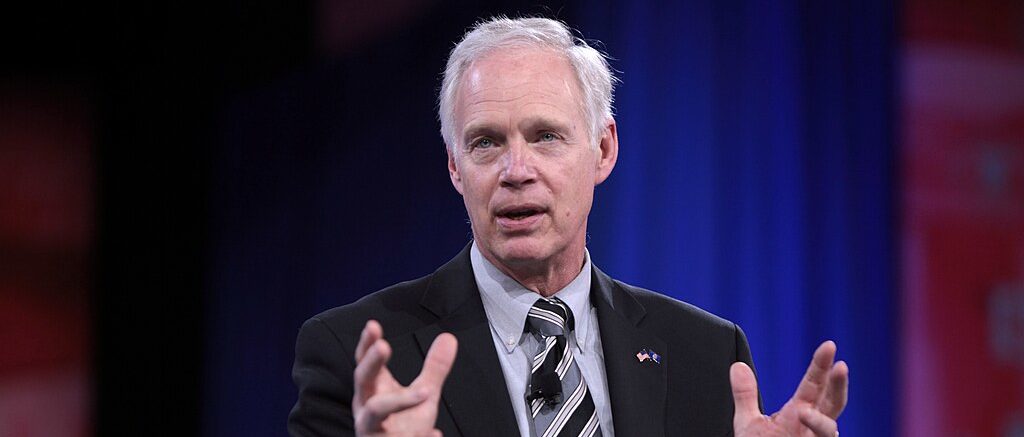
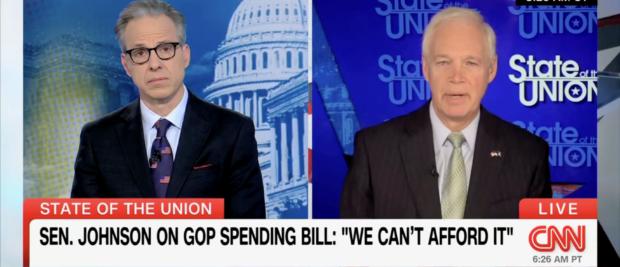
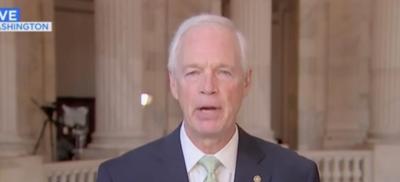
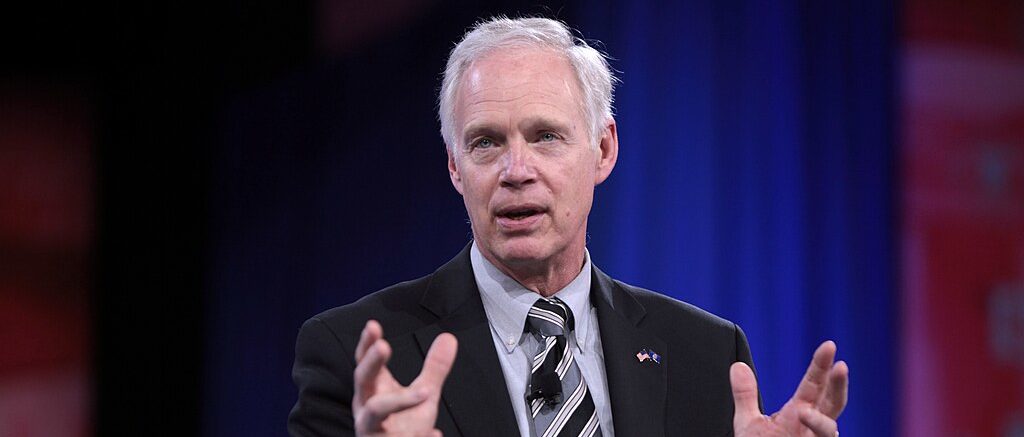
Ronald Harold Johnson (born April 8, 1955) is an American businessman and politician serving as the senior United States senator from Wisconsin, a seat he has held since 2011. A Republican, Johnson was first elected to the U.S. Senate in 2010, defeating Democratic incumbent Russ Feingold. Johnson defeated Feingold in a rematch in 2016, and defeated Lieutenant Governor Mandela Barnes in 2022. Before entering politics, he was chief executive officer of a plastics manufacturer in Oshkosh, Wisconsin.
Johnson entered politics to oppose the Affordable Care Act (ACA) and credits the Tea Party movement with his political ascent, though he does not personally identify with the movement. As a freshman senator, he gained a reputation for opposing government spending and seeking a balanced budget, having stalled or voted against budget proposals from both major parties for not offsetting spending. He is also critical of the Social Security program and has called for its partial privatization. Johnson has promoted various political conspiracy theories, including the Biden–Ukraine conspiracy theory, connections between vaccines and autism, election denial, the Great Replacement conspiracy theory, and 9/11 conspiracy theories. He advocates the use of alternative medicine and sponsored a right-to-try law to legalize the use of experimental medical treatments. Johnson also supports stronger measures against crime and illegal immigration, expansion of free trade, rejection of the scientific consensus on climate change, and protection of the right to bear arms.
Starting in his second term, Johnson aligned himself with Donald Trump. As chair of the Committee on Homeland Security and Governmental Affairs, he led investigations into Hillary Clinton, Hunter Biden, and officials involved in the FBI investigation of the Trump campaign. Johnson also worked on Ukraine–United States relations during his second term and saw Ukraine as an ally against Russia, but stopped supporting military aid for Ukraine after Russia invaded Ukraine in 2022 because he believed a Russian victory was inevitable. Due to his interactions with Ukrainian officials, Johnson was a major witness in the 2019 Trump–Ukraine scandal and the subsequent impeachment of Donald Trump, which he said was an attempt to sabotage Trump. In his third term, Johnson has focused on investigating corruption in federal agencies, which he alleges are working against the Trump administration.
Contents
Early life and business career
Ronald Harold Johnson was born on April 8, 1955, in Mankato, Minnesota. He was the son of Jean Johnson, a film processor, and Dale Johnson, a treasurer who worked both corporately and for the church. He held several jobs in his youth, including as a newspaper delivery boy, a caddie, a hay baler on his uncle's farm, a dishwasher, the night manager of a restaurant, and at a school yearbook company. Johnson attended Edina High School but skipped his senior year and graduated from the University of Minnesota in 1977 with a bachelor's degree in business and accounting. He began working as an accountant while studying for a Master of Business Administration, but he ended his studies in 1979 to enter business.
Johnson moved to Oshkosh, Wisconsin, where he worked as a machine operator and accountant to help establish the Pacur plastic company with his brother-in-law in 1979. He became Pacur's CEO in the mid-1980s when his brother-in-law left the company. The family sold Pacur to Bowater Industries for $18,000,000 (equivalent to $43,000,000 in 2024) in 1987, but Johnson remained CEO. He purchased Pacur from Bowater in 1997 and remained CEO until he was elected to the Senate in 2010.
In October 2009, Michelle Litjens invited Johnson to speak at an Oshkosh rally associated with the Tea Party movement. He was asked to speak about his experiences as a businessman regarding government regulation but extended the scope of his speech to health care reform and his daughter's heart defect. The speech was well-received among conservatives and gained him political support. Afterward, he reached out to Litjens to help him launch a campaign for the Senate. Johnson's wife took convincing, saying "absolutely not" when he first raised the idea.
U.S. Senate
2010 Senate election
Without previous political experience, Johnson announced his candidacy in the 2010 United States Senate election in Wisconsin a week before the May 15 Republican convention. He cited his opposition to the Affordable Care Act (ACA) as his reason for running, saying it was "the greatest assault on our freedom in my lifetime". Johnson first became known statewide with the assistance of conservative political commentator Charlie Sykes, who later opposed Johnson because of Johnson's support for Donald Trump. Since the Republican candidates entered the race late in the year, there was no time to seek donors, which made Johnson's personal wealth an advantage.
The other major Republican candidate for the Senate nomination, Wisconsin Secretary of Commerce Dick Leinenkugel, withdrew during the convention and gave a surprise endorsement to Johnson. Johnson also gained the support of Senator Jim DeMint, who held influence over the support received by Republican candidates. Johnson won the Republican primary in September with 85% of the vote, defeating Dave Westlake and Stephen Finn, who received 10% and 5%, respectively. Johnson's other opponent, Terrence Wall, dropped out of the race.
Wisconsin had long been a competitive state where both Democratic and Republican candidates were viable. The Democratic nominee in the general election, Russ Feingold, was the incumbent and had won his previous race by 11 points. Johnson's campaign was concerned about his debates against Feingold, an experienced public speaker, so they began practicing a month in advance in what Johnson called "murder sessions". Both candidates were seen as having performed well in the three debates. Feingold was the favorite to win early in the race, but polling fluctuated over the following months and was even in the days leading up to the election.
Johnson ran as a political outsider and small-business owner while criticizing Feingold as a Washington insider. His messaging emphasized fiscal responsibility, including job creation and reduction of the national debt. Johnson did not fully align with the Tea Party movement's strict reading of the Constitution, but his campaign had its backing and he was seen as a Tea Party candidate.
The main issue Johnson campaigned on was opposition to the Recovery Act and the ACA, both passed by the Obama administration. He launched his campaign by telling the Milwaukee Journal Sentinel that the United States "would have been far better off not spending any of the money and [letting] the recovery happen as it was going to happen". He rarely went into detail on other policies during the campaign. He declined to say how he would reduce the federal budget if elected, saying he was not going to "start naming things to be attacked about".
First term (2011–2017)
Upon entering the Senate, Johnson was appointed to the Committee on the Budget and Committee on Appropriations. He sought the position of vice chairman of the Senate Republican Conference in December 2011, but Roy Blunt was selected with 25 votes to Johnson's 22 votes. In Johnson's first term, he was mainly identified with his focus on federal spending and the national debt. He involved himself in fiscal issues and quickly became an influential member of the Senate in this area.
Johnson stepped down from the Committee on Appropriations in 2013 because he objected to the other committee members' permissiveness about spending, and joined the Committee on Foreign Relations. He used his position on the committee to investigate overuse of painkillers by the Department of Veterans Affairs and facilitate passage of the Integrated Public Alert and Warning System Act of 2015, which updated the warning system of the same name. In 2014, President Barack Obama unexpectedly appointed Johnson as a representative to a session of the United Nations General Assembly despite Johnson's opposition to both Obama and the United Nations. The same year, Johnson advocated greater international action against Ebola during the Western African Ebola epidemic.
Through Johnson's position on the Committee of Foreign Relations, he participated in the investigation into the 2012 Benghazi attack and was one of the most prominent critics of how Secretary of State Hillary Clinton handled it. An argument between Johnson and Clinton during a hearing became the basis for Republican attack ads against Clinton, though Johnson caused backlash for accusing her of faking her emotional state.
In 2014, Johnson sued the United States Office of Personnel Management to challenge the subsidies that the ACA gave members of Congress and their staff. His lawsuit alleged that it inflicted him with administrative burden, that it gave him an unfair benefit over his constituents, and that it was "an unlawful scheme". The case was dismissed when Judge William C. Griesbach found that Johnson lacked standing because no injury took place.
In 2016, Johnson rejected Republican presidential nominee Trump's allegations that the upcoming election would be rigged.
2016 Senate election
In March 2013, Johnson announced that he would seek reelection in 2016. In November 2014, he said he would not self-finance his campaign. In December 2014, the Washington Post rated Johnson the most vulnerable incumbent U.S. senator in the 2016 election cycle. He ran unopposed in the Republican primary election. The Democrats nominated Feingold again, leading to a rematch of the 2010 election. Until the campaign's final weeks, Feingold led in polling and was widely expected to win. Johnson had low name recognition for an incumbent seeking reelection, with 23% of Wisconsin voters having no opinion of him.
Johnson hired his brother Dean Johnson, a television producer, to assist in his campaign. The campaign's TV ads showed Johnson facilitating a couple's adoption of a child from the Democratic Republic of the Congo and changing his grandson's diaper as the infant urinated on him.
Senate Republicans cut off support to Johnson, believing the campaign was not viable enough to justify the cost, so he turned to the Republican leadership in the House of Representatives and worked with Speaker Paul Ryan. To improve Johnson's chances, Ryan expressed willingness to campaign with Republican presidential nominee Trump despite their animosity toward each other. Ryan was turned down. Johnson personally avoided tying himself to Trump until Trump's support in Wisconsin became apparent.
Johnson made his support for small government a key element of his campaign and used a get out the vote approach to gain voters. He returned to his 2010 campaign strategy of presenting himself as a businessman and a political outsider while portraying Feingold as a career politician. He argued that Feingold was a hypocrite for accepting campaign funds from outside Wisconsin despite advocating campaign finance reform. The Supreme Court nomination of Merrick Garland was pending in 2016, and Johnson campaigned on confirming a more conservative nominee who would uphold the right to bear arms. In contrast with his previous campaign, Johnson did not campaign on repealing the ACA.
Johnson was reelected with 50.2% of the vote to Feingold's 46.8%. He performed especially well with rural, white, male voters without college degrees, and his performance in the Milwaukee suburbs meant that he outperformed Trump's campaign in Wisconsin.
Second term (2017–2023)
Johnson's politics became more right-wing during his second term and he expressed support for various political conspiracy theories. He was a close ally of the Trump administration, though he disagreed with the administration on economic issues because of its willingness to increase government spending. Johnson initially opposed the Tax Cuts and Jobs Act in 2017, feeling it was too generous to larger corporations and did too little for small businesses, and he objected to how the bill would affect companies using a pass-through model, but he was successful in getting a 20% deduction in taxation for pass-through businesses. When accused of benefiting from the tax breaks, he said it benefited him because tax breaks benefit everyone.
As chair of the Committee on Homeland Security and Governmental Affairs, Johnson launched investigations into several people associated with the Obama administration, including Clinton and Vice President Joe Biden's son Hunter Biden. Johnson probed Hunter Biden's involvement with Ukraine and the contents of his laptop but did not present evidence of wrongdoing. He pressed the issue even after many in his party had abandoned it. He had some Republican support, but critics from both parties accused him of using the issue to spread Russian disinformation and gain support for Trump's reelection. Johnson himself was among the most prominent targets of ethics investigations by the Democratic Party. He was accused of abusing flights to Florida and of giving his chief of staff $280,000 in violation of Senate rules. The flights complaint was dismissed, and Johnson justified the payment as a personal gift for the recipient's cancer treatment.
After the 2018 Wisconsin elections, Johnson was the only Republican holding statewide office in Wisconsin and came to be seen as a leader of the state's Republican Party. He attributed that year's Republican defeats to a lack of grassroots organization or work with local political groups. Johnson criticized Senate Republicans for prioritizing their political careers over enacting conservative policy and pushed them to take stronger positions, especially on repealing the ACA. Republicans negotiated with Johnson to gain his support for a more limited rollback of the policy, including an argument between Johnson and Senate Majority Leader Mitch McConnell on the Senate floor. Johnson eventually agreed, but the bill was unsuccessful. Johnson's approval rating in Wisconsin began falling in 2019.
In 2021, during the Biden administration Johnson delayed passage of the American Rescue Plan Act. He forced a reading of all 628 pages of the bill on the grounds that the Senate had not had enough time to read it. The same year, he voted against funding highways and transit programs through the Infrastructure Investment and Jobs Act and called the trial of Derek Chauvin for the murder of George Floyd a distraction from immigration issues.
2022 Senate election
Johnson had pledged to serve only two terms, but he announced his candidacy for a third in 2022, saying there were calls for him to run and that he needed to stay in the Senate because "America is in peril". Before announcing his reelection campaign, he had been considered a possible candidate for governor of Wisconsin. Johnson won the Republican primary for the Senate with 84% percent of the vote to David Schroeder's 16%.
In 2022, Johnson was the only incumbent Republican nominee for the Senate competing in a state that Trump lost in the 2020 presidential election. The Democratic nominee was Lieutenant Governor of Wisconsin Mandela Barnes, a member of the Democratic Party's progressive faction. Johnson said Barnes was too extreme and presented himself as more moderate, while the Barnes campaign described Johnson as a Washington insider. Johnson's campaign used the election of Raphael Warnock, another black senatorial candidate whose Republican opponent called him too progressive, as an example to avoid.
Cultural issues were a major aspect of Johnson's 2022 campaign, and he frequently criticized anti-white racism and cancel culture. He also made crime a major issue, taking a law and order stance. Barnes accused Johnson of taking advantage of fear about crime without helping communities in a way that would solve the problem.
Johnson was reelected with 50% of the vote to Barnes's 49%, a much smaller margin than expected based on polling. No other Republican won a statewide race in Wisconsin in 2022.
Third term (2023–present)
Leading up to the 2024 presidential election, Johnson was unwilling to say he would accept the result, saying he wanted to but would "have to see exactly what happens". After Trump won, Johnson made anti-corruption a major priority, alleging that federal agencies intended to sabotage Trump and were under the control of businesses. He also used his position as chair of the Senate Permanent Subcommittee on Investigations to open investigations based on 9/11 conspiracy theories. Johnson was one of the strongest supporters of Robert F. Kennedy Jr.'s nomination as Secretary of Health and Human Services, and expressed interested in working with Kennedy on reevaluating the use of vaccines and investigating processed food.
In 2025, Johnson said he did not want to run for reelection in 2028 but had yet to make a final decision.
Committee assignments
As of the 119th United States Congress, Johnson has served on the following committees.
United States Senate Committee on Appropriations (112th Congress)
Committee on the Budget (112th–119th Congress)
Committee on Homeland Security and Governmental Affairs (112th–119th Congress; chairman during 114th–116th Congress)
Special Committee on Aging (112th and 119th Congress)
United States Senate Committee on Banking, Housing, and Urban Affairs (113th Congress)
Committee on Commerce, Science, and Transportation (113th–117th Congress)
Committee on Foreign Relations (113th–117th Congress)
Committee on Small Business and Entrepreneurship (113th Congress)
Committee on Finance (119th Congress)
Political positions
Johnson has a conservative Senate voting record and is among Trump's closest Congressional allies. He considers both Trump and himself "change agent[s]". Johnson has acknowledged that the Tea Party movement was a major factor in his political rise but said he did not consider himself a member of the movement and has not joined any Tea Party organizations, though he has called himself "more Tea Party than Republican". His fellow senator from Wisconsin, Tammy Baldwin, is a Democrat who diverges drastically from Johnson in ideology. Senators from the same state are typically more closely aligned. Johnson has cited Ayn Rand's novel Atlas Shrugged as a major influence on his ideology.
Johnson is known for inviting controversy and making statements that attract media attention. He has promoted conspiracy theories on a variety of issues, which he says is a way to raise uncomfortable questions, allow people to consider alternative ideas, and hold the media accountable. He argues that "conspiracy theorist" is a label used to silence people who "want to expose the truth". Many of his remarks have received media attention as gaffes, including his accusation that The Lego Movie is anti-capitalist and his comment that public school students are "idiot inner-city kids".
Johnson's supporters have praised him for taking a direct, blunt approach to politics and support him as an anti-establishment politician. Critics see him as taking advantage of conspiracy theories to retain the support of Trump's voters. As his tenure in the Senate has lengthened, his opponents have begun to portray him as an out-of-touch Washington insider rather than an anti-establishment candidate, which Johnson has called "lies and distortions".
Crime
Johnson has said that the prevalence of single-parent households and resulting lack of father figures is a driving force of criminal activity. He opposes criminal justice reforms that he sees as incentivizing crime, including the abolition of cash bail, restrictions on police chases, and dropping charges for low-level offenders. He has said Wisconsin's criminal justice system has a "revolving door policy" in which criminals are released shortly after arrest and then commit further crimes. He has also expressed concern about the Ferguson effect, whereby police have become more hesitant to stop crime because any action puts them under increased scrutiny. Johnson is critical of the defund the police movement, which he called "dispiriting".
Johnson has accused the FBI of corruption, alleging it tried to sabotage and discredit him, and opened investigations into multiple FBI officials through his position on the Committee of Homeland Security and Governmental Affairs. He aligned with the Catholic Church in opposing Wisconsin's 2010 Child Victims Act because it made it easier to sue organizations associated with sexual abusers, which he said would penalize innocent parties and disincentivize organizations from reporting abuse.
Economic and fiscal issues
Opposition to government spending and support for a balanced budget are central to Johnson's political platform. He says reducing spending is the best way to reduce the deficit. He has called high taxes "punishing success" and objects to raising taxes as a means to pay off the national debt. Johnson is critical of the Social Security program, calling it a Ponzi scheme. He has called for reforms like partial privatization, tying it to assets other than government bonds and making it subject to regular renewal by Congress. He argues that programs like Social Security and Medicare are threatened by the deficit and that he is trying to save them by reducing spending.
Johnson opposed the budget cut plan Paul Ryan proposed in 2011 because he felt the budget needed to be cut even further, and he stalled a bill authorizing military action in Libya in protest of the budget. In 2014, Johnson was one of three senators to oppose an increase in funding to the Department of Veterans Affairs, which he said passed too quickly without consideration of offsetting the expenses.
To decide what spending to cut, Johnson has proposed auditing each budget item individually to find wasteful funds that go to what he has called "grifters who are sucking down the waste, fraud and abuse". Defending cuts in spending, Johnson said Congress cannot "defeat the deep state by funding it". He has proposed eliminating government shutdowns by allowing the government to continue operating on the previous budget if a new budget is not passed. Johnson supports infrastructure spending but has expressed reservations about funding it with deficit spending. He considers deregulation a path to economic growth.
In 2016, Johnson said he would support a small increase to the national minimum wage if it were tied to inflation, and in 2021 he expressed support for "increasing the minimum wage to some extent". In 2022, he said it was better for the marketplace to decide wages than to have a government-mandated minimum wage. Johnson opposes requiring companies to provide paid family leave, arguing that they would offset the costs by halting increases in wages and benefits, though in 2015 he voted for an amendment to establish a deficit-neutral reserve fund to allow all employees in the country to earn paid sick time.
In 2024, Johnson was one of 18 senators who voted against a third budget extension to prevent a government shutdown because he wanted to avoid indefinite extensions without passing a full budget. Johnson was skeptical of the One Big Beautiful Bill Act in 2025 because it did not offset its tax cuts by reducing spending. He described the bill's $1.5 trillion spending cuts over ten years as nothing more than "a rounding error" and called for a $6 trillion cut to return spending to where it was before the COVID-19 pandemic. He voted for the bill after Trump assured him that spending would be reduced.
Environment, climate change, and energy
Johnson rejects the scientific consensus on climate change. In his 2010 Senate campaign, he called the understanding that climate change is man-made "lunacy" and said it is "not proven by any stretch of the imagination". He proposed sunspots and "the geologic eons of time" as alternative explanations. In dismissing the effects of climate change, Johnson erroneously claimed that Greenland was green when it was discovered and had become white and snow-clad over time as a result of cooling temperatures. He also disagreed that greenhouse gasses are harmful, saying that they feed trees. He has disputed that he is a climate change denier.
Johnson has supported the oil industry and advocated for increased drilling. He made a statement that suggested support for drilling in the Great Lakes during his 2010 campaign, but later said his words had been misinterpreted. He supported the creation of the Keystone Pipeline. While campaigning in 2022, Johnson said that Democrats were intentionally raising gas prices to force people to use electric vehicles.
Foreign policy
Johnson rejects global governance and has accused the United Nations of having corrupt members. He has called for international action on certain issues, such as containment of the Western African Ebola epidemic and prevention of violence against women.
Johnson said he believes Russia is an "adversary" but that dialogue must remain open because "Russia is not going away". He opposed using sanctions against Russia as a response to the country's interference in the 2016 elections and voted against a bill to condemn Trump's handling of sanctions against Russia. In the late 2010s, Johnson was a major advocate of military aid for Ukraine. He attended Ukrainian President Volodymyr Zelenskyy's 2019 inauguration and considered Zelenskyy an ally against Russia. He opposed further aid after Russia invaded Ukraine in 2022, saying that Russia would inevitably win and that further support would be a waste of funds. He said support should be delivered to Ukraine only with a plan to negotiate a settlement with Russia, and joined other Republicans in tying his support for aid to greater border security between the U.S. and Mexico.
Johnson accused the Obama and Biden administrations of making the Middle East more dangerous by taking insufficient measures against Iran, and accused Obama of taking too weak a stance against the Islamic State. Warning that the Islamic State would cause terrorism in the U.S., he advocated its total destruction and called its leaders "barbarians". Johnson opposed increasing U.S. military presence beyond what was already in Iraq and instead proposed a U.S.-led coalition of NATO and Arab states. Johnson voted against ending U.S. military involvement in Yemen in 2018 and supported launching strikes against the Houthis in Yemen in response to their attacks on ships during the Red Sea crisis that began in 2023. He has said wealthy Arab nations should pay the U.S. for the military assistance it provides.
During the Gaza war, Johnson said Israel should be given administrative authority over the Gaza Strip so it could enforce peace. He opposed a ceasefire on the grounds that it risked letting Hamas regroup and opposed aid to Palestine on the grounds that Hamas would seize it. He said Palestinian refugees should go to other Arab nations if they did not want to be under Israeli jurisdiction.
Governance
Johnson dismissed the idea that the 2016 presidential election would be rigged, but he was a major proponent of such claims for the 2020 election and at one point suggested he might not accept the results of the 2024 election. He supports requiring proof of citizenship when registering to vote and opposes what he argues is excessive use of mail-in voting, saying it reduces confidence in election results. He also opposes the nationalization of federal elections that would take election management away from state governments.
Johnson is one of the Senate Republicans who favored the nuclear option of ending the Senate's filibuster "to speed up consideration of President Trump's nominees" because changing the Senate's rules to a simple majority vote would "ensure a quicker pace on Trump's court picks". He opposed abolishing the filibuster while Republicans held the Senate in 2022 and said those in favor of abolishing it wanted "absolute power". He again supported abolishing the filibuster during a government shutdown in 2025 after Trump called for its removal.
Gun policy
Johnson opposes gun control measures as infringements of rights granted by the Second Amendment to the United States Constitution and argues that such measures do not necessarily reduce violent crime. He supports the right to concealed carry, and has said increased gun ownership would allow defensive gun use that could deter violent crime. He has called mandatory gun buyback programs "compensated confiscation" and emphasized the importance of due process in implementing red flag laws. He opposes expanded background checks on gun purchases and worked to prevent a background check bill from passing in 2013. He also opposes high-capacity magazine bans. During his 2010 campaign he initially said he was open to firearms licensing, but he later said he had been misunderstood. In April 2013, Johnson was one of 12 Republican senators to sign a letter threatening to filibuster any newly introduced gun control legislation. He responded to school shootings by proposing a school security law and responded to the Uvalde school shooting by saying it was caused by a failure to teach values in schools, a remark Governor Tony Evers called "breathtaking".
Health care and medicine
Johnson's early political career focused heavily on opposition to the ACA, which he cited as his reason for entering politics. He supported the Republican strategy of "repeal and replace" when other Senate Republicans considered a partial repeal. He has also criticized the subsequent Medicaid expansions, which he said allowed "legalized fraud" in the benefits it provided for unemployed able-bodied adults.
Johnson supports health care protections for people with preexisting conditions and has presented his daughter's congenital heart defect as an example. He expressed willingness to keep the ACA provision that offers these protections and proposed a reform so they would function through high-risk pools. He alleged that the ACA caused higher insurance premiums for people with preexisting conditions.
Johnson has accused health agencies like the Department of Health and Human Services, the Centers for Disease Control and Prevention, and the Food and Drug Administration of being nontransparent and hiding information from Congress. He indicated support for the disproven claim that there is a link between vaccines and autism and has called sanitation the best way to eradicate disease, suggesting vaccines play only a supplementary role. He supports repealing vaccine requirements for children attending school. Johnson has endorsed the false claim that the bleaching agent chlorine dioxide can treat several conditions. During the COVID-19 pandemic, he promoted skepticism of the COVID-19 vaccine and supported alternative treatments that were found to be ineffective. He sponsored a federal right-to-try law allowing patients with severe illness to try experimental treatments.
In 2011, Johnson co-sponsored a federal bill that would grant all fetuses the rights of personhood, with no exceptions for rape or incest. From 2013 to 2021, he supported bills that banned abortion after 20 weeks of conception except in cases of incest, rape, or risk to the mother's life.
In 2021, Johnson supported a request for the Supreme Court to uphold a Mississippi law banning abortion after 15 weeks, with exceptions for "severe fetal abnormality" or medical emergency but none for rape and incest. He supported Dobbs v. Jackson Women's Health Organization, the 2022 U.S. Supreme Court ruling that overturned Roe v. Wade, and the subsequent legalization of abortion bans. Johnson said he did not see that decision "as a huge threat to women's health" and suggested that those who did not like it could move out of Wisconsin.
Immigration
In 2017, Johnson supported the end of Deferred Action for Childhood Arrivals (DACA), which provided protections for illegal immigrants brought to the U.S. as children, saying it was unconstitutional and "created incentives for children from Central America to take great risks to enter America illegally". He has called on state and local governments to arrest illegal immigrants who commit violent crimes and deliver them to the custody of Immigration and Customs Enforcement (ICE). He is critical of sanctuary cities that give protections to illegal immigrants. Johnson supports a safe third country agreement with Mexico on the grounds that people seeking asylum will stop there instead of continuing to the U.S. Johnson has promoted the Great Replacement conspiracy theory, a white supremacist belief that there are efforts to replace white populations with nonwhite populations.
Johnson supported the raids led by ICE during Trump's second administration. He accused Democrats of encouraging people to interfere with ICE operations and of "neutering our ability to enforce any immigration laws" when they demanded that ICE get judicial warrants before entering people's homes. Johnson argued that killings during immigration operations by ICE should be investigated but that opposition was overstated because most operations were conducted properly, and that there were fewer victims of immigration operations than victims of crimes committed by undocumented immigrants. He opposed a reduction in spending on the Department of Homeland Security because he saw any cuts as a continuation of the defund the police movement.
National security
Johnson expressed support for the Patriot Act while campaigning in 2010. He voted to ban mass collection of data by the National Security Agency. Johnson used his position on the Committee on Homeland Security and Governmental Affairs to prevent the passage of cyber-security regulation, saying it gave the government too much control over businesses. He objected when Biden terminated the China Initiative anti-espionage program, which was criticized for racial discrimination, and insinuated without evidence that it was to help Hunter Biden engage in business in China.
Johnson has expressed belief in 9/11 conspiracy theories and alleged that information about the attack has been covered up. He endorsed the debunked claim that 7 World Trade Center was destroyed by controlled demolition and said the National Institute of Standards and Technology investigation that disproved the claim was corrupt.
Same-sex marriage and gender identity
Johnson has said marriage is "between one man and one woman" but has also said he does not oppose protections for same-sex couples. In 2015, he was one of the few Republicans who voted to allow same-sex spouses to have access to federal Social Security and veterans' benefits. In July 2022, he initially expressed support for the Respect for Marriage Act, which would codify same-sex marriage into federal law, but he reversed his stance in September 2022. Johnson also voted against the Employment Non-Discrimination Act.
Johnson opposed the Biden administration's application of the sex discrimination protections under Title IX to include protection of gender identity, saying that it was taking "a sledgehammer to Title IX". He supports banning transgender students from competing on sports teams that do not align with their gender at birth.
Personal life
Johnson lives in Oshkosh, Wisconsin. He has been married to Jane Curler, whom he met while attending Edina High School, since 1977. They have three children, and as of 2024 they have four grandchildren. He is a member of the Wisconsin Evangelical Lutheran Synod and has attributed his deeply held religious beliefs to his parents. He engages in philanthropy, including donations to the Boys & Girls Clubs of America, Catholic schools, and individuals in need. He is also involved with the faith-based Joseph Project jobs program.