
Pokémon is a Japanese media franchise consisting of video games, animated series and films, a trading card game, and other related media. The franchise takes place in a shared universe in which humans co-exist with the eponymous creatures, a large variety of species endowed with special powers. The franchise's primary target audience is children aged 5 to 12, but it is known to attract people of all ages. Pokémon is estimated to be the world's highest-grossing media franchise, with the video games in particular being among the best-selling.
The franchise originated as a pair of role-playing games developed by Game Freak, from an original concept by its founder, Satoshi Tajiri. Released on the Game Boy on 27 February 1996, the games became sleeper hits and were followed by manga series, a trading card game, and anime series and films. From 1998 to 2000, Pokémon was exported to the rest of the world, creating an unprecedented global phenomenon dubbed "Pokémania". By 2002, the craze had ended, after which Pokémon became a fixture in popular culture, with new products releasing to this day. In 2016, the franchise spawned a second craze with the release of the AR game Pokémon Go, developed by Niantic.
The franchise is managed by the Pokémon Company (TPC), which was established in 2000 by the joint owners of the franchise: original video game series publisher Nintendo, Trading Card Game developer Creatures, and Game Freak. The three companies also own the anime series alongside TV Tokyo, ShoPro, and JR Kikaku, and Pikachu Project, a joint venture between The Pokémon Company, TV Tokyo, and ShoPro, owns the anime films. Since 2009, The Pokémon Company International (TPCi), a subsidiary of TPC, has managed the franchise in all regions outside Asia.
Contents
Name
The original full name of the franchise is Pocket Monsters (ポケットモンスター, Poketto Monsutā), which has been commonly abbreviated to Pokemon (ポケモン) since its launch. When the franchise was released internationally, the short form of the title was used, with an acute accent (´) over the e to aid in pronunciation.
Pokémon refers to both the franchise itself and the eponymous creatures. As a noun, it is identical in both the singular and plural, as is every individual species name. Thus, it is grammatically correct to say "one Pokémon" and "many Pokémon", as well as "one Pikachu" and "many Pikachu".
General concept
The Pokémon franchise takes place in a shared universe in which humans co-exist with creatures known as Pokémon. The original pair of games feature 151 Pokémon species, with new ones being added in subsequent games; as of early 2026, 1,025 Pokémon species have been introduced. Most Pokémon are based on real-life animals or mythical creatures from folklore. For example, Pikachu are a yellow, mouse-like species with tails shaped as lightning bolts, able to blast powerful electric charges through the air.
The player character takes the role of a Pokémon Trainer. The Trainer has three primary aims: travel and explore the Pokémon world; discover and catch a specimen of each Pokémon species in order to complete their Pokédex; and train a team of Pokémon and have them engage in battles. Most Pokémon can be caught with spherical devices known as Poké Balls. Once the opposing Pokémon is sufficiently weakened, the Trainer throws the Poké Ball against the Pokémon, which is then transformed into a form of energy and transported into the device. If the catch is successful, the Pokémon is tamed and under the Trainer's command from then on. If the Poké Ball is thrown again, the Pokémon re-materializes into its original state. The Trainer's Pokémon can engage in battles against opposing Pokémon, including those in the wild or owned by other Trainers. Because the franchise is aimed at children, these battles are never presented as overtly violent and contain no blood or gore. Pokémon never die in battle – they faint upon being defeated, and can then be rejuvenated at a Pokémon Center.
History
Origins
The main idea behind Pokémon was conceived by Satoshi Tajiri. Tajiri was born on 28 August 1965, and grew up in Machida, a suburb of Tokyo. As a child, he enjoyed discovering and catching insects and other small creatures in the various ponds and fields that surrounded his town. During Japan's economic miracle, many cities, including Machida, were significantly expanded. As a consequence, Machida's nature was largely destroyed. In his second year of junior high school, an arcade hall opened in Tajiri's neighborhood, introducing him to video games. While studying electrical engineering at Tokyo College of Technology, Tajiri began publishing a doujinshi magazine titled Game Freak. The title was inspired by the 1932 film Freaks, which Tajiri was fascinated with at the time. He self-published the first issue of the magazine in March 1983, at the age of 17. At the time, magazines specializing in video games did not yet exist in Japan, allowing Game Freak to fill a gap in the market. Sometime later, Tajiri was contacted by aspiring manga artist Ken Sugimori, who became Game Freak's illustrator. Game Freak folded in the late 1980s, by which point Tajiri had become a respected game journalist in Japan's fledgling video game industry. Through his work, Tajiri befriended Tsunekazu Ishihara, a Japanese business man who, among other things, produced game-related shows for Fuji Television.
In 1986, Tajiri, Sugimori, and a few other enthusiasts started an informal development team called Game Freak, named after the magazine it grew out of. Over the next few years, they independently developed the puzzle game Quinty, working on it alongside school or their regular jobs. However, no one within the group knew how to make the game's music. After consulting all his contacts, Tajiri got in touch with Junichi Masuda, who became the group's composer. Quinty was finished in 1989, and published by Namco. Tajiri officially incorporated Game Freak Co., Ltd. on 26 April 1989.
1989–1995: Development of Red and Green
Tajiri started to think of what was to become Pokémon while completing Quinty, and before he officially founded Game Freak. Around this time, Nintendo announced the upcoming release of the Game Boy, a handheld console that would revolutionize the gaming industry. Tajiri learned that the device would have a link port, and with the corresponding Game Link Cable, two Game Boys could be linked together. Sometime later, Tajiri remembered an incident while playing Dragon Quest II (1987), a role-playing game (RPG) for the Famicom (NES). The game features randomly appearing items of varying rarity, including an extremely rare item called Mysterious Hat. Tajiri did not encounter any, while Ken Sugimori, who was also playing the game, encountered two. Upon recalling this experience, Tajiri realized that the cable now made it possible to transfer things from one cartridge to another. He noted that, until then, the Game Link Cable was only used for competing, but not for something else. Combining this inspiration with his memories of catching insects and other small species, Tajiri's idea would eventually evolve into a virtual recreation of his boyhood experiences, and an attempt to "regain the world that he had lost". He would later state that the game represents "the story of a boy's summer day".
Tajiri and his Game Freak staff began pondering over a game centered on capturing creatures of differing rarity. Since the Game Boy is a portable device, these creatures could then be exchanged with other players in real life using the link cable. Once the player has caught a creature in-game, it was to be stored in miniaturized form in a special capsule. This facet of the game was inspired by Ultraseven, a tokusatsu show that Tajiri had enjoyed as a child. The series' titular character owns a number of capsules containing miniaturized kaiju (monsters), which come out and return to their original sizes when the capsule is thrown into mid-air. Kaiju media in general were an important influence on Pokemon, as many Game Freak staff members had grown up with them. Other influences that have been cited by Tajiri include: gashapon, capsules with toy figures in them that can be drawn from vending machines; collectible cards, such as baseball cards, Ultraman cards and menko; The Final Fantasy Legend (1989), the first RPG for the Game Boy; and pet culture in Japan, with Tajiri noting that having Pokemon is similar to having pets. Tajiri initially named his project Capsule Monsters, which Game Freak's staff commonly shortened to Capumon. However, it later turned out that the term Capsule Monsters could not be trademarked, and it was subsequently decided to call the game Pocket Monsters, which became Pokemon.
1996–1998: Rise in Japan
After finally being finished in December 1995, Pocket Monsters Red and Green were released on 27 February 1996. Nintendo had no high expectations of the games, and media largely ignored them. By 1996, the seven-year-old Game Boy console was considered dated and near the end of its lifecycle. On the other hand, new Game Boys continued to be manufactured and sold. The console was widespread and, due to its age, affordable to children.
Two media channels that would play important roles in the Pokemon franchise were the CoroCoro Comic, released monthly, and its sister magazine Bessatsu CoroCoro Comic, released bi-monthly. Both manga magazines are published by Shogakukan, a long-time business partner of Nintendo, and have featured manga based on Nintendo properties (e.g. Super Mario-kun, Kirby of the Stars, Donkey Kong). At the time of Pokemon's release, the main CoroCoro magazine was read by one in four elementary school students. CoroCoro's deputy editor-in-chief was Masakazu Kubo. On Ishihara's suggestion, Kubo commissioned the creation of a manga adaptation, written and illustrated by Kosaku Anakubo. Shogakukan, which frequently surveys their target groups, determined that the Pocket Monsters manga was well received.
To further promote Red and Green, the May issue of CoroCoro, released on 15 April 1996, announced the "Legendary Pokemon Offer", centered around a mysterious, secret Pokemon called Mew. Mew was a last-minute addition to Red and Green. It is unobtainable in the game(s) through usual means, and was intended to be used at a later point in some post-launch activity. To participate in the promotion, CoroCoro readers had to send in a postcard, and from the entrants, 20 were selected at random. The winners then had to send in their cartridge so that Mew could be uploaded onto it. The lottery was a success and increased word-of-mouth. By September, sales of Red and Green had surpassed 1 million units.
The Pokemon Trading Card Game was one of the first collectible card games (CCGs) developed in Japan. Its creation was influenced by Magic: The Gathering, the first CCG in history. Indeed, the Pokemon Trading Card Game can be considered a simplified version of Magic. First released in the United States in 1993, Magic had gained popularity not just in North America and Europe, but also in Asia. Ishihara was fond of playing cards, and had contributed to the development of at least three simple card games designed by Shigesato Itoi and released through Ape, Inc. At the time, Ishihara was particularly interested in Magic: The Gathering. While developing the Pokemon RPG, he realized that the concept behind it could be adapted into a Magic-like CCG. The Pokemon Trading Card Game was designed by Ishihara, Akihiko Miura, Kōichi Ōyama, and Takumi Akabane. All were former staff members of Ape and had previously worked on EarthBound (1994): Miura was the game's main designer, Ōyama was its art director, and Akabane was one of its chief debuggers.
1998–2000: International expansion
Possibly the first official to show interest in a North American launch of Pokemon was Minoru Arakawa, founder and then-president of Nintendo of America (NoA). Arakawa visited Japan to participate in Shoshinkai 1996, held 22–24 November. It was around this time when he first played one of the three Pokemon titles released at the time. He thought the games were promising, but Nintendo in Japan (NCL) had no plans at the time to release them elsewhere. He returned to America with a few cartridges and tested the game on his employees – they did not believe it would work in the US. At the time, role-playing games (RPGs) were not very popular outside Japan, and NoA executives believed that American children did not have the attention span for such a complex title. Americans were said to be more interested in sport- and action-oriented games, preferably with realistic graphics. Japanese people, by contrast, were alleged to care more about characters and plot. Up to that point, few Japanese properties had been successfully mainstreamed in the US, and if they were, it was alleged to be on account of having been properly Americanized: Mighty Morphin Power Rangers was considered a prime example of this. Visually, Pokemon was believed to be too kawaii, or cute. It was assumed that Pokemon could not succeed on cute alone – it must also be cool. In an effort to enhance the franchise's coolness, NoA considered a graphical redesign and contracted a few external artists to create some test-designs for the American market. The mockups they proposed included 'graffiti style' drawings, 'beefed-up' and more muscular-looking Pokemon, and a new Pikachu that looked like "a tiger with huge breasts". Arakawa concluded that it "didn't work", and by that time, the anime had begun its production in Japan, leading NoA to conclude it was too late for a graphical revamp anyway.
Of pivotal importance to Pokemon's global expansion was Alfred R. Kahn, CEO of US-based 4Kids Entertainment, NoA's licensing agent since 1987. Convinced of the franchise's potential, Kahn agreed to invest an undisclosed sum in return for both the anime and licensing rights. Pokemon became one of the first Japanese media franchises in which both the localization of the anime and the licensing of merchandise were handled by a single company, as well as a non-Japanese company. Kahn suggested using the short version of the name, "Pokémon", adding an acute accent (´) over the e to assist with pronunciation and "give it a little flair". NCL president Hiroshi Yamauchi officially approved the project in late November, and subsequently announced it at Space World 1997. However, three weeks later, the "Dennō Senshi Porygon" incident happened, which Kubo felt made even more people resistant to the idea of an overseas introduction.
2001–2006: End of the craze
In North America, Pokémania peaked in 1999, slowing down throughout the next year. On 29 April 2000, the anime was bumped off Kids' WB's No. 1 spot after holding it for 54 weeks. Around the same time, Pokémon was surpassed at Fox Kids by its rival Digimon. In Europe, the craze peaked in 2000. On 20 January 2001, The New York Times reported that Pokémon's trading card market had collapsed in the US. A June 2001 survey in the United Kingdom confirmed that Pokémon's popularity was waning there. Joseph Tobin wrote: "By the summer of 2001, Pokémon's shelf space in Japanese and U.S. toy stores was but a fraction of what it enjoyed in the fall of 1999". By the end of 2001, Pokémania was fading globally, and by 2002, the fad was largely over.
From 2000 to 2002, Game Freak developed Pokémon Ruby and Sapphire, the successors to Gold and Silver, for the newly released Game Boy Advance. Masuda, who was appointed to assistant director during Gold and Silver, was promoted to director for Ruby and Sapphire, with Tajiri making himself executive director.
In October 2001, 4Kids Entertainment signed a new contract with Pokémon USA (PUSA), continuing to serve as Pokémon's exclusive licensing agent and anime localizer. On 23 December 2005, it was announced that the agreement would not be renewed and would expire on 31 December, with PUSA moving all licensing in-house. The localization of the anime would be done by PUSA in cooperation with TAJ Productions. PUSA proceeded to replace almost all of the original English voice actors, who were still under contract with 4Kids. This decision "raised the ire of fans and the actors themselves". According to Stuart Zagnit, who voiced Professor Oak, the recasting was done to cut back on costs.
In March 2003, Pokémon UK was established in London as a British representative of The Pokémon Company.
2006–2012: Generation IV–V, TPCi established
Following Ruby and Sapphire, Pokémon Diamond and Pearl were released for the Nintendo DS on 28 September 2006 in Japan and on 22 April 2007 in North America. A third version, Pokémon Platinum, was released on 28 September 2008 in Japan and on 22 March 2009 in North America. They form the fourth generation (Generation IV) in the Pokémon video game series. Diamond and Pearl were designed based on the DS's various features such as its Wi-Fi capabilities and slot for a Game Boy Advance cartridge. Pokémon president Tsunekazu Ishihara dubbed the games the "ultimate" Pokémon titles because they allowed the player to trade and battle Pokémon (including every Pokémon from previous iterations) globally through WiFi, whereas previously trading was only possible locally, and with fewer Pokémon. The games' characters are 2D and the environments are rendered in 3D, and it is considerably difficult to differentiate them because Game Freak designed them this way to innovate the graphics while also retaining the traditional game style and feel.
In 2009, Pokémon USA and Pokémon UK merged to form The Pokémon Company International (TPCi). This subsidiary of The Pokémon Company (TPC) has since managed the Pokémon franchise outside of Asia.
In Generation V, Pokémon Black and White were released on 18 September 2010 in Japan for the DS and on 6 March 2011 in North America. The games feature enhanced visual effects and increased use of 3D graphics. The developers excluded old Pokémon and strategies, while introducing over 150 new Pokémon to evoke a sense of novelty and to provide new players with a more "leveled playing field" against old players. The games seek to attract both new players and returning players through their detailed walkthrough and the addition of C-Gear (a real-time communication tool to improve the trade and battle experiences), respectively. Black and White were followed by Pokémon Black 2 and White 2, which were released on 23 June 2012 in Japan and on 7 October 2012 in North America.
2013–2018: 3D, Generation VI–VII, Pokémon Go
In Generation VI, Pokémon X and Y were released worldwide for the 3DS on 12 October 2013, and they are the first games to be released in this way. The developers focused on the themes of "beauty", "bond", and "evolution", and it is based on these themes that they created the games' core mechanic where Pokémon could achieve a higher form of evolution by strengthening their bonds with trainers; however, to maintain game balance, they limited this feature to a special, temporary phenomenon. The games' shift to fully 3D graphics allowed the player to freely manipulate camera angles, but due to technical limitations objects far away were rendered in lower polygon models. Addressing the move away from 2D graphics, producer Hitoshi Yamagami told fans that "at Game Freak we're big fans of 2D graphics... So there are some elements in there that I [Yamagami] think fans of 2D will appreciate as well." When asked about the Horde battle and Sky battle types, he stated that Horde battles are to supplant the roles of "really strong pokemon [sic]" to help the player more easily progress through the games and also to add "more excitement to the battles and a sense of danger", and that they added the Sky battles to take advantage of the games' 3D camera angles capabilities.
In Generation VII, Pokémon Sun and Moon were released worldwide for the 3DS on 18 November 2016, and on 23 November 2016, in Europe. The developers chose Hawaii for inspiration due to its distinctive warm sunlight and clear moonlight, as well as its unique biomes, which were conducive to the games' regional Pokémon variance concept. Ohmori said that, as director, he aimed to focus on the concept of "Pokémon as these living creatures, [and really focus] on them being alive." Having the release date on the 20th anniversary of Pokémon in mind, he treated this project as a "celebration of that life, and to really express this respect for life". As he contemplated life and its origins, Ohmori considered the significance of the Sun, enabling life with its light, and the Moon's impact on certain species' reproduction. He explained how the Sun, the Moon, and the Earth "work [together] to influence [one another], and life as a result grows and flourishes based on [this] relationship."
In 2016, the Pokémon franchise spawned a second worldwide fad with the release of Pokémon Go, a mobile augmented reality game. The app originated as a Google April Fools' Day joke in 2014: the "Google Maps Pokémon Challenge". The prank was conceived by Tsunekazu Ishihara and Satoru Iwata. On Ishihara's initiative, the hoax was turned into an actual video game developed by Niantic. Ishihara was a fan of Niantic's previous transreality game, Ingress, and saw the game's concept as a perfect match for Pokémon.
2019–present: Generation VIII–X, open-world gameplay
Generation VIII debuted with the release of Pokémon Sword and Shield on 15 November 2019, for the Switch. Director Shigeru Ohmori stated that they designed the games based on what they believed of the biggest Pokémon theme of becoming/being "the greatest or strongest", which was expressed in the games' Dynamax / Gigantamax Pokémon core mechanic and the games' increasingly powerful software and hardware capabilities. Ohmori further revealed that through developing the Let's Go games as research projects for the Switch, they were able to gain valuable experiences and knowledge to develop Sword and Shield. He noted that they took advantage of the Switch's high resolution and TV connectivity to implement the games' gigantic-size core Pokémon mechanic. They envisioned the games' setting to be a "wide-open space" that is different from the traditional route systems and is constantly changing where the player can meet and explore with other players.
In 2020, the COVID-19 pandemic broke out. The resulting widespread ennui and excessive leisure time inspired a resurgence in popularity and interest in Pokémon cards, which was further popularized by various YouTubers and other influencers, such as Logan Paul. The craze resulted in severe supply shortages, and customers' inappropriate and obsessive behavior raised safety concerns in many retail outlets. Pokémon cards' values skyrocketed, prompting collectors to submit cards and overwhelm card grading agencies. The Pokémon Company responded by reprinting impacted products at maximum capacity to ensure price stabilization and general accessibility.
Pokémon Legends: Arceus was released on 28 January 2022, for the Switch as a prequel to Diamond and Pearl. It is part of Generation VIII. According to the Pokémon Company, the game represented "a new approach for the Pokémon video game series", creating more of an "action-RPG experience" by implementing some real-time elements. Unlike traditional Pokémon games, the player can catch Pokémon by throwing a Poké Ball in real-time rather than triggering a battle; however, they can still choose the latter to weaken it for capture. Many in-game aspects, particularly its landscape, heavily resemble those of The Legend of Zelda: Breath of the Wild.
Generation IX was introduced with the release of Pokémon Scarlet and Violet for the Switch on 18 November 2022. The games were the first in the Pokémon franchise to feature an entirely open-world experience, as opposed to the partially open-world experience in previous Pokémon games such as Sword and Shield, allowing players to face gyms in any order, and to follow quest lines encountered around the world. The games' improved multiplayer experience allowed for up to four players to travel together. Their DLC, The Hidden Treasure of Area Zero, consists of two parts, The Teal Mask and The Indigo Disk; The Teal Mask was released on 12–13 September 2023 and The Indigo Disk was released on 14 December 2023. An epilogue to The Hidden Treasure of Area Zero was released on 11 January 2024.
Media
Video games
Pokémon video games encompass a wide variety of genres. The role-playing games (RPGs) developed by Game Freak are considered the core series of the franchise. Various spin-off games also exist, including Pokémon Mystery Dungeon, a roguelike RPG series; Pokémon Ranger; an action RPG series, and Detective Pikachu (2018), an adventure game. The games, specifically the core series, are classified in generations. For example, Junichi Masuda referred to Diamond and Pearl (2006) as the fourth generation and X and Y (2013) as the sixth generation.
Until 2011, most Pokémon games were released exclusively on Nintendo consoles. With the rise of the smartphone market during the 2010s, The Pokémon Company also began developing, publishing, and licensing Pokémon titles for mobile devices, most notably Niantic's 2016 AR game, Pokémon Go.
According to The Pokémon Company, over 489 million Pokémon game units have been sold worldwide as of March 2025.
Trading card game
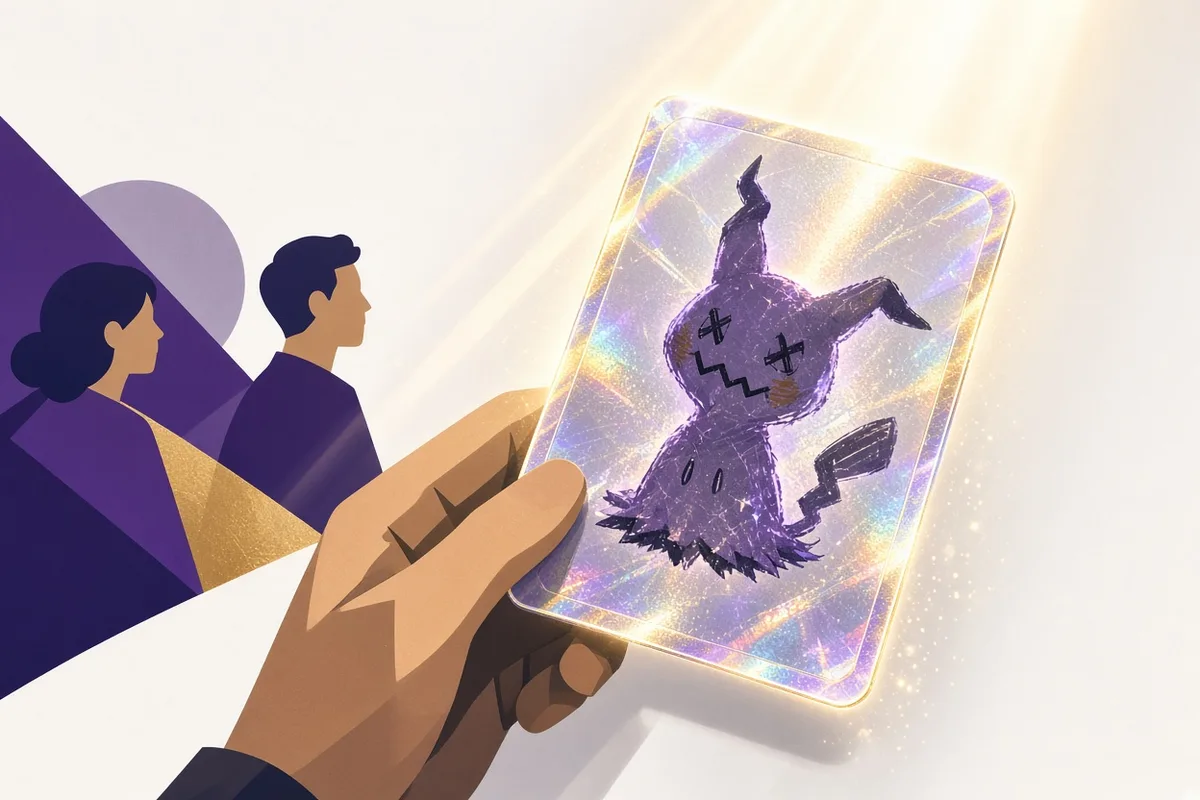
The Pokémon Trading Card Game (PTCG) was one of the first collectible card games (CCGs) in Japan. It was inspired by Magic: The Gathering. In the card game, the players use a 60-card deck featuring Basic and evolved Pokémon, Energy cards, and Trainer cards to help them knock out the opponent's Pokémon, drawing prize cards and winning the game. Cards are classified into various levels of rarity, ranging from Common to Rare Holofoil with a holographic illustration. Rare cards, including limited edition, exclusive cards, and older cards, are highly valued among collectors due to their scarcity.
According to The Pokémon Company, over 75 billion cards have been printed as of March 2025.
Anime
As of 2026, the Pokémon anime consists of over 1,300 episodes across 28 seasons. Its current season, Pokémon Horizons – Rising Hope, started airing on 11 April 2025. The anime originally focused on Ash Ketchum and his travels across the Pokémon world with his partner, Pikachu. They were retired as protagonists at the end of season 25. The 26th season, Pokémon Horizons, introduced two new protagonists, Liko and Roy. A total of 23 anime films have been released, the most recent being Pokémon the Movie: Secrets of the Jungle (2020).
Spin-off series from the anime have also been produced, including a variety show titled Weekly Pokémon Broadcasting Station (週刊ポケモン放送局, Shūkan Pokemon Hōsōkyoku), which aired on TV Tokyo from 2002 to 2004 and aired in English as part of Pokémon Chronicles. Several television specials have been released. 27 short films starring Pikachu were produced, primarily preceding the films. Various animated mini-series also exist.
Live-action
Detective Pikachu, a live-action/animated film based on the video game of the same name, was released in 2019. A sequel was announced even before the original premiered, but as of 2026, its status is unknown.
A live-action television drama, Poketto ni Bōken o Tsumekonde ("A Pocketful of Adventures"), premiered on TV Tokyo on 20 October 2023.
Reaction to Pokémania
In 1999 and 2000, Pokémon was an unprecedented, ubiquitous fad in the Western world. Time magazine described it as "a multimedia and interactive barrage like no other before it". The franchise, primarily aimed at children, elicited mixed responses from parents and teachers, some of them critical. In a 2004 essay, anthropologist Christine R. Yano even claimed that the reactions at one point constituted a moral panic.
The bulk of the criticism on Pokémon was directed at the trading cards, in particular the booster packs, sealed packages of 11 randomly inserted cards that were sold separately from the main sets. The cards are of varying scarcity, the most valuable being the "holofoil cards" (also called "holographic" or "foil cards"), in which the illustrations of the Pokémon have a shiny overlay effect. The rare cards can only be found in booster packs, and the rarest ones are very infrequently included. Joseph Tobin noted that rarity in this case is "artificially created", and "effectively a form of gambling" in which children need to repeatedly purchase booster packs to get more rare cards. Gilles Brougère described a cynicism among adults that corporations could apparently, "out of thin air", ascribe value to cards which they saw as valueless, thereby "deceiving vulnerable young consumers and garnering excessive profits".
As the franchise's popularity grew, children began taking their Pokémon cards to school for trading and playing. Soon, the cards were alleged to be "disrupting learning, poisoning playground friendships and causing such distraction that some children forget their homework, tune out in class and even miss school buses as they scramble to acquire one more card". The cards were "turning the playground into a black market", with card swaps sometimes inciting conflicts. Certain children engaged in "aggressive trading", tricking other (often younger) kids into unfair deals, forcing teachers to arbitrate. Some parents expressed their concerns about the craze, but feared that their children would be ostracized if they were to deny them Pokémon products. In the US, the Pokémon cards ended up "almost universally banned" from school grounds. Similar bans occurred in Canada, Australia, New Zealand, and European countries. In September 1999, US-based law firm Milberg filed a class-action lawsuit, claiming that the booster packs constitute a form of lottery and promote gambling in kids. The suit is believed to have been settled.
The Pokémon anime series was criticized by some as "cheap Japanese animation" that is "violent" and has "little educational value". Michelle Orecklin of Time dismissed the TV series as "less a cartoon than a half-hour exercise in Pokémon product placement". Anne Allison wrote that even those within Pokémon's US marketing team agreed that the anime's visuals were "not especially sophisticated" compared to Disney cartoons. Pokémon: The First Movie premiered in the United States on 12 November 1999, and in European countries in February 2000. While a huge box-office success, the film was received negatively by several Western film critics. The Guardian decried it as a "contemptuously cheap animated cash-in on the monster kids' craze". The American adult animated series South Park satirized Pokémon in the episode "Chinpokomon", aired on 3 November 1999. In the episode, the titular media franchise is portrayed as a low-quality line of products that is part of an evil plan by the Japanese government to invade the US. South Park co-creator Matt Stone commented that, at the time, Pokémon was "scary huge".
Legacy and influences
After World War II, Japan experienced a period of unprecedented growth and became well-known in the Western world for its consumer products, such as radios (e.g. Panasonic, Toshiba), cars (e.g. Toyota, Mitsubishi), and Sony's Walkman. From 1991 onwards, its economy stagnated, causing the country to lose its status as an economic superpower. However, during the 1990s and 2000s, Japan re-emerged as a source of 'cool' cultural goods, embraced by a growing international audience interested in Japanese culture. Nintendo, Sega, and Sony launched several popular video game consoles and franchises. In terms of children's properties, the success of Mighty Morphin Power Rangers changed perceptions on the viability of such Japanese imports in the West. The Tamagotchi fad (1997–98), centered around a portable digital pet device, was said to have "paved the way for Pokémon".
Anne Allison wrote that, before the 1990s, Japan figured little in the face of the worldwide hegemony of Euro-American cultural industries, in particular that of the US. "Hollywood has been hostile to imports", she wrote, "and foreignness has largely been, and been seen as, an impediment to mass popularization in the United States". The surprise success of Pokémon was "an undeniable breakthrough in the homeland of Disney" that "changed preexisting assumptions about the US marketplace at the same time that it was constantly resisted for deviating from them". Pokémon was a welcomed boon to Japan's faltering economy, and positively influenced the country's soft power. Sociologist Yoshinori Kamo interviewed various American children and found that kids who thought Pokémon was cool were more likely to believe that Japan was a cool nation. Anne Allison gave a similar finding: all the children she interviewed knew where Pokémon originated, and "many said that, as a result of Pokémon and other 'cool' Japanese goods, they had developed an interest in Japan". Some "said that they now wanted to study Japanese and travel there one day". Author Chris Kohler wrote: "Japanese are proud of Pokémon, the most successful export of Japanese popular culture ever". However, sociologist Koichi Iwabuchi questioned to what extent Pokémon really is 'Japanese', and to what extent it is simply a good property with universal appeal. He noted that Japanese nationalist commentators celebrated Pokémon's global success and retrospectively attributed this to its "Japanese cultural power", while ignoring the localization of Pokémon overseas, as well as decades of increasing cooperation and cultural exchange between countries (globalization).
In the 20th century, anime found niche popularity in North America and Europe in series (Astro Boy, Kimba the White Lion, Speed Racer) and films (Akira, Ghost in the Shell). The Pokémon TV series and films marked a breakthrough for anime, contributing to its growing worldwide success at the turn of the 21st century. For some children, Pokémon was their introduction to 'Japanimation', serving as a "gateway" to other anime, manga, and Japanese culture in general. Pokémon: The First Movie became one of the most successful Japanese animated films in history. After Princess Mononoke, Pokémon: The First Movie became the second anime film to open at mainstream cinemas in the West, as opposed to the usual art house venues. Pioneering anime importer John Ledford noted that Pokémon underscored the commercial potential of anime, thus making it interesting from a business perspective.


