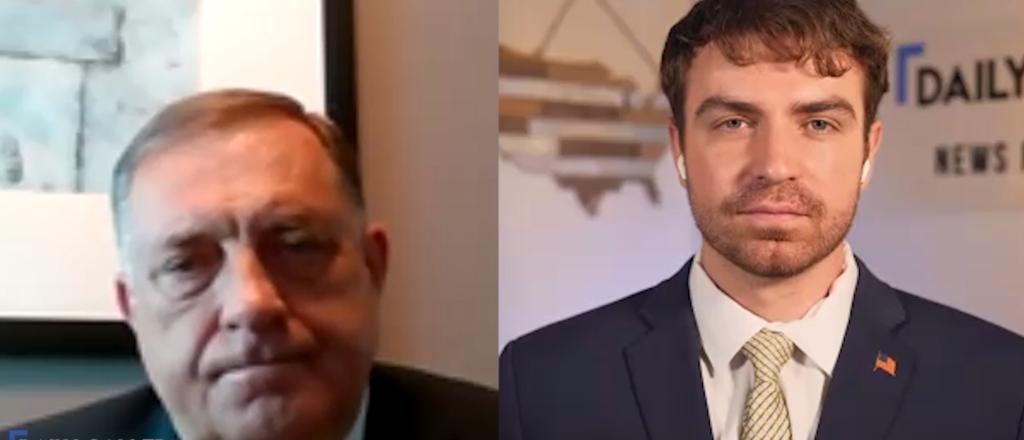
Milorad Dodik (Serbian Cyrillic: Милорад Додик, pronounced [mîloraːd dǒdik]; born 12 March 1959) is a Bosnian Serb politician who served as the 8th President of Republika Srpska from 2022 until his removal from office in 2025. Having previously held the office from 2010 to 2018, he also served as the 7th Serb member of the Presidency of Bosnia and Herzegovina from 2018 to 2022.
Dodik has been the president of the Alliance of Independent Social Democrats (SNSD) since its formation in 1996 and has held several political offices within Republika Srpska, the Serb-majority entity of Bosnia and Herzegovina. He served as the prime minister of Republika Srpska from 1998 to 2001 and again from 2006 to 2010.
In February 2025, the Court of Bosnia and Herzegovina sentenced Dodik to one year's imprisonment and forbade him from political activity for six years due to defying decisions by the High Representative. The verdict was confirmed in August 2025. The one-year prison sentence was subsequently commuted to a fine. On 18 August, Dodik's appeal was rejected and his mandate as president was officially terminated, with the termination date marked as 12 June 2025. The National Assembly of Republika Srpska initially disputed this decision, but ultimately accepted it in October 2025.
Initially, both Dodik and the SNSD were viewed as moderate and reformist alternatives to the ultranationalist Serb Democratic Party during the 1990s and early 2000s. However, since then, both Dodik and the SNSD have adopted a more Serbian nationalist and separatist stance, advocating for the right of Bosnian Serbs to self-determination. His tenure has been marked by accusations of authoritarianism from his critics, the undermining of federal Bosnian institutions, and closer ties with both Russia and Serbia.
Contents
Early life and education
Dodik was born in Banja Luka to Bogoljub and Mira Dodik. He lived in Laktaši, where he attended elementary school. There, he played on the town's basketball team in Yugoslavia's amateur league. In 1978, he graduated from an agricultural high school in Banja Luka, after which he entered the Faculty of Political Sciences at the University of Belgrade, where he graduated in 1983.
Early political career
From 1986 through 1990, Dodik was the chairman of the executive board of the Municipal Assembly of Laktaši. In 1990, at the first multi-party elections in Bosnia and Herzegovina, he was elected to the Assembly of the Socialist Republic of Bosnia and Herzegovina, as a candidate of the Union of Reform Forces of Yugoslavia and was a political disciple of liberal reformer Ante Marković. During the Bosnian War, Dodik served as a representative in the National Assembly of Republika Srpska.
During that time, he formed the Independent Members of Parliament Caucus (Клуб независних посланика у Народној Скупштини Републике Српске, Klub nezavisnih poslanika u Narodnoj Skupštini Republike Srpske), which was the only political opposition to the Serb Democratic Party (Српска демократска странка, Srpska demokratska stranka) and its allies, which held the absolute majority in the wartime parliament of the Republika Srpska. The caucus he chaired was to form the core of the Party of Independent Social Democrats (Stranka nezavisnih socijaldemokrata, or SNSD) in 1996, after the peace was signed as a result of the Dayton Agreement. He was elected as the first President of SNSD. The party later united with another social-democratic party to form the Alliance of Independent Social Democrats, of which Dodik is president.
Prime Minister of Republika Srpska
First term (1998–2001)
After conflicts between Biljana Plavšić with the rest of Radovan Karadžić's Serb Democratic Party (SDS), she founded a new political party, the Serb National Alliance (SNS). Early elections in Republika Srpska were held in 1997, after which Plavšić and her SNS closely cooperated with the smaller Serb socialist parties (Socialist Party and Dodik's SNSD). Dodik was nominated Prime Minister of Republika Srpska, even though his party had only two seats in the National Assembly.
Second term (2006–2010)
During the campaign for the 2006 general election, following Montenegrin independence, Dodik said that Republika Srpska didn't rule out its right to an independence referendum. At the election, Dodik's SNSD won 46.9% percent of votes, while the SDS won 19.5%. The international community saw him as a moderate democratic leader of Republika Srpska. Dodik had support from Western countries that were seeking to marginalise the Serbian nationalists. They believed that they had found an alternative in Dodik. After he became the prime minister, the West continued to support him at the expense of Serb nationalist parties. The Western countries promised that, if Dodik remains the prime minister, Republika Srpska would receive Western economic assistance. The High Representative for Bosnia and Herzegovina and the Western powers also wanted to ensure that he realised his promise to return 70,000 Croat and Bosniak refugees to Republika Srpska.
As promised, after Dodik won the election, Republika Srpska received financial aid from the European Union, that money was used to pay salaries for civil servants and the police. In mid-February 2007, Dodik travelled to the United States, where he was received by Madeleine Albright. She described him as "a breath of fresh air" and pledged €3.6 million of immediate aid. Republika Srpska also received aid from the British government in the same month. British Foreign Secretary, Robin Cook, said in front of the National Assembly of Republika Srpska that Dodik's government "did more in its first two weeks to improve the lives of the people than its predecessor did in two years."
Later, Dodik became the most powerful Serb politician in Bosnia and Herzegovina, and the West viewed him as "an unabashed nationalist and the greatest threat to Bosnia and Herzegovina's fragile, multiethnic peace." After he became a prime minister, Dodik became even more nationalist than the SDS. During a police reform in Republika Srpska, Dodik managed to create a nationalist profile for himself. Haris Silajdžić, meanwhile, won election for Bosniak member of the Presidency of Bosnia and Herzegovina. As he was a minister during the Bosnian War and close associate of Alija Izetbegović, Silajdžić criticised Republika Srpska as a genocidal entity and called for its abolition. Moreover, Silajdžić advocated further centralisation of Bosnia and Herzegovina.
On 5 May 2008, Dodik and Serbian President Boris Tadić inaugurated the Park Republika Srpska in Belgrade.
Presidency (2018–2022)
2018 general election
Dodik announced his candidacy in the Bosnian general election on 26 December 2017, running for Bosnia's three-person Presidency member, representing the Serbs.
At the general election held on 7 October 2018, Dodik was elected to the Presidency, having obtained 53.88% of the vote. The incumbent Bosnian Serb presidency member Mladen Ivanić, was second with 42.74%.
Domestic policy
During the first month of his presidency, quarrels transpired between Dodik and Bosniak member Šefik Džaferović, with the former stating he would not attend the first Presidency session under the new leadership until the flag of Republika Srpska was put in his office. Dodik eventually relented, agreeing to hold the session with only the national flag.
In March 2019, Dodik appointed acclaimed filmmaker Emir Kusturica as his advisor.
On 28 January 2021, the Central Election Commission of Bosnia and Herzegovina reported Dodik to the Prosecutor's Office of Bosnia and Herzegovina for spreading national hatred. He was reported for verbally insulting Central Election Commission member Vanja Bjelica-Prutina for deciding to repeat the 2020 Bosnian municipal elections in the cities of Doboj and Srebrenica, where Dodik's party had won, because of electoral irregularities.
In May 2021, Džaferović and Croat Presidency member Željko Komšić attended a joint military exercise with the United States Army, while Dodik refused.
On 5 January 2022, the United States Office of Foreign Assets Control imposed sanctions on Dodik under Executive Order 14033 ('Blocking Property and Suspending Entry Into the United States of Certain Persons Contributing to the Destabilising Situation in the Western Balkans'). In making the announcement, Under Secretary of the Treasury for Terrorism and Financial Intelligence Brian E. Nelson said that "Milorad Dodik's destabilizing corrupt activities and attempts to dismantle the Dayton Peace Accords, motivated by his own self-interest, threaten the stability of Bosnia and Herzegovina and the entire region". On 11 April 2022, Dodik and Željka Cvijanović, the president of Republika Srpska, were sanctioned by the United Kingdom for attempting to undermine the legitimacy of Bosnia and Herzegovina, with British Foreign Secretary Liz Truss stating that Dodik and Cvijanović "are deliberately undermining the hard-won peace in Bosnia and Herzegovina. Encouraged by Putin, their reckless behaviour threatens stability and security across the Western Balkans."
On 16 November 2022, Dodik was succeeded by Željka Cvijanović as the Serb member of the Presidency.
Foreign policy
In May 2021, during a flareup in the Israeli–Palestinian conflict, Dodik was thanked by Israeli Prime Minister Benjamin Netanyahu for expressing his support for Israel, unlike his presidency counterparts who expressed their support for Palestine.
In June 2021, Dodik signed the SEECP Declaration in Antalya, Turkey, which among other things, incorporates talks about NATO integration.
On 6 November 2021, he met with Hungarian Prime Minister Viktor Orbán in Banja Luka, in the process thanking him "for the understanding that Hungary has for Republika Srpska." Orbán said that "Republika Srpska is key to peace in the Balkans" and that Hungary will "expand its economic program with Republika Srpska."
On 2 December 2021, Dodik had a meeting with Russian president Vladimir Putin in Moscow, with Dodik stating, "He [Putin] is familiar with the details of the situation in Bosnia and Herzegovina." Following Russia recognizing the Donetsk People's Republic and the Luhansk People's Republic as independent states on 21 February 2022, which are disputed territories in the Ukrainian region of Donbas, Dodik said that Republika Srpska will seek neutrality at the national level regarding the issue of Ukraine. On 24 February, Putin ordered a large-scale invasion of Ukraine, marking a dramatic escalation of the Russo-Ukrainian War that began in 2014. Regarding the invasion, Dodik said that Bosnia and Herzegovina was neutral, having stated the previous day that the "events showed it was a good decision for Bosnia and Herzegovina to not enter NATO, and that the country would not support sanctions."
Originally a big advocate and supporter of the European Union, Dodik has gradually become much more Eurosceptic and critical about the EU.
In September 2020, Dodik and his fellow Presidency members said that an EU candidate status for Bosnia and Herzegovina was possible in the year 2021 if the country "implements successful reforms."
In September 2021, Dodik went to Budapest, Hungary to attend its Demographic Summit. There he met with Slovenian prime minister Janez Janša on 22 September. On 23 September, Dodik made a speech at the summit, where he criticized the European Union, LGBT community and the handling of the previous European migrant crisis. Apart from Dodik and Janša, the summit was also attended by Hungarian prime minister Viktor Orbán, Serbian president Aleksandar Vučić, Czech prime minister Andrej Babiš, Polish prime minister Mateusz Morawiecki and former U.S. vice president Mike Pence, as well as 2022 French presidential election candidate Éric Zemmour.
President of Republika Srpska
First and second term (2010–2018)
In October 2010, Dodik narrowly won the RS presidential election already in the first round, thus becoming the 8th president of the republic.
On 30 November 2010, leaked United States diplomatic cables revealed that Dodik supported the Ahtisaari plan for the independence of Kosovo. The cable was sent by Daniel Fried, a U.S. State Department official, in May 2007 and quoted Dodik as stating that "Kosovo's recognition would follow after such a decision (to adopt the plan) by the UN Security Council". Dodik denied the accusations and stated that Daniel Fried was a liar and a troublemaker.
In May 2011, Dodik planned to have a referendum held in June that he viewed would reflect on the rejection of Bosnian state institutions, including the war crimes court. The High Representative for Bosnia and Herzegovina, Valentin Inzko, warned that the referendum could potentially jeopardize the Dayton Agreement. However, shortly after tensions increased in regards to the proposed referendum, Republika Srpska decided to cancel the referendum, after Dame Catherine Ashton, the EU's High Representative of the Union for Foreign Affairs and Security Policy reassured Dodik in Banja Luka that the EU will examine the complaints of RS on abuses in justice system of Bosnia and Herzegovina, and recommend the changes.
On 25 October 2011, Dodik spoke on "An American Foreign Policy Success Story: The Dayton Accords, Republika Srpska and Bosnia's European Integration" at Columbia University. The event was protested by numerous organizations including the Congress of North American Bosniaks, the Advisory Council for Bosnia and Herzegovina, the Canadian Institute for the Research of Genocide, the Bosnian American Genocide Institute and Education Center, and the International Center for Transitional Justice. Protests also took place while the speech was in progress.
In October 2012, Dodik proposed that Bosnia and Herzegovina's unified armed forces be abolished. On 3 November 2012, Dodik announced that the government of Republika Srpska would donate an undisclosed amount to help pay for the renovation of Serbian Orthodox Patriarch Irinej's old residence in Belgrade. Irinej commented that "this is a great opportunity to show practically the unity of the Serbian people and Serbian church outside our borders." Serb bloggers expressed "disagreement with both at a time of severe economic crisis and hardship" followed.
Third term (2022–2025)
On 1 July 2022, Dodik announced his candidacy in the Republika Srpska general election, running for a third time as president of Republika Srpska.
Following the release of the preliminary results in the Republika Srpska election, opposition parties filed accusations of electoral fraud directly against Dodik, who they claimed had coordinated stuffing ballot boxes with thousands of illegal votes to put the Alliance of Independent Social Democrats (SNSD) ahead in the polls and that Jelena Trivić of the Party of Democratic Progress was the true winner of the Republika Srpska presidential election. As a result of the allegations, the Central Election Commission began a recount the ballots. When the Election Commission verified the preliminary results, they did not verify the Republika Srpska elections. However, on 27 October, officials confirmed Dodik's victory. The commission noted that while there were irregularities, none were on a level that would have changed the outcome of the election.
Dodik was sworn in as president on 15 November 2022 in the National Assembly of Republika Srpska, succeeding Željka Cvijanović.
On 23 November, Dodik asked the incumbent prime minister, Radovan Višković, to form a new Republika Srpska government. On 21 December 2022, the NSRS confirmed the appointment of Višković's cabinet.
On 8 January 2023, Dodik awarded Russian President Vladimir Putin in absentia with the entity's highest decoration, the Order of the Republika Srpska.
In March 2023, violence occurred in Banja Luka over a planned LGBT event and several human rights activists were assaulted by a few dozen men. Also in March, The United States Secretary of State Antony Blinken said that "Dodik's attacks on basic rights and freedoms in Republika Srpska show he is on President Putin's authoritarian path" and that the "State Department continues to advocate for the democratic and prosperous future that all citizens of Bosnia and Herzegovina deserve."
On 27 June 2023, the NSRS voted to suspend rulings by the Constitutional Court of Bosnia and Herzegovina and to stop publishing the High Representative's decrees and laws in the official gazette. Following this decision, High Representative Christian Schmidt annulled the two laws which the Assembly had adopted, citing that the decisions "directly violate the constitutional order of Bosnia and Herzegovina and the Dayton Peace Agreement."
Post-presidency (2025–present)
Dodik has remained the most powerful politician in Republika Srpska since the termination of his mandate. He retained leadership of the Alliance of Independent Social Democrats, and has undertaken international trips representing Republika Srpska in an unofficial capacity. In February 2026, Siniša Karan, a Dodik ally, won in the early presidential elections in Republika Srpska. Dodik's sponsorship of Prime Minister Savo Minić has been the cause of repeated controversies regarding his ability to serve in the office.
In the United States, he has solicited investment to Republika Srpska, particularly through infrastructure construction. In April 2026, Donald Trump Jr. visited Banja Luka as a guest of Dodik's son Igor. Dodik hired former U.S. national security advisor Michael Flynn as a lobbyist, and Flynn visited Banja Luka in March and May 2026.
On 5 February 2026, Dodik attended the National Prayer Breakfast in Washington, D.C. with Ana Trišić-Babić and Željka Cvijanović. On 1 May 2026, he was awarded a Leadership and Standing Up for Democracy Award by Judson University, a Baptist institution in Elgin, Illinois. His presence in Illinois caused protests by the local Bosniak community, but was defended by the University and former Illinois governor Rod Blagojevich, who spoke on a panel with him at Judson. After receiving the award, Dodik toured Serbian communities and churches in the Midwest.
Views
Opinions on Tuzla and Markale
In 2009, Dodik stated that the Tuzla massacre was staged and questioned the Markale massacres in Sarajevo. The city of Tuzla filed charges against Dodik over these statements. The city of Sarajevo filed criminal charges against Dodik for abuse of power and inciting ethnic, racial and religious hatred.
The Office of the High Representative said Dodik denied the war crimes committed and stated that "When such skewed facts come from an official in a position of high responsibility, an official who is obliged to uphold the Dayton Peace Accords and cooperate with the Hague Tribunal, then they are particularly irresponsible and undermine not only the institutions responsible for upholding the rule of law, but the credibility of the individual himself".
Genocide and Srebrenica massacre denial
Dodik has described the Srebrenica massacre as a "fabricated myth".
He stated in an interview with the Belgrade newspaper Večernje novosti in April 2010 that "we cannot and will never accept qualifying that event as a genocide", and disowned the 2004 Republika Srpska report which had acknowledged the scale of the killing and had apologised to the relatives of the victims, claiming that the report had been adopted because of pressure from the international community. Without substantiating the figure, he argued that the number of victims was 3,500 rather than the 7,000 accepted by the report, alleging that 500 listed victims were alive and that over 250 people buried in the Srebrenica Genocide Memorial in Potočari had died elsewhere. During the same month, on 10 April 2010, Dodik initiated a revision of the 2004 report saying that the numbers of killed were exaggerated and the report was manipulated by a former peace envoy. The Office of the High Representative responded and stated that: "The Republika Srpska government should reconsider its conclusions and align itself with the facts and legal requirements and act accordingly, rather than inflicting emotional distress on the survivors, torture history and denigrate the public image of the country".
On 12 July 2010, at the 15th anniversary of the Srebrenica massacre, Dodik declared that he acknowledged the killings that happened on the site, but did not regard what happened at Srebrenica as genocide, differing from the conclusions of the ICTY and of the International Court of Justice, stating that, "(i)f a genocide happened then it was committed against Serb people of this region where women, children and the elderly were killed en masse," referring to eastern Bosnia. In December 2010, Dodik condemned the Peace Implementation Council (PIC), an international community of 55 countries, for referring to the Srebrenica massacre as genocide. He used a variety of claims, espoused by other deniers and conspiracy theorists, such as that Srebrenica was, in fact, revenge for the 1993 Kravica attack and other Bosnian Muslim crimes against Serbs, confirmed or alleged.
In 2017, Dodik introduced legislation, effectively banning the teaching of the Srebrenica genocide and Sarajevo siege in Republika Srpska's schools, stating that it was "impossible to use here the textbooks ... which say the Serbs have committed genocide and kept Sarajevo under siege. This is not correct and this will not be taught here".
Radovan Karadžić and Ratko Mladić
In March 2016, a student dormitory in Pale was named in honour of the wartime Serb leader Radovan Karadžić. Dodik supported this act. The event took place only a few days before Karadžić was convicted for war crimes by the ICTY.
In December 2020, the plaque honouring Karadžić had to be removed after High Representative Inzko, with the help of Karadžić's daughter Sonja Karadžić-Jovičević, publicly called for its removal.
In February 2024, Dodik stated, "You mustn't forget Radovan Karadžić or Ratko Mladić. These are the people who, at a difficult moment, took the lead of this nation... and we are ready to give up our historical greatness just because someone said that they committed a crime," Dodik said in front of the gathered crowd. He claims that during the trial in The Hague, Karadžić was not proven to have committed a single crime and that he was found guilty "because he stood up for freedom." "What was done to them is a pure historical hoax... They made everything up," said Dodik. He added that his desire is to see the establishment of a "great Russia".
Personal life
Milorad is married to Snježana Dodik, with whom he has two children. His nephew is Bosnian Serb businessman and football administrator Vico Zeljković.
In December 2024, Dodik had surgery in Belgrade to address problems with his oesophagus and stomach.
Honours
Order of the Republic of Serbia
Order of the Republika Srpska
Order of Friendship
Order of Peter the Great with Sash – awarded by the National Committee for Social Awards of the Russian Federation for extraordinary contribution to enhancement of the Russian – Serbian cooperation
Order of the Nemanjić dynasty
Order of St. Sava
Order of Saint Simeon the Myrrh-streaming
Order of the Saint bishop Nikolaj
Order of the Holy Priest-Martyr Peter, Metropolitan of Sarajevo and Dabar-Bosnia, golden (2023)
Order of Alexander Nevsky
Holy Cross of the Holy Sepulchre Guardians, awarded by Greek Orthodox Patriarch of Jerusalem
Award of the International Foundation for the Unity of Orthodox Christian Nations
Jabotinsky Award for Liberty, Israel
Honorary awards
Honorary president of KK Partizan
Honorary citizen of Drvar
Honorary citizen of Gradiška
Honorary citizen of Trebinje
Honorary citizen of Prijedor