
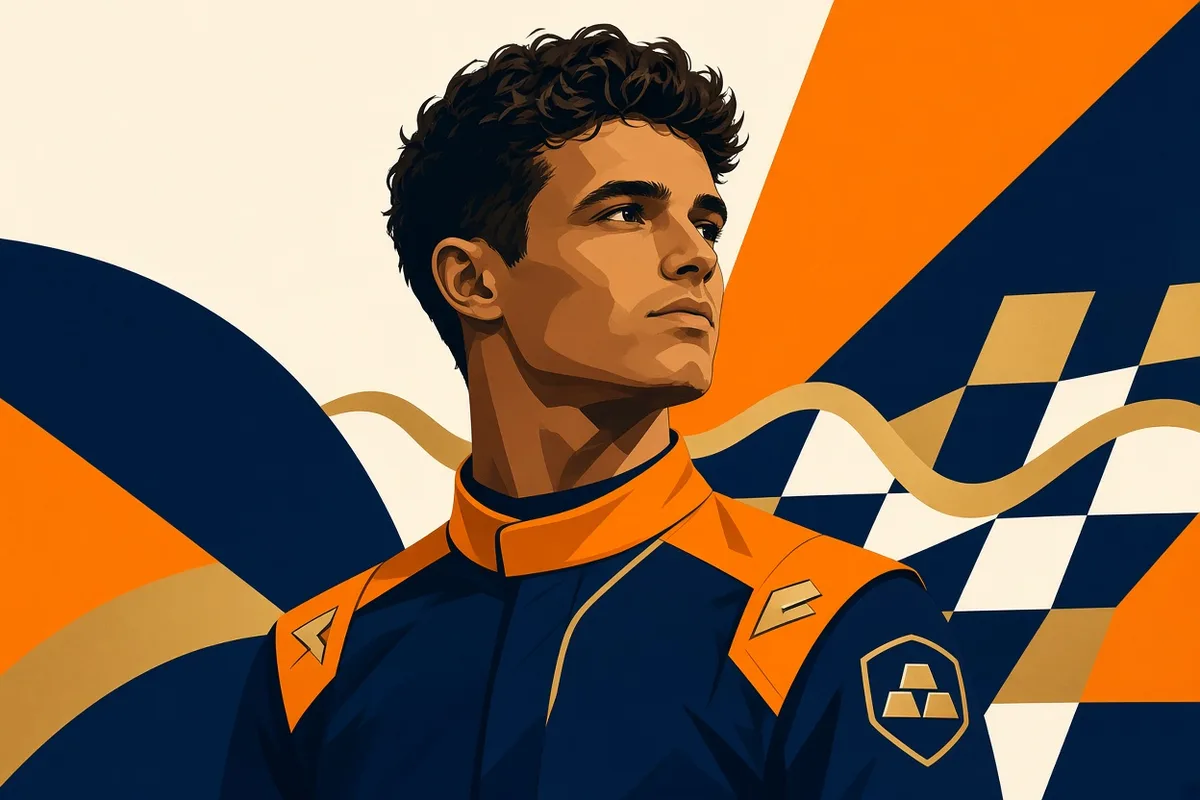
McLaren Racing Limited ( mə-KLARR-ən), currently competing in Formula One as McLaren Mastercard F1 Team, is a British motor racing team based at the McLaren Technology Centre in Woking, Surrey, England. The team is a subsidiary of the McLaren Group, wholly owned by Mumtalakat Holding Company.
McLaren is best known as a Formula One chassis constructor, the second-oldest active team and the second-most successful Formula One team after Ferrari, having won 205 races, 13 Drivers' Championships, and 10 Constructors' Championships. McLaren is one of only three constructors, and the only team, to complete the Triple Crown of Motorsport (wins at the Indianapolis 500, 24 Hours of Le Mans, and Monaco Grand Prix). The 2026 Chinese Grand Prix marked McLaren's 1000th Grand Prix entry, making them the second constructor after Ferrari to reach this milestone. The team currently uses Mercedes power. Its partnership with Honda from 1988 to 1991 produced four consecutive Constructors' Championships; the team won 15 of 16 races in 1988.
Founded by Bruce McLaren in 1963, the team made its Grand Prix debut at the 1966 Monaco Grand Prix, won its first Grand Prix at the 1968 Belgian Grand Prix, and took its first Formula One championships in 1974. Emerson Fittipaldi, James Hunt, Niki Lauda, Alain Prost, Ayrton Senna, Mika Häkkinen, Lewis Hamilton, and Lando Norris have won Drivers' Championships with McLaren. Champions Denny Hulme, Jody Scheckter, Keke Rosberg, Fernando Alonso, Kimi Räikkönen, and Jenson Button also drove for the team at one point during their careers. The team's most recent titles were secured in 2025.
McLaren also has a history in sports car and endurance racing, with a modified McLaren F1 road car winning the 24 Hours of Le Mans in 1995. The team is set to reenter the FIA World Endurance Championship in 2027 with an LMDh entry, the McLaren MCL-HY. The team has also had experience in American open wheel racing as both an entrant and a chassis constructor, and has won the Canadian-American Challenge Cup (Can-Am) sports car racing championship. Their current IndyCar entry, Arrow McLaren, has won 10 races since its takeover of Sam Schmidt Motorsports in 2020. McLaren has previously entered the electric motorsports Formula E and Extreme E, though they achieved less success there than their other ventures and ended up pulling out of both. McLaren also participates in Formula One esports, in which they won the 2022 championship.
Contents
Background
Bruce McLaren Motor Racing was founded in 1963 by New Zealander Bruce McLaren. Bruce was a works driver for the British Formula One team Cooper with whom he had won three Grands Prix and come second in the 1960 World Championship. Wanting to compete in the Australasian Tasman Series, Bruce approached his employers, but when team owner Charles Cooper insisted on using 1.5-litre Formula One-specification engines instead of the 2.5-litre motors permitted by the Tasman rules, Bruce decided to set up his own team to run him and his prospective Formula One teammate Timmy Mayer with custom-built Cooper cars.
Bruce won the 1964 series, but Mayer was killed in practice for the final race at the Longford Circuit in Tasmania. When Bruce McLaren approached Teddy Mayer to help him with the purchase of the Zerex sports car from Roger Penske, Teddy Mayer and Bruce McLaren began discussing a business partnership resulting in Teddy Mayer buying in to Bruce McLaren Motor Racing Limited (BMMR) and ultimately becoming its largest shareholder.
The team, competing under a British racing licence, was based in Feltham, England from 1963 to 1964, and in Colnbrook, England from 1965 until 1981, and it has been based in Woking, England since 1981. Despite this, Bruce never used the traditional British racing green on his cars. Instead, he used colour schemes that were not based on national principles (e.g. his first Formula One car, the McLaren M2B car, raced at the 1966 Monaco Grand Prix, was painted white with a green stripe, to represent a fictional Yamura team in John Frankenheimer's film Grand Prix).
During this period, Bruce drove for his team in sports car races in the United Kingdom and North America and also entered the 1965 Tasman Series with Phil Hill, but did not win it. He continued to drive in Grands Prix for Cooper, but judging that team's form to be waning, decided to race his own cars in 1966.
Racing history: Formula One
Overview
The team began life as a Formula One constructor in 1963 by Bruce McLaren. The team's maiden Grand Prix victory was at the 1968 Belgian Grand Prix. After Bruce McLaren died in a testing accident in 1970, Teddy Mayer took over and led the team to their first Formula One Constructors' Championship in 1974, with Emerson Fittipaldi and James Hunt winning the Drivers' Championship in 1974 and 1976 respectively. The year 1974 also marked the start of a long-standing sponsorship by the Marlboro cigarette brand.
In 1981, McLaren merged with Ron Dennis' Project Four Racing; Dennis took over as team principal, and shortly afterwards organised a buyout of the original McLaren shareholders to take full control of the team. This began the team's most successful era; with Porsche and Honda engines, Niki Lauda, Alain Prost, and Ayrton Senna won seven Drivers' Championships between them and the team took six Constructors' Championships. The combination of Prost and Senna was particularly dominant – together they won all but one race in 1988 – but later their rivalry soured and Prost left for Ferrari. Fellow English team Williams offered the most consistent challenge during this period, the two winning every constructors' title between 1984 and 1994. By the mid-1990s, Honda had withdrawn from Formula One, Senna had moved to Williams, and the team went three seasons without a win. With Mercedes-Benz engines, West sponsorship, and former Williams designer Adrian Newey, further championships came in 1998 and 1999 with driver Mika Häkkinen, and during the 2000s the team were consistent front-runners, with Lewis Hamilton winning the 2008 drivers' title.
Ron Dennis retired as McLaren team principal in 2009, handing over to long-time McLaren employee Martin Whitmarsh. At the end of 2013, after the team's worst season since 2004, Whitmarsh was ousted. McLaren announced in 2013 that they would be using Honda engines from 2015 onwards, replacing Mercedes-Benz. The team raced as McLaren Honda for the first time since 1992 at the 2015 Australian Grand Prix. The second Honda partnership did not yield good results, and in September 2017, McLaren announced they had agreed on an engine supply with Renault from 2018 to 2020. McLaren returned to using Mercedes-Benz engines from the 2021 season, with a deal in place until at least 2030. After a period of time in the midfield, McLaren surged to fourth in the Constructors' Championship in 2023 after having started that year on the back foot. They would go on to win their ninth Constructors' Championship, and first since 1998, in 2024. The following year, Lando Norris took the team's most recent drivers' title, and first since 2008, and secured their tenth Constructors' Championship title and their second consecutive title; the first time this had happened since 1991. This result made McLaren the second-most successful Formula One team of all time in terms of Constructors' Championships won.
1966–1968: Early beginnings
Bruce McLaren made the team's Grand Prix debut at the 1966 Monaco Grand Prix (of the current Formula One teams, only Ferrari is older). His race ended after nine laps due to a terminal oil leak. The 1966 car was the M2B designed by Robin Herd, but the programme was hampered by a poor choice of engines: a 3.0-litre version of Ford's Indianapolis 500 engine and a Serenissima V8 were used, the latter scoring the team's first point in Britain, but both were underpowered and unreliable. For 1967 Bruce decided to use a British Racing Motors (BRM) V12 engine, but due to delays with the engine, was forced initially to use a modified Formula Two car called the M4B powered by a 2.0-litre BRM V8, later building a similar but slightly larger car called the M5A for the V12. Neither car brought great success, the best result being a fourth at Monaco.
1968–1982: Ford-Cosworth DFV engines
For 1968, after driving McLaren's sole entry for the previous two years, Bruce was joined by 1967 champion and fellow New Zealander Denny Hulme, who was already racing for McLaren in Can-Am. That year's new M7A car, Herd's final design for the team, was powered by Cosworth's new and soon to be ubiquitous DFV engine (the DFV would go on to be used by McLaren until 1983) and with it a major upturn in form proceeded. Bruce won the Race of Champions at the Brands Hatch circuit and Hulme won the International Trophy at Silverstone, both non-championship races, before Bruce took the team's first championship win at the Belgian Grand Prix. Hulme also won the Italian and Canadian Grands Prix later in the year, helping the team to second in the Constructors' Championship. Using an updated 'C' version on the M7, a further three podium finishes followed for Bruce in 1969, but the team's fifth win had to wait until the last race of the 1969 championship when Hulme won the Mexican Grand Prix. That year, McLaren experimented with four-wheel drive in the M9A, but the car had only a single outing driven by Derek Bell at the British Grand Prix; Bruce described driving it as like "trying to write your signature with somebody jogging your elbow".
The year 1970 started with a second-place each for Hulme and Bruce in the first two Grands Prix, but in June, Bruce was killed in a crash at Goodwood while testing the new M8D Can-Am car. After his death, Teddy Mayer took over effective control of the team; Hulme continued with Dan Gurney and Peter Gethin partnering him. Gurney won the first two Can-Am events at Mosport and St. Jovite and placed ninth in the third, but left the team mid-season, and Gethin took over from there. While 1971 began promisingly when Hulme led the opening round in South Africa before retiring with broken suspension, ultimately Hulme, Gethin (who left for BRM mid-season,) and Jackie Oliver again failed to score a win. The 1972 season saw improvements though: Hulme won the team's first Grand Prix for 2+1⁄2 years in South Africa and he and Peter Revson scored ten other podiums, the team finishing third in the Constructors' Championship. McLaren gave Jody Scheckter his Formula One debut at the final race at Watkins Glen. All McLaren drivers used the Ford-Cosworth engines, except for Andrea de Adamich and Nanni Galli who used engines from Alfa Romeo in 1970.
The McLaren M23, designed by Gordon Coppuck, was the team's new car for the 1973 season. Sharing parts of the design of both McLaren's Formula One M19 and Indianapolis M16 cars (itself inspired by Lotus's 72), it was a mainstay for four years. Hulme won with it in Sweden and Revson took the only Grand Prix wins of his career in Britain and Canada. In 1974, Emerson Fittipaldi, world champion with Lotus two years earlier, joined McLaren. Hulme, in his final Formula One campaign, won the Argentinian season-opener; Fittipaldi, with wins in Brazil, Belgium and Canada, took the Drivers' Championship. It was a close fight for Fittipaldi, who secured the title with a fourth at the season-ending United States Grand Prix, putting him three points ahead of Ferrari's Clay Regazzoni. With Hulme and multiple motorcycle world champion Mike Hailwood, he also sealed McLaren's first Constructors' Championship. The year 1975 was less successful for the team: Fittipaldi was second in the championship behind Niki Lauda. Hulme's replacement Jochen Mass took his sole GP win in Spain.
1983–1992: TAG-Porsche and Honda engines
In the early 1980s, teams like Renault, Ferrari and Brabham were using 1.5-litre turbocharged engines in favour of the 3.0-litre naturally aspirated engines that had been standard since 1966. Having seen in 1982 the need for a turbo engine of their own, Dennis had convinced Williams backer Techniques d'Avant Garde (TAG) to fund Porsche-built, TAG-branded turbo engines made to Barnard's specifications; TAG's founder Mansour Ojjeh would later become a McLaren shareholder. In the meantime, they continued with Cosworth engines as old rival Lauda came out of retirement in 1982 to drive alongside Watson in that year's 1B development of the MP4. They each won two races, Watson won from 17th on the grid in Detroit, and at one stage of the season McLaren were second in the constructors' championship. As part of a dispute with FISA, they boycotted the San Marino Grand Prix. Although 1983 was not so fruitful, Watson did win again in the United States, this time from 22nd on the grid at Long Beach.
Having been fired by Renault, Prost returned to McLaren once again for 1984. Now using the TAG engines, the team dominated, scoring 12 wins and 2+1⁄2 times as many constructors' points as nearest rival Ferrari. In the Drivers' Championship, Lauda prevailed over Prost by half a point, the narrowest margin ever. The McLaren-TAGs were again strong in 1985; a third Constructors' Championship came their way while this time Prost won the Drivers' Championship. In 1986, the Williams team were resurgent with their Honda engine and drivers Nigel Mansell and Nelson Piquet, while at McLaren, Lauda's replacement, 1982 champion Keke Rosberg could not gel with the car. Williams took the Constructors' Championship, but for Prost, wins in San Marino, Monaco, and Austria combined with the fact that the Williams drivers were taking points from each other meant that he retained a chance going into the last race, the Australian Grand Prix. There, a puncture for Mansell and a precautionary pit stop for Piquet gave Prost the race win and his second title, making him the first driver to win back-to-back championships since Jack Brabham in 1959 and 1960. In 1987 Barnard departed for Ferrari to be replaced by Gordon Murray as Technical Director, with Steve Nichols (who himself joined Ferrari in 1989) remaining as Chief Designer. In the hands of Prost and Stefan Johansson, though, Nichols's MP4/3 and the TAG engine could not match the Williams-Honda.
For 1988, Honda switched their factory supply to McLaren and, encouraged by Prost, Dennis signed Ayrton Senna to drive. Despite regulations reducing the boost pressure and fuel capacity (and therefore, power) of the turbo cars, Honda persisted with a turbocharged engine. In the MP4/4, Senna and Prost engaged in a season-long battle, winning 15 of the 16 races (at the other race at Monza, Senna had been leading comfortably, but collided with back-marker Jean-Louis Schlesser). At the Portuguese Grand Prix, their relationship soured when Senna squeezed Prost against the pit wall; Prost won, but afterwards said, "It was dangerous. If he wants the world championship that badly he can have it." Prost scored more points that year, but because only the best 11 results counted, Senna took the title at the penultimate race in Japan.
1993–1994: Ford, Lamborghini and Peugeot engines
As Honda withdrew from the sport at end of 1992 following the Japanese asset price bubble in Japan, McLaren sought a new engine supplier. A deal to secure Renault engines fell through due to being vetoed by Renault's fuel and lubricant supplier Elf Aquitaine, subsequently McLaren switched to customer Ford engines for the 1993 season. Senna – who initially agreed only to a race-by-race contract before later signing for the whole year – won five races, including a record-breaking sixth victory at Monaco and a win at the European Grand Prix, where he went from fifth to first on the opening lap. His teammate, 1991 CART champion Michael Andretti, fared much worse; he scored only seven points, and was replaced by test driver Mika Häkkinen for the final three rounds of the season. Williams ultimately won both titles and Senna – who had flirted with moving there for 1993 – signed with them for the 1994 season. During the 1993 season McLaren took part in a seven part BBC Television documentary called A Season With McLaren.
McLaren tested a Lamborghini V12 engine ahead of the 1994 season, as part of a potential deal with the then-Lamborghini owner Chrysler, before eventually deciding to use full-works Peugeot engines. With Peugeot power, the MP4/9 was driven by Häkkinen and Martin Brundle, despite achieving eight podiums over the season no wins were achieved. Peugeot was dropped after a single year due to multiple engine failures/unreliability which cost McLaren potential race victories and they switched to a Mercedes-Benz-branded, Ilmor-designed engine.
1995–2014: First Mercedes partnership
For 1995 season onwards, McLaren ended their engine deal with Peugeot Sport and started an engine full-works partnership with Mercedes-Benz High Performance Engines for the first time, after the German manufacturer spent one year in partnership with the then-youngest Sauber team. The partnership included bespoke free engines from Mercedes-Benz that built, assembled and tuned by Ilmor Engineering in Brixworth, England, Mercedes-Benz official team vehicles, financial support, also earned full-factory support from Daimler AG and Mercedes-Benz and also Mercedes-Benz and Ilmor staffs would work with the team at their Woking base.
McLaren's Formula One car for the 1995 season, the MP4/10, was not a front-runner and Brundle's replacement, former champion Nigel Mansell, was unable to fit into the car at first and departed after just two races, with Mark Blundell taking his place.
While Williams dominated in 1996, McLaren, now with David Coulthard alongside Häkkinen, went a third successive season without a win. In 1997, however, Coulthard broke this run by winning the season-opening Australian Grand Prix; Häkkinen and he would each win another race before the end of the season, and highly rated designer Adrian Newey joined the team from Williams in August that year. Despite the car's improved pace, unreliability proved costly throughout the season, with retirements at the British and Luxembourg Grands Prix occurring whilst Häkkinen was in the lead. It was also at the start of this season that saw long time sponsor, Marlboro, shift its support to long time rival Ferrari. For the first time since the 1974 season, McLaren would have a new identity, shifting to fellow tobacco sponsor West. This saw the traditional red and white replaced with silver, grey, white and red. McLaren would retain this colour scheme (or very similar) for twenty years until 2017.
With Newey able to take advantage of new technical regulations for 1998, and with Williams losing their works Renault engines following Renault's temporary withdrawal from the sport, McLaren were once again able to challenge for the championship. Häkkinen and Coulthard won five of the first six races despite the banning of the team's "brake steer" system, which allowed the rear brakes to be operated individually to reduce understeer, after a protest by Ferrari at the second race in Brazil. Schumacher and Ferrari provided the greatest competition, the former levelled on points with Häkkinen with two races to go, but wins for Häkkinen at the Luxembourg and Japanese Grands Prix gave both him the Drivers' Championship and McLaren the Constructors' Championship. Häkkinen won his second Drivers' Championship the following season, but due to a combination of driver errors and mechanical failures, the team lost the constructors' title to Ferrari.
2015–2017: Return to Honda engines
For 2015, McLaren ended their engine deal with Mercedes which included buying back the 40% stake that Mercedes held in the team and reforging their historical partnership with Honda. The Honda deal not only meant they would supply engines, but that Honda staff would work with the team at their Woking base as well as received full-factory support from Honda including official team vehicles and free engines. The team announced Fernando Alonso and Jenson Button as their race drivers, with Kevin Magnussen demoted to test driver. During pre-season testing at the Circuit de Barcelona-Catalunya in February, Alonso suffered a concussion and, as a result, Kevin Magnussen replaced him for the season-opening Australian Grand Prix in March. At that inaugural race of the season, Jenson Button finished 11th, but was lapped twice and finished last of the finishing cars. Following considerable unreliability and initial suggestions that the Honda engine was underpowered relative to its competitors, steady performance gains eventually resulted in Button managing to score the team's first (four) points of the season at the sixth round in Monaco. By contrast, Alonso scored his first point three races later at the British Grand Prix.
The Hungarian Grand Prix saw the team score their best result of the season with Alonso and Button finishing fifth and ninth, respectively. However, McLaren did not score points in the next four races until Button finished ninth at the Russian Grand Prix. At the following United States Grand Prix, Button scored his best result of the season with sixth place. The team finished ninth in the constructors' standings with 27 points, McLaren's worst performance since 1980.
McLaren retained both Alonso and Button for the 2016 season. The second year of the Honda partnership was better than the first, with the team being able to challenge for top 10 positions on a more regular basis. However, the season started with a crash at the Australian Grand Prix in which Fernando Alonso sustained rib fractures and a collapsed lung after colliding with Esteban Gutiérrez and somersaulting into the crash barriers. Alonso, as a result of his injuries, was forced to miss the second round of the Championship, the Bahrain Grand Prix, and was replaced by reserve driver Stoffel Vandoorne. Vandoorne scored the team's first point of the season with 10th place on his debut. The next points for McLaren came at the Russian Grand Prix with Alonso and Button finishing sixth and 10th respectively. The rain-affected Monaco Grand Prix was one of best races of the season for the team. Alonso finished fifth, having kept Nico Rosberg's Mercedes behind him for 46 laps, while Button scored two points with ninth. At the Austrian Grand Prix, Button recorded his best result of the season with a sixth-place after qualifying third in a wet/dry session. After the British Grand Prix at Silverstone, the team scored points at the next three rounds with six points in Hungary, four in Germany, and six points again thanks to a seventh-place finish from Alonso at the Belgian Grand Prix. At the United States Grand Prix, McLaren matched their Monaco result with 12 points after Alonso claimed fifth position while Button once again finished ninth. Alonso and Button finished the championship in 10th and 15th places respectively with the team ending the season in sixth place in the Constructors' Championship with 76 points. On 3 September 2016, Jenson Button announced he would take a sabbatical from Formula One for the 2017 season. He then confirmed on 25 November that he would retire from F1 altogether with Vandoorne being Alonso's new Teammate for 2017.
2018–2020: Customer Renault engines
McLaren announced during the 2017 Singapore Grand Prix weekend that they would split from engine supplier Honda at the end of the 2017 season and had agreed on a three-year customer deal to be supplied with Mecachrome-assembled Renault engines. Team boss Éric Boullier described their performance between 2015 and 2017 as a "proper disaster" for the team's credibility. 2018 was the first season in McLaren's history when their cars were powered by Renault engines. McLaren also announced that Fernando Alonso and Stoffel Vandoorne would remain with the team for the 2018 season. On 6 November 2017, the team announced that Lando Norris would be the team's test and reserve driver.
At the season-opening Australian Grand Prix, Fernando Alonso scored the team's best finish since the 2016 Monaco Grand Prix with fifth, Alonso said that the team's target would be Red Bull Racing. McLaren had a relatively good start to the season with points finishes in the next four races, but in the next 16 races after Spain, McLaren only scored 22 points, 8 points less than in the same period in 2017. On 14 August 2018, Fernando Alonso announced he would not compete in Formula One in 2019, ending his four-year spell at the team. Carlos Sainz Jr. was signed as his replacement on a multi-year deal. On 3 September 2018, it was announced that Stoffel Vandoorne would be leaving the team at the end of the season, with Lando Norris being promoted from reserve driver to replace him in 2019. McLaren struggled with performance throughout the season, with the McLaren drivers being knocked out 21 times in the first qualifying session, and McLaren having the second-worst average qualifying ranking of any team, only ahead of Williams. The team finished the season – after being helped by the exclusion of Force India's points from the first 12 races – in 6th place with 62 points, 357 points behind their target, Red Bull Racing, with the same engine.
In the 2019 season, McLaren established themselves as the fourth-fastest constructor, behind Mercedes, Ferrari, and Red Bull. At the Brazilian Grand Prix, Sainz recorded the team's first podium since the 2014 Australian Grand Prix, finishing fourth on the road but later promoted to third after Lewis Hamilton received a post-race penalty, meaning that the team missed out on the official podium ceremony. McLaren ended the season in 4th place with 145 points, their best result since 2014 and 54 points ahead of their nearest competitor, Renault.
McLaren retained Norris and Sainz for the 2020 season. The season was significantly impacted by the COVID-19 pandemic. The season was shortened to 17 races, with the season opener to take place in Austria. At the Austrian Grand Prix, Norris achieved his first ever podium, finishing in third. Sainz achieved the team's second podium in 2020 at the Italian Grand Prix, where he finished second. The team finished the 2020 season third in the constructors' championship with 202 points. Sainz finished the drivers' championship in sixth with 105 points and Norris in ninth with 97 points.
2021–present: Return to Mercedes engines
McLaren again used Mercedes engines in 2021 after their deal with Renault ended. McLaren had previously collaborated with Mercedes from 1995 through 2014 (1995 to 2009 as a works partner and later 2010 to 2014 as a customer partner) but this time a customer role system by pay-lease agreement. Daniel Ricciardo moved from Renault to partner Lando Norris for the 2021 Formula One World Championship on a multi-year deal. Ricciardo replaced Carlos Sainz, who moved to Ferrari. In the season's first nine races, the team scored three podiums with Mercedes power, in Italy, Monaco and Austria, all courtesy of Norris.
At the 2021 Italian Grand Prix, Ricciardo scored his first win since the 2018 Monaco Grand Prix, and McLaren's first win since the 2012 Brazilian Grand Prix. A second-place finish for Norris also meant that McLaren achieved their first one-two finish since the 2010 Canadian Grand Prix and the only one-two finish for the 2021 season. Norris secured the team's first pole position in the hybrid era at the 2021 Russian Grand Prix but was unable to convert it to a win, finishing in seventh place due to the sudden drastic change in weather conditions and team strategy in the last two laps of the race. A subsequent drop in form in the latter part of the season saw McLaren ending up fourth in the constructors' championship behind Ferrari.
For the 2022 season, McLaren retained both Norris and Ricciardo. Ricciardo tested positive for COVID-19 ahead of the pre-season tests in Bahrain, which meant Norris was required to do all the remaining running for the test although a brake problem limited the testing he was able to conduct. Both drivers struggled at the first race in Bahrain, with neither driver reaching Q3 – the first time since the 2020 Turkish Grand Prix – and finishing 14th and 15th in the race. Norris achieved third at the Emilia Romagna Grand Prix. After Norris missed the first day at the track during the São Paulo Grand Prix weekend, McLaren suffered their first double DNF finish since Monaco 2017 as Norris had an electrical fault and Ricciardo was involved in a collision with Haas' Kevin Magnussen. Ricciardo struggled relative to his teammate, amid reports that McLaren could activate exit clauses in his contract. This forced Ricciardo into releasing a statement on Instagram, confirming he would stay through to 2023. In August 2022, Riccardo's contract for 2023 was terminated by mutual agreement. Oscar Piastri replaced Ricciardo for the 2023 season after a contract dispute with Alpine F1 Team was resolved in McLaren's favour by the FIA Contract Recognition Board. McLaren finished the season in fifth place in the constructors' championship behind Alpine.
Racing history: Other series
Outside of the Formula One World Championship, McLaren's greatest initial success was in Can-Am, which they dominated from 1967 to 1971. Further American triumph followed, with Indianapolis 500 wins in McLaren cars for Mark Donohue in 1972 and Johnny Rutherford in 1974 and 1976. After initially returning to the Indianapolis 500 in 2017 as a backer of Andretti Autosport to run Fernando Alonso and then in 2019 as an independent entry, McLaren announced in August 2019 that they would run in conjunction with Arrow Schmidt Peterson Motorsports starting in 2020 to run the full IndyCar Series, the combined entry being named Arrow McLaren SP. Initially having no ownership interest in the team, McLaren would purchase 75% of the operation in 2021.
Track-modified McLaren road cars have seen success in sports car and endurance racing, with a modified version of the McLaren F1 road car taking victory at the 1995 24 Hours of Le Mans; the team is set to rejoin the top class of the FIA World Endurance Championship in 2027, with McLaren Racing CEO Zak Brown's team United Autosports partnering to race a hypercar to fit with the WEC's LMDh formula regulations. McLaren entered the electric off-road racing series Extreme E from 2022 to 2024, and also entered Formula E from the 2022–23 season to the 2024–25 season.
Can-Am
McLaren's first racing car designed and built "from the rubber up" by Bruce McLaren Motor Racing was the M1. Bruce McLaren won races with the small-block Oldsmobile-powered car. The car was raced in North America and Europe in 1964 in various A sports and United States Road Racing Championship events. In 1965 the team car was the M1A prototype from which the production Elva M1As were based. In late 1965, the M1B (also known as Mk2) was the team car for the North American races at the end of the year. For the Can-Am Series, which started in 1966, McLaren created the M3 which Bruce and Chris Amon drove – customer cars also appeared in several races in the 1966 season. With the M3, they led two races but scored no wins, and the inaugural title was taken by John Surtees in a Lola T70. The following year, Robin Herd purpose-designed the Chevrolet V8-powered M6A, delays with the Formula One programme allowing the team to spend extra resources on developing the Can-Am car which was the first to be painted in McLaren orange. With Denny Hulme now partnering Bruce, they won five of six races and Bruce won the championship, setting the pattern for the next four years. In the 1968 season, they used a new car, the M8, to win four races; non-works McLarens took the other two, but this time Hulme was victorious overall. In the 1969 season, McLaren domination became total as they won all 11 races with the M8B; Hulme won five, and Bruce won six and the Drivers' Championship. From 1969 onwards, McLaren M12 – the customer "variant" of the M8 – was driven by several entrants, including a version modified by Jim Hall of Chaparral fame. McLaren's success in Can-Am brought with it financial rewards, both prize money and money from selling cars to other teams, that helped to support the team and fund the nascent and relatively poor-paying Formula One programme.
When Bruce was killed testing the 1970 season's M8D, he was at first replaced by Dan Gurney, then later by Peter Gethin. They won two and one races, respectively, while Hulme won six on the way to the championship. Private teams competing in the 1970 Can-Am series included older M3Bs as well as the M12 – the customer version of the team's M8B. In the 1971 season, the team held off the challenge of 1969 world champion Jackie Stewart in the Lola T260, winning eight races, with Peter Revson taking the title. Hulme also won three Can-Am races in the 1972 season, but the McLaren M20 was defeated by the Porsche 917/10s of Mark Donohue and George Follmer. Faced by the greater resources of Porsche, McLaren decided to abandon Can-Am at the end of 1972 and focus solely on open-wheel racing. When the original Can-Am series ceased at the end of the 1974 season, McLaren was by far the most successful constructor with 43 wins.
American open-wheel racing
McLaren first contested the United States Auto Club's (USAC) Indianapolis 500 race in 1970, encouraged by their tyre supplier Goodyear, which wanted to break competitor Firestone's stranglehold on the event. With the M15 car, Bruce, Chris Amon, and Denny Hulme entered, but after Amon withdrew and Hulme was severely burned on the hands in an incident in practice, Peter Revson and Carl Williams took their places in the race to retire and finish seventh, respectively. The team also contested some of the more prestigious races in the USAC championship that year, as they would do in subsequent years. For 1971 they had a new car, the M16, which driver Mark Donohue said: "...obsoleted every other car on track..." At that year's Indianapolis 500, Revson qualified on pole and finished second, whilst in 1972, Donohue won in privateer Team Penske's M16B. The 1973 event had Johnny Rutherford join the team; he qualified on pole, but finished ninth, Revson crashed out. McLaren won their first Indianapolis 500 in 1974 with Rutherford. The McLaren and Rutherford combination was second in 1975 and won again in 1976. Developments of the M16 had been used throughout this period until the new M24 car was introduced in 1977. The team did not reproduce their recent success at Indianapolis in 1977, 1978, or 1979, and although they continued to win other USAC races, by the end of 1979, they decided to end their involvement to concentrate on their Formula One programme.
On 12 April 2017, McLaren revealed they would participate in the 2017 Indianapolis 500 with their current Formula 1 driver Fernando Alonso at the wheel of a Honda-powered McLaren-branded Andretti Autosport IndyCar.
In qualifying, Alonso secured a second-row start from fifth. During the race Alonso led 27 laps in his first Indy 500 start. With 21 laps remaining Alonso was running seventh when his Honda engine failed. He was classified 24th. After his retirement he received a standing ovation from the grandstands. Alonso was praised for his strong debut.
On 10 November 2018, McLaren announced that they would participate in the 2019 Indianapolis 500 with Fernando Alonso and using Chevrolet engines. However, after mechanical difficulties and a severe crash in practice, the team failed to qualify for the race.
In August 2019, it was announced McLaren would contest the championship full-time in 2020, collaborating with Arrow Schmidt Peterson Motorsports to form Arrow McLaren SP.
Electric racing
Neom was McLaren's title partner into their endeavour to electric motorsport as NEOM McLaren Electric Racing.
In June 2021, McLaren announced it would enter Extreme E in the 2022 season using existing personnel from outside the Formula One programme with Tanner Foust and Emma Gilmour (who becomes the first woman factory driver for McLaren) as drivers for the team. Entering as McLaren XE, the team was rebranded for their second race as NEOM McLaren Extreme E Team for sponsorship reasons. The team won its first podium by finishing second in the Energy X-Prix. In the process, Gilmour became the first woman podium winner for McLaren. The team finished in fifth place in the Team's Championship standings.
McLaren retained Foust and Gilmour for the 2023 season. The team won its second podium by finishing second in Round 4 at the Hydro X-Prix. In Round 7 at the Island X-Prix II, Gilmour suffered a fractured rib and a concussion following a crash during the first free practice session and was ruled out for the rest of the weekend. She was replaced by Extreme E's championship reserve driver Tamara Molinaro for Rounds 7 and 8. McLaren withdrew from Round 8 due to the spare car being too heavily damaged in Round 7's redemption race after Molinaro collided with JBXE's Hedda Hosås on the run down to the first jump at the start of the race and rolled the car. This is the first instance of a team withdrawing from a race in Extreme E. For the final two rounds of the season, McLaren announced that Gilmour was still recovering from her injuries and was replaced by Hosås. McLaren finished in eighth place in the Team's Championship standings. At the end of the season, McLaren announced that Foust and Gilmour will leave the team.
For the 2024 season, McLaren announced a new driver pairing of Cristina Gutiérrez and Mattias Ekström, who moved from X44 and Sainz XE Team respectively. The team won its first podium of the season by finishing second in Round 1 at the Desert X-Prix. On 6 September, a week before the scheduled Island X-Prix, Extreme E announced that the rounds in Sardinia and Phoenix were cancelled as the series transition to Extreme H for 2025.
In December 2020, Zak Brown announced McLaren's interest in entering Formula E once the company's battery supplier contract has expired. In January the following year, McLaren signed an option to enter the championship for 2022.
Endurance racing
In 2021, McLaren reviewed the LMH/LMDh and GTP regulations for a possible entry into the FIA World Endurance Championship (WEC) Hypercar and IMSA WeatherTech SportsCar Championship GTP classes respectively in the future. On 19 June 2024, CEO Zak Brown announced that McLaren is planning a Hypercar class entry with the LMDh regulations by the 2027 season. On 10 April 2025, McLaren announced that they would enter WEC in the Hypercar class utilising the LMDh formula regulations starting from the 2027 season onwards. McLaren will collaborate with Brown's United Autosports and enter the season as McLaren United AS with James Barclay as team principal. McLaren United will also partner with Dallara as the chassis partner. On 24 April 2026, the new car was named as the MCL-HY.
Customer racing
Besides the cars raced by the works team, a variety of McLaren racing cars have also been used by customer teams. In their formative years, McLaren built Formula Two, hillclimbing, Formula 5000 and sports racing cars that were sold to customers. Lacking the capacity to build the desired numbers, Trojan was subcontracted to construct some of them. In Can-Am, Trojan built customer versions of the M6 and M8 cars and ex-works cars were sold to privateers when new models arrived; half of the field was McLarens at some races. Author Mark Hughes says, "over 220" McLarens were built by Trojan. In USAC competition and Formula One, too, many teams used McLarens during the late 1960s and 1970s. A 1972 M8F was rebuilt as the C8 for use in Group C racing in 1982, but had little success.
In the mid-1990s, McLaren Racing's sister company, McLaren Cars (now McLaren Automotive) built a racing version of their F1 road car, the F1 GTR which won the 1995 24 Hours of Le Mans and the 1995 and 1996 BPR Global GT Series. In 2011, a GT3 version of the MP4-12C road car was developed in partnership with CRS Racing, making its competitive debut at the VLN and ADAC GT Masters in 2012. The MP4-12C was succeeded by the McLaren 650S and then the McLaren 720S for GT3 racing, while a GT4 version of the McLaren 570S was also developed as well.
In 2022, McLaren Automotive announced a new GT4 model based on the McLaren Artura, along with an unrestricted version named the Artura Trophy, which is to be used in McLaren's planned one-make series.
In October 2023, McLaren Automotive announced its intent to participate in the 2024 24 Hours of Le Mans under the new LMGT3 category through CEO Zak Brown's United Autosports as its customer team. McLaren Automotive also announced that it will enter the 2024 IMSA SportsCar Championship under the GT Daytona Pro (GTD Pro) category through Pfaff Motorsports as its customer team. Both United Autosports and Pfaff Motorsports will be using the McLaren 720S GT3 Evo. In the following month, McLaren Automotive confirmed its participation in the 2024 FIA World Endurance Championship season in the LMGT3 category in collaboration with United Autosports.
Characteristics
McLaren Racing is majority owned by the McLaren Group, having sold 15% of the team to American investors MSP Sports Capital in 2020, rising to a 33% stake in 2022. The team had previously been wholly owned by the Group since its inception.
Ownership and management
After Bruce McLaren died in a testing accident in 1970, Teddy Mayer took over the team. In 1981, McLaren merged with Ron Dennis' Project Four Racing; Dennis took over as team principal and shortly after organised a buyout of the original McLaren shareholders to take full control of the team. Dennis offered Mansour Ojjeh the chance to purchase 50% of the team in 1983, with McLaren becoming a joint venture with Ojjeh's TAG Group. In 2000, after supplying engines to the team through its Mercedes subsidiary for 5 years, DaimlerChrysler (now Daimler AG) exercised an option to buy 40% of the TAG McLaren Group. Dennis and Ojjeh each retained a 30% share, and each sold half of their stake to the Mumtalakat Holding Company (the sovereign wealth fund of the Kingdom of Bahrain) in 2007. Although Daimler were reportedly considering acquiring the remaining 60% from Dennis and Ojjeh, they instead bought Brawn GP (renaming it Mercedes GP) in November 2009; their McLaren shares were sold back to Mumtalakat, Dennis, and Ojjeh in 2010.
Dennis stepped down as both CEO and team principal of McLaren in 2009, handing both roles over to Martin Whitmarsh. However, following the uncompetitive 2013 season, Dennis retook the role in January 2014; Whitmarsh formally left the team later that year. Dennis sought to take a controlling interest in the company, but his relationship with Ojjeh had deteriorated, perhaps as early as 2013. In 2016, Dennis was forced out of his role as CEO by Ojjeh. He sold his remaining shares in the company the next year.
After Dennis' 2014 return, he had abolished the position of team principal at McLaren, saying it was an 'outdated' position. Éric Boullier was instead named racing director in January 2014, becoming responsible for the F1 team. After Dennis' exit, Zak Brown was chosen for the post of Group executive director, with the positions of Group CEO and Racing CEO both being left vacant. While his position was formally within the wider McLaren Group, it was understood that his role would focus only on the F1 team. The increasing awareness of the mediocrity of the car prompted a reshuffle in 2018: Brown was appointed McLaren Racing CEO in April, and when Boullier resigned in July, his position was divided between Gil de Ferran as sporting director and Andrea Stella as performance director. In May 2019, Andreas Seidl was appointed as the new team principal. In December 2022, Seidl left McLaren to join Sauber as CEO with Stella promoted to team principal.
Since 2004 the team has been based at the McLaren Technology Centre in Woking, England. Facilities there include a wind tunnel and a driving simulator which is said to be the most sophisticated in the sport. The team also created the McLaren Driver Development Programme.
Politics
McLaren has had an uneasy relationship with Formula One's governing body, the FIA, and its predecessor FISA, as well as with the commercial rights holders of the sport. McLaren was involved, along with the other teams of the Formula One Constructors Association (FOCA), in a dispute with FISA and Alfa Romeo, Renault, and Ferrari over control of the sport in the early 1980s. During this dispute, known as the FISA-FOCA war, a breakaway series was threatened, FISA refused to sanction one race, and FOCA boycotted another. It was eventually resolved by a revenue-sharing deal called the Concorde Agreement.
Subsequent Concorde Agreements were signed in 1987 and 1992, but in 1996, McLaren was again one of the teams which disputed the terms of a new agreement, this time with former FOCA president Bernie Ecclestone's Formula One Promotions and Administration organisation; a new 10-year agreement was eventually signed in 1998. Similar arguments restarted in the mid-2000s, with McLaren and their part-owner Mercedes again threatening to start a rival series, before another Concorde Agreement was signed in 2009. In 2007, McLaren were involved in an espionage controversy after their chief designer Mike Coughlan obtained confidential technical information from Ferrari. McLaren was excluded from the Constructors' Championship for one year, and the team was fined US$100 million. Although the terms of the most recent agreements, in 2013 and 2021, have been extensively negotiated on, McLaren have not taken as openly hostile a stance as in the past.
During Brown's tenure as CEO, McLaren has been critical of collaboration between teams, particularly Red Bull GmbH's ownership of two teams.
Facilities
In 2026, McLaren Racing expanded its Indianapolis base with the opening of the McLaren Racing Center, a newly renovated $30 million facility that increased the team's footprint from approximately 33,000 sq ft to around 86,000 sq ft to support its IndyCar operations. The space includes 12 dedicated car bays, indoor space for team haulers, a pit-stop practice area, office space, and an integrated gym and recovery facility.
Sponsorship, livery and naming
Title sponsors
In 1968, the Royal Automobile Club and the FIA relaxed the rules regarding commercial sponsorship of Formula One cars. In 1972, Yardley London, a cosmetics company, became McLaren's first title sponsor and the team raced as Yardley Team McLaren. As a result, the livery was changed to a predominantly white one to reflect the sponsor's colours. In 1974, Philip Morris was signed as title sponsor through their Marlboro cigarette brand although one car continued to run-ostensibly by a separate team-with Yardley livery for the year. Marlboro's red-and-white branding lasted until 1996, during which time the team went by the many variants of the Marlboro McLaren name. This partnership was the then longest-running Formula One sponsorship which has since been surpassed by Hugo Boss' sponsorship of the team, which ran from 1981 to 2014. The McLaren–Marlboro title sponsorship deal is still the longest-running in Formula One.
In 1997, Philip Morris moved its Marlboro sponsorship to Ferrari and was replaced by Reemtsma's West cigarette brand, with the team racing as West McLaren Mercedes. As a result, McLaren adopted a silver and black livery. By mid-2005, a European Union directive banned tobacco advertising in sport, which forced McLaren to end its association with West. In 2006, the team competed without a title sponsor, entering under the name Team McLaren Mercedes. McLaren altered their livery to introduce red into the design, and changed the silver to chrome. In 2007, McLaren signed a seven-year contract with telecommunications company Vodafone and competed as Vodafone McLaren Mercedes. The arrangement was due to last until 2014, although the team announced at the 2013 Australian Grand Prix that their partnership would conclude at the end of the 2013 season. Despite explaining the decision to conclude the sponsorship as being a result of Vodafone's desire to reconsider its commercial opportunities, The Times reported that the decision to run the 2012 Bahrain Grand Prix despite an ongoing civil uprising and protests against the race, and Vodafone's inability to remove their logos from the McLaren cars during the race as a factor in the decision to terminate the sponsorship. Diageo-owned whisky brand Johnnie Walker, an associate sponsor since 2005, offered to take over as title sponsor at the end of 2013, but their offer of £43 million was turned down by Ron Dennis, who believed it to be "too small".
In 2015, McLaren was still without a title sponsor and was set to lose a further £20 million in sponsorship in 2016. Between 2015 and 2017, the team competed as McLaren Honda due to their engine partnership with Honda. After splitting with Honda, the team competed as McLaren Formula 1 Team from 2018 onwards. CEO Zak Brown said that he will not sell the name of the team to a title sponsor to keep the team's name intact and to not rely on a single sponsor. Instead, the team will look for major sponsors, which give brands increased branding position on the car. Brown's title sponsor position later shifted and in August 2025, McLaren announced a deal with Mastercard and will compete as McLaren Mastercard Formula 1 Team from 2026 onwards. The sponsorship is valued at a reported $100 million per season and will run to the mid-2030s. Brown added that the livery will "stay recognisable" despite the title sponsorship.
Liveries
In the team's debut race in 1966, it ran white-and-green coloured cars, which came about as a result of a deal with the makers of the film Grand Prix. Between 1968 and 1971, the team used an orange design, dubbed the papaya orange, which was also applied to cars competing in the Indianapolis 500 and Can-Am series, and was used as an interim testing livery in later years. Between 1972 and 2013, McLaren's livery colours reflected the colours of the title sponsors. Since 2017, McLaren returned to its traditional papaya orange colours, which was also used on their cars entered in other racing series such as Extreme E and Formula E.
McLaren have a team tradition where they would run the same design the season after a championship win. The team also would not change the livery substantially during a period of sustained success. Most recently, this was seen with the MCL39 in 2025, which saw minimal changes from the previous year's MCL38 that won McLaren's first Constructors' Championship in 26 years, and the subsequent year's MCL40 after successfully defending the Constructors' Championship and winning the team's first Drivers' Championship in 17 years.
In 2021, as part of McLaren's Gulf Oil sponsorship, the team rolled out a special one-off "heritage" Gulf livery for the Monaco Grand Prix, which then began a trend of one-off special liveries in Formula One. Vuse also partnered with McLaren to race bespoke liveries designed by emerging artists for the 2021 to 2023 Abu Dhabi Grands Prix. McLaren's other sponsors such as OKX, Google Chrome and Jack Daniel's later partnered with the team to race special liveries.
As part of McLaren's 60th-anniversary celebration during the 2023 season, a special livery was raced for the Monaco and Spanish Grands Prix to celebrate their Triple Crown achievement. The Triple Crown livery is the amalgamation of the liveries of the three winning McLaren cars that forms the Triple Crown – the papaya of the M16C/D that won the 1974 Indianapolis 500 at the rear, the white of the MP4/2 that won the 1984 Monaco Grand Prix at the middle, and the black of the F1 GTR that won the 1995 24 Hours of Le Mans at the front of the MCL60. McLaren's IndyCar Series sister team also raced their version of the Triple Crown livery for the Indianapolis 500, with the liveries of the Nos. 7, 6 and 5 painted as the M16C/D, MP4/2, and F1 GTR respectively. At the 2026 Monaco and Barcelona-Catalunya Grands Prix, McLaren raced a special livery to celebrate its 1,000th Grand Prix. The MCL40 was adorned in a bespoke metallic papaya orange and anthracite livery. The livery featured the numbers 0001 and 1000 adorning the sidepods along with details recognising the history of the team (such as the original Bruce McLaren Motor Racing logo on the base of the halo) and important milestones (such as the race dates of the first and 1,000th Grand Prix, respectively, above the numbers 0001 and 1000).
Car naming nomenclature
McLaren's cars were originally named with the letter M followed by a number, sometimes also followed by a letter denoting the model. After the 1981 merger with Project Four, the cars were called "MP4/x", or since 2001 "MP4-x", where x is the generation of the chassis (e.g. MP4/1, MP4-22). "MP4" stood initially for "Marlboro Project 4", so that the full title of the cars (McLaren MP4/x) reflected not only the historical name of the team, but also the names of the team's major sponsor and its new component part. Since the change of title sponsor in 1997, "MP4" was said to stand for "McLaren Project 4". From 2017, following Ron Dennis' departure from the team, the naming scheme of the cars changed to "MCL" followed by a number. The only deviation to the numbering scheme was 2023's MCL60, which was named for the team's 60th anniversary.
Race cars
As a constructor, McLaren has entered numerous race cars designed in-house into racing events, most prominently Formula One. As of 2025, the only exceptions to this are the Arrow McLaren IndyCar team, who run Dallara-built chassis (initially the IR-12, which was supplemented by the IR-18), McLaren's Extreme E team, who ran the Spark Odyssey 21, and their Formula E operation, who ran Formula E Gen3 with Nissan's powertrain.
Currently, McLaren builds only Formula One cars; the most successful McLaren Formula One car is the McLaren MP4/4 of 1988, also one of the most successful Formula One cars of all time. The MP4/4, driven by teammates Ayrton Senna and Alain Prost, took victories and pole positions in all but one race.
Racing results
Formula One results
Constructors' Championships winning percentage: 16.7%
Drivers' Championships winning percentage: 21.7%
Winning percentage: 20.3%
Eight drivers have won a total of thirteen Drivers' Championships with McLaren:
Emerson Fittipaldi (1974)
James Hunt (1976)
Niki Lauda (1984)
Alain Prost (1985, 1986, 1989)
Ayrton Senna (1988, 1990, 1991)
Mika Häkkinen (1998, 1999)
Lewis Hamilton (2008)
Lando Norris (2025)
Esports
* Season still in progress
The following drivers won the Formula One Esports Drivers' Championship for McLaren Shadows:
Lucas Blakeley (2022).
(key) (results in bold indicate pole position; results in italics indicate fastest lap)
* Season still in progress
Extreme E results
(Races in bold indicate best qualifiers; races in italics indicate fastest super sector)