Themes and interpretations
Critic Adam Nayman argued the theme of Loveless is "neglect" and that Alyosha represents "the lost innocence of a society deep in the throes of self-absorption". The Financial Times's Raphael Abraham stated that while Zhenya and Boris are humanized, they are "at best distracted, at worst criminally neglectful". Alyosha may be exemplary of "the unwanted or unacknowledged child" frequently seen in Zvyagintsev's filmography, according to reviewer Anthony Lane. Eric Hynes summarized Boris's and Zhenya's flaws as being "vacuity", "self-regard" and "selfhatred". Film Journal writer Simi Horwitz also said Zhenya is a narcissist "guiding prospective apartment buyers through it as if [Alyosha] were not there". The story is told with "intense domestic detail" compared to the work of Ingmar Bergman and August Strindberg.
In his review, Mark Kermode judged the police as "uncaring and ineffectual", saying this reflects a theme common throughout Zvyagintsev's work, but added the search-and-rescue team offered a contrast; "The volunteers are decent and driven, their stoical mission at odds with the dehumanising cycle of suburban life". Kermode added that Zhenya and Boris only become more resentful after Alyosha goes missing, escalating their "lovelessness", "the state ... in which (we are told) one simply cannot live". Hynes argued Boris and Zhenya do not develop as characters after Alyosha goes missing but are made aware of the "abyss" within themselves. Critic Leslie Felperin said the source of Zhenya's bitterness is revealed in her background when she visits her mother. Zhenya's mother may also live in a state of nelyubov ("lovelessness" in the English translation) according to critic Robert Koehler; the Russian word refers to a state of "anti-love" rather than the absence of love.
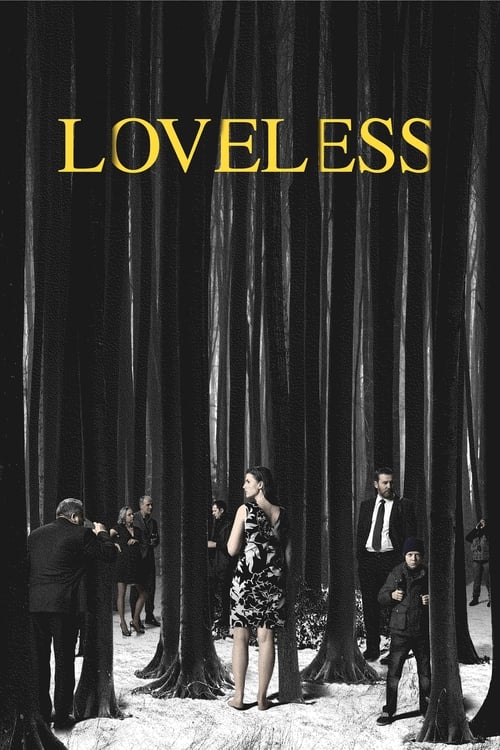
The settings and weather also feature in the themes, which according to Horwitz are "rooted in a peculiarly Russian landscape, existential and literal", exemplified by the "bleak, snowy day" that forms the backdrop of the prologue. The wintry forest featured in the prologue conveys the "eerie air of a gothic fairy tale" in Abraham's opinion; the use of the cinematography in the initial scenes may also give the camera "an independence of movement"; Hynes observed it "zooming into the split of a tree, panning skyward from the foot of it". Later in the story, snowfall threatens the search. Horwitz also found the interiors of the residences "oppressive and unwelcoming". Felperin viewed the abandoned building as symbolic, featuring broken glass and an empty pool that "starts to look like a mass grave, but one that could never hold all the runaways of the nation".
The Economist considered religious and political themes to be less important in Loveless than in Zvyagintsev's 2014 film Leviathan; while Boris' employer is devoutly Russian Orthodox, this is not a predominant theme and "the state is more absent than corrupt". Boris is "terrified" his employer will punish him for the divorce on religious grounds. Koehler equated the ineffectiveness of the police to the Russian state. Robbie Collin argued Loveless has "vast significance", noting that the story opens with Russians fearing the end of the world during the 2012 phenomenon and closes with Zhenya wearing an outfit displaying the word "Russia" prominently while running on a treadmill. Collin interpreted Zhenya as "a real 21st century Mother Russia, going nowhere yet locked unswervingly on course". Zvyagintsev said "Russia" outfits were popular during the 2014 Winter Olympics and was not meant to equate Zhenya with Mother Russia. Koehler instead viewed Zhenya's mother as representative of Mother Russia.
According to Peter Rainer, Loveless is "perhaps [Zvyagintsev's] most encompassing indictment of Russian society", considering the fears of the end of the world lead into the missing person case. Rainer wrote, "Alyosha, with his pugnacious, beseeching face, is not only a lost boy: In the movie's terms, he also represents the loss of something spiritually significant in modern Russia". Koehler interpreted the damaged family as the product of a declining large society. According to Wenlei Ma, "It’s hard not to see Loveless as standing in for Russia’s wider problem—of the promises of Perestroika and Glasnost and the progress reforms brought, progress that has since been diluted by divisions, apathy and a state with no soul". According to Koehler, the film negatively depicts modern Russia in a restaurant scene in which young men and women exchange telephone numbers and take group selfies.