1943–1952: 20th Century Fox
By August 1943, Mankiewicz had signed with Twentieth Century-Fox, stipulating his contractual right to write and direct. As a follow-up to The Song of Bernadette (1943), Mankiewicz selected A. J. Cronin's 1941 novel The Keys of the Kingdom as his first production. Rewriting a script by Nunnally Johnson, the tale centered on Father Francis Chisholm, a humble Scottish Catholic priest, in his thirty-five years as a missionary in a small Chinese village. Gregory Peck was cast in the lead role while Ingrid Bergman was the studio's first choice as the Reverend Mother Maria-Veronica. When Bergman became available, Mankiewicz pleaded with Darryl F. Zanuck to instead cast his then-wife Rose Stradner. The film opened in December 1944 to mixed reviews, though it garnered four Academy Award nominations, including Best Actor for Gregory Peck.
Meanwhile, Twentieth Century-Fox acquired the screen rights to Anya Seton's gothic romance novel Dragonwyck, with Ernst Lubitsch as the director. However, Lubitsch collapsed from a heart attack while filming A Royal Scandal (1945). While recuperating, he decided instead to produce and have Mankiewicz direct Dragonwyck (1946). By May 1944, Gregory Peck and Gene Tierney were cast in the leading roles, but Peck dropped out to star in Duel in the Sun (1946) and was replaced by Vincent Price.
Dragonwyck tells of Nicholas van Ryn, the proprietor of the Dragonwyck estate, who poisons his invalid wife and marries his cousin Miranda, in hopes of bearing an heir. When their infant son dies, Nicholas copes with opium and schemes to murder Miranda, who falls for a local doctor. Displeased with Mankiewicz's creative decisions, Lubitsch removed his name from the production credits. "We differed about some of the direction," Mankiewicz explained, "mostly about where I put the camera." Variety applauded Dragonwyck as a "psychological yarn, its mid-19th century American feudal background being always brooding with never a break in its flow of morbidity. Yet, it is always interesting if somewhat too pointed at times in its fictional contrivance." The film earned $3 million at the box office in the United States and Canada.
Somewhere in the Night (1946) was adapted from Marvin Borowsky's short story "The Lonely Journey". While Zanuck was in Europe, film producer Anderson Lawler came across the story, which impressed Zanuck. Back in the United States, Lawler handed Mankiewicz an adaptation script by Howard Dimsdale. A film noir, John Hodiak plays an amnesiac war veteran who searches for a detective named Larry Cravat, whom he discovers was involved in a murder over two million in Nazi funds funneled into Los Angeles.
Over a course of eighteen months, Mankiewicz directed three adaptations by Philip Dunne—The Late George Apley (1947), The Ghost and Mrs. Muir (1948), and Escape (1948)—each film "done in rapid succession, not of my writing, in which I concentrated upon learning the technique and craft—indeed, upon dissociating myself as far as possible from the writer's approach." Adapted from John P. Marquand's novel of the same name, The Late George Apley was first produced as a play by Marquand and George S. Kaufman. Fox purchased the film rights for $275,000, with Ronald Colman and Peggy Cummins as the title character and Eleanor Apley, George's daughter.
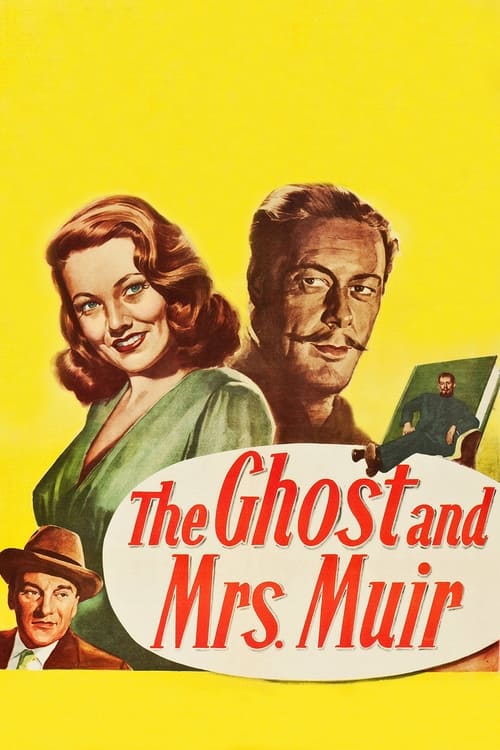
Adapted from R. A. Dick's 1945 novel, The Ghost and Mrs. Muir stars Rex Harrison as the ghost of a sea captain unsuccessfully seeking to frighten Lucy Muir (Gene Tierney), a young widow who has rented her house at the turn of the century. During filming, Tierney's first two days were reshot at Dunne and Zanuck's request, as Dunne had envisioned her as a "straightforward, practical woman" compared to Tierney's quirkier characterization. More reshoots were done when Richard Ney was replaced with George Sanders. Upon its release, film reviewers praised Harrison and Tierney's performances. The Ghost and Mrs. Muir was nominated for the Academy Award for Best Cinematography (Black and White). Mankiewicz reteamed with Harrison in Escape (1948), a story about a convict who escapes a Dartmoor prison. Filmed in Britain under tax regulations, much of the film was shot on location.
Producer Sol C. Siegel had acquired the screen rights to the 1946 novel A Letter to Five Wives, which first appeared as a short story in Cosmopolitan magazine. Siegel had intended for Ernest Lubitsch to direct, and hired Vera Caspary to write a script adaptation. Mankiewicz remembered, "I read [Caspary's script] and knew I had looked upon the Promised Land. I wrote the screenplay about four wives; Zanuck, in an almost bloodless operation, excised one, so we ended with A Letter to Three Wives." Set in an affluent, postwar American suburb, three wives—Jeanne Crain, Linda Darnell, and Ann Sothern—reflect on their marriages as each considers which of their husbands has eloped with Addie Ross, voiced by Celeste Holm. The film premiered at the Radio City Music Hall and was lauded by critics and audiences for the performances of the cast. At the 22nd Academy Awards, in 1950, Mankiewicz was bestowed two Academy Awards for Best Director and Best Adapted Screenplay.
In May 1949, Mankiewicz was the first recipient of the Screen Directors Guild (SDG)'s Award for Outstanding Directorial Achievement. A year later, he was elected as the president for the Screen Directors Guild. Cecil B. DeMille, a proponent for the Hollywood blacklist, proposed that guild members should take an anticommunist loyalty oath. In August 1950, the board approved the measure, while Mankiewicz was vacationing overseas after filming All About Eve. When Mankiewicz returned, he was shocked DeMille had gone behind his back. "It seems to me that kind of thing only happens in Moscow," to which DeMille replied, "Well, maybe we need a little of that here." On October 12, DeMille convened a general board meeting where he requested 25 signatures to recall Mankiewicz as the guild president. Mankiewicz's supporters included John Huston, William Wyler, and Billy Wilder. Throughout the night, at the Beverly Hills Hotel, Mankiewicz survived the recall election but retained the loyalty oath.
Meanwhile, Siegel had hired screenwriter Philip Yordan to adapt Jerome Weidman's novel, I'll Never Go There Anymore into a feature film titled House of Strangers (1949). However, Yordan was fired after writing two-thirds of a first draft. Between assignments, Mankiewicz did an entire rewrite of the script, in which the Screen Writers Guild arbitrated a shared credit between him and Yordan. Mankiewicz angrily disagreed, so Yordan was given the sole credit. Featuring Edward G. Robinson, Richard Conte and Susan Hayward, the story centers on Gino Monetti, an Italian-American ex-convict son of a banking family who seeks revenge against his brothers for turning him in to the police. The film was entered into the 1949 Cannes Film Festival where Robinson won the Best Actor Award.
Following a trend of socially conscious films, including Gentleman's Agreement (1947) and The Snake Pit (1948), Zanuck purchased a story by Lesser Samuels about a racially charged encounter between a Black doctor and a white racist criminal. Yordan had written a script, which Mankiewicz promptly rewrote in six weeks. Titled No Way Out (1950), Mankiewicz cast Sidney Poitier in his screen debut while Richard Widmark played one of the racist brothers who accuses Poitier's character of medical malpractice.
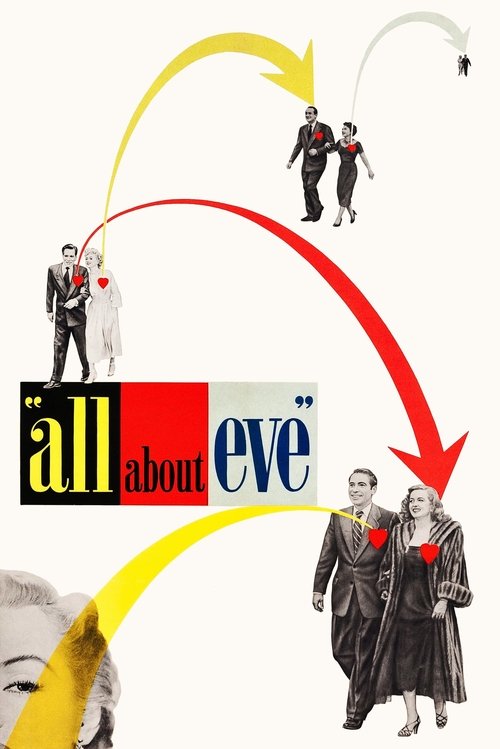
All About Eve was based on the short story "The Wisdom of Eve" written by Mary Orr and published in Cosmopolitan magazine in May 1946. Twentieth Century-Fox optioned the film rights to Orr's story for $5,000 in 1949. Mankiewicz began writing the first draft while preparing for No Way Out. Notably, he secluded himself for six weeks to laboriously write the draft at the San Ysidro Ranch near Santa Barbara. On March 7, 1950, Zanuck finished reading Mankiewicz's script and immediately sent a memo: "Without any question of a doubt you have done a remarkable job. The holes that were present in certain sections of the original treatment have disappeared." However, he delivered a lengthier memo, requesting a reduction of fifty pages.
Claudette Colbert was initially cast as Margo Channing, but suffered a back injury and withdrew less than ten days before filming. To replace her, Mankiewicz considered Gertrude Lawrence. Her attorney Fanny Holtzmann demanded changes to the script, which Mankiewicz declined to make. Fresh from her mutual split from Warner Bros., Bette Davis read the script, describing it as the best she had ever read, and accepted the role. Jeanne Crain was originally considered for the part of Eve Harrington, but Mankiewicz felt she lacked the "bitch virtuosity" needed for the role. With Zanuck's approval, Anne Baxter was instead cast. Filming for All About Eve began in April 1950 at the Curran Theatre in San Francisco, which doubled as the interior and exterior locations of a Broadway theater.
Critical reaction for All About Eve was universally positive, with praise directed towards the cast and Mankiewicz's direction and screenplay. At the 23rd Academy Awards, All About Eve was nominated for a record fourteen Academy Awards and won Best Picture. Mankiewicz and Lester Samuels were also nominated for Best Story and Screenplay for No Way Out but lost to Sunset Boulevard. Mankiewicz won his second consecutive set of Academy Awards for Best Director and Best Adapted Screenplay. Bette Davis and Anne Baxter were both nominated for Best Actress, but lost to Judy Holliday in Born Yesterday (1950). George Sanders won for Best Supporting Actor.
Mankiewicz adapted and directed People Will Talk (1951), also produced by Zanuck, which starred Cary Grant and Jeanne Crain. Adapted from Curt Goetz's 1932 play Dr. Prätorius, Grant plays a physician who is investigated for his unorthodox medical practices led by Professor Ewell (Hume Cronyn). Meanwhile, he falls for Deborah Higgins, an unwed pregnant student contemplating suicide. Though it received favorable reviews, the film was not profitable.
Mankiewicz's last film under contract with Fox was 5 Fingers (1952), starring James Mason and Danielle Darrieux. Zanuck had enlisted Henry Hathaway to direct and Michael Wilson to write a script from Ludwig Carl Moyzisch's nonfiction book Operation Cicero. Mankiewicz read Wilson's script and cabled to Zanuck, stating he wanted to rewrite the dialogue, feeling it needed "humor, sex and excitement." Zanuck consented, provided that Mankiewicz would not seek a writing credit and accept Otto Lang as the film's producer. At Zanuck's insistence, the film was retitled 5 Fingers to avoid association with a race riot that had occurred in Cicero, Illinois. On the last day of filming, in September 1951, Mankiewicz declined to renew his contract with Twentieth Century-Fox and decided to become an independent filmmaker. Released in March 1952, 5 Fingers garnered fairly positive reviews.