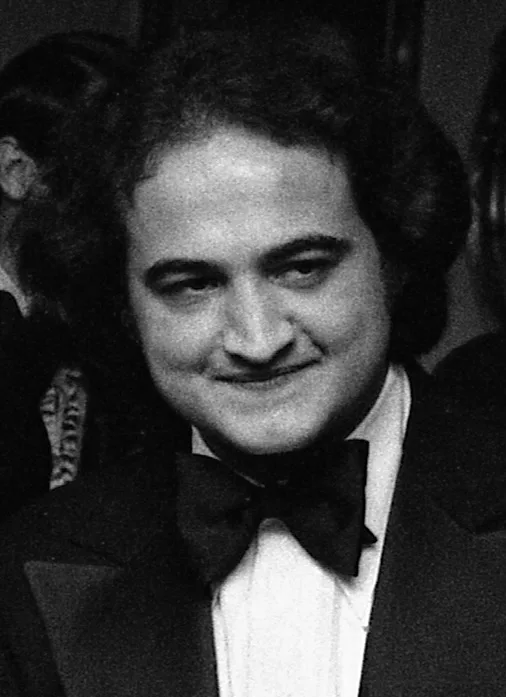
John Adam Belushi ( bə-LOO-shee; January 24, 1949 – March 5, 1982) was an American actor, comedian, and musician. He was one of seven Saturday Night Live cast members of the first season. Belushi had a working partnership with Dan Aykroyd; they had first met while at Chicago's the Second City comedy club, remaining together as cast members on Saturday Night Live.
Born in Chicago to Albanian-American parents, Belushi started his own comedy troupe with Tino Insana and Steve Beshekas, called "The West Compass Trio". Bernard Sahlins recruited him for The Second City comedy club. Once there he met Aykroyd, Brian Doyle-Murray, and Harold Ramis. In 1975, Chevy Chase and Michael O'Donoghue recommended Belushi to Saturday Night Live creator and showrunner Lorne Michaels, who accepted him as a new cast member of the show after an audition. Belushi developed a series of characters on the show that reached great success, including Henry Kissinger and Ludwig van Beethoven.
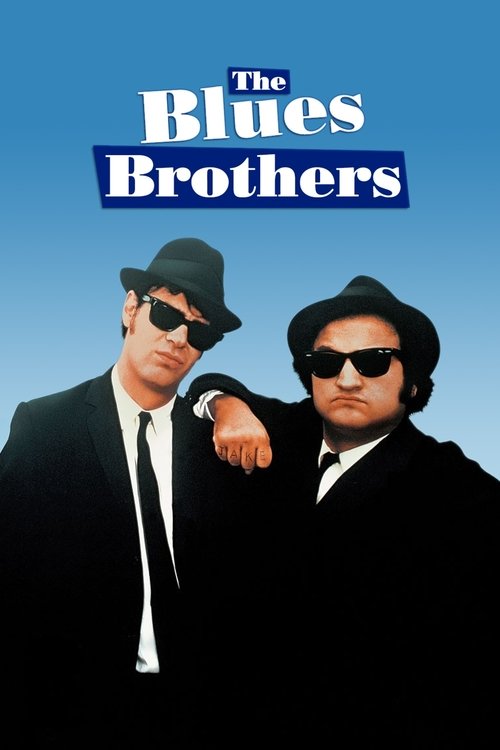
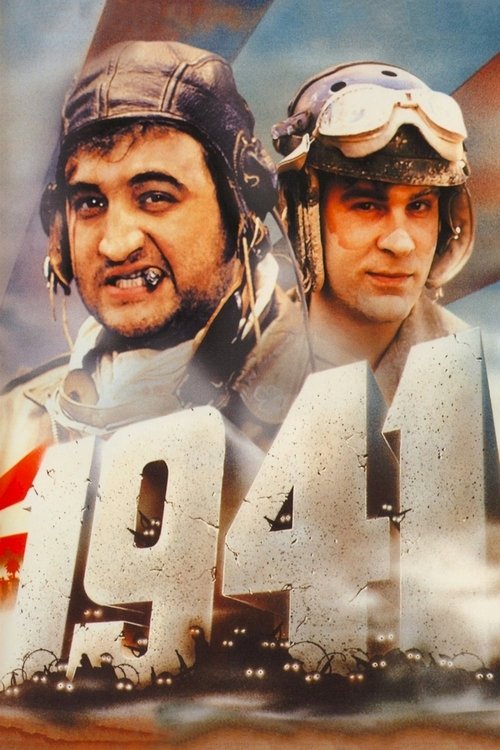
Belushi appeared in several films such as National Lampoon's Animal House, 1941, The Blues Brothers, and Neighbors. He also pursued interests in music; with Aykroyd, Lou Marini, Tom Malone, Steve Cropper, Donald "Duck" Dunn, and Paul Shaffer, he founded The Blues Brothers, which led to the film of the same name.
Belushi was dismissed from Saturday Night Live several times and rehired more than once. He died on March 5, 1982, at the age of 33. Cathy Smith confessed to dosing him with a lethal mixture of heroin and cocaine at the Chateau Marmont. Smith was charged with involuntary manslaughter, and was convicted and sentenced to 15 months in prison. Belushi was honored with a posthumous award of the star on the Hollywood Walk of Fame in 2004. He was the older brother of Jim Belushi.
Contents
Early life and education
John Adam Belushi was born to Agnes Demetri (née Samaras) Belushi and Adam Anastos Belushi in Humboldt Park, Chicago. Agnes was a pharmacy worker, who was born in Ohio to Albanian immigrants from Korçë, Albania. Adam Anastos Belushi was an Albanian immigrant from Qytezë, Albania, and was the owner of the Fair Oaks restaurant on North Avenue in Chicago.
Belushi was raised in Wheaton along with his three siblings—younger brothers Billy and Jim and sister Marian. He was Eastern Orthodox Christian, attending the Albanian Orthodox Church. He was educated at Wheaton Central High School, where he met his future wife, Judith Jacklin.
In 1965, Belushi formed a band, the Ravens, together with four fellow high-school students (Dick Blasucci, Michael Blasucci, Tony Pavilonis, and Phil Special). They recorded one single, "Listen to Me Now/Jolly Green Giant". Belushi played drums and sang vocals. The record was not successful, and the band broke up when he enrolled at the College of DuPage. During the summer of 1967, after graduating from high school, he was hired to perform in several plays at the Shawnee Summer Theatre of Greene County in Bloomfield, IN. He landed roles in Anna of a Thousand Days, Ten Little Indians, and The Tender Trap. He also attended the University of Wisconsin–Whitewater for a year, and during that time inspired the Animal House scene of a motorcycle driving up stairs. Belushi then attended The University of Illinois Chicago Circle (UICC) (now the University of Illinois Chicago) before joining the cast of Saturday Night Live. He acquired the iconic "College" crewneck, worn by his character in Animal House, at a print shop when visiting his brother Jim, who attended Southern Illinois University.
Career
1972–1975: Career beginnings: The Second City and National Lampoon
Belushi started his own comedy troupe in Chicago, the West Compass Trio (named after the improvisational cabaret revue Compass Players, active from 1955 to 1958 in Chicago), with Tino Insana and Steve Beshekas. Their success piqued the interest of Bernard Sahlins, the founder of The Second City, who asked Belushi to join the cast. At Second City, Belushi met and began working with Harold Ramis, Joe Flaherty, and Brian Doyle-Murray.
In 1972, Belushi was offered a role, together with Chevy Chase and Christopher Guest, in National Lampoon Lemmings, a parody of Woodstock, which played off-Broadway in 1972. Belushi and Jacklin moved to New York City. There, Belushi started working as a writer, director, and actor for The National Lampoon Radio Hour, a comedy radio show that was created, produced, and written by staff from National Lampoon magazine. Cast members on the shows produced by Belushi included Ramis, Flaherty, Guest, Brian Doyle Murray, his brother Bill Murray, Gilda Radner, and Richard Belzer. In 1974, Belushi and Chevy Chase voice-acted on a Lampoon Record. During a trip to Toronto in 1974, Belushi met Dan Aykroyd. Jacklin became an associate producer for the show, and she and Belushi were married on December 31, 1976. The National Lampoon Show toured the country in 1974; it was produced by Ivan Reitman. Lampoon owner Matty Simmons was offered a TV show on NBC at this time, but he declined the offer.
1975–1978: Work at Saturday Night Live and breakthrough
In 1975, Chase and writer Michael O'Donoghue recommended Belushi to Lorne Michaels as a potential member for a TV show Michaels was about to produce for NBC called NBC's Saturday Night, later Saturday Night Live. Michaels was initially reluctant, unsure whether Belushi's physical humor would fit what he was envisioning, but he changed his mind after giving Belushi an audition. He appeared alongside O'Donoghue in SNL's first sketch (subsequently titled "the Wolverines") which aired on October 11, 1975.
Over his four-year tenure at SNL Belushi developed a series of successful characters, including the belligerent SNL Samurai; Henry Kissinger; Ludwig van Beethoven; the Greek owner (Pete Dionisopoulos) of the Olympia Café; Captain James T. Kirk; and a contributor of furious opinion pieces on Weekend Update, during which he coined a catchphrase, "But N-O-O-O-O-O-O-O-O-O!" With Aykroyd, Belushi created Jake and Elwood, the Blues Brothers. Originally intended to warm up the studio audience before broadcasts of SNL, the Blues Brothers were eventually featured as musical guests. Belushi also reprised his Lemmings imitation of Joe Cocker. Cocker himself joined Belushi in 1976 to sing "Feelin' Alright?" together.
Like many other SNL cast members and writers, but not all of them, Belushi was a recreational drug user. He attended concerts including Fleetwood Mac, Meat Loaf, Kiss, The Dead Boys, Warren Zevon, The Grateful Dead, and The Allman Brothers. In 1990, Michaels remembered him as a loyal trouper, to writers, a team player, yet he was fired and rehired at SNL.
In Rolling Stone's 2015 appraisal of all 141 SNL cast members, Belushi received the top ranking. "Belushi was the 'live' in Saturday Night Live", they wrote, "the one who made the show happen on the edge … Nobody embodied the highs and lows of Saturday Night Live like Belushi."
1978–1982: Film debut, established actor and musician, and final years
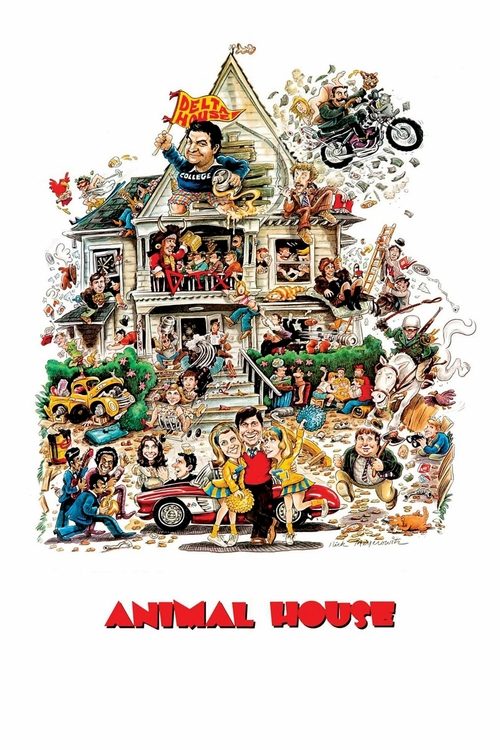
In 1978, Belushi performed in the films Old Boyfriends (directed by Joan Tewkesbury), Goin' South (directed by Jack Nicholson), and National Lampoon's Animal House (directed by John Landis). Upon its initial release, Animal House received generally mixed reviews from critics, but Time magazine and Roger Ebert proclaimed it one of the year's best movies. Filmed at a cost of $2.8 million, it is one of the most profitable movies of all time, garnering an estimated gross of more than $141 million in the form of theatrical rentals and home video, not including merchandising. Animal House was written by Doug Kenney, Harold Ramis, and Chris Miller and followed in the tradition of the Marx Brothers films, featuring subversive, satirical plots that took on traditional institutions. Hollywood studios tried to replicate the film's success without its satire, resulting in a string of "nerds vs. jocks" films in the 1980s featuring cheap sight gags involving nudity and gross-out humor.
Following the success of the Blues Brothers on SNL, Belushi and Aykroyd, with the help of pianist-arranger Paul Shaffer, assembled studio talent forming a proper band. SNL saxophonist "Blue" Lou Marini and trombonist-saxophonist Tom Malone, who had previously played in Blood, Sweat & Tears, were there. At Shaffer's suggestion, guitarist Steve Cropper and bassist Donald "Duck" Dunn, the powerhouse combo from Booker T and the M.G.'s, who played on dozens of hits from Memphis's Stax Records during the 1960s, were signed as well. In 1978, the Blues Brothers released their debut album, Briefcase Full of Blues, with Atlantic Records. The album reached number 1 on the Billboard 200 and went double platinum. Two singles were released: "Rubber Biscuit", which reached number 37 on the Billboard Hot 100, and "Soul Man", which reached number 14.
In 1979, Belushi, along with Aykroyd, left SNL. They filmed the movie The Blues Brothers, which conflicted with the schedule of SNL. Michaels decided to leave in 1980 at the end of his contract. NBC's pressure to use recurring characters was also a factor in their decision. Belushi and Aykroyd made two movies together after leaving: Neighbors (directed by John Avildsen) and, most notably, The Blues Brothers (directed by John Landis). Released in the U.S. on June 20, 1980, The Blues Brothers received generally negative reviews. It earned just under $5 million in its opening weekend, and went on to gross $115.2 million in theaters worldwide before its release on home video. The Blues Brothers band toured to promote the film, which led to a third album (and second live album), Made in America, recorded at the Universal Amphitheatre in 1980. The track "Who's Making Love" peaked at number 39.
Drug use and death
Belushi had health issues in the early to mid 1970s, during his time with the National Lampoon group, due to his drug use. Cocaine was frequently used by some of the cast and some of the writers of Saturday Night Live, but Belushi's use quickly got out of control, and he was temporarily banned from the SNL set. Belushi was aware of warnings that he was headed for an early death, warnings that influenced the 1978 short film "Don't Look Back in Anger," included in the March 11, 1978 SNL episode. Directed by Tom Schiller, the film portrays Belushi ironically as the last surviving member of the cast. He remarks, "They all thought I’d be the first one to go. I was one of those ‘live fast, die young, leave a good-looking corpse’ types, you know?"
During the production of The Blues Brothers, director John Landis confronted Belushi in his trailer after finding a stash of cocaine. Belushi tearfully admitted his addiction during the argument. Belushi was also frequently late for his call times and would delay shooting by wandering off set. The production hired Smokey Wendell to prevent Belushi from accessing more drugs. He managed to quit his habit during the production of Continental Divide, but severely relapsed during the production of Neighbors.
A few months after the filming of Neighbors ended, on the evening of February 28, 1982, he checked in to a bungalow at the Chateau Marmont in L.A. Officially, he was in L.A. for conferences with his longtime manager Bernie Brillstein and movie studio executives about projects. For several days, he frequented various nightclubs on the Sunset Strip and Santa Monica Boulevard.
On March 4, 1982, Belushi visited the L.A. office of Bernie Brillstein and asked him for money. Brillstein declined, suspecting that Belushi wanted more drugs. Later that day, Belushi returned and again asked for money while Brillstein was in a meeting. Brillstein was reluctant to rebuke Belushi in front of the other person and gave him the money. In the early morning hours of March 5, 1982, Belushi, while in his Chateau Marmont bungalow, was visited separately by friends Robin Williams and Robert De Niro, as well as Cathy Smith.
Around noon on March 5, 1982, Belushi's fitness trainer, Bill Wallace, found Belushi dead at the Chateau Marmont bungalow. During a preliminary hearing held in September 1985, two pathologists testified that Belushi's cause of death was an overdose from cocaine and heroin.
Funeral and burial
Belushi's funeral was conducted by an Albanian Orthodox priest. It was held on Martha's Vineyard with James Taylor, Murray and Aykroyd in attendance, and he was interred at Abel's Hill Cemetery in Chilmark. Belushi's tombstone has a skull and crossbones with the inscription, "I may be gone, but Rock and Roll lives on."
After the success of The Blues Brothers, Belushi's fame further escalated after his death. Members of his family, along with Chilmark officials, gradually grew more concerned that his gravesite would become a tourist attraction like Jim Morrison's. Reports of excess noise, damaging grass and disturbing the peace of others buried there, along with fans paying bizarre tributes by littering his gravesite with liquor bottles, beer cans and other paraphernalia. His widow arranged to have him reinterred in an unmarked grave near the original site. The tombstone of Belushi's mother at Elmwood Cemetery (River Grove, Illinois), has Belushi's name inscribed on it and thus serves as a cenotaph.
Belushi was scheduled to present the Best Visual Effects Oscar at the 1982 Academy Awards with Dan Aykroyd. Aykroyd presented the award alone, and stated from the lectern: "My partner, he would have loved to have been here tonight to present this award, since he was somewhat of a visual effect himself."
Tributes, legacy, and popular culture
During the first live SNL episode following Belushi's death, broadcast on March 20, 1982, cast member Brian Doyle-Murray gave a tribute to him. During the preproduction of Ghostbusters, Reitman remarked that Slimer bore a resemblance to Belushi's character Bluto from Animal House. Since then, Slimer has been described as "the ghost of John Belushi" by Aykroyd in many interviews.
Belushi's life was detailed in three books: the 1984 biography Wired: The Short Life and Fast Times of John Belushi by Bob Woodward, the accuracy of which has been questioned by journalists and by people close to Belushi, and the 1990 memoir Samurai Widow by his widow Judith. Woodward's book was adapted into a film of the same name in 1989, which was denounced by Aykroyd and Judith and received poor reviews from critics.
Six years after Belushi’s death, Elizabeth Taylor came out with a book that discussed her long struggle with low self-esteem and overeating. She referenced his comedic impersonation of her on SNL in 1978, when she had been overweight. She wrote, “How sad that that man went to such great lengths to satirize my excesses and then died of his own".
Belushi's career and death were prominently featured in the 1999 memoir of his manager Bernie Brillstein, who wrote that he was haunted by the comedian's death. He wrote that he learned how to better deal with clients. In 2005, Tanner Colby produced Belushi: A Biography, a collection of first-person interviews and photographs of Belushi's life, written in collaboration with Judith Belushi, his widow.
Eddie Money wrote "Passing by the Graveyard (Song for John B.)", from his 1982 album No Control, in tribute to Belushi. The two had become friends after Money was a musical guest on Saturday Night Live during the show's third season. The thrash metal group Anthrax penned a song about Belushi on their 1987 album Among the Living, titled "Efilnikufesin (N.F.L.)". Polish rock band Lady Pank recorded a song "John Belushi" for their 1988 album Tacy sami, with references to his Albanian ancestry. In 2025, Angus Stone, also known as Dope Lemon, released a song called "John Belushi" in his honor.
Belushi was portrayed in biographical films by actors Tyler Labine, Michael Chiklis and John Gemberling. Chris Farley, who was heavily influenced by Belushi, died in 1997 at age 33 due to a drug overdose, which has fueled many comparisons between Belushi and Farley.
Filmography
Discography
Listen to Me Now/Jolly Green Giant (Alonas Dream Records, 1965) (with the Ravens)
National Lampoon's Lemmings (Blue Thumb Records, 1973) (bass guitar, lead vocals on Lonely At The Bottom)
Old Boyfriends: Original Soundtrack (Columbia, 1978) (lead vocals on Jailhouse Rock, You Belong to Me, Get Up and Down and Tush)
National Lampoon's Animal House: Original Soundtrack (Universal, 1978) (lead vocals on Money (That's What I Want) and Louie Louie)
Briefcase Full of Blues (Atlantic, 1978) US #1 (with the Blues Brothers)
The Blues Brothers: Music from the Soundtrack (Atlantic, 1980) US #13 (with the Blues Brothers)
Made in America (Atlantic, 1980) US #49 (with the Blues Brothers)
Best of The Blues Brothers (Atlantic, 1981) US #143 (with the Blues Brothers)
Dancin' wid da Blues Brothers (Atlantic, 1983) (with the Blues Brothers)
Everybody Needs the Blues Brothers (Atlantic, 1988) (with the Blues Brothers)
The Definitive Collection (Atlantic, 1992) (with the Blues Brothers)
The Very Best of The Blues Brothers (Atlantic, 1995) (with the Blues Brothers)
The Blues Brothers Complete (Atlantic, 2000) (with the Blues Brothers)
Comedy albums
Official National Lampoon Stereo Test and Demonstration Record (National Lampoon, 1974)
The Missing White House Tapes (National Lampoon, 1974)
National Lampoon Gold Turkey (National Lampoon, 1975)
NBC's Saturday Night Live (Arista, 1976)
National Lampoon That's Not Funny, That's Sick (National Lampoon, 1977)
Greatest Hits of the National Lampoon (National Lampoon, 1978)
National Lampoon White Album (National Lampoon, 1979)