


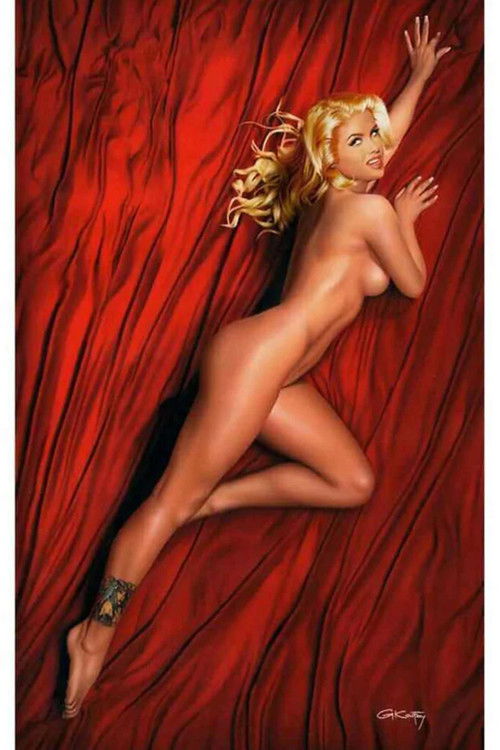
Jayne Mansfield (born Vera Jayne Palmer; April 19, 1933 – June 29, 1967) was an American actress, Playboy Playmate, and singer. Mansfield was a sex symbol of the 1950s and early 1960s, and was known for her numerous publicity stunts, her buxom figure, and her personal life.
Mansfield played the fictional actress Rita Marlowe in Will Success Spoil Rock Hunter? on Broadway in 1955–1956, obtaining a Theatre World Award for the portrayal, and reprised the role in the 1957 film adaptation. Her other film roles include the musical comedy The Girl Can't Help It (1956), the drama The Wayward Bus (1957), the neo-noir Too Hot to Handle (1960), and the sex comedy Promises! Promises! (1963). In Promises! Promises!, Mansfield became the first American actress to perform a nude scene in a starring film role. Her performance in The Girl Can't Help It won a Golden Globe Award for New Star.
Mansfield's professional name came from her first husband, public relations professional Paul Mansfield. She married three times and had five children. On June 29, 1967, she died in a traffic collision at age 34.
Contents
Early life
Jayne Mansfield was born Vera Jayne Palmer on April 19, 1933, at Bryn Mawr Hospital in Bryn Mawr, Pennsylvania, the only child of Herbert William Palmer and Vera Jeffrey Palmer. She inherited more than $90,000 from her maternal grandfather, Thomas H. Palmer, and more than $36,000 from her maternal grandmother, Beatrice Mary Palmer, in 1958.
Until age six, Palmer lived in Phillipsburg, New Jersey, where her father, Herbert, was an attorney practicing with future New Jersey governor Robert B. Meyner. In 1936, her father died of a heart attack while driving; three-year-old Palmer was in the car at the time.
In 1939, Palmer's widowed mother married sales engineer Harry Lawrence Peers. The family moved to Dallas, Texas. As a girl, Jayne was known as Vera Jayne Peers. As a child, Palmer wanted to be a Hollywood star like Shirley Temple. At age 12, she took ballroom dance lessons. She graduated from Highland Park High School in 1950. While in high school, she took violin, piano, and viola lessons. She also studied Spanish and German.
Career
Early modeling and performing
While attending the University of Texas at Austin, Palmer won several beauty contests, including Miss Photoflash, Miss Magnesium Lamp, and Miss Fire Prevention Week. By her own account, the only title she refused was Miss Roquefort Cheese, because she believed it "just didn't sound right". Mansfield rejected "Miss Prime Rib" in 1957 as well.
Palmer married Paul Mansfield in 1950. In 1952, while in Dallas, Jayne and Paul Mansfield participated in small local-theater productions of The Slaves of Demon Rum and Ten Nights in a Barroom. They also appeared in Anything Goes in Camp Gordon, Georgia. After Paul left for military service, Jayne Mansfield made her first significant stage appearance in a production of Arthur Miller's Death of a Salesman on October 22, 1953, with the players of the Knox Street Theater, headed by Sidney Lumet.
The Mansfields moved with their daughter, Jayne Marie, to Los Angeles in 1954. Jayne Mansfield sold popcorn at the Stanley Warner Theatre, taught dance, sold candy at a movie theater, modeling part-time at the Blue Book Model Agency, and worked as a photographer at Esther Williams's Trails Restaurant.
Early in Jayne Mansfield's career, some advertisers considered her prominent breasts undesirable or inappropriate. She lost her first professional assignment, a General Electric commercial featuring young women in bathing suits relaxing around a pool, having been cropped out of the final photographs. Photographer Gene Lester, who worked on the photoshoot, stated that Mansfield was "too sexy" for the advertisement.
In 1954, Mansfield auditioned at both Paramount Pictures and Warner Bros. For the Paramount audition in April, Mansfield performed a sketch from Joan of Arc for casting director Milton Lewis. Lewis told her she was wasting her "obvious talents" and had her come back a week later to perform the piano scene from The Seven Year Itch. Mansfield failed to impress, but she took the casting director's suggestion that she dye her hair platinum blond. She performed the piano scene for Warner Brothers, but, again, failed to impress.
Mansfield landed her first acting assignment in the CBS series Lux Video Theatre, in the episode "An Angel Went AWOL", aired on October 21, 1954. In it, she sat at a piano and delivered a few lines of dialogue. She was paid $300.
Playboy appearances
In December 1953, Hugh Hefner began publishing Playboy. The magazine became a success in part because of early appearances by Mansfield, Marilyn Monroe, Bettie Page, and Anita Ekberg. In February 1955, Mansfield was the Playboy Playmate of the Month, and appeared in the magazine several times. Publication of photos of Mansfield boosted the magazine's circulation and her own career. Shortly afterward, she posed for the Playboy calendar, covering her bare breasts with her hands. Playboy featured Mansfield each February from 1955 to 1958, and again in 1960. In 1964, the magazine repeated the 1955 pictorial. Playboy later reprinted photos from that pictorial issue, with titles such as December 1965s "The Playboy Portfolio of Sex Stars", and January 2000s "Centerfolds of the Century".
Film
Mansfield's first film part was a supporting role in Female Jungle, a low-budget drama completed in ten days. She was paid $150.
In February 1955, James Byron, Mansfield's manager and publicist, negotiated a seven-year contract with Warner Brothers, whose decisionmakers were intrigued by her publicity antics. The contract initially paid her $250 a week and landed her two films, one with an insignificant role and one that was unreleased for two years. Mansfield was given bit parts in Pete Kelly's Blues (1955), starring Jack Webb, and Hell on Frisco Bay (1955), starring Alan Ladd. She acted in one more movie for Warner Brothers—another small but significant role opposite Edward G. Robinson in the courtroom drama Illegal (1955).
Mansfield got out of her Warner contract just in time to star on Broadway opposite Walter Matthau. Mansfield's agent, William Shiffrin, signed her to play fictional film star Rita Marlowe in the Broadway play Will Success Spoil Rock Hunter? with Orson Bean and Walter Matthau. The part was offered to Mansfield after Mamie Van Doren turned it down. Mansfield accepted the part while working on producer Louis W. Kellman's The Burglar (1957), an adaption of the novel of the same name by David Goodis, directed by Paul Wendkos, made in film noir style. She appeared alongside Dan Duryea and Martha Vickers. The Burglar was released two years later, when Mansfield's fame was at its peak. She was successful in this straight dramatic role, though most of her subsequent film appearances were comedic or capitalized on her sex appeal. It was Kellman's first major venture, and he claimed to have "discovered" Mansfield.
On May 3, 1956, Twentieth Century Fox signed Mansfield to a six-year contract to mold her as a successor to the increasingly difficult Marilyn Monroe, their resident blonde sex symbol. Monroe had just completed Bus Stop. Mansfield was still under contract to Broadway and continued playing Will Success Spoil Rock Hunter? on stage until September 15.
Mansfield undertook her first starring film role as Jerri Jordan in Frank Tashlin's The Girl Can't Help It (1956). Originally titled Do-Re-Mi, it featured a high-profile cast of contemporary rock and roll and R&B artists, including Gene Vincent, Eddie Cochran, Fats Domino, The Platters, and Little Richard. Released in December 1956, The Girl Can't Help It became one of the year's biggest successes, both critically and financially, earning more than Gentlemen Prefer Blondes had three years before.
Television
Mansfield played her first leading role on television in 1956 on NBC's The Bachelor. In her first appearance on British television in 1957, she recited from Shakespeare (including a line from Hamlet) and played piano and violin. Her performances in television dramas included episodes of Burke's Law, Alfred Hitchcock Presents, The Red Skelton Hour (three episodes), Kraft Mystery Theater, and Follow the Sun. Mansfield's performance in Follow the Sun ("The Dumbest Blonde"; Season 1, Episode 21; February 4, 1962; produced by 20th Century Fox Television) was hailed as the advent of "a new and dramatic Jayne Mansfield". She appeared on a number of game shows, including Down You Go, The Match Game, and What's My Line?
She performed in a number of variety shows, including The Jack Benny Program (on which she played violin), The Steve Allen Show, and The Jackie Gleason Show (in the mid-1960s, when the show was the second-highest-rated program in the U.S.). In November 1957, on a special episode of NBC's The Perry Como Show ("Holiday in Las Vegas"), one of her nightclub acts was featured, something quite scandalous for the audience according to the broadcaster. She was a headlining guest for three Bob Hope television specials. In 1957, she toured United States Pacific Command areas in Hawaii, Okinawa, Guam, Tokyo, and Korea with Bob Hope for the United Service Organizations for 13 days, appearing as a comedian; in 1961, she toured Newfoundland, Labrador, and Baffin Island for a Christmas special. She made many appearances on talk shows, which she appreciated for the publicity. One of her more notable appearances on a variety show was on The Ed Sullivan Show (Season 10, Episode 35; May 26, 1957), right after her success with Rock Hunter; she played violin with a six-person backup band. After the show she exclaimed, "Now I am really national. Momma and Dallas see the Ed Sullivan show!" According to Nielsen, the episode was watched in 13,400,000 homes, reaching 34% of the total audience, almost 30 million viewers.
By 1958, she earned $20,000 per episode for television performances. In 1964, Mansfield turned down the role of Ginger Grant on the sitcom Gilligan's Island. Although her acting roles were becoming marginalized, Mansfield rejected the part as it epitomized the stereotype she wished to leave behind. The part went to Tina Louise. A widespread rumor that Mansfield had a breast-flashing wardrobe malfunction at the 1957 Academy Awards was later found to be baseless by Academy researchers.
In June 1967, ten days before her death in a car accident, she read To the Virgins, to Make Much of Time, a poem by Robert Herrick about early death, on The Joey Bishop Show—her last television appearance."
Other ventures
Stage appearances
Between 1951 and 1953, Mansfield acted in The Slaves of Demon Rum, Ten Nights in a Barroom, Macbeth, and Anything Goes. Her performance in an October 1953 production of Arthur Miller's Death of a Salesman attracted Paramount Pictures to audition her. Lumet trained her for the audition. In 1955, she went to New York and appeared in the Broadway production of George Axelrod's comedy Will Success Spoil Rock Hunter?, also featuring Orson Bean and Walter Matthau. It was her first major stage performance, garnering her critical attention which was not always positive. She starred as Rita Marlowe (a wild, blonde Hollywood starlet à la Monroe) in the musical spoofing Hollywood in general and Marilyn Monroe in particular. Her wardrobe, a bath towel, caused a sensation. She received a Theatre World Award (Promising Personality) for her performance in 1956, as well as a Golden Globe Award (New Star of the year, Actress) in 1957. Brooks Atkinson of the New York Times described the "commendable abandon" of her scantily clad rendition of Rita Marlowe in the play as "a platinum-pated movie siren with the wavy contours of Marilyn Monroe". She performed in about 450 shows between 1955 and 1956.
In May 1964, Mansfield starred in the stage production of Bus Stop at Yonkers Playhouse, co-starring Mickey Hargitay and Ann B. Davis. The play had a three week engagement that ended on June 14.
Mansfield toured U.S. towns alternating between Bus Stop and Gentlemen Prefer Blondes. In 1965, she performed in another pair of plays: Rabbit Habit at the Latin Quarter nightclub and Champagne Complex, directed by Matt Cimber, at the Pabst Theater. Both plays received poor reviews.
Nightclubs
In February 1958, the Tropicana Las Vegas launched Mansfield's striptease revue The Tropicana Holiday (produced by Monte Proser and co-starring Mansfield's then-husband, Mickey Hargitay) under a four-week contract that was extended to eight. The opening night raised $20,000 for March of Dimes She received $25,000 per week for her performance as Trixie Divoon in the show, while her contract with 20th Century Fox was paying her $2,500 per week. She had a million-dollar policy with Lloyd's of London in case Hargitay dropped her as he whirled her around for the show. In 1959, Jayne returned to the Tropicana with her show being extended from a four-week run to eight when Betty Hutton's engagement there failed to materialize. In December 1960, the Dunes hotel and casino launched Mansfield's revue The House of Love (produced by Jack Cole, co-starring Hargitay). She received a salary of $35,000 a week, the highest of her career.
Her wardrobe for the shows at Tropicana and Dunes featured a gold mesh dress with sequins to cover her nipples and pubic region. The controversial dress was called "Jayne Mansfield and a few sequins". In early 1963, she performed in her first club engagement outside Las Vegas, at the Plantation Supper Club in Greensboro, North Carolina, earning $23,000 in a week, and then at Iroquois Gardens in Louisville, Kentucky. She returned to Las Vegas in 1966, but her show was staged on Fremont Street, away from the Strip where the Tropicana and Dunes were. Her last nightclub act, French Dressing, was at the Latin Quarter in New York in 1966, also repeated at the Tropicana. It was a modified version of the Tropicana show and ran for six weeks with fair success.
Her nightclub career inspired films, documentaries, and a musical album. 20th Century Fox Records recorded "The House of Love" for the album Jayne Mansfield Busts Up Las Vegas in 1962. She played the roles of burlesque entertainer Midnight Franklin in Too Hot to Handle (1960) and Las Vegas showgirl Tawni Downs in The Las Vegas Hillbillys (1966). In 1967, the independent documentary Spree (alternative title Las Vegas by Night), about the antics of Las Vegas entertainers, was released. The film, narrated as a part of a travelogue of Vic Damone and Juliet Prowse, featured Mansfield, Hargitay, Constance Moore, and Clara Ward as guest stars. Mansfield strips and sings "Promise Her Anything" from the film Promises! Promises! A court order prohibited using any of the guest stars to promote the film.
Later in her career, Mansfield was busier on stage, performing and making appearances with her nightclub acts, club engagements, and performance tours. By 1960, she had made personal appearances for everything from supermarket promotions to drugstore openings, at $10,000 per appearance.
Musical work
Mansfield had classical training in piano and violin. She sang in film soundtracks and on stage for her theatrical and nightclub performances, and released singles and albums. After her death, she became an inspiration for punk-rock musicians.
Mansfield sang or her singing was dubbed in some of her films including The Sheriff of Fractured Jaw and Promises! Promises!.
Her screen performance of songs in The Sheriff of Fractured Jaw was actually dubbed by Connie Francis.
In 1958, an orchestra was recorded for the 31st Academy Awards ceremony with Jack Benny on first violin, Mansfield on violin, Dick Powell on trumpet, Robert Mitchum on woodwind, Fred Astaire on drums, and Jerry Lewis as conductor, but the performance was canceled. She sang "Too Marvelous for Words" for The Jack Benny Program ("Jack Takes Boat to Hawaii"; Episode 9, Season 14; November 26, 1963). Her club performances regularly featured songs like Call Me, A Little Brains, A Little Talent ("This Queen has her aces in all the right places"), Plain Jane, Quando-Quando, Bésame Mucho, and the song Marilyn Monroe made famous, Diamonds Are a Girl's Best Friend.
In 1962, 20th Century Fox Records released the album Jayne Mansfield Busts Up Las Vegas, a recording of her Las Vegas revue The House of Love. In 1964 MGM Records released the novelty album Jayne Mansfield: Shakespeare, Tchaikovsky & Me, in which Mansfield recited Shakespeare's sonnets and poems by Marlowe, Browning, Wordsworth, and others against a background of Tchaikovsky's music. The album cover depicted a bouffant-coiffed Mansfield with lips pursed and breasts barely covered by a fur stole, posing between busts of Tchaikovsky and Shakespeare. The New York Times described the album as a reading of "30-odd poems in a husky, urban, baby voice". The reviewer wrote, "Miss Mansfield is a lady with apparent charms, but reading poetry is not one of them."
In 1965, Jimi Hendrix played bass and added lead in his session musician days for Mansfield on two songs, "As The Clouds Drift By" and "Suey", released as a 45-rpm single by London Records in 1966. Ed Chalpin, the record producer, claimed that Mansfield played all the instruments on the singles. According to Hendrix historian Steven Roby (Black Gold: The Lost Archives Of Jimi Hendrix, Billboard Books), this collaboration occurred because they shared a manager. "Wo ist der Mann", sung in German and released by Polydor Records in Austria, was much in demand immediately after its release in August 1963. The A-side featured Hans Last's "Snicksnack-Snuckelchen". In 1964, the Original Sound label released two original songs from the soundtrack of The Las Vegas Hillbillys, "That Makes It" (an answer to The Big Bopper's "Chantilly Lace") on the A-side and "Little Things Mean a Lot" on the B-side.
Personal life
Marriages, children, and affairs
Mansfield was allegedly intimately involved with many men, including Claude Terrail (owner of the Paris restaurant Tour d'Argent), John F. Kennedy, Robert F. Kennedy, and Brazilian billionaire Jorge Guinle. She met John F. Kennedy through his brother-in-law Peter Lawford in Palm Springs, California, in 1960. In 1967, film critic Whitney Williams wrote of Mansfield in Variety: "Her personal life out-rivaled any of the roles she played".
Mansfield (then Jayne Palmer) met Paul Mansfield at a party on Christmas Eve in 1949. She was a popular student at Highland Park High School, and he was a student at Sunset High School in Dallas. On May 6, 1950, the couple married in Fort Worth, Texas. At the time of their marriage, Jayne Mansfield was 17 years of age and was three months pregnant, while Paul Mansfield was 20 years of age. (Some sources state that the couple married on May 10, 1950. According to biographer Raymond Strait, the couple had secretly married on January 28, after which time Jayne Mansfield conceived their child.) On November 8, 1950, Jayne Mansfield gave birth to her daughter, Jayne Marie Mansfield. Some sources say that her pregnancy resulted from date rape.
In 1952, Jayne Mansfield juggled motherhood and classes at the University of Texas. Early in 1952, Paul Mansfield was called to the United States Army Reserve for the Korean War. While he served in the army, she spent a year at Camp Gordon, Georgia. Paul Mansfield hoped their child's birth would discourage Jayne's interest in acting. When it did not, he agreed to move to Los Angeles in 1954 to further her career. Once in California, the couple lived in a small apartment in Van Nuys, Los Angeles with Jayne's pets: a great dane; three cats; two chihuahuas; a poodle dyed pink; and a rabbit. Jayne Marie was left in the care of her maternal grandparents.
After a series of arguments about Jayne's ambitions, infidelity, and animals, the Mansfields decided to dissolve their marriage. They separated in 1955. Jayne filed for separate maintenance in February 1955 and filed for divorce in California in 1956. Paul filed for divorce in 1957 in Texas, citing mental cruelty. In August 1956, Paul sought custody of Jayne Marie, alleging that Jayne was an unfit mother because she had appeared nude in Playboy; however, his attempt failed. The Mansfields received their divorce papers on January 8, 1958. Following the divorce, Jayne kept "Mansfield" as her professional name. After turning 18, Jayne Marie stated that she had not received her inheritance from the Mansfield estate or heard from her father since her mother's death.
Religion
In August 1963, Mansfield decided to convert to Catholicism. Although she never actually converted, she attended Catholic services when in Europe and followed Catholic practices when involved with Catholic partners (including Hargitay, Sardelli, and Cimber). In May 1967, her performance at the Mount Brandon Hotel in Tralee, Ireland, was canceled because Catholic clergy condemned it. She wanted to marry Matt Cimber in a Catholic ceremony, but was unable to find a priest to officiate. While involved with Sam Brody, she also showed interest in Judaism.
In San Francisco for the city's 1966 Film Festival, Mansfield and Brody visited the Church of Satan to meet Anton LaVey, the church's founder. He awarded Mansfield a medallion and the title "High Priestess of San Francisco's Church of Satan." The media enthusiastically covered the meeting and the events surrounding it, identifying Mansfield as a Satanist and speculating that she was romantically involved with LaVey. This urban legend and her relationship with LaVey became the central focus of the 2017 documentary Mansfield 66/67. However, Mansfield also definitively repudiated being a Satanist in the media. In a press release accompanying the Mansfield/LaVey photos of Walter Fischer, Mansfield is quoted: “It is very interesting. I know the real basis of [LaVey’s] church. I think he is a genius and I regard him as an interesting person. I am a Catholic and would not believe in his church. I am not a member of the black circle.”
Public image
Influence
Mansfield was a major Hollywood sex symbol of the 1950s and early 1960s and 20th Century Fox's alternative to Marilyn Monroe. She came to be known as the "Working Man's Monroe". She was one of Hollywood's original blonde bombshells, and remains one of the most recognizable icons of 1950s celebrity culture.
According to Hollywood historian and biographer James Parish, Mansfield's hourglass figure (she claimed dimensions of 40–21–35), unique sashaying walk, breathy baby talk, and cleavage-revealing costumes made an enduring impact. Hollywood historian Andrew Nelson said that she was seen as Hollywood's gaudiest, boldest, D-cupped, B-grade actress from 1955 until the early 1960s.
Frequent references have been made to Mansfield's very high IQ, which she claimed was 163. In addition to English, she spoke four other languages. She learned French, Spanish, and German in high school, and in 1963 she studied Italian. Reputed to be Hollywood's "smartest dumb blonde", she later complained that the public did not care about her brain, saying: "They're more interested in 40–21–35", a reference to her body measurements.
Trademarks
A natural brunette, Mansfield had her hair bleached and colored platinum blonde when she moved to Los Angeles, and became one of the early "blonde bombshells", along with Marilyn Monroe, Betty Grable, and Mamie Van Doren. In 1958, she also had her eyebrows dyed platinum. Following Jean Harlow (who started the trend with her film Bombshell), Monroe, Mansfield, and Van Doren helped establish the stereotype typified by a combination of curvaceous physique, very light-colored hair, and a perceived lack of intelligence. A review of English-language tabloids shows it to be one of the most persistent blonde stereotypes along with busty blonde, and blonde babe.
Mansfield and Monroe have been described as representations of a historical juncture of sexuality in comedy and popular culture. Academics have also named Anita Ekberg and Bettie Page as catalysts of the trend of exaggerated female sexuality. M. Thomas Inge describes Mansfield, Monroe, and Jane Russell as personifications of the bad girl in popular culture. Judy Holliday and Goldie Hawn have also been said to have established the "dumb blonde" stereotype, typified by overt sexuality and apparent inability to understand everyday life. Instead of the asexualized and virginal "nice girls" of earlier films, the pneumatic blonde bombshells took over the screen in the 1950s and have been consistently emulated since. Social historian Joan Jacobs Brumberg called the 1950s as "an era distinguished by its worship of full-breasted women" and attributes the paradigm shift to Mansfield and Monroe. Patricia Vettel-Becker specifically attributed the phenomenon to Playboy magazine and Mansfield's and Monroe's appearances in it.
Newspapers in the 1950s routinely published Mansfield's body measurements, which once led evangelist Billy Graham to exclaim, "This country knows more about Jayne Mansfield's statistics than the Second Commandment." Mansfield proclaimed a 41-inch bust line and a 22-inch waist when she made her Broadway debut in 1955, though those measurements are in dispute. She was known as "the Cleavage Queen" and "the Queen of Sex and Bosom". Mansfield's largest bust measurement was 46-DD (117 cm), measured by the press in 1967. According to Playboy, in 1955, her measurements were 40D-21-36 (102–53–91 cm) on her 5 ft 6 in (1.68 m) frame.
Drawing on the Freudian concept of fetishism, British science-fiction writer and socio-cultural commentator J. G. Ballard said that Mae West's, Mansfield's, and Monroe's breasts "loomed across the horizon of popular consciousness". According to Dave Kehr, as the 1960s approached, the anatomy that had made her a star turned her into a joke. In that decade, the female body ideal shifted to the slim waif-like features of supermodel Twiggy, actress Audrey Hepburn, and others.
Publicity
Mansfield's drive for publicity was one of the strongest in Hollywood. She gave up all privacy and her doors were always open to photographers. On Christmas Eve 1954, she walked into publicist James Byron's office with a gift and asked him to oversee her publicity, which he did, for the most part, until the end of 1961. Byron appointed most of the people on her team—William Shiffrin (press agent), Greg Bautzer (attorney), and Charles Goldring (business manager)—and constantly planted publicity material in the media. She appeared in about 2,500 newspaper photographs, and had about 122,000 lines of newspaper copy written about her between September 1956 and May 1957.
Because of this media blitz, she achieved international renown. On October 10, 1959, she visited White Hart Lane, England, and watched the Tottenham Hotspur versus Wolverhampton Wanderers FC football match. By 1960, Mansfield had topped press polls for most words in print, made more personal appearances than any political candidate, and was regarded as the world's most-photographed Hollywood celebrity. She made news on a regular basis, for malfunctioning dresses, clothing that burst strategically at the seams, and low-cut dresses without a bra. Things worsened when she took charge of her own publicity without advice. According to Shiffrin, "She became a freak." James Bacon wrote in the Los Angeles Herald-Examiner in 1973: "Here was a girl with real comedy talent, spectacular figure and looks and yet ridiculed herself out of business by outlandish publicity."
Mansfield received her first truly negative publicity after she and Hargitay pleaded poverty when his first wife, Mary Hargitay, whom he divorced on September 6, 1956, requested additional child support for their first child, Tina, in September 1958. Mansfield said she slept on the floor of her mansion, was unable to buy furniture, and spent only $71 on her daughter Jayne Marie.
In January 1955, Mansfield appeared at a Silver Springs, Florida, press junket promoting the film Underwater!, starring Jane Russell. She purposely wore a too-small red bikini lent to her by photographer friend Peter Gowland. When she dived into the pool for photographers, her top came off, creating a burst of media attention. The ensuing publicity led Warner Bros. and Playboy to approach her with offers. On June 8 of that year, her dress fell down to her waist twice in a single evening, once at a movie party and later at a nightclub. In February 1958, she was topless at a Carnival party in Rio de Janeiro. She shimmied out of her polka-dot dress in a Rome nightclub in June 1962. In the three years since making her Broadway debut in Will Success Spoil Rock Hunter?, Mansfield had become the most controversial star of the decade.
Signature color
Mansfield adopted pink as her color in 1954, and was associated with it for the rest of her career. Her original choice was purple, but she thought it too close to lavender, Kim Novak's signature color. "It must have been the right decision," she said, "because I got more column space from pink than Kim Novak ever did from lavender." In November 1957, shortly before their marriage, using money from an inheritance, Mansfield bought the 40-room Mediterranean-style mansion (formerly owned by Rudy Vallée) at 10100 Sunset Boulevard in the Holmby Hills section of Los Angeles. Mansfield had the house painted pink, with cupids surrounded by pink fluorescent lights, pink fur in the bathrooms, a pink heart-shaped bathtub, and a fountain spurting pink champagne; she then dubbed it the "Pink Palace". Hargitay (a plumber and carpenter before taking up bodybuilding) built the pink heart-shaped swimming pool. The year after reconstructing the "Pink Palace" as a "pink landmark", she began riding in a pink Cadillac Eldorado Biarritz convertible with tailfins, then the only pink Cadillac in Hollywood.
Rivalry
Throughout her career, Mansfield was compared by the media to the reigning sex symbol of the period, Marilyn Monroe. 20th Century Fox groomed her and Sheree North to substitute for Monroe, their resident blonde bombshell, while Universal Pictures launched Mamie Van Doren as its substitute. The studio launched Mansfield with a grand 40-day tour of England and Europe from September 25 to November 6, 1957. She adopted Monroe's vocal mannerisms instead of her original husky voice and Texas accent, performed in two plays that were based on Monroe vehicles, Bus Stop and Gentlemen Prefer Blondes, and her role in The Wayward Bus was strongly influenced by Monroe's character in Bus Stop.
Other studios also tried to find their own versions of Monroe. Columbia Pictures tried Cleo Moore, Warner Bros. Carroll Baker, Paramount Pictures Anita Ekberg, and Metro-Goldwyn-Mayer Barbara Lang, while Diana Dors was dubbed England's answer to Mansfield. Jacqueline Susann wrote, "When one studio has a Marilyn Monroe, every other studio is hiring Jayne Mansfield and Mamie Van Doren." The contenders also included Sheree North, Kim Novak, Joi Lansing, Beverly Michaels, Barbara Nichols and Greta Thyssen, and even two brunettes— Elizabeth Taylor and Jane Russell. Van Doren, Dors, and Novak also acted in productions of Gentlemen Prefer Blondes. Even when Mansfield's film roles were drying up, she was still considered Monroe's primary rival. Mansfield considered Van Doren her professional nemesis. At one point, Monroe, Mansfield, and Mamie were known as The Three M's.
Death
On June 28, 1967, Mansfield was in Biloxi, Mississippi, for an engagement at the Gus Stevens Supper Club. After midnight, Mansfield; her attorney and partner Sam Brody; Ronald B. Harrison, a 19-year-old driver for the Gus Stevens Supper Club, who was driving a 1966 Electra 225 loaned by Stevens; three of her children; and her four Chihuahuas left Biloxi for New Orleans, where Mansfield was to appear on WDSU's Midday Show. At about 2:25 a.m. on June 29, on U.S. Highway 90, 1 mile (1.6 km) west of the Rigolets Bridge, their car crashed while traveling between 60 and 80 miles per hour (97 and 129 km/h) into the rear of a tractor-trailer that had slowed down from 50 to 35 miles per hour (80 to 56 km/h) due to an approaching insecticide fog-spraying truck that was flashing a red light. Mansfield, the two other adults in the front seat, and two of the dogs died instantly. The children, asleep in the rear seat, survived with minor injuries. They were rushed to Ochsner Foundation Hospital, where Mickey Hargitay arrived that same day after learning what had happened.
Reports that Mansfield was decapitated are untrue, although she suffered severe head trauma. This urban legend started with the appearance in police photographs of the crashed car with its top virtually sheared off and what resembled a blonde-haired head tangled in the car's smashed windshield. Mansfield's death certificate gives her immediate cause of death as "crushed skull with avulsion of cranium and brain". The cause of the head-like shape has not been definitively determined. After her death, the National Highway Traffic Safety Administration recommended requiring an underride guard (a strong bar made of steel tubing) on all tractor-trailers; the trucking industry was slow to adopt this change. In America, the underride guard is sometimes known as a "Mansfield bar".
Mansfield's body was flown from New Orleans to New York and a private funeral took place on July 3 at the chapel of the Pullis Funeral Home in Pen Argyl, Pennsylvania, officiated by the pastor of the Zion Methodist Church, Rev. Charles Montgomery. Mansfield was buried in Fairview Cemetery next to her father. Mickey Hargitay was the only ex-husband of Mansfield present at the funeral.
In 1968, two wrongful-death lawsuits were filed on behalf of Mansfield and ex-husband Matt Cimber. After a 16-day trial in 1971, the jury found that Harrison, the driver of the car, was negligent, that Richard Rambo, the driver of the truck into which Mansfield crashed, was not negligent, and that James McLelland, the driver of the fog-spraying truck, was negligent but his negligence was not a proximate cause of the accident; a rehearing was denied.
Achievements and legacy
Awards and nominations
Mansfield received a Theatre World Award (Promising Personality) for Will Success Spoil Rock Hunter? in 1956.
She received a Golden Globe Award (New Star of the year, Actress) for The Girl Can't Help It in 1957.
She received a Star on the Hollywood Walk of Fame on February 8, 1960, for her contribution to motion pictures.
On Mother's Day of 1960, the Mildred Strauss Child Care Chapter of Mount Sinai Hospital, New York City declared her family as the "Family of the Year".
Italian film, radio and television journalists awarded her the Silver Mask award in 1962.
Mansfield received the Oscar of the Two World award in Italy.
In 1963, Mansfield was voted one of the top-10 box-office attractions by an organization of American theater owners for her performance in Promises! Promises! (a film banned in parts of the U.S.).
In 1968, the Hollywood Publicists Guild declared a "Jayne Mansfield Award" would be given to the actress who received the most exposure and publicity in a year. Raquel Welch was the first winner of the award in 1969.
Legacy
Mansfield left behind five children and a crumbling estate, including the Pink Palace.
Mansfield is known for helping shape the "dumb blonde" stereotype. Contrary to her public persona, Mansfield was quite intelligent, and at one point could speak up to five different languages.
Her daughter Mariska became an actress and star of Law & Order: Special Victims Unit. She has won several awards for her work on the show, including a Golden Globe Award for Best Actress in 2005 and an Emmy Award for Outstanding Lead Actress in a Drama Series in 2006. Hargitay released My Mom Jayne, a documentary about Mansfield, in June 2025.
After Mansfield's death, Hargitay, Cimber, Vera Peers (Mansfield's mother), William Pigue (Jayne Marie's legal guardian), and Charles Goldring (Mansfield's business manager), as well as Bernard B. Cohen and Jerome Webber (both administrators of the estate) filed unsuccessful suits to gain control of her estate. Mansfield's estate was appraised initially at $600,000, including the Pink Palace, estimated at $100,000, a sports car sold for $7,000, her jewelry, and Sam Brody's $185,000 estate left to her in his last will. In 1971, Beverly Brody sued the Mansfield estate for $325,000 worth of presents and jewelry given to Mansfield by Sam Brody; the suit was settled out of court. However, her four eldest children (Jayne Marie, Mickey, Zoltan, and Mariska) went to court in 1977 to find that approximately $500,000 in debt that Mansfield had incurred, including $11,000 for lingerie, $11,600 for plumbing of the heart-shaped swimming pool, and litigation had left the estate insolvent.
The Pink Palace was sold. Its subsequent owners included Ringo Starr and Engelbert Humperdinck. Cass Elliot is often falsely claimed to have owned the home. In 2002, Humperdinck sold it to developers, and the house was demolished in November of that year. What remained of her estate was subsequently managed by CMG Worldwide, an intellectual property-management company.