
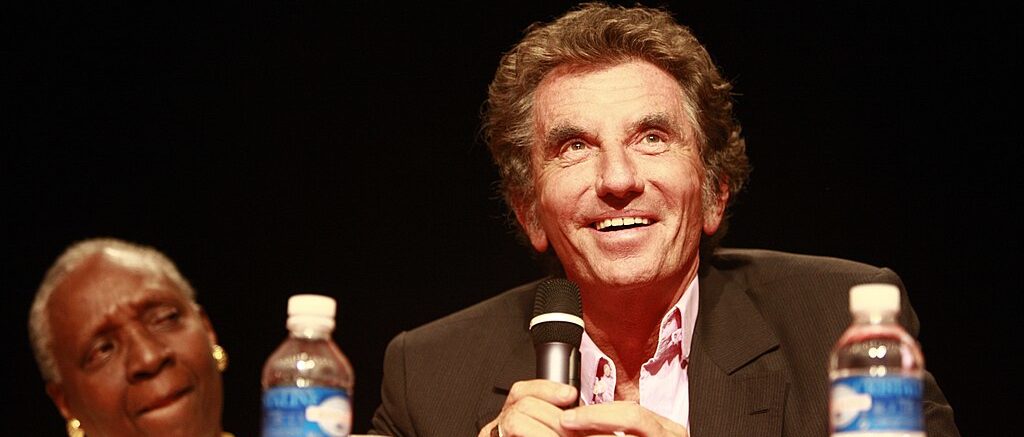
Jack Mathieu Émile Lang (French: [dʒak matjø emil lɑ̃ɡ]; born 2 September 1939) is a French politician. A member of the Socialist Party, he served as Minister of Culture from 1981 to 1986 and again from 1988 to 1993, as well as Minister of National Education from 1992 to 1993 and 2000 to 2002.
He was also Mayor of Blois from 1989 until his resignation in 2000. Lang is best known for originating the Fête de la Musique in 1982 as Culture Minister, an all-day public music festival which occurs yearly on 21 June in France and throughout the world. He was president of the Arab World Institute in Paris from 2013 until his resignation in 2026 following the revelations of the Epstein files concerning his close relationship with financier and child sex offender Jeffrey Epstein.
Contents
Life
Jack Lang was born to Roger Lang and Marie-Luce Bouchet in Mirecourt, in the département of Vosges. His father was from an assimilated, well-to-do secular Jewish family, based in Nancy. Roger Lang was the commercial manager of the family business which was founded by Jack's grandfather Albert. Roger and Albert were both freemasons. Jack's mother, Marie-Luce Bouchet, a Catholic, was born in 1919 to Emile Bouchet, who died in 1926, and Berthe Boulanger, a nurse who was also a freemason.
In 1938, Albert and Roger sent their wives to Vichy because of the threat of war with Germany. After the German invasion, Albert Lang and his wife moved to Brive-la-Gaillarde in Corrèze. The very young Jack and his mother went to stay with his great-grandmother (the mother of Berthe Boulanger) in Cholet and subsequently moved to Bordeaux. His father Roger was first mobilized in Luneville, and then joined his parents and his brother-in-law Luc Bouchet in Brive. Jack and his mother also joined them in Brive after the bombing of Bordeaux. Jack Lang's father was sentenced by the court in Brive for failing to report his children as Jews, but was later acquitted by the Court of Appeal on the ground that the children's mother was a Catholic. He had followed the advice of the rabbi of Brive, David Feuerwerker. Roger Lang was nevertheless placed under house arrest. Berthe Bouchet (Boulanger) visited the Langs in April 1942 when her daughter was about to give birth to her third child, Marianne. In 1943, Berthe was arrested in Nancy by the Gestapo for acts of propaganda and resistance. She was deported to Ravensbrück and died in the spring of 1945.
Lang studied political science at the Institut d'Études Politiques de Paris, and went on to receive a postgraduate degree in public law. His career then focused on a combination of teaching and culture and the arts. He was the founder and producer of Festival du Monde in Nancy, was director of the Nancy University Theatre from 1963 to 1972, and then director of the Théâtre national de Chaillot from 1972 to 1974. At the same time he was a professor of international law from 1971 to 1981 at Nancy University and then Paris Nanterre University. He married Monique Buczynski in 1961. The couple have two daughters, one of whom was the actress Valérie Lang. In 1997, Lang was President of the Jury at the 47th Berlin International Film Festival. He is notorious for not paying bills and thus excluded from attending the Cannes film festival since 2020, among other locations.
Politics
Lang entered politics as a Socialist member of the National Assembly from Paris in 1977. He is best known for having served as Minister of Culture (22 May 1981 – 19 March 1986 and 13 May 1988 – 29 March 1993) and as Minister of Education (3 April 1992 – 29 March 1993 and 27 March 2000 – 5 May 2002). In 1981, while Minister of Culture, he created the Fête de la Musique, a massive celebration of music held on 21 June each year, where many amateur musicians give free open-air performances. He is the co-founder and president of the Union of the Theatres of Europe. In August 1981, he created the Lang Law, which allows publishers to enforce a minimum sale price for books.
In the 1980s. Lang contributed to the creation of the Europe Theatre Prize, born in 1986, of which he is the President until 2018. Lang was a Member of the European Parliament from 1994 to 1997. In 2000, he stood unsuccessfully for Mayor of Paris. While he had planned to stand for president in 2007, he ultimately decided not to register as a candidate in the Socialist primary for the sake of party unity.
In 2007, Lang agreed to become co-chairman of a commission drafting changes to the Constitution that were supported by President Nicolas Sarkozy but opposed by the Socialist Party. This decision provoked strong criticism from his party, leading him to end his role in the party leadership. When Parliament voted on the constitutional changes on 21 July 2008, he voted in favour, becoming the only Socialist deputy so to do. A three-fifths majority was required, and the changes passed by a vote of 539 to 357, meaning that Lang's support enabled the bill to pass by a one-vote margin. The Socialist Party denounced Lang for this vote; party spokesman Julien Dray said that he had "gone too far" and "no longer has his place in our political family", while Jean-Marc Ayrault, the President of the Socialist Parliamentary Group, said that Lang's vote was an act of "crossing the Rubicon". Lang replied by saying that it "is in nobody's power to strike me from the map of the French political landscape".
In late 2009, Sarkozy appointed Lang his special envoy to North Korea, following a similar assignment earlier in the year to Cuba. Lang travelled to Pyongyang on 9 November 2009 for a self-described "listening mission" aimed at exploring bilateral ties and discussing the North Korean nuclear program, among other things. Lang briefed American officials including Deputy Secretary of State James Steinberg and special envoy Sung Kim, as well as ambassadors of countries involved such as Russia, before the assignment was publicly announced. Some critics questioned Lang's qualifications, but Lang said he would be driven by his "intuition" that change was afoot in North Korea.
Political career
Governmental functions
Minister of Culture: 1981–1986.
Minister of Culture, Communication, Great Works and of the Bicentennial: 1988–1991.
Minister of Culture and Communication, government spokesman: 1991–1992.
Minister of State, Minister of National Education and Culture: 1992–1993.
Minister of National Education: 2000–2002.
Special envoy to Cuba: February 2009.
Special envoy to North Korea: November 2009.
Electoral mandates
European Parliament
Member of European Parliament: 1994–1997 (Reelected member of the National Assembly of France in 1997). Elected in 1994.
National Assembly of France
Member of the National Assembly of France for Pas-de-Calais: Since 2002. Elected in 2002, re-elected in 2007.
Member of the National Assembly of France for Loir-et-Cher: 1986–1988 (Became minister in 1988) / March–December 1993 (Resignation) / 1997–2000 (Became minister in 2000). Elected in 1986, re-elected in 1988, 1993, 1997.
Regional Council
Vice-president of the Regional Council of Nord-Pas-de-Calais: Since 2004
Regional councillor of Nord-Pas-de-Calais: Since 2004.
Regional councillor of Centre: 1992–1998.
General Council
General councillor of Loir-et-Cher: 1992–1993 (Resignation).
Municipal Council
Mayor of Blois: 1989–2000 (Resignation). Reelected in 1995.
Municipal councillor of Blois: 1989–2002 (Resignation). Re-elected in 1995.
Councillor of Paris 1983–1989.