Special effects
Gene Warren's effects company Fantasy II were in the middle of working on Predator 2 (1990) when ABC assigned the company to work on It with a deadline of 12 weeks. The effects team of It included Warren, who handled the visual effects; Bart Mixon, who coordinated the makeup effects and Pennywise's animated deadlights; Jo-Anne Smith, who had previously worked on Curry's make-up for his role in Legend (1985); Salty Ray; J.C. Matalon; and the Fantasy II effects team run by Warren's son, Gene Warren Jr., and including Jim McLoughlln, Aaron Sim, Brent Baker, Norman Cabrera, and Joey Orosco. Fantasy II had previously worked on a feature also directed by Wallace titled Fright Night Part 2 (1988) and another King adaptation named Pet Sematary (1989).
The majority of the special effects were done practically without digital alteration, such as puppeteers being used to animate the fortune cookies in the Chinese restaurant scene. Some scenes were done with replacement animation, an animation technique similar to stop motion animation. Replacement animation was used for when Pennywise came out of the drain, killed Belch in the sewers, and did a somersault in the air. A lot of the effects Wallace planned to use while storyboarding did not make it into the final version for budget reasons, such as the roots writhing around Pennywise in his ghostly encounter with the adult Losers in the sewer. Lindsay Craig, an artist who made a living doing prop work in film and television, created some of the blood for It using food coloring, water, and methacyl.
While It's lair features many cocooned humans, Sally Ray and J.C. Matalon sculpted only six of them, four children and two adults, for close-up shots.
To work with the deadline, Mixon divided the design team of each It creature into four artists: "Each artist was given a considerable amount of freedom with his creations, with occasional input from Warren or myself to make sure we were adhering to Wallace's vision."
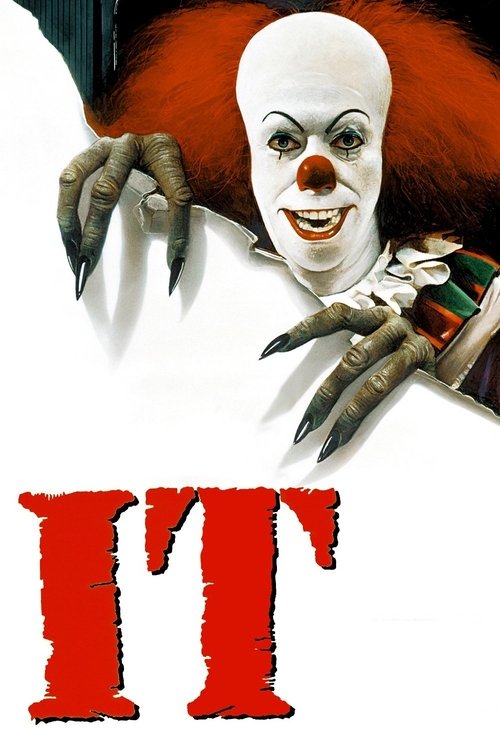
When designing Pennywise, Mixon focused on making him look as "friendly" as possible: "This creature is trying to lure children in, so he's not going to be a monster at first." He began drawing concepts for how Pennywise would look before Curry was cast, researching the looks of most other clowns in the process. Original storyboards for Pennywise featured exaggerated cheekbones, a sharp chin, and bulbous forehead.
Mixon began working on a head cast for the Pennywise character after Curry was cast in the role; he also designed three clay molds for testing. According to Mixon, he based the shape of Pennywise's head on Lon Chaney in The Phantom of the Opera (1925), "stylized into a clown." Three different versions of the clown's face were created, one of which resembled a hobo clown, another that was "a little meaner," and the final one seen in the series.
Mixon then worked with Curry on the makeup and tested two concepts: one with just a nose, headpiece, and a make-up pattern Curry suggested; and another one that was closer to the original designs. The former was chosen, although the other make-up choice is featured in the final cut when Pennywise is sprayed with battery acid. Instead of traditional clown make-up, PAX paint was used for makeup that made Pennywise look "almost like a living cartoon."
According to director Wallace, "Tim [Curry] objected strongly to all the rubber. He had recently been in several movies which covered him in prosthetics and I'm sure he felt all the glue and latex would just get in his way. He was right, of course. With those eyes, and that mouth, and his crazy, sardonic sense of humor, less turned out to be more in the makeup department." However, the bulbous forehead was kept to give the character "a supernatural aspect without getting in the way." Getting the clown faces right also depended on some of the actor's own efforts, to the point where he had to do a day of training of not only getting into the character but also practicing the faces. Small adjustments to Pennywise's face, such as on his mouth and the eyebrows ("the hardest thing to get right" according to Curry), were still being made in the first five days of shooting.
In the scenes when the clown became vicious, Curry wore yellow lenses and two sets of sharp teeth throughout shooting: a smaller set he could talk while wearing, and a less flexible but far bigger set for more horrifying shots. The teeth were designed by Jim McLoughlin. Wallace originally did not want Pennywise to switch into a "horror" look but rather maintain the "nice" clown look throughout the miniseries, but this idea was dropped.
Dan Platt sculpted a puppet replication of Pennywise specifically for the stop motion scenes, with painting done by Mixon and the hair by Jack Bricker. Rotoscoping was used for Pennywise's "dead light" effects in the first part of the miniseries.
Norman Cabrera sculpted the design of the werewolf. Because Wallace did not want it to look like a usual "Howling type of creature," Mixon instructed Cabrera to make "a slicker, '90s version" of the wolf from the 1950s film Richie viewed. The makeup used for the werewolf character was kept simple, consisting only of a spandex hood mask, gloves, and hair tied around the neck all put together through KY Jelly; this was done to suit the limited application time and "the nature of the shots." Jack Bricker created the wolf's hair, and Mimi Cabrera made stylistic additions. Aaron Sims painted three sets of false eyes for the wolf; a "beauty pair" for close-up shots, a "stunt pair" that had the pupils "drilled out," and a set of glowing eyes. Only the "stunt" and "beauty" pairs are seen in the final miniseries.
For the part when Mrs. Kersh is revealed to be Alvin Marsh's corpse, Florence Peterson was still playing the character. Cabrera was responsible for the Marsh part of Kersh's make-up, composed of two face pieces, one teeth piece, false fingernail pieces, one neck piece, two pieces on the back of the hands, and an "empty eyesocket" piece. Mixon handled a PAX paint layer of the makeup. As Mixon explained, "Director Wallace wanted an empty eyesocket look for Al, so Cabrera sculpted rot inside the sockets and then burned tiny holes through the foam for the actor to see through."
The scene when the Losers find Stanley's severed head in the refrigerator was done via a split screen effect; it consists of one shot of Masur wearing a Jim-McLoughlin-designed "severed neck" with black areas filled in by another shot of the refrigerator without the actor. McLoughlin also created a dummy head of Stan used for wide shots.
I had a problem with the spider. King was able to conjure it up in his head, but it was difficult to bring to the screen. We set the tone and parameters in the first part of the movie with Pennywise. But when you get to the spider, you move into a different world. It was supposed to be a horror movie, not Jason and the Argonauts.
Producing and shooting It's final spider form required a budget of $200,000 and 13 weeks of time. It began with Mixon coming up with the idea of a "soft and fleshy" spiderlike creature. Joey Orosco, with some help from Henry Mayo, used his idea to create a design that included the abdomen and multiple limbs of a spider; and shoulders, hips, and torso-attaching legs of a human; the body parts went through more than 16 concept sculptures. In addition to painting the entire creature, Orsco molded the torso, arms, and head; while the spider's legs and abdomen were sculpted by Sims. Sims also molded a stop-motion replica of the spider, with an armature built by Mike Joyce, used for nine split-screen, rear projection, and tabletop shots supervised by Warren.
As Wallace explained, the spider was far less "beefy and muscular" and more "lean and mean" than what was in the concept drawings; its face was also not supposed to be as visible as it was in the final cut, although he blames himself for letting that happen. As Mixon described the 500-pound, 250-foot radio-controlled spider, "They've had some other creatures on TV but I can't think of anything just this big or this neat." Its odd design and unusually large size caught the attention of Canadian customs officials when it reached the US-Canada border of White Rock during its relocation from Los Angeles to a sound stage at The Bridge Studios; the officials delayed the operation.
Brent Baker was inside the spider, previously going through three months of training in using it, where there was a video monitor showing him how the spider was moving: "It got a little stuffy, but they had a place where they could stick in a little hose if I wanted water or some fresh air." Baker got really uncomfortable when the spider had to do multiple shots of the roll-over movement, as he would have to lay on his side while the crew set up another shot. Dave Kindlon's mechanics of the spider required control by various operators for different body parts; the head was radio-controlled by three people, the legs were operated by six people, one person operated the arms, one handled the deadlights, and others handled the movement of the entire spider.
As Mixon described controlling the spider, "We used a certain amount of animatronics for the head, and the body had some of my crew members inside it. Once we got it into place, we couldn't move it around too much, because it was pretty unwieldy. For some reason, they shot it in super slow motion, so it's no wonder it looks like it's not moving! It was capable of more than what you saw onscreen."
The final spider figure disappointed both the cast and Wallace. On set, Thomas called the spider a "diva," Ritter mocked it as a "muppet from hell," and O'Toole recalled most of the cast calling it the "Alaskan king crab." King also disliked the spider, mocking it as "three Chevy headlights on the bottom of a wheelbarrow." The effects artists made touches after King revealed his disappointment during production.
As the producers were about to throw away the spider, Bart's father Tom rushed to Fantasy II to obtain it; as of January 1993, the spider resided in a Houston, Texas, warehouse owned by Bart's parents Tom and Barbara.




.jpg?width=400)