1991–present
After his Brandauer trilogy, Szabó continued to make international co-productions, filming in a variety of languages and European locations. He has continued to make some films in Hungarian, however, and even in his international co-productions, he often films in Hungary and uses Hungarian talent.
Meeting Venus (1991), the first of several English-language films directed by Szabó—and his first comedy—is based on his experience directing Tannhäuser at the Paris Opera in 1984. Niels Arestrup plays a Hungarian directing the opera at an imaginary pan-European opera company, and encountering a multitude of pitfalls that symbolize the challenges of a united Europe.
With Sweet Emma, Dear Böbe (1992), Szabó returned to a strictly Hungarian subject—this time, however, focused on a contemporary, rather than historical, social problem. The film follows two young, female teachers of Russian facing the obsolescence of their specialty after the fall of the socialist government, as well as a variety of types of sexual harassment in the new Hungary. The film won the top prize at the Berlin Film Festival.
Sunshine (1999)—a three-hour historical epic, and an English-language, international co-production—was viewed by many critics as Szabó's most ambitious film, and, along with Mephisto, his most important. Hungary's Jews had figured in either a marginal or coded fashion in several of Szabó's earlier films, produced during the socialist period when discourse around the history of the country's Jews was more circumscribed. In Sunshine, for the first time, Szabó focused explicitly on this aspect of Hungarian history, which he himself had experienced as a child during the Arrow Cross dictatorship. Ralph Fiennes plays three generations in the Sonnenschein family as they experience the trials of twentieth-century Hungarian Jewish history, from the late Austro-Hungarian Empire through the Holocaust to the 1956 Revolution.
Several characters are based on real people, including the Zwack family, with their successful liquor business, the Olympic fencer Attila Petschauer, and the Jewish police official Ernö Szücs. The film won European Film Awards for Best Screenwriter, Best Actor, and Best Cinematographer. It received a rating of 74% Fresh from review aggregator Rotten Tomatoes.
An example of an extremely positive review was that of Roger Ebert of the Chicago Sun-Times, who called it “a movie of substance and thrilling historical sweep.” A. O. Scott of the New York Times had a more mixed reaction, writing that, by the end, “the movie has accumulated sufficient power and momentum to erase the memory of its earlier awkwardness. It shows such sympathy for its characters, and approaches its subject with such intelligence, that it's easy to forgive the clumsy editing, the haphazard insertion of black-and-white newsreels, and the hyperventilating sexual ardor that seems to be a Sors family curse.”
In Taking Sides (2001), Szabó returned to thematic territory he had explored in Mephisto. Stellan Skarsgård plays real life German conductor Wilhelm Furtwängler, and Harvey Keitel a U.S. Army investigator interrogating Furtwängler about his collaboration with the Nazis. The film won several awards at the Mar del Plata Film Festival in Argentina, including Best Director.
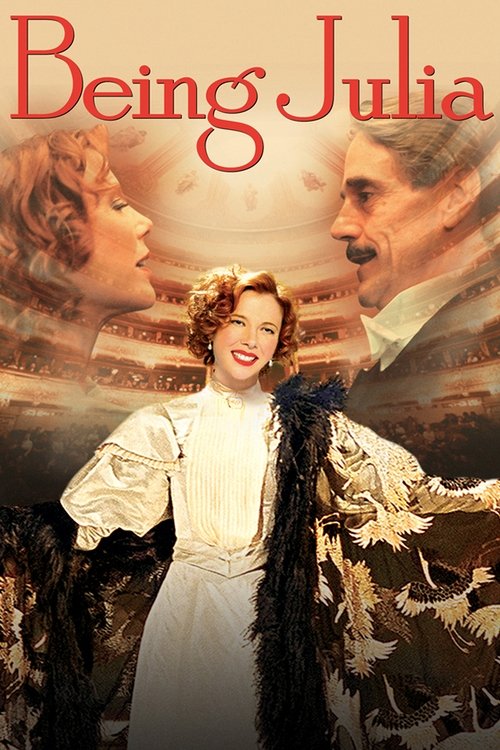
Being Julia (2004), based on a novel by W. Somerset Maugham, stars Annette Bening as a famous British actress experiencing a series of romantic and professional rivalries. Bening won a Golden Globe Award for her performance.
In 2005, Szabó was awarded the Lifetime Achievement Award at the 27th Moscow International Film Festival.
Rokonok (2006) was a Hungarian production based on a 1932 novel by Zsigmond Móricz about political corruption. Sándor Csányi plays a newly elected attorney general whose relatives (rokonok) come out of the woodwork looking for favors. It was entered into the 28th Moscow International Film Festival.
The Door (2012), an English language production based on a Hungarian novel by Magda Szabó (no relation), focuses on the relationship between an affluent novelist (Martina Gedeck) and her poor, mysterious maid (Helen Mirren). It opened the 13th Tbilisi International Film Festival and won the Michael Curtiz Audience Award at the Hungarian Film Festival of Los Angeles.
Szabó's frequent collaborators have included actors András Bálint, Klaus Maria Brandauer, Péter Andorai, and Ildikó Bánsági; cinematographer Lajos Koltai; and screenwriters Péter Dobai and Andrea Vészits.