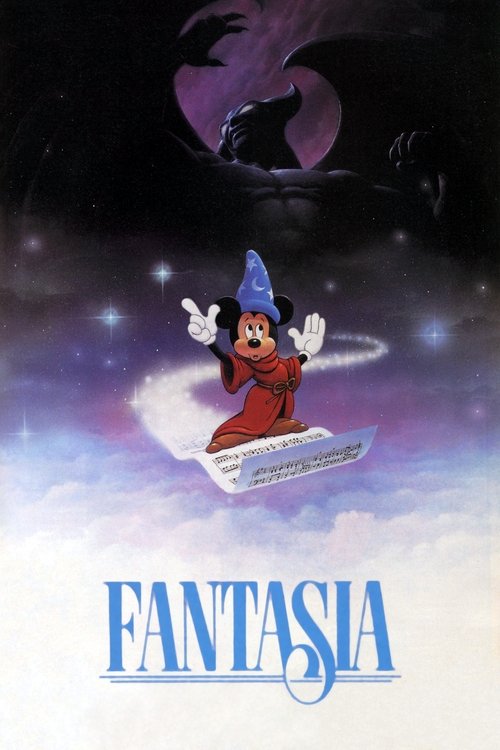

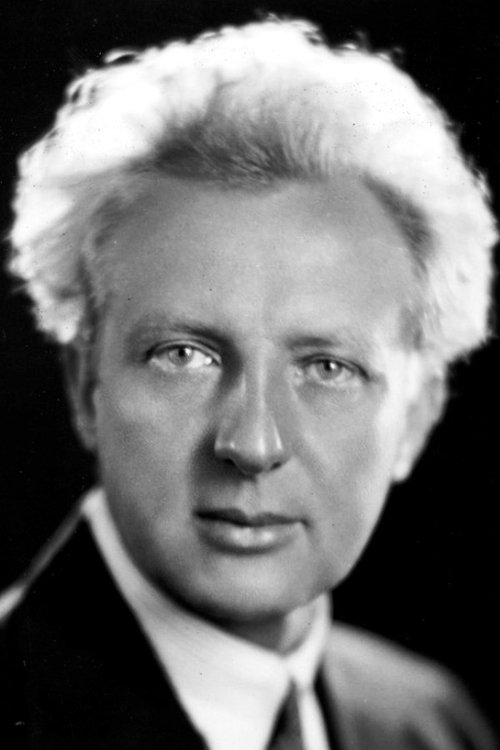
Fantasia is a 1940 American animated musical anthology film produced by Walt Disney Productions. The third Disney animated feature film, it consists of eight animated segments set to pieces of classical music conducted by Leopold Stokowski, seven of which are performed by the Philadelphia Orchestra. Music critic and composer Deems Taylor acts as the film's Master of Ceremonies who introduces each segment in live-action. The film's production was supervised by Walt Disney and Ben Sharpsteen, with story direction by Joe Grant and Dick Huemer.
Disney conceived the project in 1938 during the completion of The Sorcerer's Apprentice, which was originally planned as an elaborate Silly Symphony cartoon to revive the declining popularity of Mickey Mouse. When rising production costs threatened to outpace the short's potential revenue, Disney expanded the concept into a feature-length musical compilation with Stokowski and Taylor as collaborators. To accommodate the ambitious soundtrack, Disney and RCA developed Fantasound, a pioneering sound system that made Fantasia the first commercial film released in stereo and a precursor to surround sound.
Fantasia was first released as a theatrical roadshow that premiered at the Broadway Theatre in New York City on November 13, 1940. Disney funded and managed the roadshow himself until RKO Radio Pictures took over the roadshow distribution from April 1941, showing the film in a total of 13 U.S. cities. Despite widespread critical acclaim, the film was an initial box office failure. Its high production costs, the steep expense of leasing theatres and installing Fantasound equipment, and the loss of the European market due to World War II left the studio unable to turn a profit. Beginning in 1942, the film was reissued in a standard format by RKO and Buena Vista Distribution multiple times, with subsequent releases deleting, modifying, or restoring original footage and audio. Over time, these re-releases proved highly profitable; when adjusted for inflation, Fantasia ranks as the 23rd highest-grossing film of all time in the U.S.
Fantasia has since earned a reputation as one of the greatest animated films ever made. In 1990, it was selected for preservation in the U.S. National Film Registry by the Library of Congress for being "culturally, historically, or aesthetically significant." The American Film Institute ranked it as the 58th greatest American film overall in its 100 Years...100 Movies and the fifth greatest animated film on the 10 Top 10 list. The film's legacy has expanded into a multimedia franchise encompassing video games, theme park attractions, live concert tours, and the 1999 sequel, Fantasia 2000.
Contents
Program
Fantasia opens with live-action scenes of members of an orchestra gathering against a blue background and tuning their instruments in half-light, half-shadow. Master of ceremonies Deems Taylor enters the stage (also in half-light, half-shadow) and introduces the program.
Toccata and Fugue in D Minor by Johann Sebastian Bach. Live-action shots of the orchestra illuminated in blue and gold, backed by superimposed shadows, fade into abstract patterns. Animated lines, shapes and cloud formations reflect the sound and rhythms of the music.
The Nutcracker Suite by Pyotr Ilyich Tchaikovsky. Selections from the 1892 ballet suite underscore scenes depicting the changing of the seasons from summer to autumn to winter. A variety of dances are presented with fairies, fish, flowers, mushrooms, and leaves, including "Dance of the Sugar Plum Fairy", "Chinese Dance", "Arabian Dance", "Russian Dance", "Dance of the Flutes" and "Waltz of the Flowers".
The Sorcerer's Apprentice by Paul Dukas. Based on Goethe's 1797 poem "Der Zauberlehrling". Mickey Mouse, the young apprentice of the sorcerer Yen Sid, attempts some of his master's magic tricks but does not know how to control them.
The Rite of Spring by Igor Stravinsky. A visual history of the Earth's beginnings is depicted to selected sections of the ballet score. The sequence progresses from the planet's formation to the first living creatures, followed by the reign and extinction of the dinosaurs.
Intermission/Meet the Soundtrack: The orchestra musicians depart and the Fantasia title card is revealed. After the intermission there is a brief jam session of jazz music led by a clarinettist as the orchestra members return. Then a humorously stylized demonstration of how sound is rendered on film is shown. An animated sound track "character", initially a straight white line, changes into different shapes and colors based on the sounds played.
The Pastoral Symphony by Ludwig van Beethoven. A mythical Greco–Roman world of colorful centaurs and "centaurettes", cupids, fauns and other figures from classical mythology is portrayed to Beethoven's music. A gathering for a festival to honor Bacchus, the god of wine, is interrupted by Zeus, who creates a storm and directs Vulcan to forge lightning bolts for him to throw at the attendees.
Production
Development
In 1936, while Snow White and the Seven Dwarfs was still in production, Walt Disney felt that his cartoon studio's star character Mickey Mouse needed a boost in popularity as newcomers Donald Duck and Goofy had become new favorites amongst audiences. He decided to star Mickey in The Sorcerer's Apprentice, a deluxe cartoon short based on Goethe's poem of the same name and set to the orchestral piece by Paul Dukas also inspired by the original tale. Although Disney had explored the concept of matching animation to classical music since 1928 with his Silly Symphony cartoons, he wanted to go beyond the usual slapstick in those shorts and produce ones where "sheer fantasy unfolds". Upon receiving the rights to use the Dukas piece in July 1937, Disney considered using a well-known conductor to record the music for added prestige. He happened to meet Leopold Stokowski, then the conductor of the Philadelphia Orchestra, at Chasen's restaurant in Hollywood and talked about his plans for the short. An enthusiastic Stokowski informed Disney that he liked the piece and offered to conduct for free.
Disney's New York representative met Stokowski on a subsequent train journey, and reported the conductor was serious in his offer and "had some very interesting ideas on instrumental coloring, which would be perfect for an animation medium." Disney felt "all steamed up over the idea" and thought the partnership "would be the means of a success and should lead to a new style of motion picture presentation." He had already begun working on a story outline and wished to use "the finest men ... from color ... down to animators" on the new short that was to be promoted as a special and unique film, outside of the Mickey Mouse cartoon series. On December 16, 1937, Stokowski signed a contract with Disney that allowed him to "select and employ a complete symphony orchestra" for the recording of The Sorcerer's Apprentice, and was paid $5,000 for his services. The three-hour recording session began at midnight on January 9, 1938 at Culver Studios in California, with 85 Hollywood musicians. When production costs surpassed $125,000, as much as four times greater than the average Silly Symphony, Disney and his brother Roy, who managed the studio's finances, realised that the short could never earn such a sum back on its own. Roy urged his brother to keep additional costs to a minimum "because of its very experimental and unprecedented nature ... we have no idea what can be expected from such a production." Ben Sharpsteen, a production supervisor on Fantasia, recalled that Disney "saw this trouble in the form of an opportunity. This was the birth of a new concept, a group of separate numbers—regardless of their running time—put together in a single presentation. It turned out to be a concert—something novel and of high quality."
Segments
More than 1,000 artists and technicians were used in the making of Fantasia, which features more than 500 animated characters. Segments were color-keyed scene by scene so the colors in a single shot would harmonize between preceding and following ones. Before a segment's narrative pattern was complete, an overall color scheme was designed to the general mood of the music, and patterned to correspond with the development of the subject matter. The studio's character model department sculpted three-dimensional clay models so the animators could view their subject from all angles. The live action scenes were filmed using the three-strip Technicolor process, while the animated segments were shot in successive yellow, cyan and magenta-exposed frames. The different pieces of film were then spliced together to form a complete print. A multiplane camera that could handle seven levels, three more than the studio's original model, was built specifically for the film. Fantasia has 3,500 feet (1,100 m) of multiplane footage, more than Snow White and the Seven Dwarfs and Pinocchio combined.
Disney had been interested in producing abstract animation since he saw A Colour Box by Len Lye from 1935. He explained the work done in the Toccata and Fugue was "no sudden idea ... they were something we had nursed along several years but we never had a chance to try." Preliminary designs included those from effects animator Cy Young, who produced drawings influenced by the patterns on the edge of a piece of sound film. In late 1938, Disney hired Oskar Fischinger, a German artist who had produced numerous abstract animated films, including some with classical music, to work with Young. Upon review of three leica reels produced by the two, Disney rejected all three. According to Huemer, all Fishinger "did was little triangles and designs ... it didn't come off at all. Too dinky, Walt said." Fischinger, like Disney, was used to having full control over his work and not used to working in a group. Feeling his designs were too abstract for a mass audience, Fishinger left the studio in apparent despair, before the segment was completed, in October 1939. Disney had plans to make the Toccata and Fugue an experimental three-dimensional film, with audiences being given cardboard stereoscopic frames with their souvenir programs, but this idea was abandoned.
In The Nutcracker Suite, animator Art Babbitt is said to have credited The Three Stooges as a guide for animating the dancing mushrooms in the Chinese Dance routine. He drew with a music score pinned to his desk to work out the choreography so he could relate the action to the melody and the counterpoint, "those nasty little notes underneath ... so something has to be related to that". The studio filmed professional dancers Joyce Coles and Marjorie Belcher wearing ballet skirts that resembled shapes of blossoms that were to sit above water for Dance of the Flutes. An Arabian dancer was also brought in to study the movements for the goldfish in Arab Dance. Jules Engel also worked on the choreography and color-keying for this sequence. To avoid hard ink outlines, new techniques like transparent paint was used on the cels. The snowflakes used in the snowflake fairies sequence was difficult to draw by hand, so a man named Leonard Pickley, from the Special Effects Department, came up with the idea of using stop-motion animation. Diagrams of real snowflakes were traced by the Ink and Paint Department, who used a material a little heavier than regular cels, and painted them in translucent white. They were then cut out and placed on revolving spools attached to small steel rails. The mechanics was hidden under black velvet as the snowflakes were moved one frame at a time. The hand-drawn animation was added later.
Soundtrack
Disney wanted to experiment in more sophisticated sound recording and reproduction techniques for Fantasia. He said: "Music emerging from one speaker behind the screen sounds thin, tinkly and strainy. We wanted to reproduce such beautiful masterpieces ... so that audiences would feel as though they were standing at the podium with Stokowski". The Sorcerer's Apprentice was recorded in a three-hour session that began at midnight at the Culver Studios on January 9, 1938. The venue was chosen as the sound stage at the Disney studio at Hyperion Avenue was too small. Stokowski picked the 85 musicians himself, and felt they would be more alert by working at such a late hour. The session involved a single rehearsal. Engineers at Disney collaborated with RCA Corporation that involved recording with multiple audio channels to allow any desired dynamic balance to be achieved upon playback. The stage was altered acoustically with double plywood semi-circular partitions that separated the orchestra into five sections and acted as a baffle wall to increase reverberation. Chief Disney sound engineer William Garity was "very disappointed" with the overall results and was unable to have a full complete rehearsal and record the orchestra in separate sections as scheduled, but Stokowski insisted the recording was satisfactory.
On January 18, 1939, Stokowski signed an eighteen-month contract with Disney to conduct the remaining pieces with the Philadelphia Orchestra. The main recording sessions took place on April 6, 8, and 12, each three hours in length, at the Academy of Music, the orchestra's home which was chosen for its favourable acoustics. The 90-piece orchestra included some students at the Curtis Institute of Music, and each musician was paid a flat fee of $10 per hour with principal players receiving as much as $400. Ave Maria features Westminster Choir College under the supervision of Charles E. Henderson, and college affiliate Julietta Novis as the soprano solo. Disney commissioned American author Rachel Field to produce a set of original lyrics in English specifically for Fantasia, of which just one verse is sung in the film. Disney paid almost $18,000 towards the musician's wages, stage personnel, a music librarian, and the orchestra's manager.
Disney and RCA decided to abandon the multi-channel setup used on The Sorcerer's Apprentice and devised a more sophisticated one for the Academy sessions. Thirty-three microphones were placed around the orchestra that captured the music onto eight optical sound recording machines placed in the hall's basement, where engineers followed the music in real time and muted microphones when their assigned section was not playing. Each one represented an audio channel that focused on a different section of instruments: cellos and basses, violins, brass, violas, and woodwinds and tympani. The seventh channel was a combination of the first six while the eighth provided an overall sound of the orchestra at a distance. A ninth channel provided a click track function for the animators to time their drawings to the music. The film stock had to be stored in a truck parked outside the Academy as the highly flammable material posed a fire risk for the wooden basement. When the finished recordings arrived at the studio, a meeting was held on July 14, 1939, to allow the artists working on each segment to listen to Stokowski's arrangements, and suggest alterations in the sound to work more effectively with their designs. Some solo parts were subsequently re-recorded in California, but still under Stokowski's direction. In the 42 days it took to record, edit, and produce the final mix 483,000 feet (147,000 m) of film was used in the process.
Release history
Theatrical runs
RKO balked at the idea of distributing Fantasia, which it described as a "longhair musical", and believed its duration of two hours and five minutes plus intermission was too long for a general release. It relaxed its exclusive distribution contract with Disney, who wanted a more prestigious exhibit in the form of a limited-run roadshow attraction. A total of thirteen roadshows were held across the United States; each involving two daily screenings with seat reservations booked in advance at higher prices and a fifteen-minute intermission. Disney hired film salesman Irving Ludwig to manage the first eleven engagements, and he was given specific instructions regarding each aspect of the film's presentation, including the setup of outside theater marquees and curtain and lighting cues. Patrons were taken to their seats by staff hired and trained by Disney, and were given a program booklet illustrated by Gyo Fujikawa.
The first roadshow opened at the Broadway Theatre in New York City on November 13, 1940, the same theater where Steamboat Willie appeared 12 years earlier. The Disneys had secured a year's lease with the venue that was fully equipped with Fantasound, which took personnel a week working around the clock to install. Proceeds made on the night went to the British War Relief Society following the Battle of Britain. Ticket demand was so great that eight telephone operators were employed to handle the extra calls while the adjoining store was rented out to cater the box office bookings. Fantasia ran at the Broadway for forty-nine consecutive weeks, the longest run achieved by a film at the time. Its run continued for a total of fifty-seven weeks until February 28, 1942.
The remaining twelve roadshows were held throughout 1941, which included a 39-week run at the Carthay Circle Theatre in Los Angeles from January 29. Fantasia broke the long-run record at the venue in its twenty-eighth week; a record previously held by Gone with the Wind. Its eight-week run at the Fulton Theatre in Pittsburgh attracted over 50,000 people with reservations being made from cities located one hundred miles from the venue. Engagements were also held at the Geary Theatre in San Francisco for eight months, the Hanna Theatre in Cleveland for nine weeks, the Majestic Theatre in Boston, the Apollo Theater in Chicago, and also in Philadelphia, Detroit, Buffalo, Minneapolis, Washington, D.C., and Baltimore.
Fantasia grossed over $300,000 in the first sixteen weeks in New York; over $20,000 in the opening five weeks in San Francisco; and almost the same amount in the first ten weeks both in Los Angeles and Boston. The first eleven roadshows earned a total of $1.3 million by April 1941, but the $85,000 in production and installation costs of a single Fantasound setup, along with theatres having to be leased, forced Disney to exceed their loan limits. The onset of the Second World War prevented plans for a potential release in Europe, normally the source of as much as forty-five per cent of the studio's income. Up to eighty-eight engagements were outlined across five years, but wartime demands for material limited the number of Fantasound prints to sixteen. All but one of the Fantasound setups were dismantled and given to the war effort. Upon acquiring the film's distribution rights in April 1941, RKO initially continued the roadshow booking policy but presented the film in mono, which was easier to exhibit. The combined average receipts from each roadshow was around $325,000, which placed Fantasia at an even greater loss than Pinocchio.
Home media
Disney considered releasing the film's soundtrack around the time of the film's roadshow release, but this idea was not realized. The soundtrack was first released as a mono three LP set in sixteen countries by Disneyland and Buena Vista Records in 1957, containing the musical pieces without the narration. A stereo edition LP was issued by Buena Vista Records in 1961. Disney was required to obtain permission from Stokowski, who said he would not allow its sale unless the Philadelphia Orchestra Association received a share of the royalties.
The Kostal recording was released on two CDs, two LPs and two audio cassettes by Buena Vista Records, in 1982.
In September 1990, the remastered Stokowski soundtrack was released on CD and audio cassette by Buena Vista Records., and was later re-released in 2006. In the United States, it debuted the Billboard 200 chart at number 190, its peak position, for the week of November 17, 1990. Two months after its release, the album was certified gold by the Recording Industry Association of America (RIAA) for 500,000 copies sold in the United States. In January 1993, it was certified platinum for sales in excess of one million copies.
For the film's 75th anniversary in 2015, the Stokowski and Kostal recordings were released by Walt Disney Records on a four-disc album as the fifth volume of The Legacy Collection. The set includes Stokowski's recording of the deleted Clair de Lune segment, and a recording of The Sorcerer's Apprentice and Peter and the Wolf (from Make Mine Music) with added narration by Sterling Holloway; he himself narrated the latter originally.
Fantasia has received four home video releases. The first, featuring the 1990 restored theatrical version, was released on VHS, Betamax and LaserDisc on November 1, 1991, as part of the Walt Disney Classics line. The original soundtrack returned when Fantasound was also recreated in Dolby Stereo for the film's 1990 theatrical release. The result, named "Fantasound 90," was used as a basis of the audio for these releases. The release was limited to just 50 days, prompting 9.25 million advance orders for cassettes and a record 200,000 for discs, doubling the figure of the previous record. The "Deluxe Edition" package included the film, a "making of" feature, a commemorative lithograph, a 16-page booklet, a two-disc soundtrack of the Stokowski score, and a certificate of authenticity signed by Roy E. Disney, the nephew of Walt. In 1992, Fantasia became the biggest-selling sell-through cassette of all time in the US with 14.2 million copies being purchased. The record was surpassed later that year by Beauty and the Beast. It was also the UK's top selling video at the time, with sales of 3 million. By October 1994, 21.7 million copies of the video had been sold worldwide.
Reception
Critical response
Fantasia garnered significant critical acclaim at the time of release and was seen by some critics as a masterpiece. The West Coast premiere at the Carthay Circle Theatre was a grand affair, attracting some 5000 people, including Shirley Temple, Cecil B. DeMille, Forrest Tucker, James Cagney, Robert Montgomery, James Murphy, Edgar Bergen, and many other notables in the film industry. Among those at the film's premiere was film critic Edwin Schallert of the Los Angeles Times who considered the film to be a magnificent achievement in film which would go down in cinematic history as a landmark film, noting the rapturous applause the film received by the audience during the various interludes. He stated that Fantasia was "caviar to the general, ambrosia and nectar for the intelligentsia" and considered the film to be "courageous beyond belief". Isabel Morse Jones, the newspaper's music critic, had high praise for the soundtrack to the film, describing it as a "dream of a symphony concert", and an "enormously varied concert of pictorial ideas, of abstract music by acknowledged composers, of performers Leopold Stokowski and orchestra players of Hollywood and Philadelphia, and, for the vast majority, new and wonderful sound effects". Bosley Crowther of The New York Times, also at the premiere, noted that "motion-picture history was made last night ... Fantasia dumps conventional formulas overboard and reveals the scope of films for imaginative excursion ... Fantasia ... is simply terrific." Peyton Boswell, an editor at Art Digest, called it "an aesthetic experience never to be forgotten".
Time magazine described the premiere as "stranger and more wonderful than any of Hollywood's" and the experience of Fantasound "as if the hearer were in the midst of the music. As the music sweeps to a climax, it froths over the proscenium arch, boils into the rear of the theatre, all but prances up and down the aisles." Dance Magazine devoted its lead story to the film, saying that "the most extraordinary thing about Fantasia is, to a dancer or balletomane, not the miraculous musical recording, the range of color, or the fountainous integrity of the Disney collaborators, but quite simply the perfection of its dancing". Variety also hailed Fantasia, calling it "a successful experiment to lift the relationship from the plane of popular, mass entertainment to the higher strata of appeal to lovers of classical music". The Chicago Tribune assigned three writers to cover the film's Chicago premiere: society columnist Harriet Pribble; film critic Mae Tinee; and music critic Edward Barry. Pribble left amazed at the "brilliantly-attired audience", while Tinee felt the film was "beautiful ... but it is also bewildering. It is stupendous. It is colossal. It is an overwhelmingly ambitious orgy of color, sound, and imagination." Barry was pleased with the "program of good music well performed ... and beautifully recorded" and felt "pleasantly distracted" from the music to what was shown on the screen. In a breakdown of reviews from both film and music critics, Disney author Paul Anderson found 33% to be "very positive", 22% both "positive" and "positive and negative", and 11% negative.
Awards and honors
Fantasia was ranked fifth at the 1940 National Board of Review Awards in the Top Ten Films category. Disney and Stokowski won a Special Award for the film at the 1940 New York Film Critics Circle Awards. Fantasia was the subject of two Academy Honorary Awards on February 26, 1942—one for Disney, William Garity, John N. A. Hawkins, and the RCA Manufacturing Company for their "outstanding contribution to the advancement of the use of sound in motion pictures through the production of Fantasia", and the other to Stokowski "and his associates for their unique achievement in the creation of a new form of visualized music in Walt Disney's production Fantasia, thereby widening the scope of the motion picture as entertainment and as an art form".
In 1990, Fantasia was selected for preservation in the United States National Film Registry by the Library of Congress as being "culturally, historically, or aesthetically significant". On the 100th anniversary of cinema in 1995, the Vatican included Fantasia in its list of 45 "great films" made under the Art category (the other categories being Religion and Values). Fantasia is featured in three lists that rank the greatest American films as determined by the American Film Institute. The film ranked number 58 in 100 Years... 100 Movies in 1998, before it was dropped from its ranking in the 10th Anniversary revision in 2007, though it was nominated for inclusion. The 10 Top 10 list formed in 2008 placed Fantasia fifth under Animation.
Controversies
In April 1939, Philadelphia advertising agent Mark S. Tutelman filed an injunction suit in an attempt to prevent the film being made. Tutelman claimed the film originated from an idea of synchronizing animation with classical music which he first described to Stokowski in 1937, had prepared scenarios and orchestral arrangements at Stokowski's request without acknowledgement or credit, and demanded a cut of the film's proceeds. In April 1940, Tutelman's case was dismissed. In 1942, Tutelman filed a $25,000 damage suit against Stokowski, charging the conductor of a misappropriation of ideas without credit. In April 1942, the Irish Film Censor insisted the film cut Taylor's scientific introduction to The Rite of Spring due to its "materialistic portrayal of the origins of life".
In the 1960s, four shots from The Pastoral Symphony were removed that depicted two characters in a racially stereotyped manner. A black centaurette called Sunflower was depicted polishing the hooves of a white centaurette, and a second named Otika appeared briefly during the procession scenes with Bacchus and his followers. The characters were initially removed for a 1963 re-run of the Disneyland episode Magic and Music, which originally aired uncut in 1958. Disney himself approved of the changes. The episode aired uncut on television once again in 1966, before the edits were incorporated into the film's 1969 theatrical reissue and has remained on all releases since. John Carnochan, the editor of the 1991 video release, said: "It's sort of appalling to me that these stereotypes were ever put in". Film critic Roger Ebert commented on the edit: "While the original film should, of course, be preserved for historical purposes, there is no need for the general release version to perpetrate racist stereotypes in a film designed primarily for children." Several fan restoration projects online re-insert the cut scenes back.
In May 1992, the Philadelphia Orchestra Association filed a lawsuit against The Walt Disney Company and Buena Vista Home Video. The orchestra maintained that as a co-creator of Fantasia, the group was entitled to half of the estimated $120 million in profits from video and laser disc sales. The orchestra dropped its case in 1994 when the two parties reached an undisclosed settlement out of court. British music publisher Boosey & Hawkes filed a further lawsuit in 1993, contending that Disney did not have the rights to distribute The Rite of Spring in the 1991 video releases because the permission granted to Disney by Stravinsky in 1940 was only in the context of a film to be shown in theaters. A federal district court backed Boosey & Hawkes's case in 1996, but the Second Circuit Court of Appeals reversed the ruling in 1998, stating that Disney's original "license for motion picture rights extends to video format distribution".
Additional material
Disney had wanted Fantasia to be an ongoing project, with a new edition being released every few years. His plan was to replace one of the original segments with a new one as it was completed, so audiences would always see a new version of the film. From January to August 1941, story material was developed based on additional musical works, including Ride of the Valkyries by Richard Wagner, The Swan of Tuonela by Jean Sibelius, Invitation to the Dance by Carl Maria von Weber, the Polka and Fugue from Schwanda the Bagpiper by Jaromír Weinberger, a "baby ballet" set to Berceuse by Frédéric Chopin and a "bug ballet" set to Flight of the Bumblebee by Nikolai Rimsky-Korsakov, which was later adapted into the Bumble Boogie segment in Melody Time (1948). The film's disappointing initial box office performance and the USA's entry into World War II brought an end to these plans. Deems Taylor prepared introductions for The Firebird by Stravinsky, La Mer by Claude Debussy, Adventures in a Perambulator by John Alden Carpenter, Don Quixote by Richard Strauss, and Pictures at an Exhibition by Mussorgsky "to have them for the future in case we decided to make any one of them".
Another segment, Debussy's Clair de lune, was developed as part of the film's original program. After being completely animated, it was cut out of the final film to shorten its lengthy running time. The animation depicted two great blue herons flying through the Florida Everglades on a moonlit night, with more focus towards the segment's background art than story and animation. The sequence was later edited and re-scored for the Blue Bayou segment in Make Mine Music (1946). In 1992, a workprint of the original was discovered and Clair de Lune was restored, complete with the original soundtrack of Stokowski with the Philadelphia Orchestra. It was included as a bonus feature in The Fantasia Anthology DVD in 2000.
Destino, a collaboration between Walt Disney and surrealist artist Salvador Dalí, was also considered for inclusion as a future Fantasia segment, but was shelved until it was re-discovered during production of Fantasia 2000. In her host sequence for The Steadfast Tin Soldier in that film, Bette Midler mentions several cancelled sequences, specifically Ride of the Valkyries, Destino, Flight of the Bumblebee, Berceuse and the Polka and Fugue.
Legacy
Fantasia will enter the American public domain on January 1, 2036, assuming the Disney corporation does not further alter United States government policy as with Mickey Mouse.
Sequel
In 1980, the Los Angeles Times reported that Wolfgang Reitherman and Mel Shaw had begun work on Musicana, "an ambitious concept mixing jazz, classical music, myths, modern art and more, following the old Fantasia format". Animation historian Charles Solomon wrote that development took place between 1982 and 1983, which combined "ethnic tales from around the world with the music of the various countries". Proposed segments for the film included a battle between an ice god and a sun goddess set to Finlandia by Sibelius, one set in the Andes to the songs of Yma Sumac, another featuring caricatures of Louis Armstrong and Ella Fitzgerald and an adaptation of The Emperor's Nightingale which would have featured Mickey as the nightingale's owner, similar to his role in The Sorcerer's Apprentice. The project was shelved in favor of Mickey's Christmas Carol, though the artwork made for The Emperor's Nightingale would later be used for a book adaptation by Teddy Slater in 1992.
Roy E. Disney, the nephew of Walt, co-produced Fantasia 2000 which entered production in 1990 and features seven new segments performed by the Chicago Symphony Orchestra with conductor James Levine. The Sorcerer's Apprentice is the only segment retained from the original film. Fantasia 2000 premiered at Carnegie Hall on December 17, 1999, as part of a five-city live concert tour, followed by a four-month engagement in IMAX cinemas and a wide release in regular theatres, in 2000.
Early development for a third film began in 2002, with Fantasia 2006 as a working title. The proposed segments included The Little Matchgirl by Roger Allers, One by One by Pixote Hunt, Lorenzo by Mike Gabriel, and Destino by Dominique Monféry. The project was shelved in 2004, with the proposed segments released as individual short films.
Live-action adaptations
The Sorcerer's Apprentice segment was adapted by Jerry Bruckheimer into the feature-length film The Sorcerer's Apprentice (2010).
The Nutcracker Suite segment serves as a partial inspiration for the feature-length film The Nutcracker and the Four Realms (2018), which itself contains several references to Fantasia.
The Night on Bald Mountain segment was reported in 2015 as being in development by Disney Productions for a feature-length live-action film with a treatment written by Matt Sazama and Burk Sharpless. In 2021, it was reported that the project had been scrapped.
Parodies and references in other media
Fantasia is parodied in A Corny Concerto, a Warner Bros. cartoon from 1943 of the Merrie Melodies series directed by Bob Clampett. The short features Elmer Fudd in the role of Taylor, wearing his styled glasses, who introduces two segments set to pieces by Johann Strauss (Tales from the Vienna Woods and the Blue Danube Waltz, the former featuring Porky and Bugs and the latter featuring Daffy). In 1976, Italian animator Bruno Bozzetto produced Allegro Non Troppo, a feature-length parody of Fantasia.
The animated television series The Simpsons references Fantasia in a few episodes. Matt Groening, the creator of the series, expressed a wish to make a parody film named Simpstasia; it was never produced, partly because it would have been too difficult to write a feature-length script. In "Treehouse of Horror IV", director David Silverman had admired the animation in Night on Bald Mountain, and made the first appearance of Devil Flanders resemble Chernabog. The episode "Itchy & Scratchy Land" references The Sorcerer's Apprentice in a snippet titled "Scratchtasia", which features the music and several shots parodying it exactly.
In 2014, BBC Music created a music education scheme similar to Fantasia called Ten Pieces, intended to introduce children to classical music. Spanning two films (in 2014 and 2015), several pieces featured in the Fantasia films are also included.
The 2018 film Teen Titans Go! To the Movies references Fantasia during the musical sequence "My Superhero Movie".
Theme parks
From 2001 to 2015, the Sorcerer's Hat was the icon of Disney's Hollywood Studios, one of the four theme parks located at Walt Disney World Resort. The structure was of the magic hat from The Sorcerer's Apprentice. Also located at the resort is Fantasia Gardens, a miniature golf course that integrates characters and objects from the film in each hole. The fireworks and water show Fantasmic! features scenes from The Sorcerer's Apprentice and other Fantasia segments on water projection screens, and involves the plot of Mickey as the apprentice doing magic whilst also battling the Disney Villains.
For the 20th anniversary of Disneyland Paris, Mickey was depicted in a special version of his Sorcerer's Apprentice outfit with his friends wearing similar outfits. The "Night on Bald Mountain" segment is featured in the Storybook Land Canal Boats attraction at Disneyland Park in Paris along with the Fantasia Gelati ice cream shop in Fantasyland which is also inspired by the film.
Mickey's outfit, water buckets, and Yen Sid's spell book and chair are on display as props from The Sorcerer's Apprentice segment in the queue of the Mickey & Minnie's Runaway Railway attraction at Disneyland.
Video games
In 1983, Atari released a game called Sorcerer's Apprentice for the Atari 2600, based on that segment of Fantasia. The player, as Mickey Mouse, must collect falling stars and comets which will prevent the marching brooms from flooding Yen Sid's cavern.
In 1991, a side-scrolling Fantasia video game developed by Infogrames was released for the Sega Mega Drive/Genesis system. The player controls Mickey Mouse, who must find missing musical notes scattered across four elemental worlds based upon the film's segments.
There are several film reel levels based on some of the film's segments such as Sorcerer's Apprentice and Night on Bald Mountain that appear in the Epic Mickey games. Yen Sid and Chernabog also make cameo appearances in the games (Yen Sid narrates the openings and endings of the two games and served as the creator of the Wasteland. Chernabog appears as a painting in the first game and appears in the Night on Bald Mountain film reel levels in the second).
The Disney/Square Enix crossover game series Kingdom Hearts features Chernabog as a boss in the first installment. The Night on Bald Mountain piece is played during the fight. Yen Sid appears frequently in the series beginning with Kingdom Hearts II, voiced in English by Corey Burton. Symphony of Sorcery, a world based on the film, appears in Kingdom Hearts 3D: Dream Drop Distance. Like the Timeless River world in Kingdom Hearts II, it is featured as a period of Mickey Mouse's past.
Fantasia: Music Evolved, a music game, was developed by Harmonix in association with Disney Interactive for the Xbox 360 and Xbox One consoles. The game utilizes the Kinect device to put players in control of music in a manner similar to Harmonix' previous rhythm games, affecting the virtual environment and interactive objects within it. The game features licensed contemporary rock music such as Queen and Bruno Mars.
Mickey, in his Sorcerer's Apprentice guise, appears as a playable character in Disney Infinity.
Chernabog and Yen Sid appear as playable characters in the mobile game Disney Heroes: Battle Mode.
Concert
A live concert presentation of the film named Disney Fantasia: Live in Concert, showcases various segments from both Fantasia and Fantasia 2000. The concert version features a live symphony orchestra and piano soloist accompanying projected high definition video segments. The Fantasia concert was still touring throughout the world as late as 2022.
Television
Several elements from the film appear in television series Once Upon a Time. The hat from The Sorcerer's Apprentice appears in the fourth season episode "A Tale of Two Sisters". As the series progressed, the hat was shown to have the ability to absorb others, and those it absorbed would appear as a star on the hat. The Sorcerer's Apprentice himself makes an appearance, where he is an old man who guards the hat in the Enchanted Forest.
Chernabog from Night on Bald Mountain also makes an appearance in the episode "Darkness on the Edge of Town".
Credits
Musical score conducted by Leopold Stokowski. Performed by the Philadelphia Orchestra, except as noted.


