

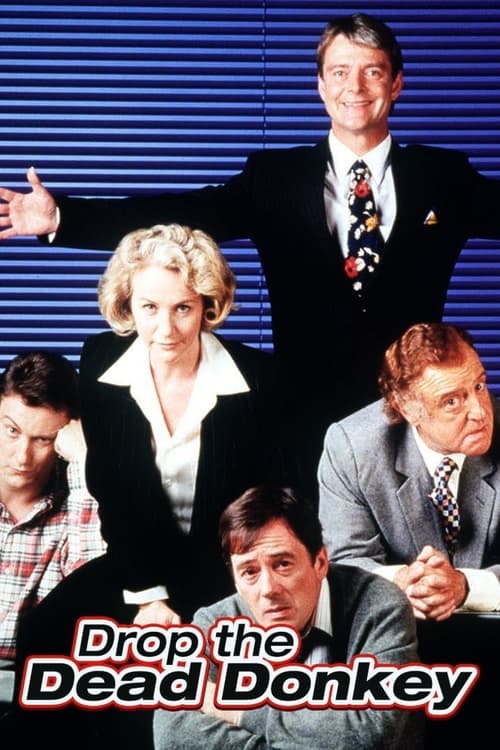


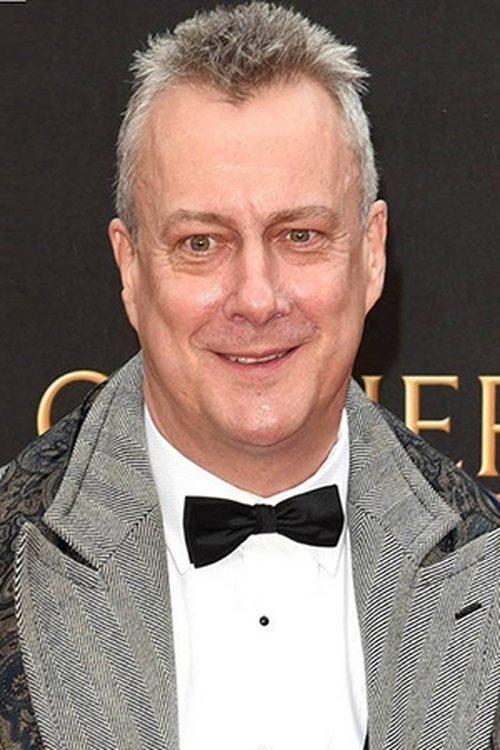

Drop the Dead Donkey is a British television sitcom that was first shown on Channel 4 in the United Kingdom between 1990 and 1998. It is set in the offices of "GlobeLink News", a fictional TV news company. Recorded close to transmission, it made use of contemporary news events to give the programme a greater sense of realism. It was created by Andy Hamilton and Guy Jenkin. The series had an ensemble cast, making stars of Haydn Gwynne, Stephen Tompkinson and Neil Pearson.
The show was awarded the Best Comedy (Programme or Series) Award at the 1994 BAFTA Awards. At the British Comedy Awards the show won Best New TV Comedy in 1990, Best Channel 4 Comedy in 1991, and Best Channel 4 Sitcom in 1994.
In 2000, the show was ranked 94 on the 100 Greatest British Television Programmes, a list compiled by the British Film Institute.
Contents
Development
The series' story began with the acquisition of GlobeLink by media mogul Sir Roysten Merchant, an allusion to either Robert Maxwell or Rupert Murdoch. Indeed, Andy Hamilton and Guy Jenkin note on their DVDs that it was fortunate for their libel lawyers that the two men shared the same initials. The series is mostly based on the ongoing battle between the staff of GlobeLink, led by editor George Dent, as they try to maintain the company as a serious news organisation, and Sir Roysten's right-hand man Gus Hedges, trying to make the show more sensationalist and suppress stories that might harm Sir Roysten's business empire.
One of the original working titles was Dead Belgians Don't Count. Dead Kuwaitis Don't Count was also considered for a short time but was ultimately replaced by Drop the Dead Donkey:
Finally, the title ‘Drop the Dead Donkey’ has been the subject of many column inches. Various journalists have with great authority explained its provenance as a well-known industry expression. The truth, sadly, is that the writers made it up. It's just something stupid that they imagined might be shouted out in the tense few minutes before a news broadcast.
Characters
Major characters
Gus Hedges (Robert Duncan) – Series One to Six – The unctuous Chief Executive of the company, yes-man to Sir Roysten Merchant and an unwavering supporter of then Conservative Prime Minister John Major is a management stereotype, complete with clichés. He transforms GlobeLink from a serious news network to a ratings-chasing tabloid channel. He is notable for management jargon, such as, "Are we cooking with napalm? You bet!" In light of what he refers to as his "hands-off" role, he frequently prefaces his interference in editorial matters with the opening, "Now, as you all know, I’m not here..." He is disliked and distrusted by the staff, who treat him with contempt. Outside the office, Gus is lonely. He has no real friends, and his occasional attempts to make friends at work fail, largely because of his insistence on behaving like an "executive management module". George appears to be the closest thing Gus has to a friend, but while Gus heavily leans on George for emotional support he shows no interest in reciprocating and frequently over-rides George's opinions and concerns. He once openly lamented that what others did to advance their careers, he had to do to maintain his current position. Some of these personality traits stem from his childhood; his older brother was his parents’ favourite and Gus has terrible feelings of inadequacy. He is sexually inexperienced and fears advances from women. He is afraid of illness, and thoughts of his own mortality terrify him. Despite his executive position, he fears that he has not really achieved anything and will be quickly forgotten. Gus is alleged to have been based on Channel 4's controller at the time, Michael Grade, although the original idea was first pitched to the BBC, with Channel Four only picking up the series after the BBC refused to broadcast it. In series 6, terrified by the news of Globelink's upcoming closure, Gus comes up with unlikely schemes to keep the company afloat and becomes increasingly comically desperate in his attempts to get reassurance from Sir Roysten, who ignores all his phone calls.
George Dent (Jeff Rawle) – Series One to Six – The station's editor. George is a nervous wreck and hypochondriac who frequently finds himself in conflict with Gus over editorial decisions, but he is usually too afraid to argue with the Chief Executive. George is generally a moral man, who has a good sense of what a news company should really be doing and what stories are important, but he is frequently bullied by Gus and distracted by his staff. He has a number of anxiety disorders and apparently psychosomatic symptoms, which he will often relate apprehensively to his colleagues. George once remarked that his doctor had suggested that he stop visiting the surgery and simply fax his new symptoms in every day. In earlier series, George comes across as broadly competent if a bit weak willed before troubles in his personal life take their toll and the job becomes out of his depth with Henry remarking in Series 3 'George seems particularly out of it these days'. George also has appalling bad luck, such as when he buys Henry's car, whose gearbox almost immediately fails; Damien has the car stolen so George can claim it on insurance, but George has already spent £2,000 on a new gearbox, and before Damien can get the car back it rolls off a cliff. George does become noticeably more confident and extroverted when drunk, although this rarely happens. On the rare occasions when George develops some confidence without alcohol such as after a paintballing weekend away where he got to take out some of his frustrations on Gus, he finds himself able to competently handle his job and manage his hypochondria. However, this is short-lived and he is quickly confronted with another insecurity. Earlier scripts followed the deterioration of George's marriage to his somewhat exploitative and vindictive wife, Margaret, and following their divorce, George's problems at home generally revolved around the antisocial and increasingly criminal behaviour of his daughter Deborah. He meets a woman from Poland called Anna (played by his real-life wife, Nina Marc) who wants to marry him but he believes it is out of love when all she wants is a passport. In spite of the general view that George is useless and inept he is commonly sought out by the other members of Globelink for advice on their personal problems. George appears particularly close to Dave despite their vast differences, George has loaned Dave significant sums of money and tries to advise and help Dave through his troubles despite his advice often making things worse.
Recurring characters
Sir Roysten Merchant – Sir Roysten Merchant is a wealthy businessman, unofficially based on a combination of Robert Maxwell and Rupert Murdoch – the initials RM are no coincidence – who buys out GlobeLink News in the first episode and remains the owner of the company throughout all six series. He is unseen on screen until a brief appearance in the final show, in which he is played by Roger Hammond and suggests that he does not know who Gus is. Sir Roysten is a terrifying figure, with a large business empire. He is also involved in housing, shipping, and sundry more shady enterprises which, based on the information that occasionally comes to the attention of the GlobeLink News team, border on (if not specifically involve) the illegal. On buying the company Sir Roysten installs Gus Hedges (see above) to prevent any potentially damaging information being leaked out in news stories. Sir Roysten is a right-wing figure, supporting both Margaret Thatcher and John Major. However, when Major and the Conservative government begin to weaken from 1994, his support starts to shift, and with the Labour victory in 1997 Sir Roysten defects to Tony Blair. In private, it is known that Sir Roysten visits prostitutes and that his wife, Lady Caroline, also has many affairs. He has a daughter, Octavia, who works for a brief time in the GlobeLink office, and a son, Roy Merchant Junior, who lives in fear of his father. Other offspring are not named, aside from one reference from Gus to a "Roystonia" – however, no further information is provided. Persistent rumours circulate to the effect that Sir Royston's father, who was also a businessman, was a Nazi sympathiser and war profiteer. Sir Roysten has several pet rottweilers and an armed personal security team who guard his mansion.
Gerry (voiced by Andy Hamilton) – One of GlobeLink's outside broadcast cameramen, Gerry is regularly assigned to work with Damien and frequently suffers injuries and mishaps as a result. His footage would normally end with something unpleasant happening to Gerry, while Damien yells at him to keep filming. Gerry is an unseen character, but incidents are frequently shown from the point of view of his camera as it disappears down holes, off cliffs or into rivers. His only on-screen appearance (of sorts) is at the office Christmas party, but on this occasion, he is covered head to toe in bandages. Gerry seems to have a decent sense of both morals and safety standards but is usually overruled by a determined Damien.
Deborah Dent (Louisa Milwood-Haigh) – George's daughter, and one of the main problems at home. A juvenile delinquent, Deborah frequently runs away from home, steals cars and other vehicles (including a fully laden car transporter and an InterCity 125), sells drugs (George's prescription medication), sets fire to supply teachers, and attacks her school classmates with a pickaxe handle. She once attempted to sue her school for failing to provide her with an education – having previously burned the school buildings down, and on one occasion is mentioned as having found her way to a Middle East guerrilla training camp. She expresses love (as well as pity) for her father, and they bond in one episode over getting revenge on Damien by taking a hammer to his Porsche.
Scripting
Unusually for a sitcom, the show was topical, and was usually written and filmed in the week before broadcast. The writers commented that this made for a very natural style of acting. In most offices, people normally converse while looking at monitors, clipboards or newspaper crosswords; the cast of the show reproduced this while actually cribbing their lines. The character plots for each episode were written in advance, and delivered to the cast on the Monday before recording. The scripts would then be re-written to add in topical references over the next few days. Typically, the last scene was filmed either the day before or sometimes on the day of broadcast, and episodes concluded with audio-only dialogue or (in later series) an additional scene during the credits, which would usually involve topical references. The most frantic rewrite is said to have occurred when, on the day of filming, British media mogul Robert Maxwell drowned. (As the writers said in a later episode, "We don't want to go overboard with the story.") A number of politicians including Neil Kinnock and Ken Livingstone made guest appearances.
The humour, like that in a real newsroom, was often very black, as the writers did not shy away from sensitive subjects. A typical line (from Henry): "The 'Troubles' in Northern Ireland. What a bloody stupid phrase. What do they think two thousand people have died from? Stress?" The view of relationships in the programme is also very bleak: all the main characters have very unstable romantic lives, with no-one being happily married.
The series ended with GlobeLink being closed down, with Series 6 being spent with the main characters trying to plan their futures elsewhere (largely unsuccessfully). The format for the final series differed slightly from the previous five. As well as being shorter (seven episodes), far less emphasis was placed on the news than before (both in terms of topical references and stories covered in the newsroom). Instead, much of the focus was on where the main characters would be once GlobeLink closed, after an announcement in the second episode of the series. Several minor characters appeared over the course of a few episodes in the final series, whereas most previously had only been in single episodes.
The ending contradicted the novel Drop the Dead Donkey 2000 by Hamilton and Alistair Beaton (1994) ISBN 0-316-91236-0, in which the company is almost destroyed in a bomb blast at the turn of the millennium.
Episodes
Drop the Dead Donkey started with an un-broadcast 1989 pilot episode. The first series started airing in August 1990, and the programme continued until the end of the sixth series in December 1998.
Including the pilot, 66 episodes were produced.
Home media
Five compilation videos, each featuring three selected episodes of Drop the Dead Donkey, were released during the 1990s. There was also a sixth, called "The Writer's Choice", which featured six episodes plus 50 classic moments chosen by the writers Andy Hamilton and Guy Jenkin.
Between 2005 and 2007 VCI (UK, now part of 2 Entertain) released all six series on DVD, via their Cinema Club label. They were also collected into two box sets, featuring three series apiece. Extra features included the unaired pilot, and introductions and interviews with Andy Hamilton, Guy Jenkin and the cast. In 2015, all six series were re-released in a "Complete Series" box set by Spirit Entertainment.
Repeats
Repeats of the programme often appeared on Comedy Central Extra. Before the show starts, there is often a short review of the major news events which happened during the week of each episode's filming. Episodes on DVD compilations are introduced in the same way (although not for Series 6 when topical references were very limited).
All series are now available via Channel 4's All 4 service and the UK streaming service BritBox.
All episodes are available in the US on the online streaming service Acorn TV starting in December 2014.
As of April 2024, it is available in the US on the streaming service TUBI.
2024 stage version
In May 2023, it was announced that a stage version, written by Hamilton and Jenkin and reuniting the surviving members of the main cast, would tour the UK in 2024.
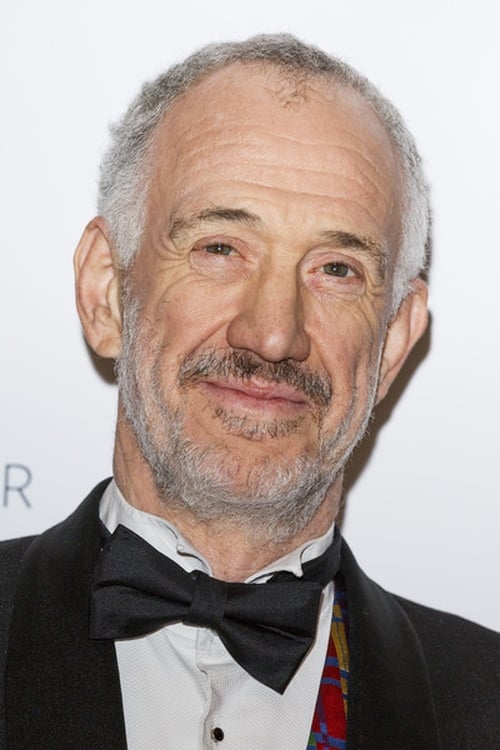
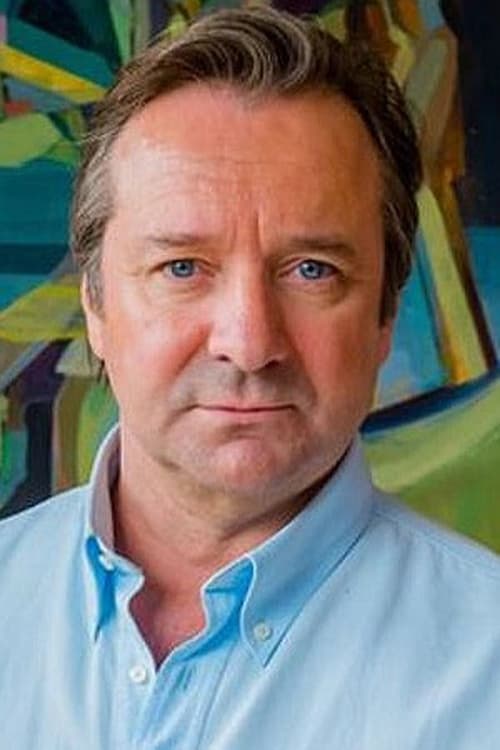
Entitled Drop the Dead Donkey: The Reawakening!, the new production is directed by Derek Bond and produced by Hat Trick Productions and Simon Friend Entertainment. The tour began at Richmond Theatre in January 2024, and will return there for a second run in June 2024 after performances around the country. As well as Susannah Doyle, Robert Duncan, Ingrid Lacey, Neil Pearson, Jeff Rawle, Stephen Tompkinson and Victoria Wicks, the show features Julia Hills and Kerena Jagpal.
Swedish version
Swedish comedian Kryddan Petersson, producer of the Swedish show Helt Apropå, has said that he and his colleagues had come up with an idea for a show like this, which they presented to British colleagues some time around 1989–1990. He has asserted that, although most of them were not impressed, two of them took the idea seriously and wrote this show. Later, the Swedish group brought the material rights to the show back to Sweden, and created the show Döda danskar räknas inte ("Dead Danes don't count"), which aired on SVT in 1994.