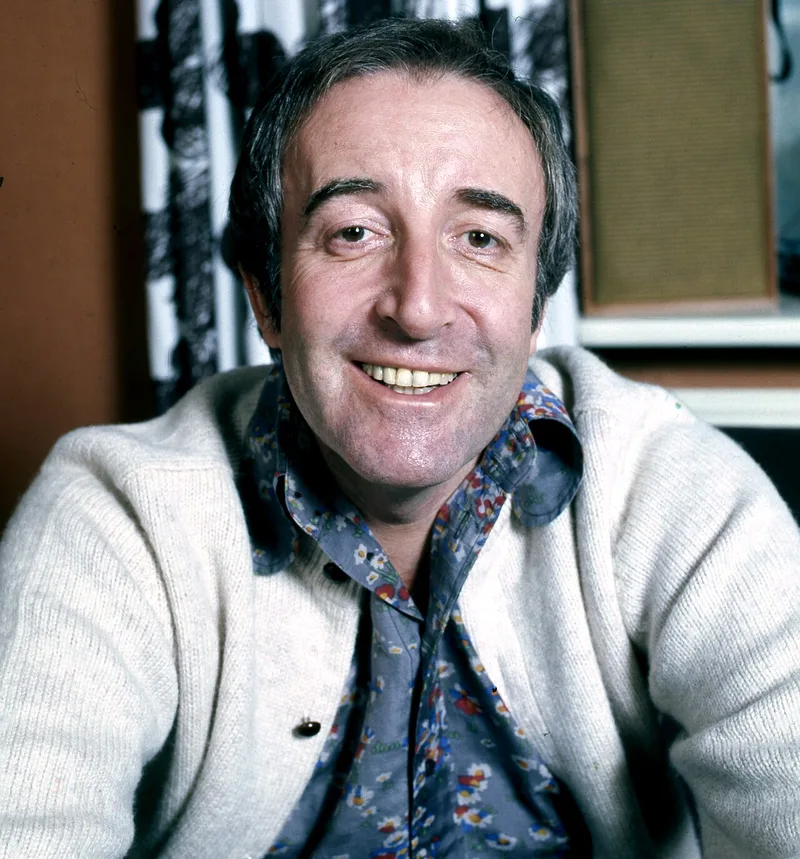
Peter Sellers's roles
Columbia Pictures agreed to finance the film if Peter Sellers played at least four major roles. The condition stemmed from the studio's opinion that much of the success of Kubrick's previous film Lolita (1962) was based on Sellers's performance, in which his single character assumes several identities. Sellers also played three roles in The Mouse That Roared (1959). Kubrick accepted the demand, later saying that "such crass and grotesque stipulations are the sine qua non of the motion-picture business."
Sellers had been expected to play Air Force Major T. J. "King" Kong, the B-52 aircraft commander, but was reluctant; he felt his workload was too heavy and worried he would not properly portray the character's Texan accent. Kubrick pleaded with him, and he asked the screenwriter Terry Southern (who had been raised in Texas) to record a tape with Kong's lines spoken in his accent; Sellers then practiced using Southern's tapes. After the start of shooting in the aircraft, Sellers sprained his ankle and could no longer work in the cramped aircraft mockup.
Sellers improvised much of his dialogue, with Kubrick incorporating the ad-libs into the written screenplay, a practice known as retroscripting.
According to film critic Alexander Walker, the author of biographies of both Sellers and Kubrick, the role of Group Captain Lionel Mandrake was the easiest of the three for Sellers to play, since he was aided by his experience of mimicking his superiors while serving in the RAF during World War II. There is also a heavy resemblance to Sellers's friend and occasional co-star Terry-Thomas and the prosthetic-limbed RAF flying ace Sir Douglas Bader.
For his performance as President Merkin Muffley, Sellers assumed a Midwestern American English accent. Sellers drew inspiration for the role from Adlai Stevenson, a former Illinois governor who was the Democratic candidate for the 1952 and 1956 presidential elections and the U.N. ambassador during the Cuban Missile Crisis.
In early takes, Sellers simulated cold symptoms to emphasize the character's apparent weakness. That caused frequent laughter among the film crew, ruining several takes. Kubrick ultimately found this comic portrayal inappropriate, feeling Muffley should be a serious character. In later takes, Sellers played the role straight, though the President's cold is still evident in several scenes.
Dr. Strangelove is a scientist and former Nazi, evoking Operation Paperclip, the US effort to recruit top German technical talent at the end of World War II. He serves as President Muffley's scientific adviser in the War Room. When General Turgidson wonders aloud to Mr. Staines (Jack Creley), what kind of name "Strangelove" is, as it does not sound like a "Kraut name", Staines responds that Strangelove's original German surname was Merkwürdigliebe ("strange love" in German) and that "he changed it when he became a citizen". Strangelove accidentally addresses the president as Mein Führer twice in the film. Dr. Strangelove did not appear in the book Red Alert.
The character is an amalgamation of the Hungarian mathematician John Von Neumann, RAND Corporation strategist Herman Kahn, rocket scientist Wernher von Braun (a central figure in Nazi Germany's rocket development program recruited to the US after the war), and Edward Teller, the "father of the hydrogen bomb". Rumors claimed the character was based on Henry Kissinger, but Kubrick and Sellers denied this; Sellers said: "Strangelove was never modeled after Kissinger—that's a popular misconception. It was always Wernher von Braun." Furthermore, Henry Kissinger points out in his memoirs that at the time of the writing of Dr. Strangelove, he was a little-known academic.
The wheelchair-using Strangelove furthers a Kubrick trope of the menacing, seated antagonist, first depicted in Lolita through the character Dr. Zaempf. Strangelove's accent was influenced by that of Austrian-American photographer Weegee, who worked for Kubrick as a special photographic effects consultant. Strangelove's appearance echoes the mad scientist archetype as seen in the character Rotwang in Fritz Lang's film Metropolis (1927). Sellers's Strangelove takes from Rotwang the single black gloved hand (which, in Rotwang's case, is mechanical because of a lab accident), the wild hair, and, most importantly, his ability to avoid being controlled by political power. According to Alexander Walker, Sellers improvised Dr. Strangelove's lapse into the Nazi salute, borrowing one of Kubrick's black leather gloves for the uncontrollable hand that makes the gesture. Dr. Strangelove apparently has alien hand syndrome. Kubrick wore the gloves on the set to avoid being burned when handling hot lights, and Sellers, recognizing the potential connection to Lang's work, found them to be menacing.