



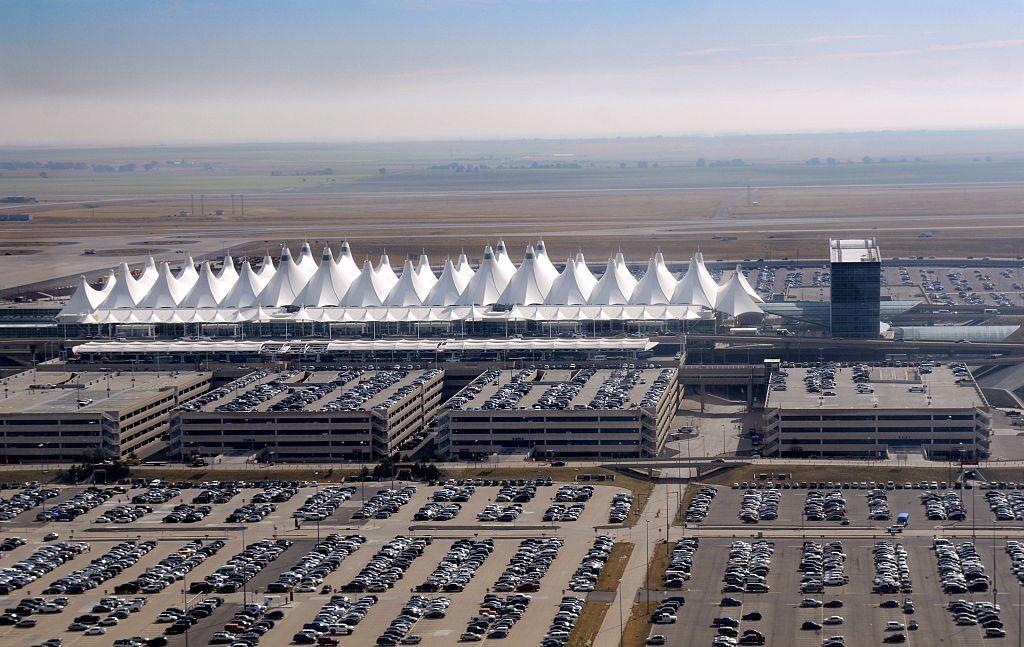
Denver International Airport (IATA: DEN, ICAO: KDEN, FAA LID: DEN), often referred to by locals as DIA, is an international airport in the Western United States, primarily serving metropolitan Denver, Colorado, as well as the greater Front Range Urban Corridor.
Runway 16R/34L, with a length of 16000 ft (4877 m), is the longest public use runway in North America and the fifth longest in the world. The airport is 25 miles (40 km) driving distance northeast of Downtown Denver, 19 miles (31 km) farther than the former Stapleton International Airport which DEN replaced; the airport is actually closer to the city of Aurora than central Denver, and many airport-related services, such as hotels, are located in Aurora.
Opened on February 28, 1995, DEN serves 26 airlines (as of 2025) providing nonstop service to 230 destinations throughout the Americas, Europe, and Asia; it was the fourth airport in the United States to exceed 200 destinations. The airport has been the largest operating hub for Frontier Airlines and Southwest Airlines for several years and, as of 2024, DEN has eclipsed Chicago's O'Hare International Airport as the largest operating hub for United Airlines as well. The Colorado Department of Transportation's 2025 Economic Impact Study estimated that the airport contributes $47.2 billion annually to Colorado's economy and, with over 40,000 employees, the airport is the largest employer in the state of Colorado. The airport is located on the western edge of the Great Plains and within sight of the Front Range of the Rocky Mountains.
In 2021 and 2022, DEN was the third busiest airport in the world as well as the third busiest airport in the United States by passenger traffic. In 2023, it was the sixth busiest airport in the world and remained the third busiest in the United States, having served around 77.8 million passengers, more than a 12% increase from the prior year. DEN has been among the top 20 busiest airports in the world and top 10 busiest airports in the United States every year since 2000.
In 2025, DEN set an all-time passenger record with 82,427,962 passengers served, up 0.1% over the previous record set in 2024.
Contents
History
Denver has traditionally been home to one of the busier airports in the United States because its midcontinent location was ideal for an airline hub. Several airlines, notably United Airlines and Continental Airlines, had hubs at the former Stapleton International Airport, helping make it the sixth-busiest airport in the country by the 1960s. However, Stapleton had little room to add more flights and its runways were too close together, which led to long delays and nationwide travel disruptions in bad weather.
From 1980 to 1983, the Denver Regional Council of Governments investigated areas for a new area airport north and east of Denver. Meanwhile, in 1983, Federico Peña was elected mayor of Denver, campaigning on a plan to expand Stapleton onto Rocky Mountain Arsenal lands. The plan had broad support, but leaders in nearby Adams County threatened to sue over noise concerns.
Eventually Peña struck a deal: Adams County leaders would rally citizens to back a plan for Denver to annex 54 square miles (140 km2) of the county to build an airport away from established neighborhoods. In 1988, Adams County voters approved the annexation. The proposal was met with some skepticism because of its location: 24 miles (39 km) from the heart of the city. But seeing the importance of a Denver air hub to the national transportation system, the federal government put $500 million (equivalent to $1.1 billion as of 2024) toward the new airport. The rest of the cost would be financed by bonds, to be repaid with fees on airlines. Ground was broken in September 1989.
Two years later, Mayor Wellington Webb inherited the megaproject, which at that time was scheduled to open on October 29, 1993. At the time United was refusing to move to the new airport over the high proposed fees. The airline finally relented under the condition that the airport include an automated baggage system.
Construction delays pushed opening day back, first to December 1993, then to March 1994. By September 1993, delays due to a millwright strike and other events meant opening day was pushed back again to May 1994.
In April 1994, the city invited reporters to observe the first test of the new automated baggage system. Reporters were treated to scenes of clothing and other personal effects scattered beneath the system's tracks and carts that would often toss the luggage right off the system. After the embarrassing preview, the mayor cancelled the planned May opening. The baggage system continued to be a maintenance hassle and was finally terminated in September 2005, with traditional baggage handlers manually handling cargo and passenger luggage.
Facilities
The airport is 23 miles (37 km) from Downtown Denver, which is 15 miles (24 km) farther away than Stapleton International Airport, the airport DEN replaced.
The 33,531 acres (52.4 sq mi; 135.7 km2) of land owned by DEN is the largest amount of commercial airport land area in North America, by a great extent. DEN is so large that in terms of airports, Dallas Fort Worth International Airport, Chicago O'Hare International Airport, Hartsfield-Jackson Atlanta International Airport, and Los Angeles International Airport can fit into the airport's expansive property with almost 500 acres (200 ha) of land to spare. The land, transferred from Adams County to Denver after a 1989 vote, increased the city's size by 50 percent and bifurcated the western portion of the neighboring county. All freeway traffic accessing the airport from central Denver leaves the city and passes through Aurora for nearly two miles (3.2 km), making the airport a practical exclave. Similarly, the A Line rail service connecting the airport with downtown Denver has two intervening stations in Aurora.
Terminal
DEN has one terminal, named the Jeppesen Terminal after aviation safety pioneer Elrey Borge Jeppesen, and three midfield concourses, spaced far apart. The three midfield concourses have a total of 169 gates in operation as of early 2025. Concourse A is accessible via a pedestrian bridge directly from the terminal building, as well as via the underground train system that services all three concourses. For access to Concourses B and C, passengers must utilize the train. All international arrivals without border pre-clearance are processed in Concourse A; this concourse also has four 3-jetway international gates that can support ADG Group VI aircraft such as an Airbus A380 and a Boeing 747-8, the two largest commercial aircraft in the world.
Concourse A is used by Alaska Airlines, Allegiant Air, Breeze Airways, Delta Air Lines, Frontier Airlines, JetBlue, Sun Country Airlines and United Airlines (including all international arrivals), and all international carriers. It has 60 gates, including several ground-level boarding and double jetway gates.
Concourse B is solely used for United Airlines flights. It has 72 gates, including four double jetways and several regional gates.
Concourse C is primarily used for Southwest Airlines flights, as well as American Airlines, and the majority regional airliner flights. It has 47 gates, including four ground-level boarding gates.
In 2023, the airport announced a plan to significantly increase its passenger capacity by expanding the Jeppesen Terminal by 2045 with additional check-in and TSA counters. The plan would also add new concourses with a further 100 gates.
Security
Passenger security screening at Denver International Airport is operated directly by the Transportation Security Administration (TSA) and is centralized within two closely mirrored checkpoints (East and West Security) located on the east and west sides at the north end of Level 6 in the Jeppesen Terminal. Each checkpoint features 17 screening lanes (34 total).
With the centralization of screening to Level 6, all legacy security areas, including the former South, North, and Bridge checkpoints have been permanently closed as of August 2025. Following these closures and the opening of East and West Security checkpoints, the pedestrian bridge connecting the Jeppesen Terminal to Concourse A reopened as a post-security walkway, allowing screened passengers to walk directly to Concourse A from either the East or West checkpoint as an alternative to the underground train system. Access to Concourses B and C is available exclusively via the train.
Both East and West Security accommodate Standard screening, TSA PreCheck, CLEAR, combined TSA PreCheck with CLEAR, premium/premier access, military personnel, passengers with accessibility needs, and restricted access personnel. DEN Reserve has been discontinued at all security checkpoints.
Operating hours for the checkpoints and screening lanes are as follows:
East Security Checkpoint:
Standard Screening: 3:00 a.m. to 8:00 p.m. daily
TSA PreCheck: 4:00 a.m. to 8:00 p.m. daily
West Security Checkpoint:
Standard Screening: 3:30 a.m. to 1:00 a.m. (next morning) daily
TSA PreCheck: 4:00 a.m. to 8:45 p.m. daily
Denver International Airport does not offer 24-hour passenger security screening.
Art and aesthetics
The Jeppesen Terminal's internationally recognized peaked roof, designed by Fentress Bradburn Architects, resembles snow-capped mountains and evokes the early history of Colorado when Native American teepees were located across the Great Plains. The catenary steel cable system, similar to the Brooklyn Bridge design, supports the fabric roof. DEN is also known for a pedestrian bridge connecting the terminal to Concourse A that allows travelers to walk from the main Terminal to Concourse A, while viewing planes taxiing beneath them. It offers views of the Rocky Mountains to the west and the high plains to the east.
Denver's public art program (which is financed by a mandatory 1% capital improvement budget) has resulted in a significant number of artworks being installed at the airport. The artwork includes sculptures, murals, photos, sound art and paintings.
The airport features a bronze statue of Denver native Jack Swigert by Loveland, Colorado, artist George Lundeen in Concourse B. Swigert flew on Apollo 13 as Command Module Pilot, and was elected to the House of Representatives in 1982, but died of cancer before he was sworn in. The statue is dressed in an A7L pressure suit, and is posed holding a gold-plated helmet. It is a duplicate of a statue placed at the United States Capitol in 1997. George Lundeen is also the sculptor of The Aviator, a monumental bronze sculpture of Elrey Borge Jeppesen, for whom the terminal is named.
Denver International Airport has four murals by the Chicano artist Leo Tanguma. Children of the World Dream of Peace is in two-parts. The first depicts the horrors of war, with a man in a gasmask brandishing a saber. The second, larger part shows this man toppled, and smiling children from many nations making swords into plowshares; Tanguma explains this is a reference to the Book of Isaiah 2:4:...and they shall beat their swords into plowshares—nation shall not lift up sword against nation, neither shall they learn war any more. Per Denver Public Art:"Children of the World Dream of Peace" is a powerful mural expressing the artist's desire to abolish violence in society. One section of the piece speaks to the tragedy and devastation of war and its impact on humanity. The mural then moves on to images of smiling children, dressed in traditional folk costumes from around the world, celebrating peace prevailing over war.In Peace and Harmony With Nature is also in two parts; Denver Public Art explains that:The first half of the mural shows children displaying great sadness over the destruction and extinction of life, as the second half of the artwork depicts humanity coming together to rehabilitate and celebrate nature.Tanguma confirms this was his intent.
Ground transportation
The Regional Transportation District (RTD) operates the A Line rail service between DEN and Denver Union Station in downtown Denver, making the 37 minute trip about every 15 minutes. RTD also operates an airport express bus service called skyRide between Arapahoe County or Boulder and DEN. There is also hourly service to Thornton on RTD route 104L, a limited stop bus. The airport is also served by two commuter routes with just a few runs per day: RTD route 145X to Brighton and 169L to Aurora.
Scheduled bus service is also available to points such as Fort Collins, and van services stretch into Nebraska, Wyoming, and Colorado summer and ski resort areas. Amtrak offers a Fly-Rail plan for ticketing with United Airlines for trips into scenic areas in the Western U.S. via a Denver stopover.
The airport is connected to I-70 and Denver via the Peña Boulevard freeway. A number of car rental companies are located at the airport, providing courtesy shuttle services from Jeppesen Terminal Level 5, Island 4, to their parking areas.
The airport claims that it is completely accessible to bicycling travelers. The city of Denver's designated bike route consists of the non-separated shoulders of the 65-mph Peña Boulevard freeway, a route which Denver's former bicycle planner James Mackay has called "a facade, an appearance, a deceit, a contrivance." The airport suggests that cyclists who prefer a less-traveled route may use 56th Avenue to Valleyhead Road, a rural 55-mph highway with no shoulder.
Conspiracy theories
Conspiracies concerning the airport, inspired by the type of art, unusual architecture, and construction problems, started shortly after its completion. With the expansion of the internet, television shows such as Conspiracy Theory with Jesse Ventura, and annual media reporting of these theories, they continued to grow. Airport administration decided to embrace the conspiracy theories instead of trying to fight them. In 2016, a small "Conspiracy Theories Uncovered" exhibition was installed in the terminal, explaining some of the more popular theories. In 2019, an animatronic gargoyle named Gregoriden, or Greg for short, that randomly makes statements such as "welcome to Illuminati headquarters" was installed. Some took offense to the gargoyle, claiming it was satanic, so the gargoyle was removed and replaced with a more muted version. Other gargoyle statues, sitting on open suitcases, are in the baggage claim area. Some also view these statues as malevolent, despite their intended purpose as playful artistic creations that are claimed to safeguard luggage.
In April 2019, the Roswell International Air Center and Denver International Airport became "supernatural sister airports." In the agreement, they would work together to enhance industry best practices that involve commerce, trade and tourism. It also includes a clause that they would share strategies for extraterrestrial combat. For the airport's 20th birthday, plans to decorate the airport property with crop circles proved to be too expensive, so they were not implemented. In a marketing campaign that was tied to renovations started in 2018, posters were created with aliens joking that breeding grounds for gargoyles or meeting halls for Freemasons were being constructed. The campaign was successful, generating over $8 million in revenue.
Theories
Tunnels: The delay in opening the airport and the large budget overrun led to a variety of rumors about the tunnels that were built under the airport. The scope has been exaggerated, and there is lore that the tunnels lead to underground survival bunkers for the rich and elite, military bases, homes for aliens, homes for lizard people, or to the North American Aerospace Defense Command. The actual use for the tunnels is to move luggage between check-in counters, airplanes and baggage claim areas. Employees have been known to prank the media by wearing lizard masks. Blurry videos of lizard people have appeared online and drawings of aliens have appeared on tunnel walls. However, other graffiti, besides alien drawings, exist along the tunnels.
New World Order and other secret societies: Because of the isolated location, there are rumors that the airport will be used by the New World Order as a prison or concentration camp. The time capsule at the airport showcases an inscribed plaque that has the Freemason symbol and the words "New World Airport Commission," which is a group that has never existed, prompting the conspiracy theory that the airport is controlled by Freemasons and linked to the New World Order or other secret societies. A spokesperson for Denver International Airport, Alex Renteria, has said that the Freemasons had created the cover, and thus had included their symbol, but there is no evidence that they have any influence in running the airport. The wording about the commission was used to represent that the new airport would permit access to the world and is a reference to Dvořák's New World Symphony.
Nazism: Tanguma's murals have been purported to represent Nazism, death, or a prophecy of the end of the world, counter to the artist's meaning. The removal of the murals to keep them safe during construction prompted rumors that the project was an excuse to cover the truth. In addition, there are conspiracy theories around Nazism based on the supposedly swastika-shaped runway arrangement, which aerial views refute.
Alien languages: People have noted apparent markings that are supposed to represent alien or secret languages. The markings are actually Navajo language characters and identifiers for the airport artists.
Blue Mustang eyes: The red, glowing eyes have led some to call the horse statue demonic, thinking that the glowing eyes are referencing the Four Horsemen of the Apocalypse. The eyes are actually a tribute to the artist's father, who owned a neon light shop in Mexico.
Airlines and destinations
Statistics
Accidents and incidents
On December 20, 2008, Continental Airlines Flight 1404, a Boeing 737-500 bound for George Bush Intercontinental Airport in Houston, departed the left side of runway 34R during the takeoff roll during high (30 knots) crosswinds. A post-crash fire ensued. There were 6 serious injuries and 41 minor injuries, and 68 passengers were uninjured. There were no fatalities. The aircraft was destroyed and written off. The captain's cessation of right rudder input during takeoff was the major cause of the accident.
On May 8, 2026, Frontier Airlines Flight 4345, an Airbus A321neo bound for Los Angeles International Airport was taking off on runway 17L when it struck and killed a trespasser who had jumped over the perimeter fence. The aircraft stopped on the runway. The collision caused an engine fire, prompting passengers to evacuate via the escape slides.