




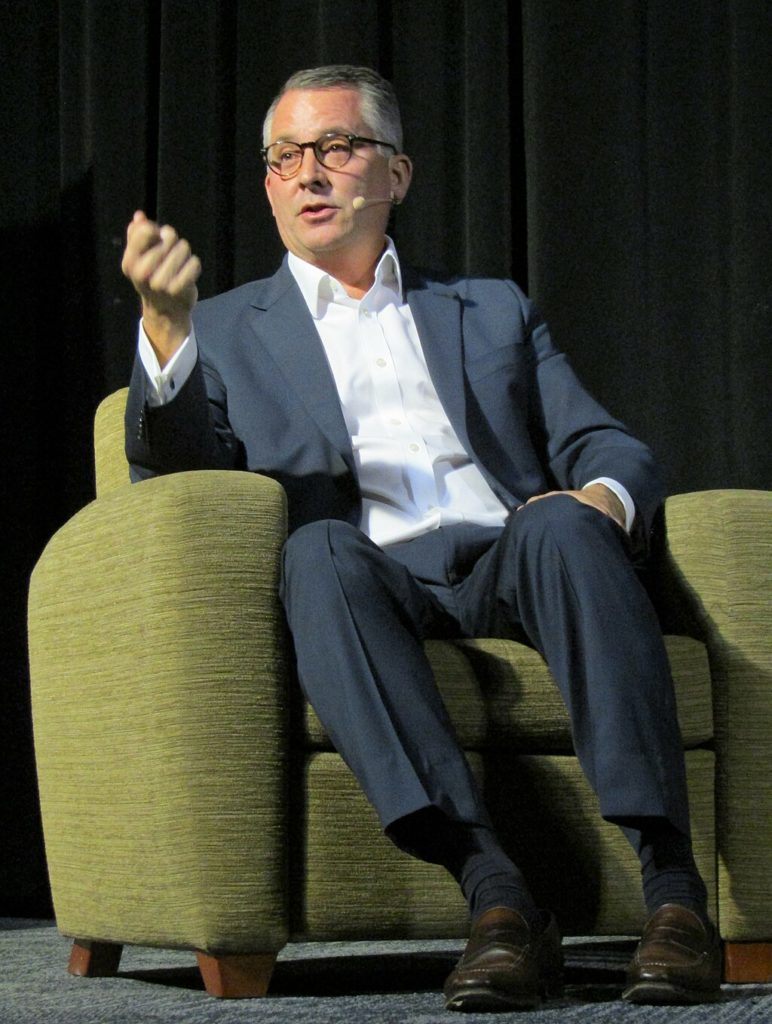
David Wilson Jolly (born October 31, 1972) is an American attorney, politician, and lobbyist who served as the U.S. representative for Florida's 13th congressional district from 2014 to 2017 as a Republican. After leaving office, Jolly became a prominent Republican critic of President Donald Trump and a political pundit. In September 2018, Jolly left the Republican Party.
In April 2025, Jolly switched his party registration to run in the 2026 Florida gubernatorial race as a Democrat.
Contents
Early life and education
Jolly was born in Dunedin, Florida, the son of Judith and Lawson Jolly, a Baptist pastor. He grew up in Dade City, Florida. At age 16, Jolly was involved in an automobile accident that killed a pedestrian; authorities determined that he was not at fault.
He received his B.A. degree from Emory University in 1994 and his J.D. degree from the George Mason University School of Law in 2001.
U.S. House of Representatives (2014–2017)
Before running for political office, Jolly worked for Republican U.S. Representative Bill Young full time from 1995 to 2006 in various positions, with a brief break for six months in 2001 when he worked at a Washington securities firm. In 2002, Jolly became Young's general counsel and held that position until he left in 2006. He served as the personal attorney for Young's family as well.
In 2007, Jolly joined Washington, D.C. firm Van Scoyoc Associates as a lobbyist and in 2011, he left Van Scoyoc to open his own lobbying firm, Three Bridges Advisors. During his time as a lobbyist he made political donations to both Republicans (about $36,000) and Democrats (about $30,000). Jolly had his name removed from the Lobby Registry to run for the vacant House seat. At the time, Jolly was working as vice president of the Clearwater-based investment company Boston Finance Group.
2014 special election
After being behind in the early tallies, Jolly won the 2014 election on March 11, with 48.4% of the vote. He was sworn into office on March 13.
Jolly had won the Republican nomination on January 14, 2014, over Mark Bircher and Kathleen Peters, winning a plurality of 45% of the vote. Jolly faced Democratic nominee Alex Sink and a Libertarian candidate, Lucas Overby, in the special election. The race received national attention as possibly forecasting the mid-term elections that were coming in November of that year and became the most expensive Congressional race in history, with approximately $11M spent, $9M of it by outside groups. During the campaign there was friction between the National Republican Congressional Committee and Jolly; the RNC thought Jolly's campaign was inept and Jolly criticized the negative ads run by the RNC. and voters were generally unhappy with the overwhelming number of attack ads on both sides.
2014 general election
Jolly ran for reelection to a full term in November 2014. He was unopposed in the Republican primary and no Democrat ran against him in the general election. His only challenger was Lucas Overby, the Libertarian nominee who came in third in the special election one year prior. Jolly defeated Overby with 75% of the vote.
2016 U.S. Senate election
On July 20, 2015, Jolly announced that he was giving up his seat to run for the United States Senate seat being vacated by Marco Rubio, who was not running for reelection due to his bid for the U.S. presidency. As of August 2015, it appeared that Jolly would face several opponents in the August 30, 2016, Republican primary election, including U.S. Representative Ron DeSantis and Lieutenant Governor of Florida Carlos López-Cantera. However, on June 17, 2016, after Rubio reversed his decision, Jolly withdrew from the Senate race to run for re-election to the House, citing "unfinished business".
2016 general election
In his bid for a second full term, Jolly faced former Florida Governor and St. Petersburg resident Charlie Crist, a former Republican who had turned Democratic after a brief stint as an independent. He found himself in a district that had been made significantly more Democratic after a court threw out Florida's original congressional map. Notably, the new district absorbed a heavily Democratic portion of southern Pinellas County, including almost all of St. Petersburg; some of the more Democratic portions of St. Petersburg had previously been in the Tampa-based 14th District.
Ultimately, Jolly lost to Crist by 51.9% to 48.1%. Jolly's defeat ended a 62-year hold on this St. Petersburg-based district by the GOP. William Cramer had won the seat for the Republicans in 1954, handing it to Young in 1970.
Tenure
According to Politico, Jolly was known for his centrist stances in U.S. Congress, where he served one partial and one full term as a Republican. During his Congressional tenure, Jolly opposed the Patient Protection and Affordable Care Act, but later he stated on an interview with MSNBC that during unemployment he had a new appreciation for its use as a "safety net". In 2016, Jolly said that he was "pro-life".
Jolly introduced the bipartisan "Stop Act" in 2016 to prohibit federally elected officials from directly soliciting campaign funds or donations on the belief that post-Citizens United fundraising was taking an excessive amount of their time away from their elected duties.
In April 2016, Jolly's United States Senate campaign spokesperson Sarah Bascom confirmed that the campaign had made edits to his Wikipedia page to remove information about Jolly that included references to the Church of Scientology and to his lobbying activities, alleging that the posts presented a "public negative narrative" against him, and she accused an unnamed rival campaign of adding "propaganda" to the article. Jolly called the removal "a careless staff mistake" and said that he stands by his record and wants the public to be fully informed.
In 2016, Jolly was ranked as the 48th most bipartisan member of the U.S. House of Representatives during the 114th United States Congress (and the fourth most bipartisan House Rep. from Florida) by The Lugar Center and the McCourt School of Public Policy.
Committee on Appropriations
Subcommittee on Commerce, Justice, Science, and Related Agencies
Subcommittee on Military Construction, Veterans Affairs, and Related Agencies
Subcommittee on Transportation, Housing and Urban Development, and Related Agencies
Between campaigns (2017–2026)
Since leaving his Congressional office, Jolly has participated regularly as a political commentator on cable news sources such as CNN and MSNBC; in this capacity he has been critical of President Donald Trump. He considered running for lieutenant governor of Florida in 2018 on a bipartisan ticket, with former Democratic congressman Patrick Murphy as the candidate for governor. They conducted a speaking tour around the state. Jolly ultimately decided not to run for any public office in 2018.
In October 2018, Jolly appeared on HBO's Real Time with Bill Maher and said that he and his wife, Laura, had quit the Republican party. In April 2025, Jolly registered as a Democrat.
In July 2018, Jolly became executive vice president and principal of Shumaker Advisors Florida, LLC, a wholly owned subsidiary of the Shumaker, Loop, and Kendrick law firm, at their Tampa office. In making the announcement, the firm said he would be working on ballot initiatives and community issues, including the effort to build a new stadium for the Tampa Bay Rays major league baseball team.
2026 gubernatorial campaign
After formally joining the Democratic Party that April, in June 2025 Jolly announced a campaign for governor of Florida for the 2026 election. His running mate is former Democratic congresswoman Gwen Graham from Florida's 2nd congressional district, with whom he served in the House of Representatives, and the runner-up in the Democratic gubernatorial primary in 2018.
Jolly states that, unlike Charlie Crist, who has commented, "I didn't leave the party. The [Republican] party left me," his experience differs as Jolly himself left the Republican Party after changing his views. He argues that this is a strength, not a weakness, as opposed to what his critics say, because America "needs more politicians willing to admit they were wrong" and evolve to meet the moment where voters currently are. He further contends that many voters have also changed their beliefs in the past few years.
Political positions
U.S. debt
Jolly supported the Balanced Budget Amendment and said he would have voted to raise the debt limit in early 2014.
Foreign policy
Jolly also supported sending special operations forces overseas, securing the border, increasing the vetting process for legal immigrants, and increasing surveillance of suspected domestic terrorists. In February 2014, Jolly introduced the "Naval Station Guantanamo Bay Protection Act" bill.
Energy
In 2015, Jolly pushed to extend the ban on oil drilling in the gulf off Florida. In January 2015, Jolly announced plans to introduce a bill that would extend the reforms of the federal flood insurance program. In July 2015, Jolly introduced the "Veterans Health Care Freedom Act" bill. Jolly encouraged the U.S. House to extend the Treasure Island beach renourishment project.
Education
Jolly proposed a 10-year plan to revitalize public education in Florida if elected Governor, including increasing teacher pay by 30% so salaries are closer to the national average. He also stated that he would direct Florida's state university system to prioritize the admittance of in-state students, and has called for reforms to the universal school voucher program.
Jolly stated that he would not participate in culture wars, arguing that "to bring politicians into the classrooms and the bedrooms and the doctor's offices, where the results are often communities who have already been marginalized, and are now further marginalized, I just think that's the wrong direction."
LGBTQ+ rights
In July 2014, Jolly declared support for legalizing same-sex marriage. Although he does not personally support same sex-marriage due to his Christian faith, he explained that "the sanctity of one’s marriage should be defined by their faith and by their church, not by their state", and that this position was consistent with his support of limited government and the protection of personal liberties.
Jolly is similarly opposed to government regulation of transgender women in women's sports despite his personal objection, stating that "if a 10- or 12-year-old soccer league in the community has a coed team, I don't think the governor should be throwing a flag on the field". When asked about his support of gender-affirming care for minors, Jolly similarly stated that he supported parents' rights to make medical decisions for their children without government interference, and that "I simply subscribe to the old-school Republican position that government should stay out of your life, out of your doctor's office, and out of your bedroom".
In August 2026, following an attack ad by his Republican opponent Byron Donalds centered on his implied support of transgender rights (stemming from a quote taken out of context from his appearance on a LGBTQ+ podcast), Jolly stated that "local communities should be able to celebrate their own and that government should stay out of your medical decisions."
Abortion
Jolly states that he is pro-choice, having shifted his position on the issue after leaving the Republican Party, and he supports Florida restoring reproductive freedom and codification of the Roe v. Wade and Casey v. Planned Parenthood framework. He said that having grown up in an evangelical household as the son of a preacher, he had previously conflated being religious with opposing Roe. He affirmed his belief and change in perspective that abortion rights should be protected by law, adding that, if elected governor, he would introduce legislation to codify abortion rights. By July 2025, he was endorsed by the leaders of Florida's pro-choice movement, including Gwen Graham, who wrote that they trusted him and his change in perspective.
Firearms
Speaking about firearms policy, Jolly said: "I do believe the Second Amendment is a fundamental right, but I don't believe it's beyond the reach of regulation, and I believe it's appropriate to look at regulations that ultimately keep the guns out of the hands of criminals."
Initially supporting a broad interpretation of the Second Amendment, he now advocates for stricter firearm regulations. He has expressed support for measures such as licensing, registration, and insurance requirements for gun ownership. He has cited the 2016 Pulse nightclub shooting as a turning point, noting his participation as the only Republican joining Democrats on the House floor to call for legislative action. Jolly now supports comprehensive background checks, including for private and intra-family transfers, as well as an assault weapons ban. He has stated that he views unlimited and largely unrestricted access to firearms as a primary contributor to gun violence. He said that Republicans are lying when they say that gun owners, not a lack of gun control, are the problem in cases of gun violence and mass shootings.
Jolly says that he wants the votes of gun owners because he respects their rights and believes that they are not the problem, but rather that Florida's lack of gun violence prevention laws are. He argues that no law-abiding gun-owning voters will be hurt by his proposals which will "protect their children".
Democratic party
Jolly said he believes that the "Democratic Party's values are absolutely right and don't need to be changed" as some prominent Democrats have proposed following the party's 2024 presidential election loss.
Personal life
Jolly and his first wife, Carrie, divorced on January 16, 2014.
Jolly married Laura Donahoe on July 3, 2015.They have two children.