Revolutionary government (1959–present)
The US government initially reacted favorably to the Cuban Revolution, seeing it as part of a movement to bring democracy to Latin America. Castro's legalization of the Communist Party and the hundreds of executions of Batista agents, policemen, and soldiers that followed caused a deterioration in the relationship between the two countries. The promulgation of the Agrarian Reform Law, expropriating thousands of acres of farmland (including from large U.S. landholders), further worsened relations. In response, between 1960 and 1964 the U.S. imposed a range of sanctions, eventually including a total ban on trade between the countries and a freeze on all Cuban-owned assets in the U.S. In February 1960, Castro signed a commercial agreement with Soviet Vice-Premier Anastas Mikoyan.
In March 1960, U.S. President Dwight D. Eisenhower gave his approval to a CIA plan to arm and train a group of Cuban refugees to overthrow the Castro government. The CIA provided B-26 light bombers and ships to the rebels for the invasion. On 15 April 1961 at dawn, Brigade 2506 flew from Puerto Cabezas, Nicaragua, and carried out preemptive airstrikes on Cuban military airfields at San Antonio de Los Baños, Ciudad Libertad, Pinar del Río, and Santiago de Cuba, destroying five aircraft and damaging an indeterminable number. The invasion (known as the Bay of Pigs Invasion) took place on 17 April, during the term of President John F. Kennedy. About 1,400 Cuban exiles disembarked at the Bay of Pigs. Cuban troops and local militias defeated the invasion by 19 April, killing over 100 invaders and taking the remainder prisoner. Five B-26s were shot down by the Cuban air force, and one was downed by anti-aircraft fire. In 1961, the U.S. and Cuba laid minefields along opposite sides of the Guantánamo Bay perimeter. In January 1962, Cuba was suspended from the Organization of American States (OAS), which imposed sanctions of similar nature to the U.S. sanctions. The failed amphibious assault on Cuba contributed to the Soviet decision to deploy R-12 missiles there, and the ensuing Cuban Missile Crisis of October 1962 almost sparked World War III. A settlement was reached without Cuba's participation, under which Soviet missiles were withdrawn from Cuba in exchange for a U.S. pledge not to invade the island. In 1962, American generals proposed Operation Northwoods which would entail committing terrorist attacks in American cities and against refugees and falsely blaming the attacks on the Cuban government, manufacturing a reason for the United States to invade Cuba. This plan was rejected by Kennedy. By 1963, Cuba was moving towards a full-fledged communist state system modeled on the USSR.
Eloy Gutiérrez Menoyo founded the anti-Castro group Alpha 66 in the early 1960s, which used small craft to attack Cuban and Soviet merchant ships, killing or wounding crew members. In 1964, Menoyo set up a guerrilla training camp in the Dominican Republic, and after entering Cuba in 1965, he was captured; however, Alpha 66 continued its raids under new leadership. By the mid-1960s, Soviet aid had strengthened the Cuban air force and navy, making raids costly without significant U.S. support.
During the 1960s, Cuba provided support to revolutions throughout Africa and Latin America. Between 1961 and 1964, Cuba sent more than US$1 million as well as arms and military equipment to insurgent groups in Venezuela. In 1963, Cuba sent 686 troops together with 22 tanks, an anti-tank battery, mortars, anti-aircraft artillery, and field guns to Oran to support Algeria in the Sand War against Morocco. The Moroccan government backed down before the planned Cuban counterattack on 29 October and agreed to a ceasefire and suspension of hostilities. The Cuban forces remained in Algeria for over a year, providing training to the Algerian army. Che Guevara, authorized by Castro, engaged in guerrilla activities in Africa and was killed in 1967 while attempting to start a revolution in Bolivia. Cuba supplied arms to the People's Movement for the Liberation of Angola; gave aid to the African Party for the Independence of Guinea and Cape Verde; and provided military training to the Mozambique Liberation Front. Cuban troops prevented the 1966 Republic of the Congo coup attempt; the coup collapsed when the Congolese army refused to engage in combat against the Cubans. Cuban advisors began operating with guerrillas in the Guinea-Bissau War of Independence, and in November 1969 Portuguese troops captured Cuban Captain Pedro Rodriguez Peralta.
Starting in 1968, a campaign titled the "revolutionary offensive" was initiated to nationalize some 58,000 remaining private small businesses. The campaign would spur industrialization in Cuba and focus the economy on sugar production, with a goal of 10 million tons by 1970. The economic focus on sugar production involved international volunteers and the mobilization of workers from all sectors of the economy. Economic mobilization coincided with greater militarization of political structures and society in general. The harvest goal was not reached. The economy fell into decline after large sectors were neglected after urban labor was mobilized to the countryside.
The standard of living in the 1970s was "extremely spartan," and discontent was rife. Castro admitted the failures of economic policies in a 1970 speech. In 1975, the OAS lifted its sanctions against Cuba with the approval of 16 member states, including the United States. The U.S., however, maintained its own sanctions. According to Amnesty International, official death sentences from 1959 to 1987 numbered 237, of which all but 21 were carried out. The vast majority of those executed directly following the 1959 Revolution were policemen, politicians, and informers of the Batista regime accused of crimes such as torture and murder, and their public trials and executions had widespread popular support among the Cuban population.
During the Cold War, Cuba received $33 billion in Soviet aid, and Cuban forces were deployed to all corners of Africa, either as military advisors or as combatants. Soviet pilots and technicians assumed defense duties in Cuba, freeing up personnel to be deployed in Africa. In 1979, the U.S. objected to the presence of Soviet combat troops on the island.
In November 1975, Cuba deployed more than 65,000 troops and 400 Soviet-made tanks in Angola in one of the fastest military mobilizations in history. South Africa developed nuclear weapons because of the threat to its security posed by the presence of large numbers of Cuban troops in Angola. In 1975–76 and again in 1988 at the Battle of Cuito Cuanavale, the Cubans alongside their MPLA allies fought UNITA rebels and apartheid South African forces. On 13 November 1977, Somalia broke diplomatic relations with Cuba and expelled Cuban and Soviet military advisors. In December 1977, Cuba sent its combat troops from Angola, the People's Republic of the Congo, and the Caribbean to Ethiopia, assisted by mechanized Soviet battalions, to help defeat a Somali invasion of the Ogaden. On 24 January 1978, Ethiopian and Cuban troops counterattacked, inflicting 3,000 casualties on the Somali forces. In February, Cuban forces launched a major offensive with 10,000 to 12,000 troops and 30 pilots flying Soviet-supplied aircraft, forcing the Somali army back into its own territory by 9 March. Cuban forces remained in Ethiopia until September 1989.
Despite its small size and the long distance separating it from the Middle East, Cuba played an active role in the region during the Cold War. In 1972, a major military mission consisting of tank, air, and artillery specialists was dispatched to South Yemen. Cuban military advisors were sent to Iraq in the mid-1970s, but their mission was canceled after Iraq invaded Iran in 1980. The Cubans were also involved in the Syrian-Israeli conflict in 1973 and 1974 that followed the Yom Kippur War. Israeli sources reported the presence of a Cuban tank brigade in the Golan Heights, which was supported by two brigades. Tank forces engaged in battle on the Golan front. In June 1978, Soviet aircraft transported 1,000 Cuban troops from Ethiopia to South Yemen following a coup there; in March 1979, Soviet aircraft flew 1,500 Cuban troops to South Yemen during an open conflict between Aden and Sanaa.
After the U.S. was defeated by communist forces in the Vietnam War, Castro began supporting Marxist insurgencies in Guatemala, El Salvador, Nicaragua, and Colombia by supplying weapons, munitions, and training. Following the 1983 coup that resulted in the execution of Grenadian Prime Minister Maurice Bishop and establishment of the military government led by Hudson Austin, U.S. forces invaded Grenada in 1983, overthrowing the pro-Castro government. In a few days of fighting, 6,000 American combat troops defeated 784 Cubans (636 construction workers with military training, 43 military advisors, and 18 diplomats).
Cuba gradually withdrew its troops from Angola in 1989–91. An important psychological and political aspect of the Cuban military involvement in Africa was the significant presence of black or mixed-race soldiers among the Cuban forces. According to one source, more than 300,000 Cuban military personnel and civilian experts were deployed in Africa. The source also states that out of the 50,000 Cubans sent to Angola, half contracted AIDS, and that 10,000 Cubans died as a consequence of their military actions in Africa. Cuban troops allegedly committed atrocities in Africa.
Soviet troops began to withdraw from Cuba in September 1991, and Castro's rule was severely tested in the aftermath of the Soviet collapse in December 1991 (known in Cuba as the Special Period). The country faced a severe economic downturn following the withdrawal of Soviet subsidies worth $4 billion to $6 billion annually, resulting in effects such as food and fuel shortages. The government did not accept American donations of food, medicines and cash until 1993. On 5 August 1994, state security dispersed protesters in a spontaneous protest in Havana. From the start of the crisis until 1995, Cuba saw its gross domestic product (GDP) shrink by 35%. It took another five years for its GDP to reach pre-crisis levels. In 1996, after Cuban fighter jets shot down two small aircraft piloted by a Florida-based anti-Castro group, the U.S. Congress passed the Helms–Burton Act, strengthening U.S. embargoes.
Cuba then found a new source of aid and support in the People's Republic of China. In addition, Castro, Venezuelan President Hugo Chávez and Bolivian President Evo Morales became allies, and both countries began to support the Cuban economy. In 2003, the government arrested and imprisoned a large number of civil activists, a period known as the "Black Spring".
In February 2008, Castro resigned as President of the State Council due to illness. On 24 February, the National Assembly elected his brother Raúl Castro as president. In his inauguration speech, Raúl promised that some of the restrictions on freedom in Cuba would be removed. In March 2009, Raúl Castro removed some of his brother's appointees. In 2009 the OAS adopted a resolution to end the 47-year ban on Cuban membership of the group. The resolution stated, however, that full membership would be delayed until Cuba was "in conformity with the practices, purposes, and principles of the OAS". Fidel Castro wrote that Cuba would not rejoin the OAS, which he said was a "U.S. Trojan horse" and "complicit" in actions taken by the U.S. against Cuba and other Latin American nations.
In 2013 Cuba ended the requirement established in 1961 that any citizens who wished to travel abroad were required to obtain an expensive government permit and a letter of invitation. In 1961 the Cuban government had imposed broad restrictions on travel to prevent the mass emigration of people after the 1959 revolution; it approved exit visas only on rare occasions. In the first year of the program, over 180,000 left Cuba and returned. Talks with American officials, including President Barack Obama, resulted in the 2014 release of Alan Gross, 52 political prisoners, and an unnamed non-citizen agent of the United States in return for the release of three Cubans who had been convicted of espionage in the United States. The embargo between the United States and Cuba was relaxed to allow import, export, and certain limited commerce.
Raúl Castro stepped down from the presidency in 2018, and Miguel Díaz-Canel was elected president of the State Council by the National Assembly following parliamentary elections. Raúl Castro remained the First Secretary of the Communist Party and retained broad authority, including oversight over the president.
Cuba approved a new constitution in 2019. The optional vote attracted 84.4% of eligible voters; 90% of those who voted approved the constitution, and 9% opposed it. The constitution states that the Communist Party is the only legitimate political party, describes access to health and education as fundamental rights, imposes presidential term limits, enshrines the right to legal representation upon arrest, recognizes private property, and strengthens the rights of multinationals investing with the state. Any form of discrimination harmful to human dignity is banned under the constitution.In 2021 U.S. President Donald Trump added Cuba to the State Sponsors of Terrorism list, implementing a series of additional economic sanctions on the country. Díaz-Canel succeeded Castro as first secretary of the Communist Party. In July 2021, there were several large protests against the government. Cuban exiles also conducted protests overseas.
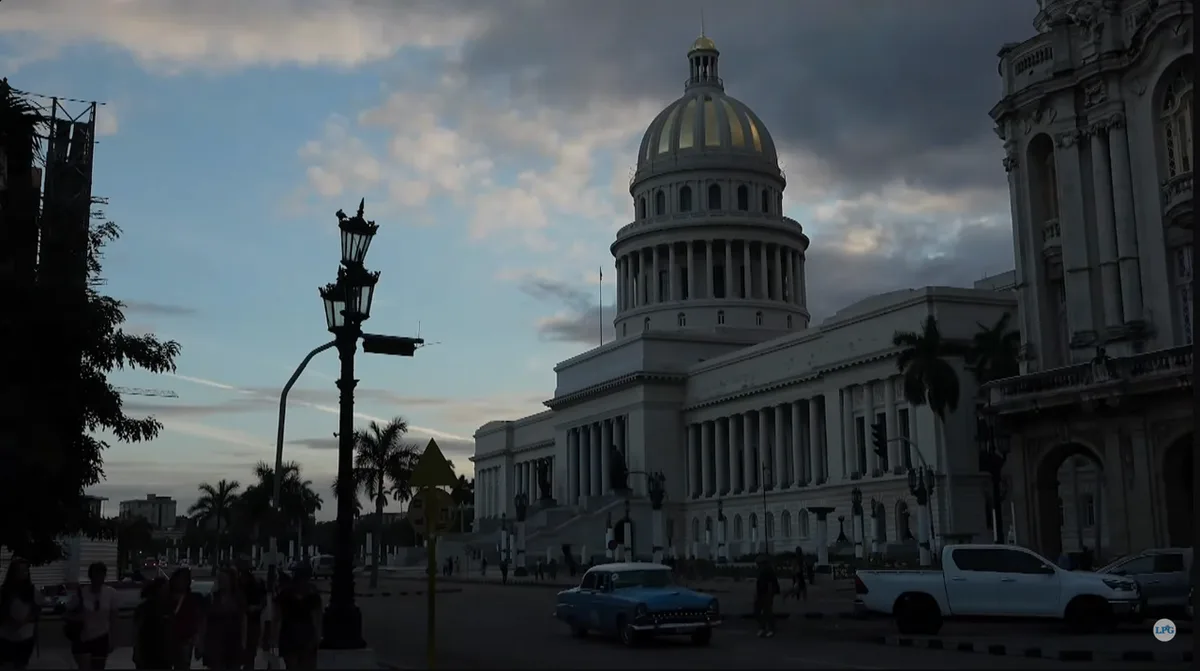
The 2024–2026 Cuba blackouts were the most severe living crisis that the country has experienced since the dissolution of the Soviet Union in 1991. Díaz-Canel blamed the blackout on the United States embargo against Cuba, which he said prevented much needed supplies and replacement parts from reaching Cuba.
In February 2026, following the United States intervention in Venezuela, which was a major oil supplier to Cuba, and expansion of US sanctions on trade with Cuba, Cuba experienced widespread energy shortages, resulting in rolling blackouts, hospital shortages and flight cancellations, culminating in the 2026 Cuban crisis. UN experts have condemned the executive order issued by the Trump administration, describing the imposition of a fuel blockade on Cuba as "a serious violation of international law and a grave threat to a democratic and equitable international order."