
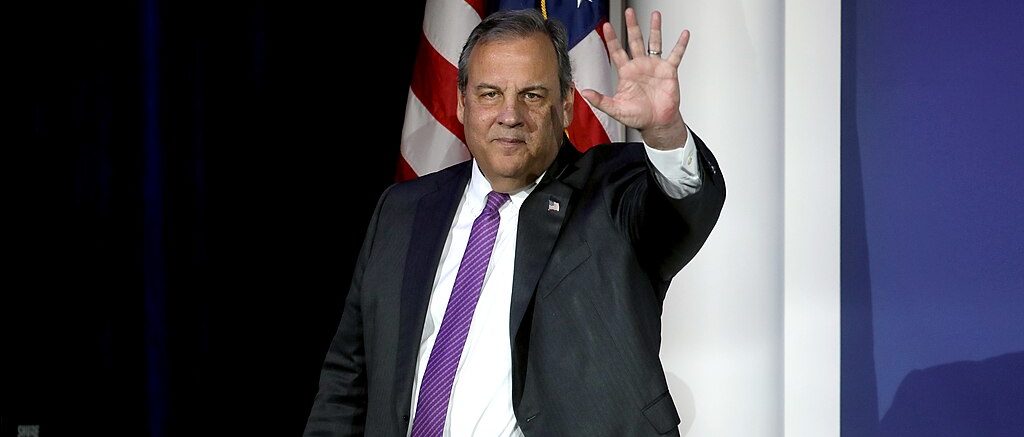
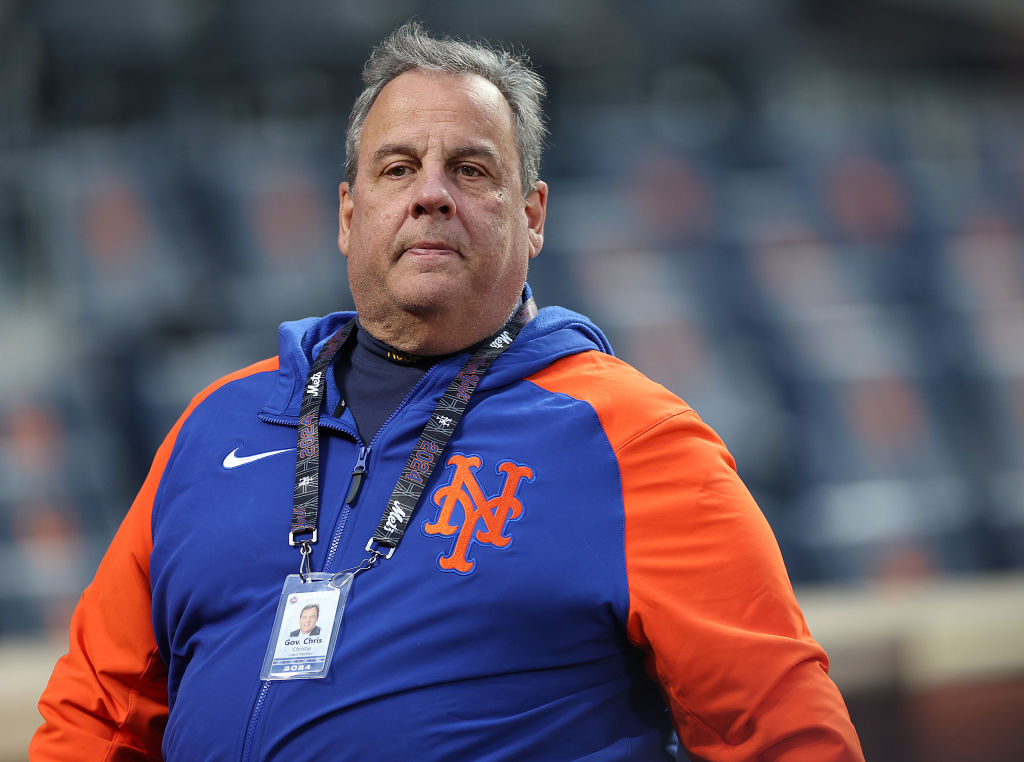
Christopher James Christie (born September 6, 1962) is an American politician and lawyer who served as the 55th governor of New Jersey from 2010 to 2018. A member of the Republican Party, he was the United States attorney for the District of New Jersey from 2002 to 2008 and a Morris County commissioner from 1995 to 1997. He was a candidate for the Republican presidential nomination in 2016 and 2024.
Born and raised in New Jersey, Christie graduated from the University of Delaware in 1984 and later earned a J.D. at Seton Hall University School of Law. He began his political career as a volunteer for Republican Thomas Kean's 1981 gubernatorial campaign. In 1994, Christie was elected as a county freeholder (legislator) for Morris County, New Jersey. His campaign that year was met with criticism as he had made several false statements about his opponent's legal issues. This criticism led to Christie losing his 1996 Republican primary reelection campaign. He later worked for the 2000 presidential campaign of George W. Bush; after Bush became president, he appointed Christie U.S. Attorney for New Jersey, a position he held from January 2002 to December 2008. During his tenure, he oversaw the convictions of 130 public officials from both local and state levels.
Christie won the 2009 Republican primary for Governor of New Jersey and defeated Democratic incumbent Jon Corzine in the general election. In his first term, he was credited with cutting spending, capping property tax growth, and engaging in recovery efforts after Hurricane Sandy. He was re-elected by a wide margin in 2013, defeating State Senate Majority Leader Barbara Buono. Christie's second term saw multiple controversies, namely the Fort Lee lane closure and his various absences from the state. He chaired the Republican Governors Association during the 2014 campaign. His term as governor expired in 2018, and he registered as a lobbyist in 2020.
On June 30, 2015, Christie announced his candidacy for the Republican nomination in the 2016 presidential election. However, he suspended his candidacy six months later following a poor showing in the New Hampshire primary. Later, he endorsed eventual winner Donald Trump and was named head of Trump's transition planning team. He remained a close ally of Trump during his first presidency. However, he later emerged as a critic following Trump's refusal to accept his loss in the 2020 United States presidential election and the subsequent January 6 Capitol attack. On June 6, 2023, Christie announced his second presidential campaign for the Republican nomination in the 2024 presidential election. His campaign was notable in its criticism of Trump compared to other Republican candidates. He ultimately dropped out of the Republican primary before voting started.
Contents
Early life
Christie was born on September 6, 1962, in Newark, New Jersey, to Sondra A. (née Grasso), a telephone receptionist, and Wilbur James "Bill" Christie, a certified public accountant who graduated from Rutgers Business School. His mother was of Italian (Sicilian) ancestry, and his father is of German, Scottish, and Irish descent. Christie's family moved to Livingston, New Jersey, after the 1967 Newark riots, and Christie lived there until he graduated from Livingston High School in 1980. At Livingston, Christie served as class president, played catcher for the baseball team, and was selected as a New Jersey Representative to the United States Senate Youth Program.
Christie's father and mother were Republican and Democratic, respectively. He has credited his Democratic-leaning mother for indirectly making him a Republican by encouraging him to volunteer for the gubernatorial candidate who became his role model, Tom Kean. Christie had become interested in Kean after the politician, then a state legislator, spoke to Christie's junior high school class.
Christie graduated from the University of Delaware in 1984 with a Bachelor of Arts in political science; while there, he served as president of the student body. He graduated from Seton Hall University School of Law with a J.D. in 1987. He was admitted to the New Jersey State Bar Association and the Bar of the United States District Court, District of New Jersey, in December 1987. He was awarded honorary doctorate degrees by Rutgers University and Monmouth University in 2010.
Law practice and local politics
Lawyer
In 1987, Christie joined the law firm of Dughi, Hewit & Palatucci of Cranford, New Jersey. In 1993, he was named a partner in the firm. Christie specialized in securities law, appellate practice, election law, and government affairs. He is a member of the American Bar Association and the New Jersey State Bar Association and was a member of the Election Law Committee of the New Jersey State Bar Association. From 1999 to 2001, Christie was registered statehouse lobbyist for Dughi and Hewit.
Morris County freeholder
Christie volunteered for the 1992 re-election campaign of President George H. W. Bush in New Jersey and became close to Bush's state director, Bill Palatucci. Following the campaign, Christie decided to run for office and moved to Mendham Township, New Jersey. In 1993, Christie launched a primary challenge against the New Jersey Senate Majority Leader, John H. Dorsey. However, Christie's campaign ended after Dorsey successfully challenged the validity of Christie's petition to appear on the ballot.
In 1994, Christie was elected as a Republican to the Board of Chosen Freeholders, or legislators, for Morris County, New Jersey, after he and a running mate defeated incumbents in the party primary. Following the election, the defeated incumbents filed a defamation lawsuit against Christie based on statements made during the primary campaign. Christie had incorrectly stated that the incumbents were under "investigation" for violating certain local laws. The lawsuit was settled out of court, with Christie acknowledging that the prosecutor had convened an "inquiry" instead of an "investigation", and apologizing for the error, which he said was unintentional.
As a county commissioner, Christie required the county government to obtain three quotes from qualified firms for all contracts. He led a successful effort to bar county officials from accepting gifts from people and firms doing business with the county. He voted to raise the county's open space tax for land preservation; however, county taxes, on the whole, were decreased by 6.6% during his tenure. He successfully pushed for the dismissal of an architect hired to design a new jail, saying that the architect was costing taxpayers too much money. The architect then sued Christie for defamation over remarks he made about the dismissal, eventually dropping the suit without explanation.
In 1995, Christie announced a bid for a seat in the New Jersey General Assembly. He and attorney Rick Merkt ran on a ticket against incumbent Assemblyman Anthony Bucco and attorney Michael Patrick Carroll in the Republican primary. Christie ran as a pro-choice candidate and supporter of the ban on assault weapons. Bucco and Carroll, the establishment candidates, defeated the up-and-comers by a wide margin. After this loss, Christie's bid for re-nomination to the freeholder board was unlikely, as unhappy Republicans recruited John J. Murphy to run against Christie in 1997. Murphy defeated Christie in the primary. Murphy, who had falsely accused Christie of having the county pay his legal bills in the architect's lawsuit, was sued by Christie after the election. They settled out of court with the freeholders admitting wrongdoing and apologizing. Christie's career in Morris County politics was over by 1998.
Lobbyist
When Christie's part-time position as a chosen freeholder lapsed, he returned full attention to his law firm Dughi, Hewit & Palatucci. Alongside fellow partner and later, gubernatorial campaign fundraiser Bill Palatucci, Christie's firm opened an office in the state capital, Trenton, devoted mainly to lobbying. Between 1999 and 2001, Christie and Palatucci lobbied on behalf of GPU Energy for deregulation of New Jersey's electric and gas industry; the Securities Industry Association to block the inclusion of securities fraud under the state's Consumer Fraud Act; Hackensack University Medical Center for state grants; and the University of Phoenix for a New Jersey higher education license. During the 2000 United States presidential election, Christie was George W. Bush's campaign lawyer for the state of New Jersey.
United States Attorney
Appointment
On December 7, 2001, President George W. Bush appointed Christie the U.S. Attorney for the District of New Jersey. During Republican presidential debates in August 2015 and November 2023, Christie falsely claimed he had been appointed by President Bush on September 10, 2001, and that the 9/11 attacks occurred in his state the next day. Some members of the New Jersey Bar professed disappointment at Christie's lack of experience. At the time, he had never practiced in a federal courtroom before, and had little experience in criminal law. Christie received the overwhelming support of the Republican Party in New Jersey. A spokesperson for Governor Donald DiFrancesco, who selected nominees for the position, said that he received hundreds of letters of support for Christie "from everyone from the Assembly speaker down to the county level, close to every member of the Legislature and every county chairman." Christie was also a top fundraiser for Bush's 2000 presidential campaign. He helped raise $350,000 for Bush, qualifying him as a "Pioneer", and also donated to DiFrancesco. Democrats seized upon the role played by Bush's political adviser, Karl Rove, after Christie's law partner, William Palatucci, a Republican political consultant and Bush supporter, boasted that he had selected a United States attorney by forwarding Christie's résumé to Rove. According to New Jersey's senior senator, Bob Torricelli, Christie promised to appoint a "professional" with federal courtroom experience as deputy if confirmed. By Senate tradition, if a state's senior Senator opposes the nomination of a U.S. Attorney, the nomination is effectively dead, but Christie's promise was enough for Torricelli to give the nomination his blessing. He was unanimously confirmed by the United States Senate on December 20, 2001, and sworn into office on January 17, 2002.
The brother of Christie's uncle (his aunt's second husband), Tino Fiumara, was an organized crime figure. According to Christie, the FBI presumably knew that when they conducted his background check. Later, Christie recused himself from the case and commented about what he had learned growing up with such a relative, "It just told me that you make bad decisions in life and you wind up paying a price."
Enforcement record
Christie served as U.S. Attorney from January 17, 2002, to December 1, 2008. His office included 137 attorneys, with offices in Newark, Trenton, and Camden. Christie also served on the 17-member Advisory Committee of U.S. Attorneys for Attorneys General John Ashcroft and Alberto Gonzales.
Soon after taking office, Christie let it be known that his office would make public corruption a high priority, second only to terrorism. During his six-year tenure, he received praise for his record of convictions in public corruption cases. His office convicted or won guilty pleas from 130 public officials, both Republican and Democratic, at the state, county and local levels. The most notable of these convictions included those of Democratic Hudson County Executive Robert C. Janiszewski in 2002 on bribery charges, Republican Essex County Executive James W. Treffinger in 2003 on corruption charges, former Democratic New Jersey Senate President John A. Lynch Jr., in 2006 on charges of mail fraud and tax evasion, State Senator and former Newark Democratic mayor Sharpe James in 2008 on fraud charges, and Democratic State Senator Wayne R. Bryant in 2008 on charges of bribery, mail fraud, and wire fraud.
In 2005, following an investigation, Christie negotiated a plea agreement with Charles Kushner, under which he pleaded guilty to 18 counts of illegal campaign contributions, tax evasion, and witness tampering. Kushner was sentenced to two years in prison. In December 2020, President Donald Trump pardoned Kushner.
From 2005 to 2007, Christie prosecuted the executives of Cendant for mail, wire, and securities fraud. During his 2009 gubernatorial campaign, Christie was criticized for buying shares of Cendant in 2004 and selling them the following year. Christie's defense was that his stock trades were made via investment in an externally-controlled fund and that he had inherited this prosecution from his predecessor Robert J. Cleary.
Christie negotiated seven deal deferred prosecution agreements (DPAs) during his tenure, some of which were controversial. Under agreements like these, corporations avoid prosecution if they promise not just to obey the law or pay for bad acts, but also promise to change personnel, or revamp business practices, or adopt new types of corporate governance. They are typically used in lieu of prosecution when there is evidence of particularly egregious corporate misconduct. Since 2002, these types of agreements have been sharply on the rise among federal prosecutors, with 23 between 2002 and 2005, and 66 between 2006 and 2008. Outside monitors are appointed in about half of all DPAs, to make sure that the corporations comply. In one case, Christie recommended the appointment of The Ashcroft Group, a consulting firm owned by his former boss John Ashcroft, as an outside monitor of Zimmer Holdings—a contract worth as much as $52 million from Zimmer, which was an amount in line with fee structures at that time. In another instance, Christie's office deferred criminal prosecution of pharmaceutical company Bristol Myers in a deal that required the company to dedicate $5 million for a business ethics chair at Seton Hall University School of Law, Christie's alma mater.
Governor of New Jersey (2010–2018)
2009 gubernatorial campaign
Christie filed as a candidate for the office of governor on January 8, 2009. Former Governor Thomas Kean helped Christie campaign and raise money. In the primary on June 2, Christie won the Republican nomination with 55% of the vote, defeating opponents Steve Lonegan and Rick Merkt. He then chose Kimberly Guadagno, Monmouth County sheriff, to complete his campaign ticket as a candidate for lieutenant governor. On November 3, Christie defeated Jon Corzine by a margin of 49% to 45%, with 6% of the vote going to independent candidate Chris Daggett.
2013 gubernatorial campaign
In November 2012, Christie filed papers to run for a second term in office. Christie was reelected by a large margin, 60% to 38% on November 5, 2013, defeating Democratic nominee Barbara Buono. Christie advisors said that Christie sought to win by a large margin to position himself for the presidential primaries and develop a model for other Republican candidates. Christie began building a national fundraising network, aided by the fact that only one other state had a gubernatorial contest in 2013, and those financial resources were intended to support a major outreach effort toward blacks, Hispanics and women. He also ordered a $25 million special election to fill the seat of the deceased Senator Frank Lautenberg. The move was believed to be motivated by a desire to keep Newark Mayor Cory Booker from sharing an election day, 20 days afterward, with Christie, thereby depressing otherwise anticipated black voter turnout that tended to vote Democratic.
Tenure and political positions
Christie took office as Governor of New Jersey on January 19, 2010. He chose not to move his family into Drumthwacket, the governor's official mansion, and instead resided in a private Mendham Township, New Jersey, residence.
Fiscal issues
While campaigning for governor, Christie promised not to raise taxes. He also vowed to lower the state income and business taxes, with the qualification that this might not occur immediately.
As governor, Christie claims his annual budgets did not increase taxes, though he made reductions to tax credits such as the earned income tax credit and property tax relief programs; he would also sign legislation limiting property tax growth to 2% annually. Under Christie, there were no rate increases in the state's top three revenue generators: income tax, sales tax, and corporate tax.
In February 2010, Christie signed an executive order declaring a "state of fiscal emergency" due to the projected $2.2 billion budget deficit for that fiscal year. Following the order, Christie proposed a new budget which eliminated the New Jersey Department of the Public Advocate, which had an upkeep of $1.3 million. In late June 2011, Christie utilized New Jersey's line-item veto to eliminate nearly $1 billion from the proposed budget, signing it into law just hours prior to July 1, 2011, the beginning of the state's fiscal year. That same year, Christie signed into law a payroll tax cut authorizing the New Jersey Department of Labor and Workforce Development to reduce payroll deduction for most employees from $148 to $61 per year.
On five separate occasions, Christie vetoed legislation pushed by Democrats to implement a millionaire tax. After Democrat Phil Murphy became governor, Democrats backed off the legislation, with New Jersey Senate President Stephen Sweeney stating, "[t]his state is taxed out. If you know anything about New Jersey, they're just weary of the taxes." The tax was eventually passed into law in 2020.
During Christie's tenure, New Jersey's credit rating was downgraded nine times (across Standard & Poor, Fitch Ratings, and Moody's Investors Service), leaving only Illinois with a lower rating among U.S. states. Christie received a B grade in 2012 and in 2014 from the Cato Institute, a libertarian think tank, in their biennial fiscal policy report on America's governors.
On September 18, 2013, Christie signed legislation to overhaul the state's business tax incentive programs. The legislation reduced the number of tax incentive programs from five to two, raised the caps on tax credits, and allowed smaller companies to qualify. It also increased the credits available for businesses in South Jersey.
Education
One of Christie's most controversial school policies was to increase the state's control of school districts. The districts contained relatively high numbers of underachieving students, people of color, poor people, and members of the Democratic Party. In Newark, Christie hired Chris Cerf to replace Cami Anderson as the state-appointed superintendent of its school district. Under Christie, Cerf overruled the district's locally elected school board. Recent research indicated that the reforms implemented by Christie, Anderson, and Cerf did not improve educational outcomes.
Christie has been accused of under-funding school districts. Reports indicated that Christie's administration did not adhere to the School Funding Reform Act, and illegally withheld funds from districts throughout the state. His 2017 school funding proposal was described by education researchers as "one of the least equitable in the country". State commissioner of education Chris Cerf defended policies declared unconstitutional by the Supreme Court of New Jersey.
Christie, whose children attend Catholic school, supports the state giving tax credits to parents who send their children to private and parochial schools. He also supports school vouchers, which parents of students in failing school districts could use for tuition in private schools or for public schools in communities outside their own. Christie supports merit pay for teachers.
On August 25, 2010, the U.S. Department of Health and Human Services announced that $400 million in federal Race to the Top education grants to New Jersey would not be issued due to a clerical error in the state's application by an unidentified mid-level state official. Christie said that the Obama administration had overstepped its authority, and the error was in the administration's failure to communicate with the New Jersey government. It was later learned that the issue had been raised with Bret Schundler, Christie's education commissioner. Christie asked for Schundler's resignation; Schundler initially agreed to resign, but asked to be fired the following morning to claim unemployment benefits. According to Schundler, he told Christie the truth and Christie misstated what actually occurred.
The Christie administration approved 23 new charter schools in January 2011, including New Jersey's first independent school for children with autism. The approvals increased the state's number of charter schools to 96.
Energy and environment
Christie has stated that he believes that the New Jersey Department of Environmental Protection is too big and is "killing business" with permit delays and indiscriminate fines. He announced that, if elected, the agency would be his first target for government reduction: he would reduce its workforce and strip it of its fish and wildlife oversight.
Christie has stated that he intends to simultaneously spur growth in the state's manufacturing sector and increase New Jersey's capability to produce alternative energy. He has proposed a list of policy measures to achieve this, including giving tax credits to businesses that build new wind energy and manufacturing facilities, changing land use rules to allow solar energy on permanently preserved farmland, installing solar farms on closed landfills, setting up a consolidated energy promotion program, and following a five-to-one production to non-production job ratio in the creation of new energy jobs. In August 2010, legislation to encourage the development of wind power in New Jersey was signed by Christie at the Port of Paulsboro. The Offshore Wind Economic Development Act authorized New Jersey Economic Development Authority to provide up to $100 million in tax credits for wind energy facilities. The governor has pledged to ban coal-fired power plants, and to reach 22.5% renewable generation in the state by 2021.
On May 26, 2011, Christie announced he would pull the state out of Regional Greenhouse Gas Initiative. This was challenged in court which ruled in March 2014 that Christie had acted illegally in doing so since state regulations do not permit it. His administration sought to repeal the rules.
Christie has rejected permanent bans on hydraulic fracturing (fracking) in New Jersey and vetoed measures that would ban the process and disposal of hydraulic fracturing waste in the State. New Jersey has few proven shale reserves and the process is not practiced there. Christie argued that the vetoed Senate Bill (S253) was premature because of an ongoing study to be completed in 2014 and would discriminate against other states, a violation of the Dormant Commerce Clause of the U.S. Constitution. Supporters of legislation have said that hydraulic fracturing waste from Pennsylvania makes its way into New Jersey for treatment, although how much is not clear. They also criticized Christie's legal analysis saying that the Office of Legislative Services has said that the bill is constitutional.
New Jersey Supreme Court nominations
By tradition since the 1947 state constitution, the seven-member New Jersey Supreme Court maintains a political balance and is composed of four members of either the Democratic Party or Republican Party and three of the other. Christie broke with the tradition in May 2010 when he chose not to renominate Justice John E. Wallace Jr. While on the campaign trail, Christie had said the court "inappropriately encroached on both the executive and legislative function, and that if elected governor, [he] would take steps . . . to bring back an appropriate constitutional balance to the court." Over the course of his tenure, Christie had been in a major conflict with the New Jersey Legislature over the court's partisan balance. The stand-off between the governor and the New Jersey Senate resulted in longstanding vacancies, with temporarily assigned appellate judges filling in.
Minimum wage and equal pay for women
In January 2013, Christie vetoed a New Jersey Legislature bill that would have raised the minimum wage from $7.25 to $8.50 per hour. The following November, the issue was placed on the ballot as a constitutional amendment referendum, passing with 61% of the vote.
On September 21, 2012, Christie signed Assembly Bill No. 2647 (A-2647) into law that requires employers to post and distribute notice of employees' rights to gender-equal pay, but conditionally vetoed other gender parity bills, requesting revision.
Immigration
Christie emphasizes the need to secure the border, and believes it is premature to discuss legalization of people who came to the United States unlawfully. While serving as U.S. attorney for the District of New Jersey, Christie stressed that simply "[b]eing in this country without proper documentation is not a crime," but rather a civil wrong; and that undocumented people are not criminals unless they have re-entered the country after being deported. As such, Christie stated, responsibility for dealing with improperly documented foreign nationals lies with U.S. Immigration and Customs Enforcement, not the U.S. Attorney's Office.
Christie has been critical about section 287(g) of the Immigration and Nationality Act, enacted in 1996, which can be used to grant local law enforcement officers power to perform immigration law enforcement functions.
In December 2013, Christie signed legislation allowing unauthorized immigrants who attend high school for at least three years in New Jersey and graduate to be eligible for the resident rates at state college and universities and community colleges.
Social issues
Early in his political career, Christie stated in an interview that "I would call myself … a kind of a non-thinking pro-choice person, kind of the default position". In 2009, Christie identified himself as anti-abortion, but stated that he would not use the governor's office to "force that down people's throats", while still expressing support for banning "partial-birth abortion", parental notification, and a 24-hour waiting period. He does support legal access to abortion in cases of rape, incest, or if the woman's life is in danger.
In 2014, campaigning in Alabama for incumbent governor Robert Bentley, Christie stated that he was the first "pro-life governor" elected in New Jersey since Roe v. Wade in 1973. He also stated that he had vetoed funding for Planned Parenthood five times as governor. In March 2015, Christie joined other potential 2016 Republican presidential candidates in endorsing a ban on abortions after 20 weeks of pregnancy.
Christie stated in 2023 that he believed that abortion should be a state-by-state issue, and that he would oppose a federal ban on abortion.
In 2017, Christie conditionally vetoed a proposed bill that would have made New Jersey the first state in the Union to completely ban child marriages, arguing that "the severe bar this bill creates is not necessary to address the concerns voiced by the bill's proponents and does not comport with the sensibilities and, in some cases, the religious customs, of the people of this state." Instead, he suggested a complete ban on marriage for everyone under the age of 16 and judicial approval for those aged 16 and 17. At that time, New Jersey permitted people aged 16 and 17 to marry with parental consent and judicial approval, assuming there was "clear and convincing evidence that granting the license would be in the best interest and welfare of the minor." After Christie left office in 2018, New Jersey became the second state in the Union to prohibit marriage for everyone under the age of majority (after Delaware), when the new governor, Phil Murphy, signed the bill into law.
As governor, Christie opposed same-sex marriage but voiced support for New Jersey's civil union law, which extended to gay couples the same legal benefits of marriage with regard to state law. Christie indicated in 2009 that he would veto any bill legalizing same-sex marriage in the state, saying, "I also believe marriage should be exclusively between one man and one woman.... If a bill legalizing same sex marriage came to my desk as Governor, I would veto it." On February 17, 2012, Christie vetoed a bill that would have legalized same-sex marriage in New Jersey. The bill passed by wide but not veto-proof margins in both houses of the legislature. Christie instead proposed that the issue be presented to the voters in a statewide ballot referendum.
Gun control
In December 2010, Christie commuted the seven-year sentence of Brian Aitken, who had been convicted of transporting three guns within the state; as a result, Aitken was released from prison.
Christie has said that each state has the right to determine firearms laws without federal interference. When announcing his candidacy in 2009 he said he supported aggressive enforcement of the state's current gun laws. In 2013, he chose not to defend a legal challenge to a New Jersey law requiring individuals to prove an urgent threat of violence before getting permits to carry handguns. In July 2014, Christie vetoed legislation that would have reduced the allowed legal size of ammunition magazines. Instead he re-wrote it, proposing a new standard for involuntary commitment of people who are not necessarily deemed dangerous "but whose mental illness, if untreated, could deteriorate to the point of harm" as well as other forms of involuntary mental health treatments. Christie had previously vetoed proposed legislation that would bar the state pension fund from investing in companies that manufacture or sell assault firearms for civilian use and a bill to prohibit the sale of .50-caliber rifles to civilians. In July 2015, Christie vetoed a bill passed by the Assembly, 74–0 (six abstentions), and the Senate by a 38–0 (two abstentions) which would require anyone seeking to have their mental health records expunged to purchase a firearm to notify the State Police, their county prosecutor and their local police department when petitioning the court. In October 2015, the New Jersey Senate voted to override Christie's veto.
In January 2018, during his final days as Governor of New Jersey, Christie signed legislation making bump stocks illegal in the state.
Transportation
Christie has raised tolls and fares ("user fees") on the New Jersey Turnpike, Garden State Parkway, Hudson River crossings and NJ Transit buses and trains during his administration to fund projects throughout the state. In 2014, Christie authorized the increase of numerous other fees charged by the state for various licensing and administrative fees.
In 2010, Christie cancelled the Access to the Region's Core project, which would have constructed two new tunnels under the Hudson River and a new terminal station in New York City for NJ Transit commuter trains. Christopher O. Ward advocated for the tunnel on behalf of the Port Authority. Christie cited escalating costs and possible further overruns as the reason for his decision. Proponents of the project said it would have created 6,000 construction jobs per year and 45,000 secondary jobs once complete. After the cancellation, New Jersey had to return $95 million to the federal government, and used $1.8 billion of Port Authority of New York and New Jersey money from the project budget to pay for repairs to the Pulaski Skyway, since the New Jersey Transportation Trust Fund that should fund such maintenance was effectively bankrupt. The termination of the project made the need for increased rail capacity under the Hudson River more urgent, and shortly thereafter, in 2011, Amtrak's Gateway Project was unveiled, which began construction in 2023.
From September 9 through September 13, 2013, two of the three traffic lanes in Fort Lee normally open to access the George Washington Bridge and New York City were closed on orders from a senior Christie aide and a Christie administration appointee. The lane closures in the morning rush hour resulted in massive traffic back-ups on the local streets for five days.
One common theory as to why the lanes were closed is that it was political retribution against Democratic Fort Lee mayor Mark Sokolich for not supporting Christie in the 2013 gubernatorial election. Another possible motive involves a major real estate development project, which was a top priority for Sokolich, that was under way at the Fort Lee bridge access point.
Several of Christie's appointees and aides resigned, and Christie fired others, as investigations into the closures intensified. In a radio interview on February 3, 2014, Christie indicated that he "unequivocally" had no knowledge of, did not approve, and did not authorize plans to close the toll lanes, and stated that he first found out about the traffic jams from a story in The Wall Street Journal after the lanes had been reopened. In an interview on ABC, Christie reiterated that he was shocked by the actions of his former aides, stating that "Sometimes, people do inexplicably stupid things."
Response to Hurricane Sandy
On December 28, 2012, the U.S. Senate approved $60.4 billion disaster relief package for Hurricane Sandy, which damaged New Jersey and other states. The House did not vote until the next session on January 3. On January 2, Christie criticized the delay as "selfishness and duplicity" and blamed house speaker John Boehner and the rest of the House Republican leadership. A bill for relief was passed in the House on January 15.
In 2014, the U.S. Department of Justice opened an inquiry into allegations that Christie made state grants of Hurricane Sandy relief funds to New Jersey cities conditional on support for other projects.
Official visit to the Middle East
Continuing the tradition of earlier New Jersey governors since the 1980s, Christie traveled to Israel in April 2012. During the visit, which included meetings with Prime Minister Benjamin Netanyahu and President Shimon Peres, Christie commented that "Jerusalem has never been better or freer than under Israeli control." Christie took a helicopter tour of the West Bank and cautioned against Israeli withdrawal from the West Bank, Jerusalem or the Golan Heights. The official title given to the trip was "Jersey to Jerusalem Trade Mission: Economic Growth, Diplomacy, Observance". The visit to Israel was Christie's first official overseas trip since taking office. From Israel, Christie continued with his family to Jordan, as guests of King Abdullah II.
Out of state travel
Christie was absent from New Jersey at various points during his governorship. Christie was criticized for a December 2010 vacation to Disney World with his family, while a major blizzard damaged parts of New Jersey. At the same time, Lieutenant Governor Kim Guadagno was vacationing in Mexico, leaving Stephen Sweeney to serve as acting governor during the crisis. In a response, Christie said the vacation was a long-held promise to his children, and that he had constantly been updated about the storm by officials.
In 2015, while campaigning for president, Christie was absent from New Jersey for 261 days. Amid the January 2016 United States blizzard, Christie stayed only briefly in New Jersey for 36 hours, before heading off to New Hampshire. When asked why he was campaigning in New Hampshire when parts of the Jersey Shore were flooded in sea water Christie said: "What do you want me to do, go down there with a mop?"
Official records showed 190 full days and 71 partial days that Christie spent out of state in 2015 costed taxpayers about $614,000, and the final quarter, when Christie spent 32 days out of state campaigning for the presidency, cost $193,890. The bills totaled cost $492,420 in 2014, $220,355 in 2013; $248,277 in 2012; $129,842 in 2011 and $64,975 in 2010, which did not include the cost of overtime for the State Police troopers in EPU, which according to state regulations is confidential. A lawsuit which claimed that Christie "inappropriately forced New Jersey taxpayers to cover the cost of the governor's security and other key expenses while pursuing the presidency" was dismissed.
Island Beach State Park incident
In July 2017 during a budget shutdown and partial closing of state government services and facilities, the governor and his family were photographed from an airplane vacationing at Island Beach State Park alone on the beach. The beach was closed to the public as a result of the shutdown, and Christie commuted to the beach from Trenton via state helicopter while his family was staying at the official governor's residence there. His spokesman said that he didn't "get any sun" because he was wearing a baseball cap at the time of the photo. When asked in an interview about people being upset that he was at the beach when they were unable to visit the beach, Christie responded, "I'm sorry they're not the governor".
Open records battles
During his administration's eight years, the governor's office spent more than $1 million fighting New Jersey Open Public Records Act (OPRA) requests. On his way out, the governor, in an official letter to the State Archives, dictated how his office's records be handled. This came to light in May 2018, as the State Archives' release of electronic records relating to business by Jared Kushner, President Trump's son-in-law, were denied by his personal lawyer; Kushner's real estate company received $33 million in state tax breaks. Open records experts challenged Christie's "disturbing" actions.
End of tenure
Christie was term limited from running for a third term in the 2017 New Jersey gubernatorial election. His lieutenant governor, Kim Guadagno, ran in the election to replace him, but lost to the Democratic Party's nominee, former ambassador Phil Murphy.
By most estimates, his approval ratings when leaving office were as low as 15 percent, a drastic decline from his peak approval rating, 77 percent, in the aftermath of Hurricane Sandy. When referring to his low poll numbers, Christie said he did not care because he was not running for office. Christie left office on January 16, 2018.
Republican Governors Association
In November 2013, Christie was elected chairman of the Republican Governors Association, succeeding Louisiana Governor Bobby Jindal. Christie campaigned extensively on behalf of Republican governors running for re-election. In the first three months of 2014, the RGA raised a record sum for the first quarter of a mid-term election year, and almost doubled the amount raised by the Democratic Governors Association during the same period.
Christie presided over net gains in Republican governorships in the 2014 elections, including for Republican gubernatorial candidates in three largely Democratic states: Bruce Rauner in Illinois, Larry Hogan in Maryland and Charlie Baker in Massachusetts.
Presidential politics
2012 presidential election
There was ongoing speculation that Christie would attempt a run for President of the United States in 2012 by competing in the Republican primaries. In September 2011, a number of press stories cited unnamed sources indicating Christie was reconsidering his decision to stay out of the race. An Associated Press story dated September 30 indicated a decision on whether he would run for president in 2012 would be made "soon". In a late September speech at the Reagan Library, he had again said he was not a candidate for president, but the speech also coincided with his "reconsideration" of the negative decision. The Koch brothers (David H. Koch and Charles G. Koch), Kenneth Langone, and retired General Electric CEO Jack Welch expressed support for a potential Christie candidacy. In October 2011, Christie said that he had reconsidered his decision but had again decided not to run for president, stating at a press conference: "New Jersey, whether you like it or not, you're stuck with me." Christie endorsed Mitt Romney for president a few days later.
Political commentators debated whether Christie's weight would or should affect his viability as a 2012 presidential candidate, either for medical or social reasons. The Obesity Society, a nonprofit scientific group, released a statement asserting, "To suggest that Governor Christie's body weight discounts and discredits his ability to be an effective political candidate is inappropriate, unjust, and wrong."
The New York Post has cited anonymous sources as saying Christie was not willing to give up the governorship to be Romney's running mate because he had doubts about their ability to win. The Romney campaign was reported to have asked him to resign his governorship if he became the vice-presidential nominee because "pay to play" laws restrict campaign contributions from financial corporation executives to governors running for federal office when the companies do business with the governor's state. A memo from the campaign attributed Romney's decision not to choose Christie as his running mate, in part, to unanswered questions during the vetting process regarding a defamation lawsuit following Christie's initial campaign for Morris County Freeholder, a Securities and Exchange Commission investigation of Christie's brother, as well as his weight.
Christie gave the keynote address at the Republican National Convention in August 2012. On October 30, 2012, during a press conference to discuss the impact of Hurricane Sandy, Christie praised the disaster relief efforts of President Barack Obama.
2016 presidential election
In January 2015, Christie took his first formal step towards a presidential candidacy by forming a political action committee (PAC) in order to raise funds and prepare for a likely 2016 presidential bid. On June 27, 2015, Christie launched his presidential campaign website. He formally announced his candidacy on June 30, 2015.
Christie dropped out of the race on February 10, 2016, after the New Hampshire primary following a poor showing and low poll numbers. He received 7.4% of the overall vote in the New Hampshire primary.
Despite having criticized Donald Trump prior to leaving the race, he endorsed Trump on February 26, 2016. On May 9, 2016, Trump named Christie to head a transition team in the event of a Trump presidency. He soon emerged as a major power with the Trump campaign.
Trump considered Christie as a potential vice-presidential running mate, and he was on the shortlist alongside former Speaker of the House Newt Gingrich and Indiana Governor Mike Pence. Trump passed over Christie and selected Pence. The subject's transition list for likely candidates for Trump's National Security Adviser did not include Michael Flynn, but rather, Peter Pace and William H. McRaven.
In September 2016, Christie acknowledged that the Fort Lee lane closure scandal, also known as Bridgegate, was a factor in his being denied the nomination. Trump had said earlier that Christie knew about the closures, which Christie denies. Following the release of Trump's tape-recorded comments on an Access Hollywood bus, Christie called Trump's comments "completely indefensible", but also added "I don't think it's the only way you should make a judgment."
After calls for his impeachment as governor and felony convictions in U.S. federal court of high-ranking members of his staff in the Bridgegate scandal, Christie was dropped by Trump as leader of the transition team, in favor of Pence. On the same day, Christie's close associates Richard Bagger and Bill Palatucci were both removed by Trump from the transition team. Former Congressman Mike Rogers, a national security expert on the Trump transition team, was additionally another close associate of Chris Christie who was also removed a few days after Christie's departure.
2020 presidential election
In 2020, Christie offered to help Trump win re-election. One of his roles was helping the president to prepare for his first debate with challenger Joe Biden on September 29, 2020. He visited the White House repeatedly during the four days preceding the debate. He said the prep sessions involved five or six people in total, none of whom wore facial coverings despite the ongoing coronavirus pandemic. He added that he tested negative for the virus each time he entered the White House and saw no-one exhibiting symptoms. On October 3 he tested positive and was hospitalized, calling it a precautionary measure. He was released from the hospital on October 10.
Following the election, Christie refused to support Trump's false claims of a stolen election. On election night, Christie spoke with one of Trump's sons and later texted Eric Trump asking for proof of their claims of election fraud. When they could not provide any evidence, Christie said he would thus not support their claims. During the January 6 Capitol attack, Christie phoned Trump to tell the president to call for an end to the violence, but Trump did not pick up. Following the attack, Christie blamed Trump for January 6 and voiced support for Trump's impeachment.
2024 presidential election
In December 2020, Christie told radio talk show host Hugh Hewitt that he was considering running for president in 2024 even if Trump decided to run (who at this point Christie still aligned with). In October 2022, Christie appeared on Real Time with Bill Maher, where he responded "sure" when asked if he was open to a potential 2024 presidential bid. On March 16, 2023, Christie announced that he would decide if he was running for president within 45 to 60 days. During this time, Christie voiced his criticism of Florida governor and Republican presidential candidate Ron DeSantis and his feud with The Walt Disney Company, claiming that the conflict showed DeSantis' lack of conservative values. Christie visited New Hampshire in late March, claiming that he wanted to see if he was ready to "get into the battle".On May 31, 2023, Axios reported that Chris Christie was planning to announce his presidential campaign in the coming days. On June 6, Christie filed paperwork with the Federal Election Commission (FEC) to run for president, announcing his bid later that day at an event in Manchester, New Hampshire.
While campaigning, Christie focused on attacking Trump, including at his campaign launch, where he called Trump a "lonely, self-consumed, self-serving mirror hog." Christie has also attacked other primary contenders for not criticizing Trump enough and defending Trump with regard to his federal indictment for mishandling classified documents and his conduct leading up to and during the January 6 Capitol attack. In order to participate in the Republican primary debates, Christie was required to sign a loyalty pledge from the Republican National Committee stating he would support the eventual nominee. Christie criticized the pledge, calling it a "useless idea," but ultimately signed it in order to debate, citing that Trump himself signed a similar pledge during the 2016 primaries, despite later denouncing it during a debate. As Trump was the frontrunner for the nomination throughout the primary, whether or not Christie would follow through with the pledge was in question.
Christie supported increasing military aid to Ukraine, labeling current aid as insufficient to defeat the Russian invasion, and stated that arming Ukraine would deter China from potentially invading Taiwan. On August 4, 2023, Christie made an unannounced trip to Ukraine, visiting the city of Bucha, the site of a massacre of civilians by Russian forces. Later in the day, Christie met with Ukrainian President Volodymyr Zelenskyy, praising Ukraine's fight against Russia and reiterating his support for arming Ukraine. According to Christie, he and Zelenskyy did not discuss the U.S. presidential race. Christie was the second Republican presidential candidate, after Mike Pence, to visit Ukraine.
Opioid epidemic efforts
In March 2017, Trump picked Christie to chair the Opioid and Drug Abuse Commission, an advisory committee on the opioid epidemic in the United States.
Christie said that New Jersey would be spending $500 million on the epidemic, and in his last few months as governor promoted the Reach NJ Campaign, which included television ads in which he appeared.
In May 2019, Santa Monica, California, tech firm WeRecover announced that Christie had joined their team as Senior Advisor on Strategy and Public Policy. Upon joining Christie said, "As the chairman of the opioid task force, I was honored to shape our federal government's efforts to combat the opioid epidemic. But this isn't a problem government alone can solve. This is the worst epidemic we've ever faced, and we need the kind of innovation that can only come from the private sector. In WeRecover, I've found a team of some of the best and brightest people in tech, fully committed to broadening access to care through data, design and technology."
Post-gubernatorial career
In January 2018, Christie joined ABC News as a regular network contributor, which he continues to be part. In November 2018, it was reported that he was being considered for the role of United States Attorney General by the Trump administration, although William Barr was ultimately selected. After meeting with Trump into December 2018, Christie said he did not want to be considered for the job of White House Chief of Staff.
Christie published a book titled Let Me Finish in January 2019.
In 2019, Christie became a director of the pharmaceutical firm Pacira Biosciences.
In May 2020, Christie stated that measures taken during the COVID-19 pandemic in the United States should be lifted for economic reasons. "Of course, everybody wants to save every life they can – but the question is, towards what end, ultimately? ... Are there ways that we can ... thread the middle here to allow that there are going to be deaths, and there are going to be deaths no matter what?"
In 2018 Christie started a federal lobbying firm called Christie 55 Solutions. The firm earned roughly $1.3 million during the COVID-19 pandemic before ceasing its operations in 2021. Christie was paid $240,000 during the pandemic for lobbying on behalf of a Tennessee-based chain of addiction treatment centers and three New Jersey hospital systems seeking federal funding.
Christie distanced himself from Donald Trump after the January 6, 2021, attack on the U.S. Capitol. In a September 9, 2021, speech at the Ronald Reagan Library in Simi Valley, California, Christie implored Republicans to reject their most extreme elements such as QAnon, white supremacists and election fraud conspiracy theorists.
In March 2021, Christie joined the board of directors of the New York Mets front office. It was reported in June 2023 that he would remain on the board while running for president.
On August 24, 2025, Christie appeared on the ABC TV program This Week. Christie criticized President Donald Trump for wanting the Justice Department to act "as his personal legal representation." "Donald Trump sees himself as the person who gets to decide everything, and he doesn't care about any separation," Christie said. "In fact, he absolutely rejects the idea that there should be separation between criminal investigations and the politically elected leader of the United States." In response to Christie's remarks, Trump said on social media that Christie "lied" about the 2013 Bridgegate scandal, suggesting he should be investigated again, saying "perhaps we should start looking at that very serious situation again? NO ONE IS ABOVE THE LAW!". The following day Trump told reporters that he "always felt [Christie] was guilty", but that a decision on whether to open a Justice Department investigation on him was up to Attorney General Pam Bondi. This came despite Trump praising Christie in 2020 after Christie was exonerated on the Bridgegate affair, saying at that time, "Congratulations to former Governor of New Jersey, Chris Christie, and all others involved, on a complete and total exoneration (with a 9–0 vote by the U.S. Supreme Court) on the Obama DOJ Scam referred to as 'Bridgegate'".
Personal life
In 1986, Christie married Mary Pat Foster, a fellow student at the University of Delaware. After marrying, they shared a studio apartment in Summit, New Jersey. Mary Pat Christie pursued a career in investment banking and eventually worked at the Wall Street firm Cantor Fitzgerald; she left the firm in 2001 following the September 11 attacks. As of April 2015 she was a managing director at the Wall Street investment firm Angelo, Gordon & Co.
Christie and his wife have four children: Andrew (b. 1993), Sarah (b. 1996), Patrick (b. 2000), and Bridget (b. 2003). The family resides in Mendham Township. The family also owns a house in Bay Head.
In July 2002, Christie was involved in a traffic accident that injured a motorcyclist on a road in Elizabeth, New Jersey, but was not issued a traffic ticket. The incident came to light in September 2009 when Christie was running for governor.
Christie's hobbies have included coaching Little League, watching the New York Mets, and attending Bruce Springsteen concerts (152 of them). Christie's other favorite sports teams are the New York Knicks, New York Rangers, and Dallas Cowboys. He is a practicing Catholic and member of St. Joseph's Catholic Church.
Health
In 2011, columnist Eugene Robinson applied the term "extremely obese" to Christie, citing medical guidelines established by the National Institutes of Health. Christie himself was reportedly concerned about his weight and its implications for his health, describing himself as relatively healthy overall. Christie underwent lap-band stomach surgery in February 2013 and disclosed the surgery to the New York Post in May of that year.
On October 3, 2020, Christie tested positive for COVID-19 and was admitted to the Morristown Medical Center in New Jersey the same day, citing asthma as an underlying health concern. On October 10, Christie was released from the hospital. In his 2021 book, Republican Rescue, Christie revealed that Donald Trump called him while he was being hospitalized, and asked "Are you gonna say you got it from me?"