
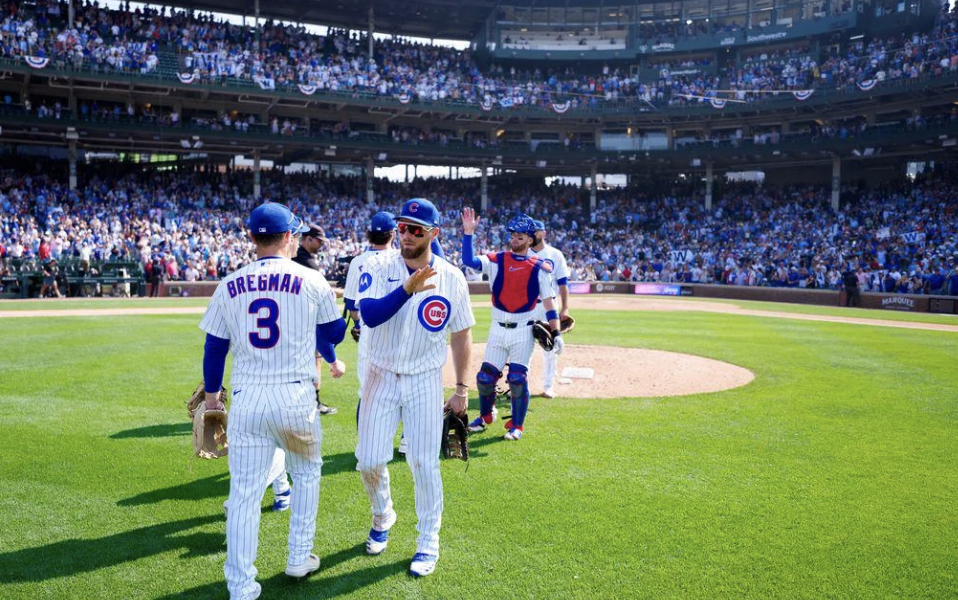


The Chicago Cubs are an American professional baseball team based in Chicago. The Cubs compete in Major League Baseball (MLB) as a member club of the National League (NL) Central Division. The club plays its home games at Wrigley Field, which is located on Chicago's North Side. They are one of two major league teams based in Chicago, alongside the American League (AL)’s Chicago White Sox. The Cubs, first known as the White Stockings, were founded in 1870 and are one of two remaining NL charter franchises that debuted in 1876. They have been known as the Chicago Cubs since 1903.
Throughout the club's history, the Cubs have played in a total of 11 World Series. The 1906 Cubs won 116 games, finishing 116–36 and posting a modern-era record winning percentage of .763, before losing the World Series to the Chicago White Sox by four games to two. The Cubs won back-to-back World Series championships in 1907 and 1908, becoming the first major league team to play in three consecutive World Series, and the first to win it twice. Most recently, the Cubs won the 2016 National League Championship Series and 2016 World Series, which ended a 71-year National League pennant drought and a 108-year World Series championship drought, both of which are record droughts in Major League Baseball. The 108-year drought was also the longest such occurrence in all major professional sports leagues in the United States and Canada. Since the start of divisional play in 1969, the Cubs have appeared in the postseason 12 times through the 2025 season.
The Cubs are known as "the North Siders", a reference to the location of Wrigley Field within the city of Chicago, and in contrast to the White Sox, whose home field (Rate Field) is located on the South Side. Through 2024, the franchise has played the most games in MLB history, with an all-time regular season record of 11,419–10,837–161 (.513).
Contents
History
Early club history
The Cubs began in 1870 as the Chicago White Stockings, playing their home games at West Side Grounds.
Six years later, they joined the National League (NL) as a charter member. In the runup to their NL debut, owner William Hulbert signed various star players, such as pitcher Albert Spalding and infielders Ross Barnes, Deacon White, and Adrian "Cap" Anson. The White Stockings quickly established themselves as one of the new league's top teams. Spalding won forty-seven games and Barnes led the league in hitting at .429 as Chicago won the first National League pennant, which at the time was the game's top prize.
After back-to-back pennants in 1880 and 1881, Hulbert died, and Spalding, who had retired from playing to start Spalding sporting goods, assumed ownership of the club. The White Stockings, with Anson acting as player-manager, captured their third consecutive pennant in 1882, and Anson established himself as the game's first true superstar. In 1885 and 1886, after winning NL pennants, the White Stockings met the champions of the short-lived American Association in that era's version of a World Series. Both seasons resulted in matchups with the St. Louis Brown Stockings; the clubs tied in 1885 and St. Louis won in 1886. This was the genesis of what would eventually become one of the greatest rivalries in sports. In all, the Anson-led Chicago Base Ball Club won six National League pennants between 1876 and 1886. By 1890, the team had become known the Chicago Colts, or sometimes "Anson's Colts", referring to Cap's influence within the club. Anson was the first player in history credited with 3,000 career hits. In 1897, after a disappointing record of 59–73 and a ninth-place finish, Anson was released by the club as both a player and manager. His departure after 22 years led local newspaper reporters to refer to the Colts as the "Orphans".
After the 1900 season, the American Base-Ball League formed as a rival professional league. The club's old White Stockings nickname (eventually shortened to White Sox) was adopted by a new American League neighbor to the south.
In 1902, Spalding, who by this time had revamped the roster to boast what would soon be one of the best teams of the early century, sold the club to Jim Hart. Referencing the youth of the team's roster, the Chicago Daily News called the franchise the Cubs in 1902; it officially took the name five years later. During this period, which has become known as baseball's dead-ball era, Cub infielders Joe Tinker, Johnny Evers, and Frank Chance were made famous as a double-play combination by Franklin P. Adams' poem "Baseball's Sad Lexicon". The poem first appeared in the July 18, 1910, edition of the New York Evening Mail. Mordecai "Three-Finger" Brown, Jack Taylor, Ed Reulbach, Jack Pfiester, and Orval Overall were several key pitchers for the Cubs during this time period. With Chance acting as player-manager from 1905 to 1912, the Cubs won four pennants and two World Series titles over a five-year span. Although they fell to the "Hitless Wonders" White Sox in the 1906 World Series, the Cubs recorded a record 116 victories and the best winning percentage (.763) in major league history. With mostly the same roster, Chicago won back-to-back World Series championships in 1907 and 1908, becoming the first major league club to play three times in the Fall Classic and the first to win it twice. However, the Cubs would not win another World Series until 2016; this remains the longest championship drought in North American professional sports.
The Wrigley years (1921–1945)
Near the end of the first decade of the double-Bills' guidance, the Cubs won the NL Pennant in 1929 and then achieved the unusual feat of winning a pennant every three years, following up the 1929 flag with league titles in 1932, 1935, and 1938. Their success did not extend to the Fall Classic, as they fell to their AL rivals each time. The '32 series against the Yankees featured Babe Ruth's "called shot" at Wrigley Field in game three. There were some historic moments for the Cubs as well; In 1930, Hack Wilson, one of the top home run hitters in the game, had one of the most impressive seasons in MLB history, hitting 56 home runs and establishing the current runs-batted-in record of 191. That 1930 club, which boasted six eventual hall of fame members (Wilson, Gabby Hartnett, Rogers Hornsby, George "High Pockets" Kelly, Kiki Cuyler and manager Joe McCarthy) established the current team batting average record of .309. In 1935 the Cubs claimed the pennant in thrilling fashion, winning a record 21 games in a row in September. The '38 club saw Dizzy Dean lead the team's pitching staff and provided a historic moment when they won a crucial late-season game at Wrigley Field over the Pittsburgh Pirates with a walk-off home run by Gabby Hartnett, which became known in baseball lore as "The Homer in the Gloamin'".
After the "Double-Bills" (Wrigley and Veeck) died in 1932 and 1933 respectively, P.K. Wrigley, son of Bill Wrigley, took over as majority owner. He was unable to extend his father's baseball success beyond 1938, and the Cubs slipped into years of mediocrity, although the Wrigley family would retain control of the team until 1981.
The Cubs enjoyed one more pennant at the close of World War II, finishing 98–56. Due to the wartime travel restrictions, the first three games of the 1945 World Series were played in Detroit, where the Cubs won two games, including a one-hitter by Claude Passeau, and the final four were played at Wrigley. The Cubs lost the series, and did not return until the 2016 World Series. After losing the 1945 World Series to the Detroit Tigers, the Cubs finished with a respectable 82–71 record in the following year, but this was only good enough for third place.
In the following two decades, the Cubs played mostly forgettable baseball, finishing among the worst teams in the National League on an almost annual basis. From 1947 to 1966, they only notched one winning season. Longtime infielder-manager Phil Cavarretta, who had been a key player during the 1945 season, was fired during spring training in 1954 after admitting the team was unlikely to finish above fifth place. Although shortstop Ernie Banks would become one of the star players in the league during the next decade, finding help for him proved a difficult task, as quality players such as Hank Sauer were few and far between. This, combined with poor ownership decisions such as the College of Coaches, and the ill-fated trade of future Hall of Fame member Lou Brock to the Cardinals for pitcher Ernie Broglio (who won only seven games over the next three seasons), hampered on-field performance.
Tribune Company years (1981–2008)
After over a dozen more subpar seasons, in 1981 the Cubs hired GM Dallas Green from Philadelphia to turn around the franchise. Green had managed the 1980 Phillies to the World Series title. One of his early GM moves brought in a young Phillies minor-league 3rd baseman named Ryne Sandberg, along with Larry Bowa for Iván DeJesús. The 1983 Cubs had finished 71–91 under Lee Elia, who was fired before the season ended by Green. Green continued the culture of change and overhauled the Cubs roster, front-office and coaching staff prior to 1984. Jim Frey was hired to manage the 1984 Cubs, with Don Zimmer coaching 3rd base and Billy Connors serving as pitching coach.
Green shored up the 1984 roster with a series of transactions. In December 1983 Scott Sanderson was acquired from Montreal in a three-team deal with San Diego for Carmelo Martínez. Pinch hitter Richie Hebner (.333 BA in 1984) was signed as a free-agent. In spring training, moves continued: LF Gary Matthews and CF Bobby Dernier came from Philadelphia on March 26, for Bill Campbell and a minor leaguer. Reliever Tim Stoddard (10–6 3.82, 7 saves) was acquired the same day for a minor leaguer; veteran pitcher Ferguson Jenkins was released.
The team's commitment to contend was complete when Green made a midseason deal on June 15 to shore up the starting rotation due to injuries to Rick Reuschel (5–5) and Sanderson. The deal brought 1979 NL Rookie of the Year pitcher Rick Sutcliffe from the Cleveland Indians. Joe Carter (who was with the Triple-A Iowa Cubs at the time) and right fielder Mel Hall were sent to Cleveland for Sutcliffe and back-up catcher Ron Hassey (.333 with Cubs in 1984). Sutcliffe (5–5 with the Indians) immediately joined Sanderson (8–5 3.14), Eckersley (10–8 3.03), Steve Trout (13–7 3.41) and Dick Ruthven (6–10 5.04) in the starting rotation. Sutcliffe proceeded to go 16–1 for Cubs and capture the Cy Young Award.
The Cubs 1984 starting lineup was very strong. It consisted of LF Matthews (.291 14–82 101 runs 17 SB), C Jody Davis (.256 19–94), RF Keith Moreland (.279 16–80), SS Larry Bowa (.223 10 SB), 1B Leon "Bull" Durham (.279 23–96 16SB), CF Dernier (.278 45 SB), 3B Ron Cey (.240 25–97), Closer Lee Smith (9–7 3.65 33 saves) and 1984 NL MVP Ryne Sandberg (.314 19–84 114 runs, 19 triples, 32 SB).
Reserve players Hebner, Thad Bosley, Henry Cotto, Hassey and Dave Owen produced exciting moments. The bullpen depth of Rich Bordi, George Frazier, Warren Brusstar and Dickie Noles did their job in getting the game to Smith or Stoddard.
The Ricketts era (2009–present)
The Ricketts family acquired a majority interest in the Cubs in 2009, ending the Tribune years. Apparently handcuffed by the Tribune's bankruptcy and the sale of the club to the Ricketts siblings, led by chairman Thomas S. Ricketts, the Cubs' quest for a NL Central three-peat started with notice that there would be less invested into contracts than in previous years. Chicago engaged St. Louis in a see-saw battle for first place into August 2009, but the Cardinals played to a torrid 20–6 pace that month, designating their rivals to battle in the Wild Card race, from which they were eliminated in the season's final week. The Cubs were plagued by injuries in 2009, and were only able to field their Opening Day starting lineup three times the entire season. Third baseman Aramis Ramírez injured his throwing shoulder in an early May game against the Milwaukee Brewers, sidelining him until early July and forcing journeyman players like Mike Fontenot and Aaron Miles into more prominent roles. Additionally, key players like Derrek Lee (who still managed to hit .306 with 35 home runs and 111 RBI that season), Alfonso Soriano, and Geovany Soto also nursed nagging injuries. The Cubs posted a winning record (83–78) for the third consecutive season, the first time the club had done so since 1972, and a new era of ownership under the Ricketts family was approved by MLB owners in early October.
Rookie Starlin Castro debuted in early May (2010) as the starting shortstop. The club played poorly in the early season, finding themselves 10 games under .500 at the end of June. In addition, long-time ace Carlos Zambrano was pulled from a game against the White Sox on June 25 after a tirade and shoving match with Derrek Lee, and was suspended indefinitely by Jim Hendry, who called the conduct "unacceptable". On August 22, Lou Piniella, who had already announced his retirement at the end of the season, announced that he would leave the Cubs prematurely to take care of his sick mother. Mike Quade took over as the interim manager for the final 37 games of the year. Despite being well out of playoff contention the Cubs went 24–13 under Quade, the best record in baseball during that 37 game stretch, earning Quade the manager position going forward on October 19.
On December 3, 2010, Cubs broadcaster and former third baseman, Ron Santo, died due to complications from bladder cancer and diabetes. He spent 13 seasons as a player with the Cubs, and at the time of his death was regarded as one of the greatest players not in the Hall of Fame. He was posthumously elected to the Major League Baseball Hall of Fame in 2012.
Ballpark
Wrigley Field and Wrigleyville
The Cubs have played their home games at Wrigley Field, also known as "The Friendly Confines" since 1916. It was built in 1914 as Weeghman Park for the Chicago Whales, a Federal League baseball team. The Cubs also shared the park with the Chicago Bears of the NFL for 50 years. The ballpark includes a manual scoreboard, ivy-covered brick walls, and relatively small dimensions.
Located in Chicago's Lake View neighborhood, Wrigley Field sits on an irregular block bounded by Clark and Addison Streets and Waveland and Sheffield Avenues. The area surrounding the ballpark is typically referred to as Wrigleyville. There is a dense collection of sports bars and restaurants in the area, most with baseball-inspired themes, including Sluggers, Murphy's Bleachers and The Cubby Bear. Many of the apartment buildings surrounding Wrigley Field on Waveland and Sheffield Avenues have built bleachers on their rooftops for fans to view games and other sell space for advertisement. One building on Sheffield Avenue has a sign atop its roof which says "Eamus Catuli!" which roughly translates into Latin as "Let's Go Cubs!" and another chronicles the years since the last Division title, National League pennant, and World Series championship. On game days, many residents rent out their yards and driveways to people looking for parking spots. The uniqueness of the neighborhood itself has ingrained itself into the culture of the Chicago Cubs as well as the Wrigleyville neighborhood, and has led to being used for concerts and other sporting events, such as the 2010 NHL Winter Classic between the Chicago Blackhawks and Detroit Red Wings, as well as a 2010 NCAA men's football game between the Northwestern Wildcats and Illinois Fighting Illini.
In 2013, Tom Ricketts and team president Crane Kenney unveiled plans for a five-year, $575 million privately funded renovation of Wrigley Field. Called the 1060 Project, the proposed plans included vast improvements to the stadium's facade, infrastructure, restrooms, concourses, suites, press box, bullpens, and clubhouses, as well as a 6,000-square-foot (560 m2) jumbotron to be added in the left field bleachers, batting tunnels, a 3,000-square-foot (280 m2) video board in right field, and, eventually, an adjacent hotel, plaza, and office-retail complex. In previous years mostly all efforts to conduct any large-scale renovations to the field had been opposed by the city, former mayor Richard M. Daley (a staunch White Sox fan), and especially the rooftop owners.
Months of negotiations between the team, a group of rooftop properties investors, local Alderman Tom Tunney, and Chicago Mayor Rahm Emanuel followed with the eventual endorsements of the city's Landmarks Commission, the Plan Commission and final approval by the Chicago City Council in July 2013. The project began at the conclusion of the 2014 season.
Bleacher Bums
The "Bleacher Bums" is a name given to fans, many of whom spend much of the day heckling, who sit in the bleacher section at Wrigley Field. Initially, the group was called "bums" because they attended most of the games, and as Wrigley did not yet have lights, these were all day games, so it was jokingly presumed these fans were jobless. The group was started in 1967 by dedicated fans Ron Grousl, Tom Nall and "mad bugler" Mike Murphy, who was a sports radio host during mid days on Chicago-based WSCR AM 670 "The Score". Murphy has said that Grousl started the Wrigley tradition of throwing back opposing teams' home run balls. A 1977 Broadway play called Bleacher Bums, starring Joe Mantegna, Dennis Farina, Dennis Franz, and James Belushi, was based on a group of Cub fans who frequented the club's games.
Culture
Cubs Win Flag
Beginning in the days of P.K. Wrigley and the 1937 bleacher/scoreboard reconstruction, and prior to modern media saturation, a flag with either a "W" or an "L" has flown from atop the scoreboard masthead, indicating the day's result(s) when baseball was played at Wrigley. In case of a split doubleheader, both the "W" and "L" flags are flown.
Past Cubs media guides show that originally the flags were blue with a white "W" and white with a blue "L". In 1978, consistent with the dominant colors of the flags, blue and white lights were mounted atop the scoreboard, denoting "win" and "loss" respectively for the benefit of nighttime passers-by.
The flags were replaced by 1990, the first year in which the Cubs media guide reports the switch to the now-familiar colors of the flags: White with blue "W" and blue with white "L". In addition to needing to replace the worn-out flags, by then the retired numbers of Banks and Williams were flying on the foul poles, as white with blue numbers; so the "good" flag was switched to match that scheme.
This long-established tradition has evolved to fans carrying the white-with-blue-W flags to both home and away games, and displaying them after a Cub win. The flags are known as the Cubs Win Flag. The flags have become more and more popular each season since 1998, and are now even sold as T-shirts with the same layout. In 2009, the tradition spilled over to the NHL as Chicago Blackhawks fans adopted a red and black "W" flag of their own.
During the early and mid-2000s, Chip Caray usually declared that a Cubs win at home meant it was "White flag time at Wrigley!" More recently, the Cubs have promoted the phrase "Fly the W!" among fans and on social media.
Mascots
The official Cubs team mascot is a young bear cub, named Clark, described by the team's press release as a young and friendly Cub. Clark made his debut at Advocate Health Care on January 13, 2014, the same day as the press release announcing his installation as the club's first-ever official physical mascot. The bear cub itself was used in the clubs since the early 1900s and was the inspiration of the Chicago Staleys changing their team's name to the Chicago Bears, because the Cubs allowed the bigger football players—like bears to cubs—to play at Wrigley Field in the 1930s.
The Cubs had no official physical mascot prior to Clark, though a man in a 'polar bear' looking outfit, called "The Bear-man" (or Beeman), which was mildly popular with the fans, paraded the stands briefly in the early 1990s. There is no record of whether or not he was just a fan in a costume or employed by the club. Through the 2013 season, there were "Cubbie-bear" mascots outside of Wrigley on game day, but none were employed by the team. They pose for pictures with fans for tips. The most notable of these was "Billy Cub" who worked outside of the stadium for over six years until July 2013, when the club asked him to stop. Billy Cub, who is played by fan John Paul Weier, had unsuccessfully petitioned the team to become the official mascot.
Another unofficial but much more well-known mascot is Ronnie "Woo Woo" Wickers who is a longtime fan and local celebrity in the Chicago area. He is known to Wrigley Field visitors for his idiosyncratic cheers at baseball games, generally punctuated with an exclamatory "Woo!" (e.g., "Cubs, woo! Cubs, woo! Big-Z, woo! Zambrano, woo! Cubs, woo!") Longtime Cubs announcer Harry Caray dubbed Wickers "Leather Lungs" for his ability to shout for hours at a time. He is not employed by the team, although the club has on two separate occasions allowed him into the broadcast booth and allow him some degree of freedom once he purchases or is given a ticket by fans to get into the games. He is largely allowed to roam the park and interact with fans by Wrigley Field security.
Music
During the summer of 1969, a Chicago studio group produced a single record called "Hey Hey! Holy Mackerel! (The Cubs Song)" whose title and lyrics incorporated the catch-phrases of the respective TV and radio announcers for the Cubs, Jack Brickhouse and Vince Lloyd. Several members of the Cubs recorded an album called Cub Power which contained a cover of the song. The song received a good deal of local airplay that summer, associating it very strongly with that season. It was played much less frequently thereafter, although it remained an unofficial Cubs theme song for some years after.
For many years, Cubs radio broadcasts started with "It's a Beautiful Day for a Ball Game" by the Harry Simeone Chorale. In 1979, Roger Bain released a 45 rpm record of his song "Thanks Mr. Banks", to honor "Mr. Cub" Ernie Banks.
The song "Go, Cubs, Go!" by Steve Goodman was recorded early in the 1984 season, and was heard frequently during that season. Goodman died in September of that year, four days before the Cubs clinched the National League Eastern Division title, their first title in 39 years. Since 1984, the song started being played from time to time at Wrigley Field; since 2007, the song has been played over the loudspeakers following each Cubs home victory.
The Mountain Goats recorded a song entitled "Cubs in Five" on its 1995 EP Nine Black Poppies which refers to the seeming impossibility of the Cubs winning a World Series in both its title and chorus.
In 2007, Pearl Jam frontman Eddie Vedder composed a song dedicated to the team called "All the Way." Vedder, a Chicago native, and lifelong Cubs fan, composed the song at the request of Ernie Banks.
Pearl Jam has played this song live multiple times several of which occurring at Wrigley Field. Eddie Vedder has played this song live twice, at his solo shows at the Chicago Auditorium on August 21 and 22, 2008.
An album entitled Take Me Out to a Cubs Game was released in 2008. It is a collection of 17 songs and other recordings related to the team, including Harry Caray's final performance of "Take Me Out to the Ball Game" on September 21, 1997, the Steve Goodman song mentioned above, and a newly recorded rendition of "Talkin' Baseball" (subtitled "Baseball and the Cubs") by Terry Cashman. The album was produced in celebration of the 100th anniversary of the Cubs' 1908 World Series victory and contains sounds and songs of the Cubs and Wrigley Field.
Popular culture
Season 1 Episode 3 of the television show Kolchak: The Night Stalker ("They Have Been, They Are, They Will Be...") is supposed to take place during a fictional 1974 World Series matchup between the Chicago Cubs and the Boston Red Sox.
The 1986 film Ferris Bueller's Day Off showed a game played by the Cubs when Ferris' principal goes to a bar looking for him.
The 1989 film Back to the Future Part II depicts the Chicago Cubs defeating a baseball team from Miami in the 2015 World Series, ending the longest championship drought in all four of the major North American professional sports leagues. In 2015, the Miami Marlins failed to make the playoffs but the Cubs were able to make it to the 2015 National League Wild Card round and move on to the 2015 National League Championship Series by October 21, 2015, the date where protagonist Marty McFly traveled to the future in the film. However, it was on October 21 that the Cubs were swept by the New York Mets in the NLCS.
The 1993 film Rookie of the Year, directed by Daniel Stern, centers on the Cubs as a team going nowhere into August when the team chances upon 12-year-old Cubs fan Henry Rowengartner (Thomas Ian Nicholas), whose right (throwing) arm tendons have healed tightly after a broken arm and granted him the ability to regularly pitch at speeds in excess of 100 miles per hour (160 km/h). Following the Cubs' win over the Cleveland Indians in Game 7 of the 2016 World Series, Nicholas, in celebration, tweeted the final shot from the movie: Henry holding his fist up to the camera to show a Cubs World Series ring. Director Daniel Stern, also reprised his role as Brickma during the Cubs playoff run.
Tinker to Evers to Chance
"Baseball's Sad Lexicon", also known as "Tinker to Evers to Chance" after its refrain, is a 1910 baseball poem by Franklin Pierce Adams. The poem is presented as a single, rueful stanza from the point of view of a New York Giants fan seeing the talented Chicago Cubs infield of shortstop Joe Tinker, second baseman Johnny Evers, and first baseman Frank Chance complete a double play. The trio began playing together with the Cubs in 1902, and formed a double-play combination that lasted through April 1912. The Cubs won the pennant four times between 1906 and 1910, often defeating the Giants en route to the World Series.
These are the saddest of possible words:
"Tinker to Evers to Chance."
Trio of bear cubs, and fleeter than birds,
Tinker and Evers and Chance.
Ruthlessly pricking our gonfalon bubble,
Making a Giant hit into a double –
Words that are heavy with nothing but trouble:
"Tinker to Evers to Chance."
The poem was first published in the New York Evening Mail on July 12, 1912. Popular among sportswriters, numerous additional verses were written. The poem gave Tinker, Evers, and Chance increased popularity and has been credited with their elections to the National Baseball Hall of Fame in 1946.
Rivalries
Divisional
The Cardinals–Cubs rivalry refers to games between the Cubs and St. Louis Cardinals. The rivalry is also known as the Downstate Illinois rivalry or the I-55 Series (in earlier years as the Route 66 Series) as both cities are located along Interstate 55 (which itself succeeded the famous U.S. Route 66). The Cubs lead the series 1,253–1,196, through October 2021, while the Cardinals lead in National League pennants with 19 against the Cubs' 17. The Cubs have won 11 of those pennants in Major League Baseball's Modern Era (1901–present), while all 19 of the Cardinals' pennants have been won since 1926. The Cardinals also have an edge when it comes to World Series successes, having won 11 championships to the Cubs' 3. Games featuring the Cardinals and Cubs see numerous visiting fans in either Busch Stadium in St. Louis or Wrigley Field in Chicago given the proximity of both cities. When the National League split into multiple divisions, the Cardinals and Cubs remained together through the two realignments. This has added intensity to several pennant races over the years. The Cardinals and Cubs have played each other once in the postseason, 2015 National League Division Series, which the Cubs won 3–1.
The Cubs' rivalry with the Milwaukee Brewers refers to games between the Milwaukee Brewers and Chicago Cubs, the rivalry is also known as the I-94 rivalry due to the proximity between clubs' ballparks along an 83.3-mile drive along Interstate 94. The rivalry followed a 1969–97 rivalry between the Brewers, then in the American League, and the Chicago White Sox. The proximity of the two cities and the Bears-Packers football rivalry helped make the Cubs-Brewers rivalry one of baseball's best. In the 2018 season, the teams faced off in a Game 163 for the NL Central division title, which Milwaukee won.
Chicago White Sox
The Cubs have held a longtime rivalry with crosstown foes the Chicago White Sox as Chicago has only retained two franchises in one major sports league since the Chicago Cardinals of the NFL relocated in 1960. The rivalry takes multiple names such as the Wintrust Crosstown Cup, Crosstown Classic, The Windy City Showdown, Red Line Series, City Series, Crosstown Series, Crosstown Cup or Crosstown Showdown referring to both Major League Baseball teams fighting for dominance across Chicago. The terms "North Siders" and "South Siders" are synonymous with the respective teams and their fans as Wrigley Field is located in the North side of the city while Rate Field is in the South, setting up an enduring cross-town rivalry with the White Sox.
Notably this rivalry predates the Interleague Play Era, with the only postseason meeting against the Sox occurring in the 1906 World Series. It was the first World Series between teams from the same city. The White Sox won the series 4 games to 2, over the highly favored Cubs who had won a record 116 games during the regular season. The rivalry continued through of exhibition games, culminating in the Crosstown Classic from 1985 to 1995, in which the White Sox were undefeated at 10–0–2. The White Sox currently lead the regular season series 72–64.
Uniforms
Home
The Cubs currently wear pinstriped white uniforms at home. This design dates back to 1957 when the Cubs debuted the first version of the uniform. The basic look has the Cubs logo on the left chest, along with blue pinstripes and blue numbers. A left sleeve patch featuring the cub head logo was added in 1962. This design was then tweaked to include a red circle and angrier expression in 1979, before returning to a cuter version in 1994. In 1997, the patch was changed to the current "walking cub" logo. During this period the uniform received a few alterations, going from zippers to pullovers with sleeve stripes to the current buttoned look. The primary Cubs logo also received thicker letters and circle, while blue numbers received red outlines and player names were added.
Road
The Cubs' road gray uniform has been in use since 1997. This design has "Chicago" in blue letters outlined in white arranged in a radial arch, along with front numbers of red outlined in white. The back of the uniform has player names in blue outlined in white, and numbers in red with white outlines. This set also features the "walking cub" patch on the left sleeve.
Alternate
The Cubs also wear a blue alternate uniform. The current design, first introduced in 1997, has the "walking cub" logo on the left chest, along with red letters and numbers with white outlines. Prior to 2023, the National League logo was placed on the right sleeve; this has since been removed in anticipation of a future advertisement patch. The Cubs alternates are usually worn for road games, though in the past it was also worn at home, and at one point, a home blue version minus the player's name was used as well.
In 2025, the Cubs unveiled a powder blue home alternate uniform inspired by Chicago's history of blues music. The design featured a stylized Cubs logo inspired by the previous Cubs logos of the early 20th century. A stylized guitar pick logo featuring the city name was added to the other sleeve opposite the sponsor patch. Letters and numbers were also influenced by blues-era typography; the player's name is in royal blue trimmed in white, and both the chest and back numbers are in red trimmed in white. The uniform is typically worn during Friday day home games in the summer, and is paired with plain white pants. The uniform is worn with a white-paneled blue cap featuring the stylized Cubs logo.
The primary home, primary road and alternate road uniform designs are paired with an all-blue cap with the red "C" outlined in white, which was first worn in 1959. In 2024, the Cubs received its first uniform sponsor in Motorola Mobility, with the logo being placed on the sleeve depending on a player's handedness. The other sleeve would accommodate the team's "walking cub" logo on both the home and road uniforms.
City Connect
Beginning in 2021, Major League Baseball and Nike introduced the "City Connect" series, featuring uniquely designed uniforms inspired by each city's community and personality. The Cubs' design is navy blue with light blue accents on both the uniform and pants, and features the "Wrigleyville" wordmark inspired by the Wrigley Field marquee. Caps are navy blue with a light blue brim, and feature the "C" monogram in white with light blue trim with a red six-pointed star inside. The left sleeve patch features the full team name inside a navy circle, along with a specially designed municipal device incorporating the Chicago city flag. The Cubs' "City Connect" uniforms were worn until 2024, when it was replaced by a new alternate powder blue uniform.
Past designs
Prior to unveiling their current look, the Cubs went through a variety of uniform looks in their early years, incorporating either a "standing cub" logo, a primitive version of the "C-UBS" logo, a "wishbone C" mark (later adopted by the Chicago Bears of the NFL), or the team or city name in various fonts. The uniform itself went from having pinstripes to racing stripes and chest piping. Navy blue and sometimes red served as the team colors through the mid-1940s when the team switched to the more familiar royal blue and red color scheme.
After unveiling the first version of what later became their current home uniform in 1957, the Cubs went through various changes with the road uniform. It had the full team name in red letters for its first season, before going to a more basic city name in blue letters with red trim. A cub head logo was also added to the sleeves in 1962, with several alterations coming afterward. By 1969, the red trim was removed, and chest numbers were added. Switching to pullovers in 1972, the Cubs' road uniform remained gray, but the chest numbers were moved to the middle before returning to the left side the following year. This was then changed to a powder blue base in 1976, added pinstripes in 1978, and added player names the following year. From 1982 to 1989, the Cubs wore blue tops with plain white pants for road games, featuring the primary Cubs logo in front and red letters with white trim.
In 1990, the Cubs returned to wearing gray uniforms with buttons on the road. However, it also went through some cosmetic changes, from a straight "Chicago" wordmark with red chest numbers (later with a taller font and red back numbers), to a script "Cubs" wordmark written diagonally. The sleeve patches also changed, originally with both the primary logo and the "angry cub" alternate before removing the former and changing to the "cute cub" patch in the mid-1990s. A blue alternate uniform returned in 1994, also incorporating the script "Cubs" wordmark in red minus the chest numbers and incorporated the "cute cub" sleeve patch. This was then changed to the "walking cub" logo in 1997, which was also incorporated as a sleeve patch on the road uniform. From 1994 to 2008, the Cubs also wore an alternate road blue cap with red brim. In 2014, the Cubs wore a second gray road uniform, this time with the block "Cubs" lettering with blue piping and red block numbers, but only lasted two seasons.
Regular season home attendance
Wrigley Field
*Due to the COVID-19 pandemic, no fans were allowed at Wrigley Field during the 2020 season.
**Attendance capped at 20% capacity until June 11.
Playoffs/Championships
a Prior to 1969, divisions did not exist in MLB. The Chicago Cubs played in the National League East between 1969 and 1993 before moving to the newly created National League Central in 1994.
b Prior to 1995, only two divisions existed in each league. With the realignment into three divisions and the institution of the wild card in 1995, the Division Series was added. Division Series.
c Prior to 1969, the National League champion was determined by the best win–loss record at the end of the regular season. See League Championship Series.
d None of the World Series contested before 1903 are recognized by MLB. See List of pre-World Series baseball champions.
e The 2020 season was shortened to 60 games due to the COVID-19 pandemic. The season's playoff structure was changed to allow eight teams to advance to the playoffs in each league with all eight teams playing a best-of-three Wild Card Series.
Distinctions
Throughout the history of the Chicago Cubs' franchise, 15 different Cubs pitchers have pitched no-hitters; however, no Cubs pitcher has thrown a perfect game.
Forbes value rankings
As of 2020, the Chicago Cubs are ranked as the 17th most valuable sports team in the world, 14th in the United States, fourth in MLB, and tied for second in the city of Chicago with the Bulls.
Personnel
Achievements
Retired numbers
The Chicago Cubs retired numbers are commemorated on pinstriped flags flying from the foul poles at Wrigley Field, with the exception of Jackie Robinson, the Brooklyn Dodgers player whose number 42 was retired for all clubs. The first retired number flag, Ernie Banks' number 14, was raised on the left-field pole, and they have alternated since then. 14, 10 and 31 (Jenkins) fly on the left-field pole; and 26, 23 and 31 (Maddux) fly on the right-field pole.
* Robinson's number was retired by all MLB clubs.
Cubs Hall of Fame
In August 2021, the Cubs reintroduced the Hall of Fame exhibit. The team had first established a Cubs Hall of Fame in 1982, inducting 41 members in the next four years. Six years later, it began again with the Cubs Walk of Fame, which enshrined nine until it was paused in 1998. As such, every member of those exhibits was inducted into the new Hall of Fame alongside the five most recent Cubs to enter the National Baseball Hall of Fame (Sutter, Dawson, Santo, Maddux, Smith), with the exception of Cap Anson. The 2021 class inducted one new member with Margaret Donahue (team corporate/executive secretary and vice president) to make 56 names inducted as the inaugural members of the Hall.
Two stipulations were put for induction: at least five years as a Cub and significant contributions done as a member of the Cubs.
The exhibit is located in the Budweiser Bleacher concourse in left field of Wrigley Field. The 2026 class included Vince Lloyd while bestowing him a Lifetime Achievement Award to honor significant contributions to the Cubs organization over a lifetime.
Awards
1911 – Frank Schulte
1929 – Rogers Hornsby
1935 – Gabby Hartnett
1945 – Phil Cavarretta
1952 – Hank Sauer
1958 – Ernie Banks
1959 – Ernie Banks
1984 – Ryne Sandberg
1987 – Andre Dawson
1998 – Sammy Sosa
2016 – Kris Bryant
1971 – Ferguson Jenkins
1979 – Bruce Sutter
1984 – Rick Sutcliffe
1992 – Greg Maddux
2015 – Jake Arrieta
1961 – Billy Williams
1962 – Ken Hubbs
1989 – Jerome Walton
1998 – Kerry Wood
2008 – Geovany Soto
2015 – Kris Bryant
Minor league affiliations
The Chicago Cubs farm system consists of seven minor league affiliates.
Spring training history
The Chicago White Stockings, (today's Chicago Cubs), began spring training in Hot Springs, Arkansas, in 1886. President Albert Spalding (founder of Spalding Sporting Goods) and player/manager Cap Anson brought their players to Hot Springs and played at the Hot Springs Baseball Grounds. The concept was for the players to have training and fitness before the start of the regular season, utilizing the bath houses of Hot Springs after practices. After the White Stockings had a successful season in 1886, winning the National League Pennant, other teams began bringing their players to Hot Springs for "spring training". The Chicago Cubs, St. Louis Browns, New York Yankees, St. Louis Cardinals, Cleveland Spiders, Detroit Tigers, Pittsburgh Pirates, Cincinnati Reds, New York Highlanders, Brooklyn Dodgers and Boston Red Sox were among the early squads to arrive. Whittington Park (1894) and later Majestic Park (1909) and Fogel Field (1912) were all built in Hot Springs specifically to host major league teams.
The Cubs' current spring training facility is located in Sloan Park in Mesa, Arizona, where they play in the Cactus League. The park seats 15,000, making it Major League Baseball's largest spring training facility by capacity. The Cubs annually sell out most of their games both at home and on the road. Before Sloan Park opened in 2014, the team played games at HoHoKam Park – Dwight Patterson Field from 1979. "HoHoKam" is literally translated from Native American as "those who vanished". The North Siders have called Mesa their spring home for most seasons since 1952.
In addition to Mesa, the club has held spring training in Hot Springs, Arkansas (1886, 1896–1900), (1909–1910) New Orleans (1870, 1907, 1911–1912); Champaign, Illinois (1901–02, 1906); Los Angeles (1903–04, 1948–1949), Santa Monica, California (1905); French Lick, Indiana (1908, 1943–1945); Tampa, Florida (1913–1916); Pasadena, California (1917–1921); Santa Catalina Island, California (1922–1942, 1946–1947, 1950–1951); Rendezvous Park in Mesa (1952–1965); Blair Field in Long Beach, California (1966); and Scottsdale, Arizona (1967–1978).
The curious location on Catalina Island stemmed from Cubs owner William Wrigley Jr.'s then-majority interest in the island in 1919. Wrigley constructed a ballpark on the island to house the Cubs in spring training: it was built to the same dimensions as Wrigley Field. The ballpark was called Wrigley Field of Avalon. (The ballpark is long gone, but a clubhouse built by Wrigley to house the Cubs exists as the Catalina County Club.) However, by 1951 the team chose to leave Catalina Island and spring training was shifted to Mesa, Arizona. The Cubs' 30-year association with Catalina is chronicled in the book, The Cubs on Catalina, by Jim Vitti, which was named International 'Book of the Year' by The Sporting News. The Cubs left Catalina after some bad weather in 1951, choosing to move to Mesa, a city where the Wrigleys also had interests. Today, there is an exhibit at the Catalina Museum dedicated to the Cubs' spring training on the island.
Radio and television
Radio
Cubs radio rights are held by Entercom; its acquisition of the radio rights effective 2015 (under CBS Radio) ended the team's 90-year association with 720 WGN. During the first season of the contract, Cubs games aired on WBBM, taking over as flagship of the Chicago Cubs Radio Network. On November 11, 2015, CBS announced that the Cubs would move to WBBM's all-sports sister station, WSCR, beginning in the 2016 season. The move was enabled by WSCR's end of their rights agreement for the White Sox, who moved to WLS.
The play-by-play voice of the Cubs is Pat Hughes, who has held the position since 1996, joined by Ron Coomer. Former Cubs third baseman and fan favorite Ron Santo had been Hughes' long-time partner until his death in 2010. Keith Moreland replaced Hall of Fame inductee Santo for three seasons, followed by Coomer for the 2014 season.
Television
As of the 2020 season, all Cubs games not aired on broadcast television will air on Marquee Sports Network, a joint venture between the team and Sinclair Broadcast Group. The venture was officially announced in February 2019.
WGN-TV had a long-term association with the team, having aired Cubs games via its WGN Sports department from its establishment in 1948, through the 2019 season. For a period, WGN's Cubs games aired nationally on WGN America (formerly Superstation WGN); however, prior to the 2015 season, the Cubs, as well as all other Chicago sports programming, was dropped from the channel as part of its re-positioning as a general entertainment cable channel. To compensate, all games carried by over-the-air channels were syndicated to a network of other television stations within the Cubs' market, which includes Illinois and parts of Indiana and Iowa. Due to limits on program pre-emptions imposed by WGN's former affiliations with The WB and its successor The CW, WGN occasionally sub-licensed some of its sports broadcasts to another station in the market, particularly independent station WCIU-TV (and later MyNetworkTV station WPWR-TV).
In November 2013, the Cubs exercised an option to terminate its existing broadcast rights with WGN-TV after the 2014 season, requesting a higher-valued contract lasting through the 2019 season (which would be aligned with the end of its contract with CSN Chicago). The team would split its over-the-air package with a second partner, ABC owned-and-operated station WLS-TV, who would acquire rights to 25 games per season from 2015 through 2019. On January 7, 2015, WGN announced that it would air 45 games per-season through 2019.
From 1999, regional sports network FSN Chicago served as a cable rightsholder for games not on WGN or MLB's national television outlets. In 2003, the owners of the Cubs, White Sox, Blackhawks, and Bulls all broke away from FSN Chicago, and partnered with Comcast to form Comcast SportsNet Chicago (CSN Chicago, now NBC Sports Chicago) in 2004, assuming cable rights to all four teams.
As of the 2021 season, Jon Sciambi serves as the Cubs' lead television play-by-play announcer; when Sciambi is on national TV/radio assignment with ESPN, his role would be filled by Alex Cohen. Sciambi is joined by Jim Deshaies, Ryan Dempster, Joe Girardi or Rick Sutcliffe.