Development
Carol is based on Patricia Highsmith's 1952 semi-autobiographical romantic novel The Price of Salt. The book was originally published under the pseudonym "Claire Morgan" by Coward-McCann after Highsmith's publisher Harper & Brothers rejected it. In 1990, Highsmith agreed to republish with Bloomsbury Publishing under her own name, and retitled it Carol. It had been inspired by an encounter in 1948 between Highsmith and a blonde woman wearing a mink coat, Kathleen Wiggins Senn, while she was working as a Christmas season salesgirl at the toy department of Bloomingdale's in New York. That evening she wrote an eight-page outline, which she developed some weeks later and had completed by 1951. The character of Therese Belivet was based on Highsmith herself. Senn inspired the character of Carol Aird, but its template was inspired by Highsmith's relationships with two former lovers, Philadelphia socialite Virginia Kent Catherwood and psychoanalyst Kathryn Hamill Cohen. Catherwood lost custody of her daughter in a high-profile divorce that involved secret tape recordings of her and her female lover.
London-born, New York–based producer Dorothy Berwin was initially attached to the project in 1996, owning the rights to the novel. She enlisted then-playwright Phyllis Nagy to write the screenplay on the recommendation of her London agent. Nagy, who was a friend of Highsmith, wrote the first draft of the script in 1997. Highsmith had suggested to Nagy that she adapt one of her novels. According to Nagy, Highsmith was not confident that the novel could be made into a "satisfying" film because of its "intense, subjective point of view". Nagy decided to adapt the script to ensure its fidelity to the source material, remarking, "I felt a strange responsibility to take it, and to make sure that it wasn't screwed up in some fundamental way, because she so disliked many of the screen adaptations of her work."
While searching for investors, Nagy and Berwin learned that the characters' homosexuality was not as much of an obstacle as that they were women. "Having two women leads was the issue", Nagy noted. In 2015, Berwin said that, in those days, it was a risky idea to play the role of Carol. "As a project it came together with Cate Blanchett. You needed to always start with her role". Film4 Productions and Tessa Ross financed the development of the film and kept it alive through the years, as it "underwent a decade-plus of revision under various directors and investors"—including Hettie MacDonald, Kenneth Branagh, Kimberly Peirce, John Maybury, and Stephen Frears—until the project completely stalled. The long delay was a result of struggles with funding, rights, and trepidations about a film with a gay theme and two female leads. "During its development, there was a very different kind of lesbian or gay movie that got financed", Nagy said. "They were very agenda or issue driven, and this was not. In fact it insists on not being that in order to make the point. I would talk about that with financiers, and I could see them glaze over."
Nagy said it was important that the screenplay be authentic to the early 1950s. "There was a different protocol then, a different etiquette, a different way people related to each other physically", she said. "It does you no service to spoonfeed a contemporary audience their own emotional codes and value systems." While various directors and investors had input to the script during its long gestation period, Nagy rejected suggestions that Carol or Therese "should feel guilty about being gay and suffer some kind of breakdown scene about it." "What I knew going in to the adaptation", Nagy said, "was that Pat's lack of psychologizing about Carol and Therese's sexual attraction, and ultimately their love, had to be maintained. It could not be corrupted by an impulse to indulge in any number of dramatic narrative clichés about guilt concerning one's sexuality or the like."
Nagy set the adaptation several years later than the novel is set, so that "the dawn of the Eisenhower administration and the rise of HUAC could be front and center". One of the challenges was translating the subjective and limited third-person viewpoint, where the narrator "sits on the shoulder of Therese and makes regular advances into (and retreats from) her head"; Carol is thus largely seen through Therese's fanatical prism. Nagy was initially apprehensive about the narrative structure, considering "there's no character of Carol. She's a ghost appropriately, as she should be, in the novel", adding that she was "overwhelmed by the task of trying to come up with the visual equivalent for it structurally." She decided to split the point of view and shift perspectives from Therese to Carol, as "the point of view is always with the more vulnerable party". She made Therese a photographer instead of a set designer, allowing her "to be seen moving from objects to people", which she likened to Highsmith as Therese is a "clear stand-in" for the author. Nagy drew from her personal knowledge of Highsmith for Therese, describing one of Therese's lines, "I started taking pictures of people because my friend says I have to be more interested in humans", as the epitome of Highsmith: "that ability to step outside of life and comment on it before participating in it". For Carol, she took inspiration from Grace Kelly's character in Rear Window (1954). Nagy had freedom in "inventing a life for [Carol], for whom, basically, we knew the outline of what was going on." Once she was able to understand the inner life of Carol, and her motivations, the character became easy to write. Nagy aimed to "focus on the nature of what it's like to fall in love from two points of view", and show the characters "just behaving ... not inhabiting positions."
Nagy realized she would "pass time in a different way" than the novel, eliminating unnecessary elements. She had "great freedom" developing the screenplay in England, while no studio or director was attached. Over the years, five "proper" drafts materialized. Nagy said that after all the previous collaborations, "working for Todd was easy and quick. We both have an interest in restraint." Haynes and Nagy collaborated on honing the screenplay. When Haynes came on board they had discussions about "what became the framing device"; the story reminded Haynes of the 1945 classic film Brief Encounter, and he proposed using a similar technique, which Nagy "then ran with in a certain way". "He was interested in the same things, tonally, that the script was interested in", she noted. "We were able to keep that restraint going". Nagy made the story more enigmatic, pruning some of the backstory in light of a significant early line that Carol says to Therese: "What a strange girl you are, flung out of space." Nagy and Haynes were determined not to make "an agenda film" or a "look how far we've come" film.
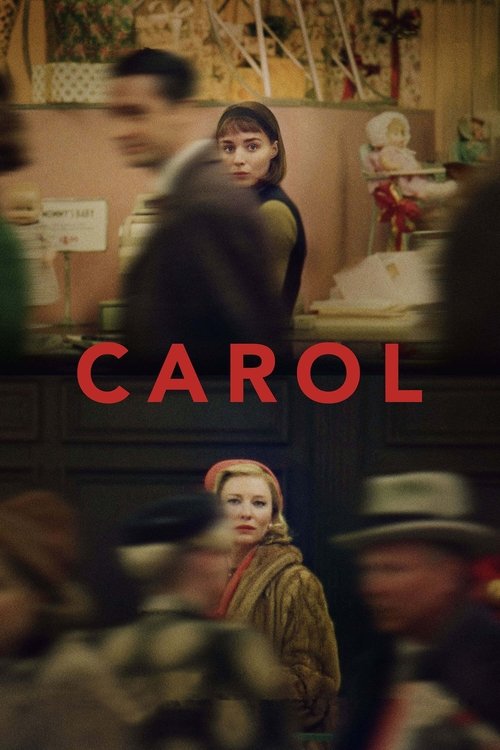
At the London Film Festival, Nagy said she had titled the film Carol and not The Price of Salt because Highsmith herself had changed the title to Carol when the novel was republished, and also because she "liked the sort of strange, obsessive nature of calling it by someone's name." Haynes said the film is called Carol because the novel "is locked into the subjectivity of the younger woman" and Carol is "really the object of desire in the story." "There's an element of, something aloof ... something unsettled about [her], that puts Therese and these new feelings ... on edge throughout much of the film". Of the story's universal theme, Haynes said, "the real determining question is not whether society will accept [Therese's] feelings or not; it's, will this person return her love or not? ... That is what transcends the class of love, or the period in which it's occurring, and makes it something that just humbles us all and levels us all."




.jpg?width=400)