







.jpg?width=400)




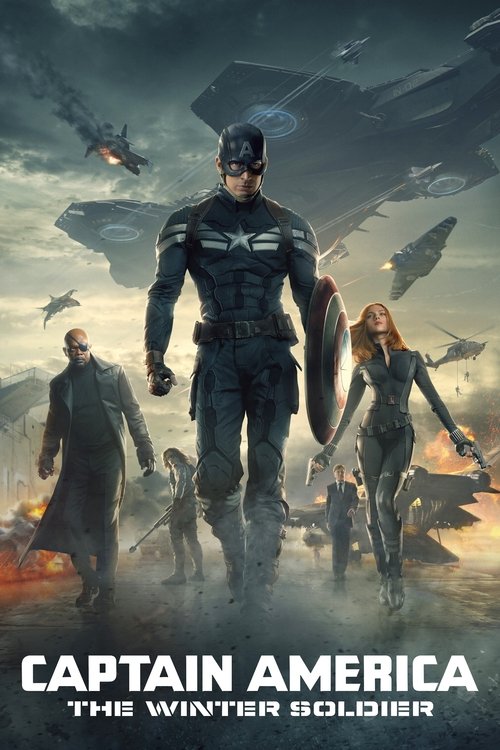
Captain America: The Winter Soldier is a 2014 American superhero film based on the Marvel Comics character Captain America, produced by Marvel Studios and distributed by Walt Disney Studios Motion Pictures. It is the sequel to Captain America: The First Avenger (2011) and the ninth film in the Marvel Cinematic Universe (MCU). The film was directed by Anthony and Joe Russo from a screenplay by Christopher Markus and Stephen McFeely. It stars Chris Evans as Steve Rogers / Captain America alongside Scarlett Johansson, Sebastian Stan, Anthony Mackie, Cobie Smulders, Frank Grillo, Emily VanCamp, Hayley Atwell, Toby Jones, Jenny Agutter, Robert Redford, and Samuel L. Jackson. In the film, Rogers, Natasha Romanoff (Johansson), and Sam Wilson (Mackie) uncover a conspiracy within the spy agency S.H.I.E.L.D. while facing the Winter Soldier (Stan), a mysterious assassin.
Markus and McFeely began writing the sequel around the release of The First Avenger in July 2011. The script draws from the Winter Soldier story arc in the comic books written by Ed Brubaker, as well as conspiracy fiction from the 1970s such as the film Three Days of the Condor (1975). The Winter Soldier explores S.H.I.E.L.D. in a similar way to how the first film explored the U.S. military, after Rogers was shown working for S.H.I.E.L.D. in the MCU crossover film The Avengers (2012). The Russo brothers signed on to direct in June 2012 and casting began the following month. They wanted the film to be a political thriller that focused on topical ideas such as drone warfare, targeted killing, and global surveillance. Filming began in April 2013 in Los Angeles, California, before moving to Washington, D.C., and Cleveland, Ohio. Though the directors prioritized practical effects and intense stunt work to differentiate from previous Captain America portrayals, visual effects were created by six companies for 2,500 shots including the climactic Helicarrier sequence.
Captain America: The Winter Soldier premiered at the El Capitan Theatre in Hollywood, Los Angeles, on March 13, 2014, and was released in the United States on April 4, as part of Phase Two of the MCU. The film received positive reviews from critics, with praise for the performances, action sequences, storyline, and themes. It grossed $714 million worldwide, making it the seventh-highest-grossing film of 2014, and received several accolades including a nomination for best visual effects at the 87th Academy Awards. A sequel titled Captain America: Civil War, also directed by the Russos, was released in 2016.
Contents
Plot
Two years after the Battle of New York, Steve Rogers works in Washington, D.C., for the espionage agency S.H.I.E.L.D., while adjusting to contemporary society. While running laps around the Lincoln Memorial Reflecting Pool and Tidal Basin, Rogers meets and befriends Sam Wilson, a VA counselor and former USAF pararescueman. Rogers is then sent with Agent Natasha Romanoff and S.H.I.E.L.D.'s counter-terrorism team S.T.R.I.K.E., led by Agent Brock Rumlow, to free hostages aboard a S.H.I.E.L.D. vessel from pirates led by Georges Batroc. During the mission, Rogers learns that Romanoff has a secret assignment from S.H.I.E.L.D. Director Nick Fury to extract data from the ship's computers.
At the Triskelion, S.H.I.E.L.D.'s headquarters, Rogers confronts Fury and is briefed about Project Insight: three Helicarriers linked to spy satellites, designed to preemptively eliminate threats. Unable to decrypt Romanoff's data, Fury becomes suspicious about Insight and asks senior S.H.I.E.L.D. official Alexander Pierce to delay the project. On his way to rendezvous with Agent Maria Hill, Fury is ambushed by assailants led by an assassin called the Winter Soldier. Escaping to Rogers's apartment, Fury warns him that S.H.I.E.L.D. is compromised. He is shot by the Winter Soldier before handing Rogers a flash drive of the ship's data and tells him to trust no one. Fury is later pronounced dead during surgery.
Pierce questions Rogers about Fury, but Rogers refuses to answer. He is branded a fugitive, escapes from S.T.R.I.K.E., and is joined by Romanoff. They use the flash drive to find a secret S.H.I.E.L.D. bunker in New Jersey, where they activate a supercomputer containing the preserved consciousness of Arnim Zola. Zola explains that after being captured by Rogers during World War II, he was recruited to S.H.I.E.L.D. and helped to secretly reform Hydra within its ranks. Over the decades, Hydra convinced the world to trade freedom for security and used the Winter Soldier to cover their tracks. Rogers and Romanoff narrowly escape a S.H.I.E.L.D. missile that destroys the bunker, and realize that Pierce is Hydra's leader within S.H.I.E.L.D.
Rogers and Romanoff seek refuge at Sam Wilson's home, whom they discover uses a powered "Falcon" wingpack. The trio captures S.H.I.E.L.D. agent Jasper Sitwell, a Hydra mole, and force him to divulge that Zola developed a data mining algorithm that can identify current or future threats to Hydra. The Insight Helicarriers would sweep the globe using satellite-directed guns to eliminate these threats. Sitwell is killed in an ambush by the Winter Soldier, whom Rogers recognizes as his presumed-dead best friend Bucky Barnes. Barnes survived due to Zola's experimentation and has been repeatedly brainwashed and cryogenically frozen to perform Hydra's missions. Hill extracts Rogers, Romanoff, and Wilson to a safehouse where Fury, who faked his death, plans to sabotage the Helicarriers by replacing their control chips.
Cast
Chris Evans as Steve Rogers / Captain America:An Avenger and a World War II veteran who was enhanced to the peak of human physicality by an experimental serum, frozen in suspended animation, and is now struggling to adjust to the 21st century. Describing his character's adjustment to the modern world, Evans said, "It's not so much about his shock with [technology]... It's more about the societal differences. He's gone from the '40s to today; he comes from a world where people were a little more trusting, the threats not as deep. Now, it's harder to tell who's right and wrong. Actions you take to protect people from threats could compromise liberties and privacy. That's tough for Steve to swallow." Evans trained in "parkour, Brazilian jiu-jitsu, karate, and boxing", as the Russo brothers believed that Rogers being brought to the present "also meant that he had studied and mastered modern fighting styles and techniques". The filmmakers also looked to make the character's shield, which has traditionally been used for defense, a more offensive weapon.
Scarlett Johansson as Natasha Romanoff / Black Widow:An Avenger and a highly trained spy and assassin working for S.H.I.E.L.D. who teams up with Rogers. Screenwriter Christopher Markus said that Black Widow was a "great contrast" to Captain America, describing her as "incredibly modern, not very reverent, and just very straightforward whereas Steve is, you know a man from the '40s. He's not a boy scout, but he is reserved and has a moral center, whereas her moral center moves." The Russos added, "She's a character who lies for a living. That's what she does. He's a character who tells the truth. Give them a problem and they'll have different ways of approaching it. She's pushing him to modernize, and he's pushing her to add a certain level of integrity to her life." When asked about Romanoff's relationship with Rogers, Johansson responded, "By a series of unfortunate encounters, they will be in a situation in which their friendship becomes more intimate. They share many similarities because they live on the defensive without relying on anyone. Also, the two have been working for the government throughout their professional careers. With their friendship they begin to question what they want and what is their true identity."
Sebastian Stan as Bucky Barnes / Winter Soldier:Steve Rogers' childhood best friend who has re-emerged as an enhanced brainwashed assassin after supposedly being killed in action during World War II. Regarding the character, Feige said, "Winter Soldier has been methodically, almost robotically, following orders for 70 years." Stan said despite his nine-picture deal with Marvel Studios including his appearance in Captain America: The First Avenger (2011), he was not sure that Bucky would make an imminent return, and only heard the sequel's official title was "The Winter Soldier" through a friend attending San Diego Comic-Con. Stan did five months of physical training to prepare for the role and did historical research, stating, "I dove into the whole Cold War thing. I looked at the KGB. I looked at all kinds of spy movies, and all kinds of documentaries about that time, and what it was about. I grabbed anything from that time period. Anything about brainwashing." Stan also practiced daily with a plastic knife to be able to do the Winter Soldier's knife tricks without the aid of a stuntman. Regarding Bucky's transition into the Winter Soldier, Stan said, "You know, the truth of the situation is although he looks very different and there's different things about him, it still comes from the same person. I think you'll get to see that no matter what. I think part of my goal here was to make sure that you see an extension of that version but just a different color of that same version in a way. I think he's still the same guy; he's cut from the same cloth." Stan said he felt the character's introduction in The Winter Soldier was "a preview of the guy", with more aspects of the character being explored in the film's sequel Captain America: Civil War (2016).
Production
Development
In April 2011, prior to the release of the Marvel Cinematic Universe (MCU) film Captain America: The First Avenger in theaters that July, screenwriters Christopher Markus & Stephen McFeely announced that they were hired by Marvel Studios to begin work on the film's sequel. In September 2011, Chris Evans, who portrayed Steve Rogers / Captain America in The First Avengers, said that a sequel might not be released until 2014. In January 2012, Neal McDonough, who played Dum Dum Dugan in The First Avenger, mentioned that a sequel would likely be filmed after the completion of the MCU film Thor: The Dark World (2013), meaning sometime in 2012. By March 2012, Marvel whittled down the list of possible directors to three candidates: George Nolfi, F. Gary Gray, and the Russo brothers.
The following month, Gary Gray withdrew his name from consideration, choosing instead to direct the N.W.A biographical film Straight Outta Compton (2015). The Russos were under consideration to direct the film due to their Community (2009–2015) episode "For a Few Paintballs More", which spoofed Marvel Studios president Kevin Feige's love for the Star Wars franchise. The Russos weren't allowed to read the screenplay until their first meeting with Marvel, and the project consumed all of their time over the following two months, as they proceeded with storyboards, rewriting scenes, and creating an animatic to show what they intended to do both tonally and textually. Their efforts paid off and led to their hiring; Anthony Russo had told his wife Ann that if he wasn't selected for the job, he would rethink his career.
Walt Disney Studios announced intentions to release The First Avenger sequel on April 4, 2014. Disney said, "The second installment will pick-up where ... The Avengers (2012) leaves off, as Steve Rogers continues his affiliation with Nick Fury and S.H.I.E.L.D. and struggles to embrace his role in the modern world". Markus later elaborated, "I think S.H.I.E.L.D. is the water [Rogers is] swimming in. It's definitely a Captain America movie. You know, if the first movie was a movie about the US Army, then this is a movie about S.H.I.E.L.D... You will learn about S.H.I.E.L.D. You will learn about where it came from and where it's going and some of the cool things they have".
McFeely said the writing began around the release of The First Avenger in the middle of 2011, with him and Markus "noodling on in hopes that there would be a second one and we did a lot of just throwing stuff at the wall and seeing what stuck". The first few months of writing were a back and forth process with Marvel, but after an outline was finished, the story did not change much. They opted to set the story in the present day, and, after "experimenting with flashback elements for more period World War II stuff", decided to abandon the flashbacks as "it became unwieldy." The film would be "Cap versus the world we all live in today", while averting excessive comedy regarding the hero's time displacement, as Markus considered the Captain "the most adaptive man on the planet." The tone would be more grounded in reality despite the advanced technology to contrast the fantasy elements from both the first Captain America and The Avengers. Despite that, the comic book origins guaranteed that the film would have no verisimilitude. This still proved a challenge in the reveal of Arnim Zola, that had to be extensively rewritten to convey how "this grounded espionage paranoid thriller suddenly screeches to a halt and you switch gears really quickly with this ghost in the machine" that introduces more science fiction elements.
Pre-production
By June 2012, the Russo brothers entered negotiations to direct the sequel, and Jackson was confirmed to return as S.H.I.E.L.D. leader Nick Fury. Feige sought out the Russos after watching the genre-parodying season 2 finale of Community which Joe directed, and for the additional ideas they brought to the initial story pitch. Joe Russo detailed that since the intent was for a political thriller, "all the great political thrillers have very current issues in them that reflect the anxiety of the audience." Thus, the brothers opted to include references to drone warfare, targeted killing and global surveillance. Joe even noted how during principal photography, the issues became more topical due to the disclosure of several National Security Agency surveillance-related documents. At the 2012 San Diego Comic-Con, it was announced that the official title for the sequel was Captain America: The Winter Soldier, and that the Russo brothers would direct the film. After signing on to direct, the Russo brothers met with Ed Brubaker to learn more about where the Winter Soldier character came from, his thinking and the themes behind the character. In July 2012, Anthony Mackie entered negotiations to star as Sam Wilson / Falcon alongside Evans in the sequel. At that time, Sebastian Stan was also confirmed to be reprising his role as Bucky Barnes / Winter Soldier from The First Avenger in the film.
In September 2012, Evans said filming would begin in March 2013. He also said that Rogers' adjustment to the modern world, which was originally set to be included in The Avengers, would be better suited for The Winter Soldier. At the end of the month, The Greater Cleveland Film Commission announced that Captain America: The Winter Soldier would film in Cleveland, Ohio after the production was approved for a $9.5 million tax credit. Producer Nate Moore said that after also serving as a location in The Avengers, Cleveland's government was helpful in providing large locations for filming, which "provided production value which we probably could not have built in a backlot." McFeely joked that while writing ambitious action scenes "I did not realize a great American metropolis would say 'Sure, shut down three miles of freeway and go to town'." Portions of the film were also scheduled to be shot in California and Washington, D.C. By October, Emilia Clarke, Jessica Brown Findlay, Teresa Palmer, Imogen Poots, Alison Brie, and Mary Elizabeth Winstead were being considered for Rogers' love interest in the film, and Scarlett Johansson was brought back to reprise her role as Natasha Romanoff / Black Widow. Later in the month, Frank Grillo was testing for the role of Brock Rumlow in the film, and by the end of the month, Grillo closed a deal to portray the character and Cobie Smulders signed on to reprise her role as Maria Hill from The Avengers. Nikolaj Coster-Waldau, Josh Holloway, and Kevin Durand were also considered for the role of Rumlow.
Filming
Principal photography began on April 1, 2013, at the Raleigh Manhattan Beach Studios in Los Angeles, under the working title Freezer Burn. Scenes taking place on the Lemurian Star were filmed on the Sea Launch Commander, docked in Long Beach, California. In early May, Dominic Cooper confirmed he would return to reprise his role as Howard Stark from The First Avenger in the film. On May 14, 2013, production moved to Washington, D.C., with filming taking place at the National Mall and the Theodore Roosevelt Bridge. The following day, Garry Shandling was spotted on set reprising his role of Senator Stern from the MCU film Iron Man 2 (2010). Other filming locations in Washington, D.C., included the Willard Hotel and Dupont Circle. Filming in Cleveland began on May 17 and was scheduled to last until mid-June with locations scheduled on the West Shoreway, the Southerly Wastewater Treatment Plant in Cuyahoga Heights and the Lakeview Cemetery Dam. Cleveland was chosen as a stand-in for Washington, D.C., with the city's East 6th Street doubling as 7th and D Streets in Southwest D.C. Other locations in Cleveland included the Federal Reserve Bank of Cleveland, the Cleveland Public Library, Cleveland State University, the Cleveland Arcade, Tower City Center, the Cleveland Museum of Art, and the Western Reserve Historical Society. Interior shots were also filmed inside private homes and the Pilgrim Congregational Church in Tremont. Filming in Cleveland concluded on June 27, 2013.
Trent Opaloch, best known for his work on the films District 9 (2009) and Elysium (2013), was brought in as the director of photography. Opaloch said that while attempting to emulate the 1970s thrillers that served as inspiration for the writers and directors, the staging and lighting tried to bring realism through "classic framing and naturalistic lighting", and the filming was done with hand-held cameras. To achieve this, Opaloch used Arri Alexa Plus 4:3 cameras with Panavision anamorphic lenses and Codex Digital recorders. Stunt work aimed for realistic action, prioritizing practical effects. The fight scenes were staged for months, with a choreography that aimed to highlight Captain America's superhuman qualities, and "move away from impressionistic action into specificity": the raid on the S.H.I.E.L.D. vessel had stealthiness as the Captain knocked out enemies to avert detection, and the freeway fight with Winter Soldier was more "last minute" to highlight the characters' struggle to survive. In contrast to the quick editing and moving cameras of modern action films, The Winter Soldier aimed to feature longer action scenes that felt more visceral and dangerous. The Russos mentioned the bank robbing scene of the film Heat (1995) as a major influence, which they described as "the most intense eight minutes of filmmaking I've seen in a movie theater", and action scenes directed by Brian De Palma, such as the vault heist in the film Mission: Impossible (1996) where "very likable characters are put in impossible situations that the audience is put on the edge on how they'd escape". Examples of these types of scenes include the ambushes on Nick Fury in the street and Captain America in the elevator.
Post-production
Editing on the film was done by the Russos on their trailer at the filming lot of Community. Additional photography was filmed in December 2013 and January 2014, for the Russos to accurately show the state of each character after the defeat of S.H.I.E.L.D., having read the script of the MCU film Avengers: Age of Ultron (2015) to guide their choices. Joss Whedon, director of The Avengers and Age of Ultron, wrote and directed the mid-credits scene, which featured Elizabeth Olsen as Wanda Maximoff, Aaron Taylor-Johnson as Pietro Maximoff, and Thomas Kretschmann as Baron Wolfgang von Strucker. The title sequences were created by design firm Sarofsky, who had worked with the Russos since Community. Sarofsky collaborated with comic book artist David W. Mack on the sequences.
Anthony Mackie said the Russo brothers relied on minimal use of computer-generated imagery, stating, "The Russos, what they did that was so great was, they wanted to stay with live action, which is a dying art form. If they can build it, they built it. If we could do it, we did it. They wanted to do as little CGI as possible. That's why the movie looks so great." Nevertheless, six special effects companies were involved in creating the visual effects of the film, including Industrial Light & Magic (ILM), Scanline VFX, Lola Visual Effects, Luma Pictures, Whiskytree and The Embassy, with previsualization completed by Proof. The film contained 2,500 visual effects shots, with 900 worked on by ILM. The film featured extensive use of digital doubles. Russell Earl, ILM visual effects supervisor, said, "The character that we did the most work on was Falcon. We knew we were going to do CG wings. We also did some shots with wires and some with stunt doubles and head replacement. And we needed a very good digital double." Lola VFX, who worked on the pre-serum Steve Rogers scenes in this film and The First Avenger, also worked on shots featuring an elderly Peggy Carter. This involved digitally transposing the facial features of an elderly actress onto the face of Atwell, who had performed her lines with no make-up and only a few tracking markers.
The Helicarriers in the film were completely digital. Earl said, "In [The Avengers] it was more like an aircraft carrier, now it's an aircraft carrier with the addition of battle ship-sized guns. We were all over the carriers [with the virtual camera]. We were on the decks; we were flying next to them. We had a lot of close ups and different angles. And we didn't just have one; we had three. On top of that, we had to destroy them all." This CGI environment was also used in close ups. Earl said, "The challenge was to get in all of the detail to make it feel like it is a real, working ship. We created details down to the railings and all the human-scale stuff. ... For the shots in which we were destroying them, we had to have the internals as well—the hallways, the storage areas." Many of the shots of Washington, D.C., were digitally created due to numerous flight restrictions in the city which necessitated that locations be recreated by computer. However, aerial footage of the city was filmed and used for live action plate photography for shots involving the Triskelion, which is located on Theodore Roosevelt Island on the Potomac River.
Music
In June 2013, Henry Jackman announced that he would compose the film's score. About the score Jackman said, "...it's 50% production and all the tricks I've learnt from spending years in the record industry but then it's also got the kind of injection of symphonic, thematic, heroic music that all kind of merges into one musical, and hopefully coherent piece". A soundtrack album was released by Hollywood Records on April 1, 2014.
Marketing
In July 2013, Marvel Studios released a teaser poster depicting a damaged and discolored Captain America shield. The Los Angeles Times said, "the image suggests that [Captain America] might see some serious battle in the sequel" while Rolling Stone said, "the image hints at darker themes in the sequel". Later that month, Marvel Studios head and producer Kevin Feige, directors Joe and Anthony Russo, and cast members Chris Evans, Scarlett Johansson, Samuel L. Jackson, Sebastian Stan, Anthony Mackie, Cobie Smulders, Emily VanCamp, and Frank Grillo held a panel at the 2013 San Diego Comic-Con and presented footage from the film. In addition, Marvel had booths depicting a Smithsonian-type exhibit showing Captain America and the Howling Commandos from Captain America: The First Avenger. At the end of the month, audiences were shown a glimpse of the film along with some of Marvel's other Phase Two slate of films at Disney XD's Disney Fandom event.
In August 2013, Feige, Evans, Stan, and Mackie presented a clip of the film at Disney's D23 Expo. In September 2013, Marvel announced that it is again partnering with Harley-Davidson, continuing their relationship from Captain America: The First Avenger, with Captain America riding the company's Softail Breakout motorcycle in the film.
In October 2013, Marvel released the first trailer for Captain America: The Winter Soldier. The Hollywood Reporter said, "it looks like it'll live up to the 'political thriller' that's been promised for months now." Los Angeles Times said, "[the] trailer runs 2½ minutes and teases plenty of action, conspiracy and clever banter between Captain America and his S.H.I.E.L.D. colleagues, with a smattering of the previously released Comic-Con International and D23 footage." Los Angeles Times also noted that the day before the release of the trailer, the studio released "a teaser for a trailer." The trailer received 23.5 million views in the 24 hours after its release. In November 2013, Jed Whedon, the co-creator of the television series Agents of S.H.I.E.L.D. (2013–2020), said that there were plans to reference events from the film into the show, stating, "Nick Fury is in [Captain America: The Winter Soldier], and S.H.I.E.L.D. makes an appearance, so we will definitely try to tee-up some stuff and probably play a little bit of the fallout from that film."
In January 2014, Disney announced that in honor of the film, Captain America would be making appearances at Disneyland. The meet and greet experience opened March 7, 2014, and is called Captain America: The Living Legend and Symbol of Courage, located at Innoventions in Tomorrowland. Also in January, Marvel Comics released a prelude digital comic titled, Marvel's Captain America: The Winter Soldier Infinite Comic, written by Peter David, with art by Rock-He Kim. The comic sees the return of the "Zodiac", the mysterious weapon first seen in the One-Shot Agent Carter (2013), which has fallen into the wrong hands. Captain America, Black Widow, and Rumlow must track the weapon down and put it back in S.H.I.E.L.D. protection.
Release
Theatrical
Captain America: The Winter Soldier was released in 32 markets on March 26, 2014 and in North America on April 4, 2014, in 2D, 3D and IMAX 3D. The film debuted on 668 IMAX screens worldwide, a record for films releasing in April. The world premiere took place on March 13, 2014, at the El Capitan Theatre in Hollywood, Los Angeles. The Paris premiere occurred on March 17 at Le Grand Rex, the London premiere took place on March 20 at Westfield London, the Beijing premiere took place on March 24 and the Cleveland premiere took place on April 1. Chris Evans and Scarlett Johansson auctioned off passes to one of the premieres for charity. Captain America: The Winter Soldier is part of Phase Two of the MCU.
Home media
Captain America: The Winter Soldier was released by Walt Disney Studios Home Entertainment for digital download on August 19, 2014, and on Blu-ray, Blu-ray 3D, and DVD on September 9, 2014. The physical media releases include behind-the-scenes featurettes, audio commentary, deleted scenes, and a blooper reel.
The film was also collected in a 13-disc box set, titled "Marvel Cinematic Universe: Phase Two Collection", which includes all of the Phase Two films in the Marvel Cinematic Universe. It was released on December 8, 2015. Captain America: The Winter Soldier was released on 4K UHD Blu-Ray on April 23, 2019.
Reception
Box office
Captain America: The Winter Soldier earned $259.8 million in North America and $454.7 million in other territories for a worldwide total of $714.4 million. It became the fifth-highest-grossing film of 2014 worldwide. Deadline Hollywood calculated the film's net profit as $166.2 million, accounting for production budgets, marketing, talent participations, and other costs; box office grosses and home media revenues placed it ninth on their list of 2014's "Most Valuable Blockbusters".
Captain America: The Winter Soldier made $10.2 million in Thursday night showings, more than double the midnight gross of its predecessor. It surpassed Fast Five to set an April single-day ($36.9 million) and April opening-weekend record ($95.0 million), while its opening weekend was a 46% increase over its predecessor. The film held the number one spot at the box office for three consecutive weekends, before being overtaken by The Other Woman in its fourth weekend. It achieved the largest total gross among films released in the month of April. In June 2014, it surpassed The Lego Movie to become the highest-grossing film of the year. At the end of its theatrical run, the film became the fourth-highest-grossing film of 2014 behind American Sniper, The Hunger Games: Mockingjay – Part 1, and Guardians of the Galaxy.
Captain America: The Winter Soldier topped the box office on its opening weekend with $75.2 million from 32 overseas markets. The film debuted at number one in many territories, including Australia, China, and Russia and set a 3-day opening-weekend record in China among Disney films, with $38.81 million. It topped the box office outside North America on two consecutive weekends, followed by two weeks in second, behind Rio 2.
Critical response
The review aggregator Rotten Tomatoes reported an approval rating of 90%, with an average score of 7.7/10, based on 311 reviews. The website's critics consensus reads, "Suspenseful and politically astute, Captain America: The Winter Soldier is a superior entry in the Avengers canon and is sure to thrill Marvel diehards." Metacritic, which uses a weighted average, assigned a score of 70 out of 100 based on 48 critics, indicating "generally favorable" reviews. CinemaScore audiences gave Captain America: The Winter Soldier an "A" grade rating on an A+ to F scale.
Todd McCarthy of The Hollywood Reporter said the film "takes the bold (for Marvel) step of reducing CGI spectacle to a relative minimum in favor of reviving the pleasures of hard-driving old-school action, surprising character development and intriguing suspense." Scott Foundas of Variety said it is "chockfull of the breathless cliffhangers dictated by the genre, but equally rich in the quiet, tender character moments that made the first film unique among recent Marvel fare." Richard Roeper of the Chicago Sun-Times considered it "another rock-solid chapter in the big-screen story of Marvel," though he compared it unfavorably to The Avengers, Iron Man and Iron Man 3. Owen Gleiberman of Entertainment Weekly noted the topicality of the film, and compared it to The Dark Knight (2008). Ty Burr of The Boston Globe said the film "delivers all the 3D CGI mayhem audiences have come to expect from the Marvel entertainment juggernaut, but there's darkness and confusion just under its comic-book surface." Joe Morgenstern of The Wall Street Journal praised the film's "emotional bandwidth" and nuances, and felt it fixed all the shortcomings of The First Avenger "and then some".
Conversely, Kenneth Turan of the Los Angeles Times characterized the film with a lack of inspiration. Manohla Dargis of The New York Times said, "Like many others of its type, [Captain America: The Winter Soldier] gets off to a kinetic start only to lose steam before blowing everything up." Robbie Collin of The Daily Telegraph expressed disappointment with the lack of risks taken by the film compared to its "relatively spicy premise". Mick LaSalle of the San Francisco Chronicle felt the film was too long, with unexciting and illegible action scenes. Joe Williams of the St. Louis Post Dispatch felt The Winter Soldier didn't explore the issues it raised and paled in comparison to The First Avenger. Jake Coyle of the Associated Press said the film's biggest misstep was the handling of Stan's Winter Soldier, and that it was "getting difficult to tell the Marvel movies apart".
Sequel
Captain America: Civil War was released on May 6, 2016, with the Russo brothers returning to direct, and Markus and McFeely again writing the screenplay. Evans, Johansson, Stan, Mackie, VanCamp, and Grillo reprise their roles from The Winter Soldier and are joined by Robert Downey Jr. as Tony Stark / Iron Man, Paul Bettany as Vision, Jeremy Renner as Clint Barton / Hawkeye, Don Cheadle as James "Rhodey" Rhodes / War Machine, Elizabeth Olsen as Wanda Maximoff, Paul Rudd as Scott Lang / Ant-Man, and William Hurt as Thaddeus "Thunderbolt" Ross, all reprising their roles from previous MCU films. Tom Holland and Chadwick Boseman appear as Peter Parker / Spider-Man and T'Challa / Black Panther, respectively.