



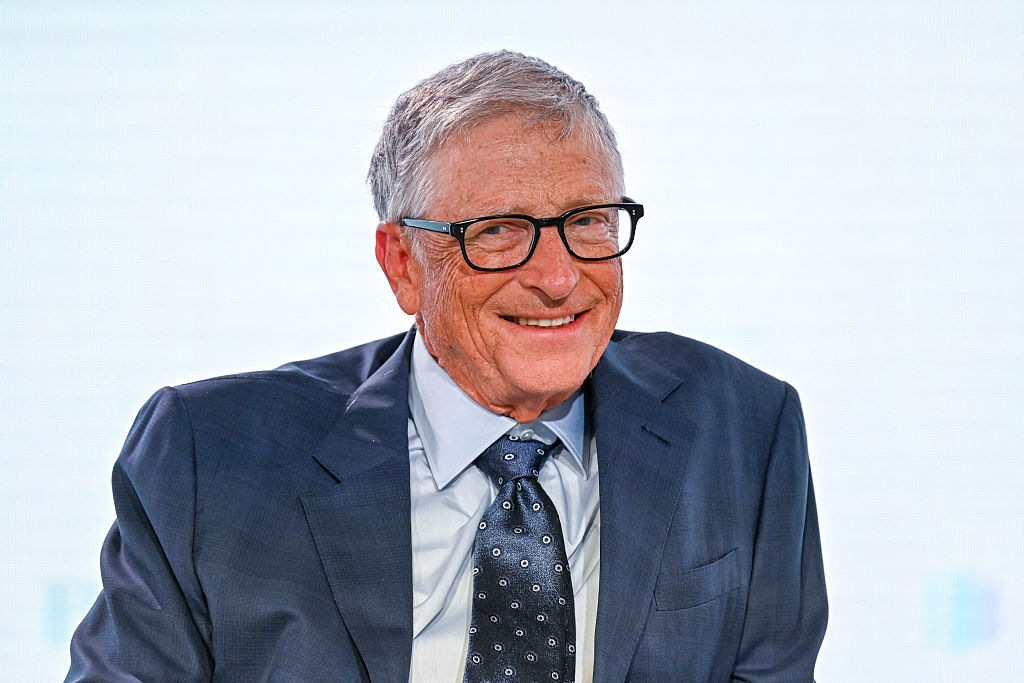
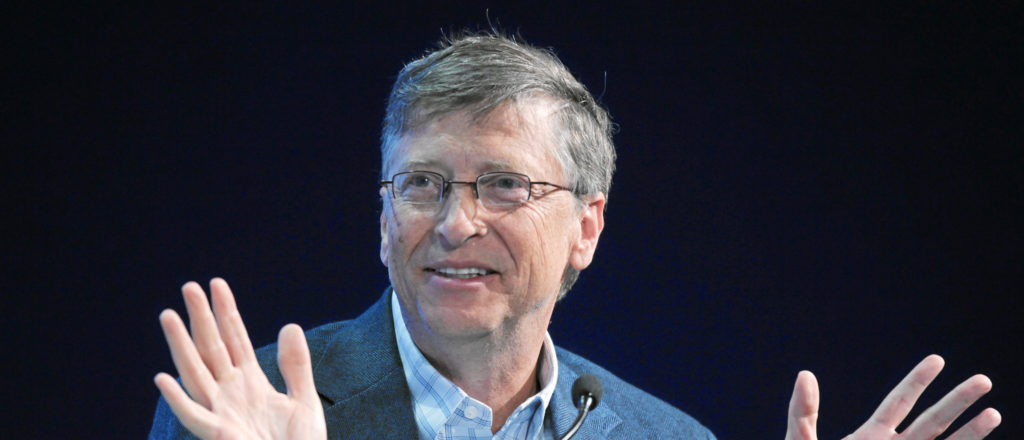
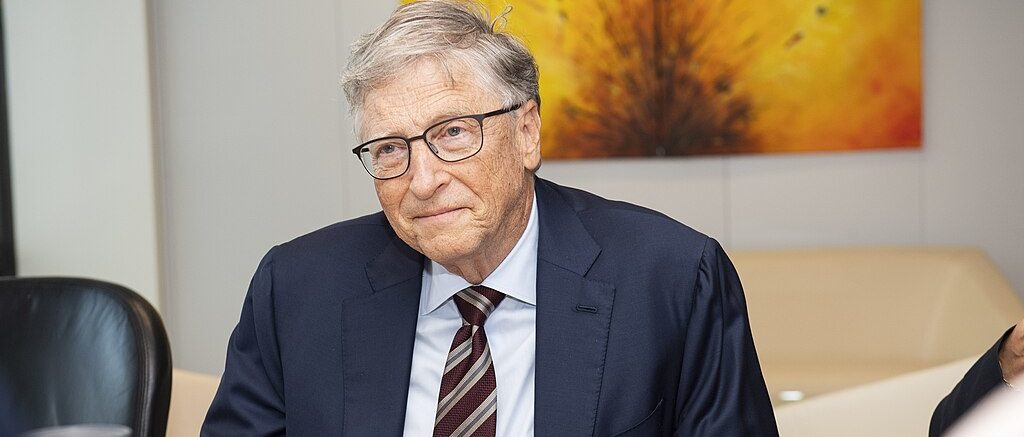
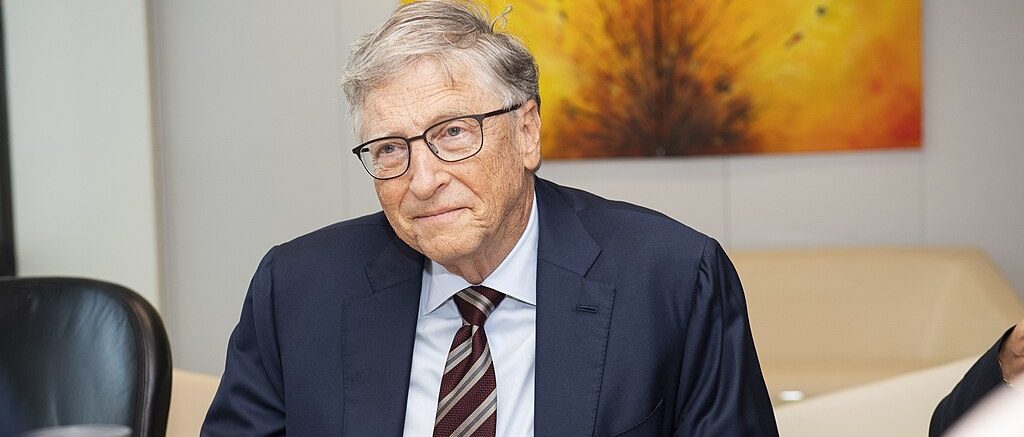
William Henry Gates III (born October 28, 1955) is an American businessman and philanthropist. A pioneer of the microcomputer revolution of the 1970s and 1980s, he co-founded the software company Microsoft in 1975 with his childhood friend Paul Allen. Following Microsoft's initial public offering in 1986 and the subsequent increase in its stock price, Gates became the world's then-youngest billionaire in 1987, at age 31. Forbes magazine ranked him as the world's wealthiest person in their The World's Billionaires list for 18 out of 24 years between 1995 and 2017, including 13 years consecutively from 1995 to 2007. Gates became the first centibillionaire in 1999, when his net worth briefly surpassed US$100 billion. According to Forbes, as of July 2026, his net worth stood at US$106.5 billion, making him the 19th-wealthiest individual in the world.
Born and raised in Seattle, Washington, Gates was privately educated at Lakeside School, where he befriended Allen and developed his computing interests. In 1973, he enrolled at Harvard University, where he took classes including Math 55 and graduate-level computer science courses, but he dropped out in 1975 to co-found and lead Microsoft. He served as its CEO for the next 25 years and also became president and chairman of the board when the company was incorporated in 1981. Succeeded as CEO by Steve Ballmer in 2000, he transitioned to chief software architect, a position he held until 2008. He stepped down as chairman of the board in 2014 and became technology adviser to CEO Satya Nadella and other Microsoft leaders, a position he still holds. He resigned from the board in 2020.
Over time, Gates reduced his role at Microsoft to focus on his philanthropic work with the Bill & Melinda Gates Foundation, the world's largest private charitable organization, which he and his then-wife, Melinda French Gates, co-chaired from 2000 until 2024. Focusing on areas including health, education, and poverty alleviation, Gates became known for his efforts to combat transmissible diseases such as tuberculosis, malaria, and polio. After French Gates resigned as co-chair following the couple's divorce, the foundation was renamed the Gates Foundation, with Gates as its sole chair.
Gates is the founder and chairman of several other companies, including BEN, Cascade Investment, TerraPower, Gates Ventures, and Breakthrough Energy. In 2010, he and Warren Buffett founded the Giving Pledge, whereby they and other billionaires pledged to give at least half their wealth to philanthropy. Named as one of the 100 most influential people of the 20th century by Time magazine in 1999, he has received numerous other honors and accolades, including a Presidential Medal of Freedom, awarded jointly to him and French Gates in 2016 for their philanthropic work. The subject of several documentary films, he published the first of three planned memoirs, Source Code: My Beginnings, in 2025.
Contents
Early life and education
William Henry Gates III was born on October 28, 1955, in Seattle, Washington, as the only son of Bill Gates Sr. (1925–2020) and his first wife, Mary Maxwell Gates (1929–1994). His ancestry includes English, German, and Irish/Scots-Irish. His father was a prominent lawyer, and his mother served on the board of directors of First Interstate BancSystem and United Way of America. Gates's maternal grandfather, J. W. Maxwell, was a national bank president. Gates also has an older sister, Kristi (Kristianne), and a younger sister, Libby. He is the fourth of his name in his family, but is known as William Gates III or "Trey" (i.e., three) because his father had the "II" suffix. The family lived in the Sand Point area of Seattle in a home that was damaged by a rare tornado when Gates was 7.
When Gates was young, his parents wanted him to pursue a career in law. During his childhood, his family regularly attended a church of the Congregational Christian Churches, a Protestant Reformed denomination.
Gates was small for his age and was bullied as a child. The family encouraged competition; one visitor reported that "it didn't matter whether it was hearts or pickleball or swimming to the dock; there was always a reward for winning, and there was always a penalty for losing".
At age 13, Gates enrolled in the private Lakeside Prep School. When he was in the eighth grade, the Mothers' Club at the school used proceeds from Lakeside School's rummage sale to buy a Teletype Model 33 ASR terminal and a block of computer time on a General Electric (GE) computer for the students. Gates took an interest in programming the GE system in BASIC, and he was excused from math classes to pursue his interest. He wrote his first computer program on this machine, an implementation of tic-tac-toe that allowed users to play games against the computer. Gates was fascinated by the machine and how it would always execute software code perfectly.
After the Mothers Club donation was exhausted, Gates and other students sought time on systems, including DEC PDP minicomputers. One of these systems was a PDP-10 belonging to Computer Center Corporation (CCC), which banned Gates, Paul Allen, Ric Weiland, and Gates's best friend and first business partner, Kent Evans, for the summer after it caught them exploiting bugs in the operating system to obtain free computer time.
Business career
Microsoft
Gates read the January 1975 issue of Popular Electronics, which demonstrated the Altair 8800, and contacted Micro Instrumentation and Telemetry Systems (MITS) to inform them that he and others were working on a BASIC interpreter for the platform. In reality, Gates and Allen did not have an Altair and had not written code for it; they merely wanted to gauge MITS's interest. MITS president Ed Roberts agreed to meet them for a demonstration, and over the course of a few weeks, they developed an Altair emulator that ran on a minicomputer and then the BASIC interpreter.
The demonstration was held at MITS's offices in Albuquerque, New Mexico. It was a success and resulted in a deal with MITS to distribute the interpreter as Altair BASIC. MITS hired Allen, and Gates took a leave of absence from Harvard to work with him at MITS in November 1975. Allen named their partnership "Micro-Soft", a combination of "microcomputer" and "software". Their first office was in Albuquerque. The first employee Gates and Allen hired was their high school collaborator Ric Weiland. They dropped the hyphen within a year and officially registered the trade name "Microsoft" with the Secretary of the State of New Mexico on November 26, 1976. Gates never returned to Harvard to complete his studies.
Microsoft's Altair BASIC was popular with computer hobbyists, but Gates discovered that a pre-market copy had leaked out and was being widely copied and distributed. In February 1976, he wrote An Open Letter to Hobbyists in the MITS newsletter in which he asserted that more than 90% of the users of Microsoft Altair BASIC had not paid Microsoft for it, and the Altair "hobby market" was in danger of eliminating the incentive for any professional developers to produce, distribute, and maintain high-quality software. This letter was unpopular with many computer hobbyists, but Gates persisted in his belief that software developers should be able to demand payment. Microsoft became independent of MITS in late 1976, and it continued to develop programming language software for various systems. The company moved from Albuquerque to Bellevue, Washington, on January 1, 1979.
Gates said he personally reviewed and often rewrote every line of code that the company produced in its first five years. As the company grew, he transitioned into a manager role, then an executive. His ideas about programming and memories of the Altair BASIC project are described in the book Programmers at Work, a collection of interviews published by Microsoft Press in 1986.
Business ventures and investments (partial list)
Gates has a multi-billion dollar investment portfolio with stakes in companies in multiple sectors and has participated in several entrepreneurial ventures beyond Microsoft, including:
AutoNation, an automotive retailer which trades on the NYSE and in which Gates has a 16% stake.
bgC3 LLC, a think-tank and research company founded by Gates.
Canadian National Railway (CN), a Canadian Class I freight railway. As of 2019, Gates is the single largest shareholder of the company.
Cascade Investment LLC, a private investment and holding company incorporated in the United States, founded and controlled by Gates and headquartered in Kirkland, Washington.
Gates is the largest private owner of farmland in the United States with his landholdings owned through Cascade Investment totalling 242,000 acres across 19 states. He is the 49th largest private owner of land in the US.
Carbon Engineering, a for-profit venture founded by David Keith, which Gates helped fund. It is also supported by Chevron Corporation and Occidental Petroleum.
SCoPEx, Keith's academic venture in "sun-dimming" geoengineering, which Gates provided most of the $12 million for.
Corbis (originally named Interactive Home Systems, then Corbis and now known as Branded Entertainment Network), a digital image licensing and rights services company founded and chaired by Gates. Corbis Images, its enormous photo image library, was sold to a Chinese firm in January 2016.
EarthNow, a Seattle-based startup company aiming to blanket the Earth with live satellite video coverage. Gates is a large financial backer.
Later life
Since leaving day-to-day operations at Microsoft, Gates has continued his philanthropy and works on other projects. He stepped down as chairman of Microsoft in February 2014 to become a technology advisor at the firm to support newly appointed CEO Satya Nadella.
Gates provided his perspective on a range of issues in an interview that was published in the March 2014 issue of Rolling Stone magazine. In the interview, he provided his perspective on climate change, his charitable activities, various tech companies and people involved in them, and the state of America. In response to a question about his greatest fear when he looks 50 years into the future, Gates stated: "there'll be some really bad things that'll happen in the next 50 or 100 years, but hopefully none of them on the scale of, say, a million people that you didn't expect to die from a pandemic, or nuclear or bioterrorism." Gates also identified innovation as the "real driver of progress" and pronounced that "America's way better today than it's ever been." Gates has often expressed concern about the potential harms of superintelligence; in a Reddit "ask me anything", he stated that:
First the machines will do a lot of jobs for us and not be super intelligent. That should be positive if we manage it well. A few decades after that though the intelligence is strong enough to be a concern. I agree with Elon Musk and some others on this and don't understand why some people are not concerned.
In an interview that was held at the TED conference in March 2015, with Baidu co-founder and CEO, Robin Li, Gates said he would "highly recommend" Nick Bostrom's recent work, Superintelligence: Paths, Dangers, Strategies. During the conference, Gates warned that the world was not prepared for the next pandemic, a situation that would come to pass in late 2019 when the COVID-19 pandemic began. In March 2018, Gates met at his home in Seattle with Mohammed bin Salman, the crown prince and de facto ruler of Saudi Arabia, to discuss investment opportunities for Saudi Vision 2030. In June 2019, Gates admitted that losing the mobile operating system race to Android was his biggest mistake. He stated that it was within their skill set of be the dominant player, but partially blames the antitrust litigation during that time. That same year, Gates became an advisory board member of the Bloomberg New Economy Forum.
In March 2020, Microsoft announced Gates would be leaving his board positions at Berkshire Hathaway and Microsoft to dedicate himself to philanthropic endeavors such as climate change, global health and development, and education. The Wall Street Journal reported in May 2021 that Gates stepped down before Microsoft's board finished its investigation into Gates's alleged inappropriate sexual relationship with a Microsoft employee, which an external law firm had begun probing in late 2019.
Philanthropy
In an interview with the BBC in 2025, Gates stated that his charitable donations have totalled $100 billion, of which $60 billion have gone to the Bill & Melinda Gates Foundation.
Gates studied the work of Andrew Carnegie and John D. Rockefeller, and donated some of his Microsoft stock in 1994 to create the "William H. Gates Foundation". In 2000, Gates and his wife combined three family foundations and donated stock valued at $5 billion to create the Bill & Melinda Gates Foundation, which was identified by the Funds for NGOs company in 2013, as the world's largest charitable foundation, with assets reportedly valued at more than $34.6 billion. The foundation allows benefactors to access information that shows how its money is being spent, unlike other major charitable organizations such as the Wellcome Trust. Gates, through his foundation, also donated $20 million to the Carnegie Mellon University for a new building to be named Gates Center for Computer Science which opened in 2009.
Gates has credited the generosity and extensive philanthropy of David Rockefeller as a major influence. He and his father met with Rockefeller several times, and their charity work is partly modeled on the Rockefeller family's philanthropic focus, whereby they are interested in tackling the global problems that are ignored by governments and other organizations.
The foundation is organized into five program areas: Global Development Division, Global Health Division, United States Division, and Global Policy & Advocacy Division. Among others, it supports a wide range of public health projects, granting aid to fight transmissible diseases such AIDS, tuberculosis and malaria, as well as widespread vaccine programs to eradicate polio. It grants funds to learning institutes and libraries and supports scholarships at universities. The foundation established a water, sanitation and hygiene program to provide sustainable sanitation services in poor countries. Its agriculture division supports the International Rice Research Institute in developing Golden Rice, a genetically modified rice variant used to combat vitamin A deficiency. The foundation aims to provide women and girls in the developing world with information and support regarding contraception and, ultimately, universal access to consensual family planning. In 2007, the Los Angeles Times criticized the foundation for investing its assets in companies that have been accused of worsening poverty, pollution and pharmaceutical firms that do not sell to developing countries. Although the foundation announced a review of its investments to assess social responsibility, it was subsequently canceled and upheld its policy of investing for maximum return, while using voting rights to influence company practices.
Political positions
In October 2024, The New York Times reported Gates had recently donated $50 million to Future Forward USA Action, a 501(c)(4) organization supporting Kamala Harris's 2024 presidential campaign. In response to the report, he did not explicitly address the donation or endorse Harris, but said "this election is different".
Climate change and energy
Gates considers climate change and global access to energy to be critical, interrelated issues. He has urged governments and the private sector to invest in research and development to make clean, reliable energy cheaper. Gates envisions that a breakthrough innovation in sustainable energy technology could drive down both greenhouse gas emissions and poverty, and bring economic benefits by stabilizing energy prices. In 2011, he said, "If you gave me the choice between picking the next 10 presidents or ensuring that energy is environmentally friendly and a quarter as costly, I'd pick the energy thing."
In 2015, he wrote about the challenge of transitioning the world's energy system from one based primarily on fossil fuels to one based on sustainable energy sources. Global energy transitions have historically taken decades. He wrote, "I believe we can make this transition faster, both because the pace of innovation is accelerating, and because we have never had such an urgent reason to move from one source of energy to another." This rapid transition, according to Gates, would depend on increased government funding for basic research and financially risky private-sector investment, to enable innovation in diverse areas such as nuclear energy, grid energy storage to facilitate greater use of solar and wind energy, and solar fuels.
Gates spearheaded two initiatives that he announced at the 2015 United Nations Climate Change Conference in Paris. One was Mission Innovation, in which 20 national governments pledged to double their spending on research and development for carbon-free energy in over five years' time. Another initiative was Breakthrough Energy, a group of investors who agreed to fund high-risk startups in clean energy technologies. Gates, who had already invested $1 billion of his own money in innovative energy startups, committed a further $1 billion to Breakthrough Energy. In December 2020, he called for the U.S. federal government to create institutes for clean energy research, analogous to the National Institutes of Health. Gates has also urged rich nations to shift to 100% synthetic beef industries to reduce greenhouse gas emissions from food production.
Gates has been criticized for holding a large stake in Signature Aviation, a company that services emissions-intensive private jets. In 2019, he began to divest from fossil fuels. He does not expect divestment itself to have much practical impact, but says that if his efforts to provide alternatives were to fail, he would not want to personally benefit from an increase in fossil fuel stock prices. After he published his book How to Avoid a Climate Disaster, parts of the climate activist community criticized Gates's approach as technological solutionism. In 2022, educational streamer Wondrium produced the series "Solving for Zero: The Search for Climate Innovation", inspired by the book.
Regulation of the software industry
In 1998, Gates rejected the need for regulation of the software industry in testimony before the United States Senate. During the Federal Trade Commission's (FTC) investigation of Microsoft in the 1990s, Gates was reportedly upset at then Commissioner Dennis Yao for "float[ing] a line of hypothetical questions suggesting possible curbs on Microsoft's growing monopoly power".
Donald Trump Facebook ban
After Facebook and Twitter had banned Donald Trump from their platforms on January 7, 2021, as a result of the 2020 United States presidential election which led to the January 6 United States Capitol attack, Gates said in February that a permanent ban of Trump "would be a shame" and would be an "extreme measure". He warned that it would cause "polarization" if users with different political views divide up among various social networks, and said: "I don't think banning somebody who actually did get a fair number of votes (in the presidential election) – well less than a majority – but I don't think having him off forever would be that good."
Patents for COVID-19 vaccines
In April 2021, during the COVID-19 pandemic, Gates was criticized for suggesting that pharmaceutical companies should hold onto patents and intellectual property for COVID-19 vaccines. He opposed the TRIPS waiver. The Gates Foundation encouraged Oxford University to partner with a big company rather than give away the rights to its COVID-19 vaccine, as the university had initially announced. Oxford University eventually partnered with AstraZeneca. The criticism came due to the possibility of this preventing poorer nations from obtaining adequate vaccines. Gates argued that what limited widespread access was not intellectual property, but rather the time needed for safety protocols, and the difficulty of safely transferring vaccine production to new facilities. His views on the topic have been linked to his views on legal monopolies in software.
Cryptocurrencies
Gates has been critical of cryptocurrencies like Bitcoin. According to him, cryptocurrencies provide no "valuable output", contribute nothing to society, and pose a danger especially for smaller investors who could not survive the potentially high losses. Gates also does not own any cryptocurrencies himself.
Artificial intelligence
On August 26, 2026, Gates published an essay on his blog Gates Notes, titled "The turbulent AI era is here. The choices we make now are critical.", in which he argued that the transition to artificial intelligence would be "one of the most turbulent times in human history" and that "AI will either be the greatest equalizer ever invented, or the worst source of injustice". He wrote that the world was not preparing adequately and that "there is no plan to ease the entry into the AI era".
Gates set out three risks. The first was permanent job loss, concentrated in entry- and mid-level work, which he argued would differ from earlier technological transitions because AI can substitute for human cognition and would reach law, customer service, medicine, software and manufacturing "over the course of a decade rather than a few generations". The second was the empowerment of bad actors through AI-enabled cyberattacks, bioterrorism, fraud and surveillance, together with the prospect that AI systems "could begin to act against our interests and we could lose control". The third was harm to children's development from AI companions, which he likened to raising a child in "a big, protected greenhouse". In an accompanying interview he said that "we've crossed the threshold" on AI's biological, cyber, psychosocial and job-displacement capabilities.
He proposed three responses: new national bodies and an international organization to manage the transition, drawing on the precedents of nuclear weapons inspections, international aviation regulation and the ozone layer agreements; a category of work he called "Human Reserved" that would be performed only by people; and a tax on AI tokens and robots to fund retraining and the social safety net, on the grounds that the existing tax system "nudges you toward replacing people with machines". Gates wrote that he would support a credible plan to slow AI development globally but did not expect one to emerge, saying "the geopolitical and economic incentives are pushing too hard to go full speed ahead". He disclosed his continuing financial ties to the technology industry, and described the essay as the first of several he planned on the subject.
In an interview with The New York Times published the same day, Gates said that technology had genuinely astonished him three times: seeing a graphical user interface in 1980, a demonstration by OpenAI executives at his home in 2022 of the software that became ChatGPT, and, in 2026, the coding ability of Anthropic's Claude Code. Programming, he said, was the subject he knew best, and he described his reaction as "The idea that now these things are in a meaningful sense better than I am is like: What the hell?"
Personal life
Gates is an avid reader, and the ceiling of his large home library is engraved with a quotation from The Great Gatsby. He also enjoys bridge, golf, and tennis. His days are planned for him on a minute-by-minute basis, similarly to the U.S. president's schedule. Despite his wealth and extensive business travel, Gates flew coach (economy class) in commercial aircraft until 1997, when he bought a private jet.
In the 1990s, Gates built an earth-sheltered mansion, designed by James Cutler and Peter Bohlin, in the side of a hill overlooking Lake Washington in Medina, Washington. The estate has been nicknamed "Xanadu 2.0" by Gates's biographers. In 2009, property taxes on the mansion were reported to be US$1.063 million, on a total assessed value of US$147.5 million. The 66,000-square-foot (6,100 m2) estate has a 60-foot (18 m) swimming pool with an underwater music system, as well as a 2,500-square-foot (230 m2) gym and a 1,000-square-foot (93 m2) dining room.
Gates purchased the Codex Leicester, a collection of scientific writings by Leonardo da Vinci, for US$30.8 million at an auction in 1994. In 1998, he reportedly paid $30 million for the original 1885 maritime painting Lost on the Grand Banks, at the time a record price for an American painting. In 2016, he revealed that he was color-blind. In 2025, in Source Code, Gates wrote that he believed he was autistic.
Marriage, family and divorce
In 1987, at a trade fair in New York, Gates met Melinda French, then a recent graduate of Duke University who had begun working at Microsoft around four months earlier. Gates and French became engaged in 1993 after dating for six years. They married on January 1, 1994, at the 12th hole of the Jack Nicklaus–designed Manele Golf Course on the Hawaiian Island of Lānaʻi. They have three children, two daughters and a son. On May 3, 2021, Bill and Melinda Gates announced their decision to divorce after more than 27 years of marriage. The Wall Street Journal reported that Melinda had begun meeting with divorce attorneys in 2019, citing interviews that suggested Gates's ties with Jeffrey Epstein were among her concerns. However, the couple delayed their divorce until their youngest child Phoebe Gates graduated from high school. The divorce was finalized on August 2, 2021, and the financial details have remained confidential.
In October 2021, Gates's eldest daughter Jennifer, a pediatrician and professional show-jumper, married Olympic equestrian Nayel Nassar, with whom she has two daughters, born in March 2023 and October 2024. His son Rory is pursuing a PhD at the Institute of World Politics. His youngest daughter Phoebe co-founded the digital fashion platform Phia and is an advocate for women's health and reproductive rights.
In February 2023, Gates confirmed that he was dating Paula Hurd (née Kalupa), widow of former Oracle Corporation and Hewlett-Packard chief executive Mark Hurd. Appearing on the Today show in February 2025, he described Hurd as a "serious girlfriend", stating he had "moved past the divorce".
Public image
Gates's public image has changed over the years. At first he was perceived as a brilliant but ruthless "robber baron", a "nerd-turned-tycoon". Starting in 2000 with the foundation of the Bill & Melinda Gates Foundation, and particularly after he stepped down as head of Microsoft, he turned his attention to philanthropy, spending more than $50 billion on causes like health, poverty, and education. His image morphed from "tyrannical technocrat to saintly savior" to a "huggable billionaire techno-philanthropist", celebrated on magazine covers and sought after for his opinions on major issues like global health and climate change. Still another shift in public opinion came in 2021 with the announcement that he and Melinda were divorcing. Coverage of that proceeding brought out information about romantic pursuits of women who worked for him, a long-term extra-marital affair, and a friendship with convicted sex offender Jeffrey Epstein. This information and his response to the COVID-19 pandemic resulted in some deterioration of his public image, going from "a lovable nerd who was out to save the world" to "a tech supervillain who wants to protect profits over public health".
Investigative journalist Tim Schwab has accused Gates of using his contributions to the media to shape their coverage of him in order to protect his public image. In September 2022, Politico published an exposé critical of NGO leadership at the helm of the worldwide COVID-19 pandemic response, written in cooperation with the German newspaper Die Welt. Criticisms included the interconnectivity of the non-profits with Gates, as well as his personal lack of formal credentials in medicine.
Gates and the projects of his foundation have been the subject of many conspiracy theories that proliferate on Facebook and elsewhere. He has been implausibly accused of attempting to depopulate the world, distributing harmful or unethical vaccines, and implanting people with privacy-violating microchips. These unfounded theories reached a new level of influence during the COVID-19 pandemic when, according to New York Times journalist Rory Smith, the uncertainties of pandemic life drove people to seek explanations from the Internet. When asked about the theories, Gates has remarked that some people are tempted by the "simple explanation" that an evil person rather than biological factors are to blame, and that he does not know for what purpose anyone believes he would want to track them with microchips.
Religious views
In an interview with Rolling Stone, Gates said in regard to his faith: "The moral systems of religion, I think, are super important. We've raised our kids in a religious way; they've gone to the Catholic church that Melinda goes to and I participate in. I've been very lucky, and therefore I owe it to try and reduce the inequity in the world. And that's kind of a religious belief. I mean, it's at least a moral belief." In the same 2014 interview he also said: "I agree with people like Richard Dawkins that mankind felt the need for creation myths. Before we really began to understand disease and the weather and things like that, we sought false explanations for them. Now science has filled in some of the realm – not all – that religion used to fill. But the mystery and the beauty of the world is overwhelmingly amazing, and there's no scientific explanation of how it came about. To say that it was generated by random numbers, that does seem, you know, sort of an uncharitable view [laughs]. I think it makes sense to believe in God, but exactly what decision in your life you make differently because of it, I don't know."
Wealth
When Microsoft went public in 1986, Gates retained 44.9% ownership of the company. In 1987, he was listed as a billionaire in Forbes magazine's first America's richest issue; Gates was the world's youngest-ever self-made billionaire, with a net worth of $1.25 billion. Since then, he has been featured on The World's Billionaires list and was ranked as the richest person in 1995, 1996, 1998–2007, and 2009, maintaining the position until 2018, when Jeff Bezos surpassed his wealth. Gates was ranked first on the Forbes 400 list of wealthiest Americans from 1993 to 2007, in 2009, and from 2014 to 2017. According to Forbes, as of July 2026, Gates' estimated net worth stood at US$106.5 billion, making him the 19th-wealthiest individual in the world.
Gates's wealth briefly surpassed US$100 billion in 1999, making him the first person to reach this net worth. After 2000, the nominal value of his Microsoft holdings declined, partly because of the decline in Microsoft's stock price after the dot-com bubble burst, and partly because of the multi-billion dollar donations he had made to his charitable foundations. In May 2006, Gates remarked that he wished that he was not the richest man in the world, because he disliked the attention that it brought. In March 2010, Gates was the second wealthiest person after Carlos Slim, but regained the top position in 2013, according to the Bloomberg Billionaires Index. Slim regained the position again in June 2014 (but then lost the top position back to Gates). Between 2009 and 2014, his wealth doubled from US$40 billion to US$82 billion. In October 2017, Gates was surpassed by Amazon founder Jeff Bezos as the richest person in the world. In the Forbes 400 list of wealthiest Americans in 2023, he was ranked sixth with a wealth of $115.0 billion. He once again became the richest person in the world in November 2019 after a 48% increase in Microsoft shares, surpassing Bezos. Gates told the BBC, "I've paid more tax than any individual ever, and gladly so ... I've paid over $6 billion in taxes." He is a proponent of higher taxes, particularly for the rich.
Gates has several investments outside Microsoft, which in 2006 paid him a salary of US$616,667 and a bonus of US$350,000, for a total of US$966,667. In 1989, he founded Corbis, a digital imaging company. In 2004, he became a board member of Berkshire Hathaway, the investment company headed by long-time friend Warren Buffett. Buffet and Gates met with Chuck Feeney who gave away his fortune at lifetime.
Connection with Jeffrey Epstein
Epstein and Gates were acknowledged to have first met in 1992, but would only start to have more frequent contact later on. A 2019 New York Times article reported that Gates's relationship with financier Jeffrey Epstein started in 2011, a few years after Epstein was convicted for procuring a child for prostitution, and continued for some years, including a visit to Epstein's house with his wife in the fall of 2013, despite her declared discomfort. Gates said in 2011 about Epstein: "His lifestyle is very different and kind of intriguing although it would not work for me".
The depth of the friendship between Gates and Epstein is unclear though Gates generally commented that "I met him. I didn't have any business relationship or friendship with him". However, Gates visited Epstein "many times, despite [Epstein's] past". It was reported that Epstein and Gates "discussed the Gates Foundation and philanthropy". Gates stated "Every meeting where I was with him were meetings with men. I was never at any parties or anything like that. He never donated any money to anything that I know about." In August 2021, Gates said the reason he had meetings with Epstein was because Gates hoped Epstein could provide money for philanthropic work, though nothing came of the idea. Gates added, "It was a huge mistake to spend time with him, to give him the credibility of being there." According to a fact check published by Reuters in 2020, Gates appears in the flight logs for the Lolita Express once in 2013, and there is no record of him ever travelling to Little Saint James.
It has also been reported that Epstein and Gates met with Nobel Committee chair Thorbjørn Jagland at his residence in Strasbourg, France, in March 2013 to discuss the Nobel Prize. Also in attendance were representatives of the International Peace Institute which has received millions in grants from the Gates Foundation, including a $2.5 million "community engagement" grant in October 2013. In 2023, it was reported that Epstein threatened to expose an alleged affair Gates had with a Russian bridge player.
In December 2025, Gates appeared in two photos released by the House Oversight and Government Reform Committee from documents in Jeffrey Epstein's estate. These photos were part of thousands of other files ordered to be released pursuant to the Epstein Files Transparency Act.
Awards and recognition
Time magazine listed Gates as one of the 100 most influential people of the 20th century in 1999, as well as one of the 100 most influential people in 2004, 2005, and 2006 respectively.
Time also collectively named Gates, his wife Melinda and U2's lead singer Bono as the 2005 Persons of the Year for their humanitarian efforts. In 2006, he was voted eighth in the list of "Heroes of our time" published by New Statesman.
Gates was listed in the Sunday Times power list in 1999, named CEO of the year by Chief Executive Officers magazine in 1994, ranked number one in the "Top 50 Cyber Elite" by Time in 1998, ranked number two in the Upside Elite 100 in 1999, and was also included in The Guardian as one of the "Top 100 influential people in media" in 2001.
Gates has received honorary doctorates from Nyenrode Business Universiteit (1996), KTH Royal Institute of Technology (2002), Waseda University (2005), Tsinghua University (2007), Harvard University (2007), the Karolinska Institute (2007), the University of Cambridge (2009), and Northern Arizona University (2023). He was also made an honorary trustee of Peking University in 2007.
In 1994, he was honored as the 20th Distinguished Fellow of the British Computer Society (DFBCS). In 1999, Gates received New York Institute of Technology's President's Medal.
Gates was elected a Member of the US National Academy of Engineering in 1996 "for contributions to the founding and development of personal computing".
Entomologists named Bill Gates' flower fly, Eristalis gatesi, in his honor in 1997.
He was awarded American Library Association Honorary Membership in 1998.
In 2002, Bill and Melinda Gates received the Jefferson Award for Greatest Public Service Benefiting the Disadvantaged.
In popular culture
Documentary films about Gates
The Machine That Changed the World (1990)
Triumph of the Nerds (1996)
Nerds 2.0.1 (1998)
Waiting for "Superman" (2010)
The Virtual Revolution (2010)
Inside Bill's Brain: Decoding Bill Gates (2019)
What's Next? The Future with Bill Gates (2024)
Feature films
1999: Pirates of Silicon Valley, a film that chronicles the rise of Apple and Microsoft from the early 1970s to 1997. Gates is portrayed by Anthony Michael Hall.
2002: Nothing So Strange, a mockumentary featuring Gates as the subject of a modern assassination. Gates briefly appears at the start, played by Steve Sires.
2010: The Social Network, a film that chronicles the development of Facebook. Gates is portrayed by Steve Sires.
2015: Steve Jobs vs. Bill Gates: The Competition to Control the Personal Computer, 1974–1999: Original film from the National Geographic Channel for the American Genius series.
Video and film clips
1983: Steve Jobs hosts Gates and others in the "Macintosh dating game" at the Macintosh pre-launch event (a parody of the television game show The Dating Game)
1991: Gates spoke to the Berkeley Macintosh Users Group lively weekly Thursday night meeting with questions and answers in PSL Hall (renamed Pimentel Hall in 1994) at University of California, Berkeley
2007: Steve Jobs and Bill Gates Together at the D5 Conference on YouTube, All Things Digital
Since 2009, Gates has given numerous TED talks on current concerns such as innovation, education and fighting global diseases
Radio
Gates was the guest on BBC Radio 4's Desert Island Discs on January 31, 2016, in which he talked about his relationships with his father and Steve Jobs, meeting Melinda Ann French, the start of Microsoft and some of his habits (for example reading The Economist "from cover to cover every week"). His choice of things to take on a desert island were, for music: "Blue Skies" by Willie Nelson; a book: The Better Angels of Our Nature by Steven Pinker; and luxury item: a DVD Collection of Lectures from The Teaching Company.
Television
Gates starred as himself in a brief appearance on the Frasier episode "The Two Hundredth Episode". He also made a guest appearance as himself on the TV show The Big Bang Theory, in an episode titled "The Gates Excitation". He also appeared in a cameo role in 2019 on the series finale of Silicon Valley. Gates was parodied in The Simpsons episode "Das Bus". In 2023, Gates was the interviewee in an episode of the Amol Rajan Interviews series on BBC Two, and was the subject of an episode of the UK Channel 4 series The Billionaires Who Made Our World. In 2025, he also made a guest appearance via video call in Hindi TV show Kyunki Saas Bhi Kabhi Bahu Thi 2.
Works
In 1989, Gates wrote the foreword to the Microsoft Press book Learn BASIC Now, by Michael Halvorson and David Rygmyr, reflecting on the growth of the BASIC language and its use in most of the era's personal computers. He also sketched out plans for BASIC's use as a universal language to embellish or alter the performance of a range of software applications.
Gates has authored several books. The Road Ahead, co-authored with Microsoft executive Nathan Myhrvold and journalist Peter Rinearson, was published in November 1995. It summarized the implications of the personal computing revolution and described a future profoundly changed by the arrival of a global information superhighway. His second book, Business @ the Speed of Thought, co-authored with Collins Hemingway, was published in 1999, and discusses how business and technology are integrated, and shows how digital infrastructures and information networks can help to get an edge on the competition. In 2021 he published How to Avoid a Climate Disaster, which presents what Gates learned in over a decade of studying climate change and investing in innovations to address climate problems. Following the COVID-19 pandemic Gates published How to Prevent the Next Pandemic in 2022 which proposes a "Global Epidemic Response and Mobilization" (GERM) team with annual funding of $1 billion, under the auspices of the WHO.
The first of Gates's planned three memoirs, Source Code was published in February 2025.
Gates, Bill (February 4, 2025). Source Code: My Beginnings. New York: Alfred A. Knopf. ISBN 978-0593801581. OCLC 1485475200.
Schwab, Tim (September 19, 2024). The Bill Gates Problem (Paperback ed.). New York: Penguin. p. 496. ISBN 9780241609484.