



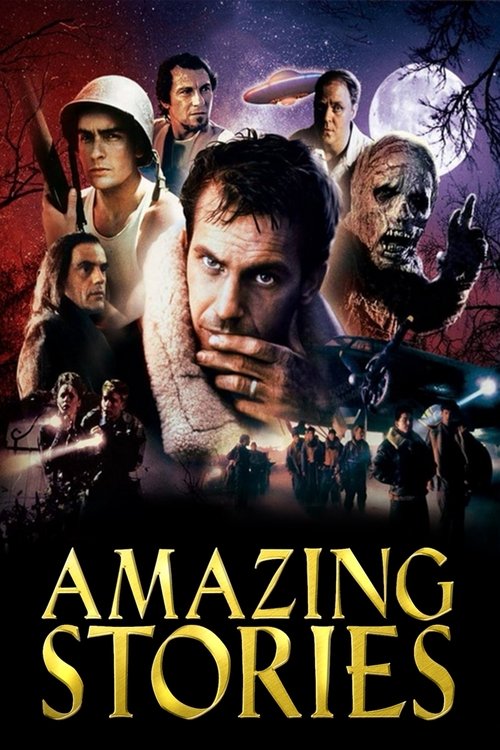


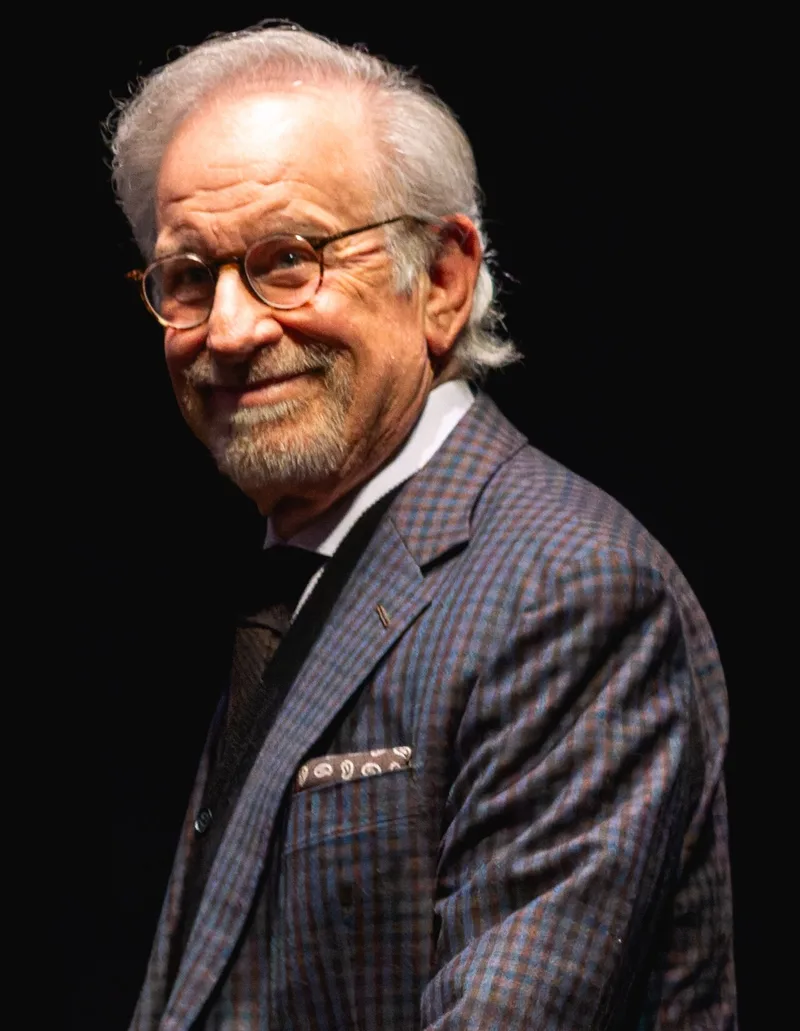
Amazing Stories is an American anthology television series created by Steven Spielberg, that originally ran on NBC in the United States from September 29, 1985, to April 10, 1987.
The series was nominated for 12 Emmy Awards and won five. The first-season episode "The Amazing Falsworth" earned writer Mick Garris an Edgar Award for Best Episode in a TV Series. It was not a ratings hit (ranking 40th in Season 1 and 52nd in Season 2), however, and the network did not renew it after the two-year contract expired. The 1987 science fiction film Batteries Not Included was originally intended as a story for Amazing Stories, but Spielberg liked the idea so much that it was made into a theatrical release.
The series title licensed the name of Amazing Stories, the first dedicated science fiction magazine created by Hugo Gernsback in April 1926.
The title sequence was made by computer-generated imagery (CGI) firm Robert Abel and Associates.
On March 6, 2020, a revival of Amazing Stories premiered on Apple TV+.
Contents
Episodes
All episodes have a running time of around 24 minutes, with the exceptions of "The Mission" and "Go to the Head of the Class" (both running 46 minutes).
Production
Development
The series came from Steven Spielberg's desire to use his ideas and short stories that were not substantial enough to support feature films and to return to work in television, having fond memories of his start in the medium directing episodes of Night Gallery, Marcus Welby, M.D., and Columbo, and the television movie Duel. The title of the series came from the science fiction magazine of the same name. With the introduction of producer Gary David Goldberg, Spielberg met with Grant Tinker and Brandon Tartikoff of NBC; after Spielberg outlined his conditions for the series (including avoiding using his name for promotion following the premiere and placement in the 8 p.m. Sunday Night timeslot), NBC gave Amazing Stories a then-unprecedented commitment of 44 episodes over a two year period, as Spielberg didn't want to do the series without a guaranteed second season with which to adjust any flaws between seasons.
The series had a budget of $750,000 to $1 million per half-hour episode, higher than the average hour long TV budget, $900,000 per episode, and double that of concurrent half-hour programs such as Cheers and Family Ties, $350,000-400,000 per episode. Questioned about the nature of the deal, Tartikoff responded that they wanted to give Spielberg the most comfortable creative environment possible as they felt Amazing Stories had the potential to be hit for the network. Spielberg's intention with the show was to create an all-ages program emphasizing wonderment, fantasy, irony and comedy, whilst sidestepping more scary or macabre stories (though some would still be produced, but would be broadcast later in the evening if Spielberg deemed them "too intense" for family viewing). While Spielberg expressed admiration for prior anthology TV series, he wanted to avoid the "moralizing" seen in the original The Twilight Zone.
Spielberg's heavy hands-on involvement in the series lead to rumors that no Amazing Stories episodes would be screened for critics and the no clips from the series would be used in promos, both of which Spielberg denied; though the first two episodes were held back when Spielberg adopted a similar approach to how he handled his film releases. Spielberg wanted one third of the series directors to be newcomers, as he felt the series could serve as a good training ground for writers and directors; thanks to Spielberg's reputation, established directors such as Clint Eastwood and Martin Scorsese also agreed to direct, as they'd wanted to work with Spielberg. Peter Weir had wanted to direct a segment, but due to scheduling conflicts with The Mosquito Coast this ultimately never came to be. NBC hoped to build a Sunday night block around Amazing Stories that would be able to beat out CBS, who had claimed the number one spot for Sunday night during the previous television season with their block of 60 Minutes, Murder, She Wrote, Crazy Like a Fox, and Trapper John, M.D..
Season One
In the lead up to the series premiere, Amazing Stories was noted for the high level of secrecy Spielberg demanded of the production - it the only major series not to be screened by TV critics during the Upfronts for the 1985–86 television season. Spielberg defended his limited pre-release publicity for Amazing Stories, citing the approach he'd taken for the successful E.T. the Extra-Terrestrial as well as his belief that pre-release info for films is detrimental to audiences, leaving them feeling they'd already seen what's being promoted. Spielberg also refused to do interviews for the show and instituted a rule that he would not give interviews on the series until 19 episodes of the first season had aired. The premiere episode, the Spielberg-directed "Ghost Train", was a decent sized hit that managed to pull in one third of the television viewing audience, beaten only by CBS' Murder, She Wrote, but word of mouth saw ratings rapidly decline until the series ranked 40th out of 67 series.
Season one story editor Mick Garris blamed the lukewarm reception on unrealistic audience expectations of moments comparable to those in Spielberg's films, and contrasted the internal enthusiasm for "Ghost Train" against the public's ire and derision. According to Garris, Spielberg had final say on every script, with Garris' job primarily rewriting the scripts to match Spielberg's specifications, leading to Spielberg having a "Story by' credit on 16 of the season's 22 episodes. In a November 1986 article for the Los Angeles Times, it was reported that a "story checklist" developed by Spielberg's office was handed out to writers detailing what the story editors would be looking for. The checklist included:
Story Checklist
Season Two
Following the middling performance of season one, Spielberg agreed to take a less hands-on approach to season two: authoring fewer stories, taking less of a role in reworking scripts, a less juvenile tone, and allowing a panel of writers and producers to be brought in on a consulting basis, including Richard Matheson, Robert Zemeckis, and Garris. Tartikoff also blamed Amazing Stories under performance on its pairing with the revival of Alfred Hitchcock Presents on Sunday nights, as parents looking for an "electronic babysitter" for their children were taken aback by the colorful whimsy-filled fantasies presented in Amazing Stories that would then segue into stories of murder on Alfred Hitchcock Presents, with parents opting to put on ABC's Wonderful World of Disney, which aired before Alfred Hitchcock Presents for uninterrupted family viewing, meaning that Amazing Stories target audience was being siphoned off. As a result, when Amazing Stories returned for a second season Alfred Hitchcock Presents was cancelled by NBC (though later revived by USA Network for an additional three seasons).
In an attempt to improve the writing quality of the show, twice as many scripts were ordered for season two, with the logic that increasing the order would lead to a greater yield of high quality scripts after culling the inferior ones. The additional scripts were acquired at the expense of both Spielberg and Universal Television, as NBC had already made a sizable commitment with a two season order and $1 million per episode budget. The behind the scenes changes were unable to stem the downward trend in viewership, with the series falling to 62nd place, and NBC cancelled the series after the completion of its two year commitment.
Soundtrack
In 1999, Varèse Sarabande released a CD containing a rerecording of the scores for the episodes "The Mission" and "Dorothy and Ben" (John Williams and Georges Delerue respectively) plus Williams' opening and closing themes, performed by the Royal Scottish National Orchestra and conducted by Joel McNeely.
In 2006–2007, Intrada released three volumes of original music from the series, covering the impressive lineup of composers who worked on it and featuring all of the most noteworthy scores (with the exception of Danny Elfman and Steve Bartek's "The Family Dog," because the masters could not be found – a brief suite is on Music for a Darkened Theatre: Vol. 2, however), as well as two alternate versions of Williams' main title theme, one used just once (Alternate #1, on "Alamo Jobe") and the other never used. The album is also notable for the premiere release of the music Williams composed for the Amblin Entertainment logo (although the logo music is not heard on the show itself).
Other than Williams, Bruce Broughton and Billy Goldenberg are the only composers to be represented on all three volumes. The running times below indicate the cumulative time for each score rather than the time of each track. (The series theme is not quoted in any of the episode scores, with the exception of "Ghost Train.")
Volume 1 (2006)
CD1:
Amazing Stories Main Title – John Williams (1:02)
Ghost Train – John Williams (15:45)
Alamo Jobe – James Horner (10:01)
Gather Ye Acorns – Bruce Broughton (18:37)
The Doll – Georges Delerue (10:09)
The Amazing Falsworth – Billy Goldenberg (8:47)
CD2:
Amazing Stories Bumper #1 – John Williams (:04)
Reception
The series gained a number of positive reviews. However, some reviewers were unimpressed with the show, with Jeff Jarvis of People saying "Amazing Stories is one of the worst disappointments I've ever had watching TV."
Spin-offs
One episode of the show, "Family Dog", was spun off into its own series. Six years after Amazing Stories finished its run, Family Dog ran on CBS for ten episodes before being pulled off the schedule.
The video game The Dig originated as an idea Spielberg had for Amazing Stories, but decided it would be too expensive to film.
In 1986, Steven Bauer wrote two novelizations of the series which were both published by Charter Books in the US and Futura Books in the UK. The first book, Steven Spielberg's Amazing Stories (October 1986, ISBN 0-441-01906-4), adapted episodes 5, 12, 9, 2, 7 and 12, while the second book, Volume II of Steven Spielberg's Amazing Stories (December 1986, ISBN 0-441-01912-9), adapted episodes 7, 20, 8, 11, 18, 25, 4, 3, 21, 17 and 19.
In 1985–86, TSR published six tie-in novels under the Amazing Stories banner. They were branching (Choose Your Own Adventure style) books where the reader chose where to jump at key points.
The 4-D Funhouse by Clayton Emery and Earl Wajenberg. Cover by Jeff Easley. ISBN 0-394-74176-5
Jaguar! by Morris Simon. Cover by Jeff Easley. ISBN 0-88038-256-2
Portrait in Blood by Mary L. Kirchoff (credited as Mary Kirchoff). Cover by Jeff Easley. ISBN 0-88038-258-9
Nightmare Universe by Gene DeWeese and Robert Coulson. Cover by Jeff Easley. ISBN 0-88038-259-7
Starskimmer by John Betancourt. Cover by Doug Chaffee.
Day of the Mayfly by Lee Enderlin. Cover by Doug Chaffee.
The 1987 film Batteries Not Included was originally planned to be a segment for the series under the title Gramps and Grammie and Company, but Spielberg thought the story would work better on the big screen instead of television.
Reboot
On October 23, 2015, it was announced that NBC was developing a reboot of the series with Bryan Fuller writing the pilot episode and executive producing alongside Justin Falvey and Darryl Frank. Production companies involved with the series were set to include Universal Television. Steven Spielberg was not expected to be involved with the new series. On May 5, 2017, NBC and Universal Television were formally notified that their option rights to the Amazing Stories properties had been withdrawn. Rights for the development of a genre television series under the name Amazing Stories were subsequently sold to Experimenter Media LLC.
On October 10, 2017, it was announced that Apple Inc. made a deal with Steven Spielberg's Amblin Television and NBC Universal to develop a new, ten-episode series on Apple's streaming service, Apple TV+. On February 7, 2018, it was announced that Fuller had stepped down as showrunner of the series over creative differences. It was further reported that it was unclear whether he would have a different role on the project going forward. He had not delivered a script to Apple before his amicable departure. Later that day, it was also announced that executive producer Hart Hanson was exiting the series as well. On May 22, 2018, it was announced that Once Upon a Time creators Edward Kitsis and Adam Horowitz had joined the production as executive producers and showrunners.
Home media
VHS
A selection of the original series episodes were released in the VHS format in 1993; these were titled "Book One" through "Book Five" in the US. In Japan and Europe episodes were cut together as movies and released in 8 volumes during the late 1980s, early 1990s. A three-tape VHS (PAL) set was released in the UK in 2001.
Europe/Japan VHS series
Amazing Stories: The Movie (1987) - contains "The Mission", "Mummy Daddy" and "Go To The Head Of The Class"
Amazing Stories II (1987) - contains "The Amazing Falsworth", "Ghost Train" and "The Wedding Ring"
Amazing Stories III (1988) - contains "The Griebble", "Moving Day" and "Miscalculation"
Amazing Stories IV (1988) - contains "Dorothy And Ben", "Family Dog" and "The Main Attraction"
Amazing Stories V (1989) - contains "The Doll", "Thanksgiving" and "Life On Death Row"
Amazing Stories VI (1989) - contains "Mirror, Mirror", "Blue Man Down" and "Mr Magic"
Amazing Stories VII (1990) - contains "The 21-Inch Sun", "Magic Saturday", "You Gotta Believe Me" and "One Amazing Night (Santa '85)"
Amazing Stories VIII (1990) - contains "The Pumpkin Competition", "Without Diana" and "Fine Tuning"
US VHS series
Amazing Stories: Book One (1993) - contains "The Mission" and "The Wedding Ring"
Amazing Stories: Book Two (1993) - contains "Go To The Head Of The Class" and "Family Dog"
DVD
Between 2006 and 2009, The Complete First Season was released on DVD in the US, UK, France, Holland, Italy, Scandinavia, Spain and Australia. In 2009, both seasons were released in Germany and Japan only. In Germany both seasons were released as 12 separate DVDs or a complete box set, which was also reissued in 2011. All countries' DVDs contain the original English soundtrack, while Italy, Germany, France, Spain and Japan have a second soundtrack, dubbed in their respective languages. The second season was never released in any video format in America despite much demand by collectors.
Apple iTunes
On January 8, 2018, Seasons 1 and 2 were released on Apple iTunes in standard definition.
Foreign broadcasts
In 1992, the series was somewhat erratically screened in Britain by BBC1 and BBC2 – billed in the Radio Times as "Steven Spielberg's Amazing Stories" – with episodes airing at any time from early on Sunday morning (such as "The Family Dog") to weekday evenings (like "Such Interesting Neighbors") to very late at night (for instance "Mirror, Mirror"); it later received a more coherent run on Sci-Fi. Three of the episodes ("The Mission", "Mummy Daddy" and "Go to the Head of the Class") were packaged together as an anthology film and released theatrically in several European countries such as Spain, France (July 10, 1986) or Finland (June 26, 1987), and also in Australia on September 17, 1987. It later appeared on LaserDisc in Japan as Amazing Stories: The Movie shortly afterwards.
Until 2006, the Sci Fi Channel in the United States showed episodes on an irregular schedule. The MoviePlex channel also showed the series as a collection of "movies," which are blocks of three episodes.
American TV movies/home video compilations
Following the broadcast of Amazing Stories, in 1992 a series of six compilation films were produced by editing episodes together into feature length installments. The first compilation titled Amazing Stories: The Movie was given a theatrical release in international markets by Cinema International Corporation and was released in broadcast syndication in the United States. The films were also released on home video on VHS and LaserDisc.
Films