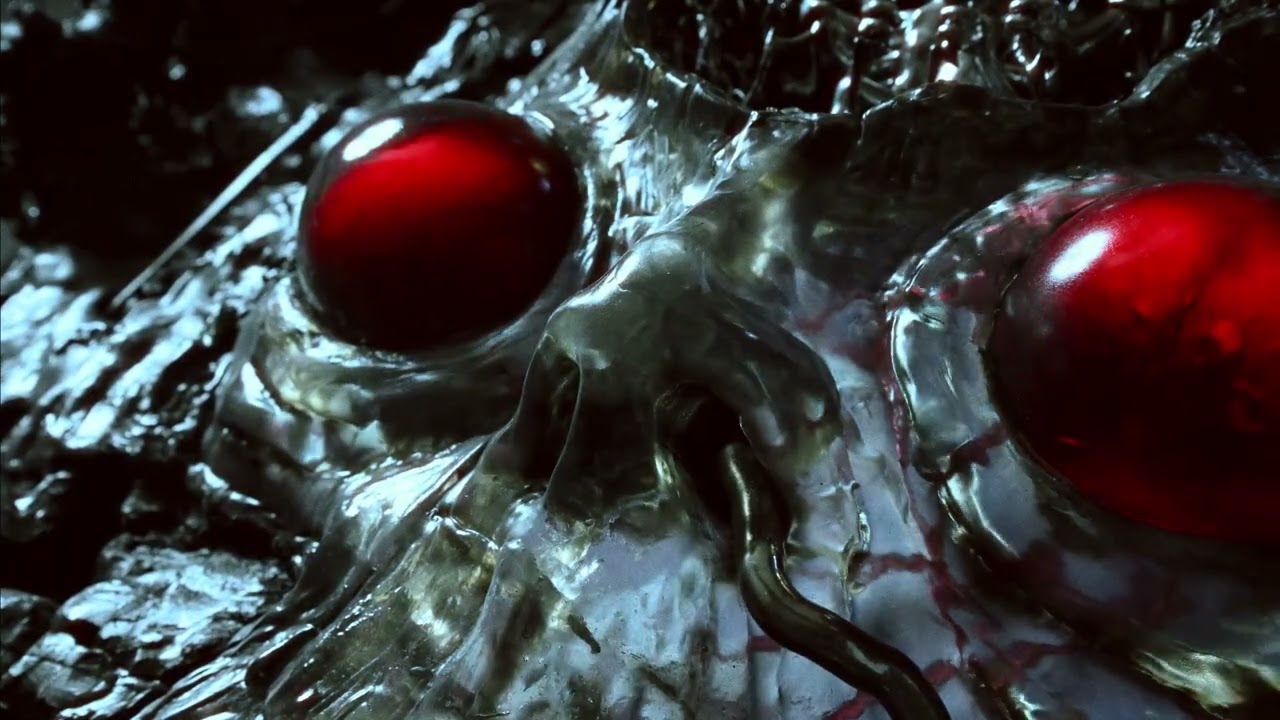
Alien is an American science fiction horror and action media franchise created by screenwriters Dan O'Bannon and Ronald Shusett, which began as the 1979 film Alien. The series primarily follows deadly encounters between humans and the extraterrestrial Xenomorphs in the future.
Released as seven films distributed by 20th Century Studios (formerly 20th Century Fox) and produced by Brandywine Productions since 1979, the series has led to numerous novels, comics, and video games, and a 2025 television series created by Noah Hawley titled Alien: Earth. Sigourney Weaver starred as warrant officer Ellen Ripley in the first four films, Alien (1979), Aliens (1986), Alien 3 (1992), and Alien Resurrection (1997). The other three films follow different characters, and include prequels Prometheus (2012) and Alien: Covenant (2017), and Alien: Romulus (2024), which is set between the first two films. The films were directed by Ridley Scott, James Cameron, David Fincher, Jean-Pierre Jeunet, and Fede Álvarez.
The film series has also inspired a number of spin-offs—most notably the Alien vs. Predator series, which combines the continuities of the Alien franchise with the Predator franchise and consists of two films as well as various series of comics, books, and video games.
Contents
Premise
The Alien franchise depicts a series of deadly encounters, predominantly spanning the 22nd and 24th centuries, between humanity and the Xenomorph; a hostile, endoparasitoid, extraterrestrial species. Humanity is depicted as a space-faring species with an interstellar dominion; space journeys typically last months, even years, and require the use of cryosleep. Throughout the series, characters are repeatedly manipulated and endangered by the unscrupulous megacorporation Weyland-Yutani Corp, which seeks to profit from the Xenomorph.
The series fictionalizes the origin of the human race. A member of an ancient humanoid species called the Engineers sacrifices himself, allowing his DNA to spark the genesis of mankind. The Engineers' other experiments, designed to exterminate the human race through the means of a deadly mutagen, pave the way for the Xenomorphs to rise and populate through the traumatic implantation of larvae in hosts. Incidents across several generations are chronicled throughout the franchise.
Background
Writer Dan O'Bannon, wanting to write a science-fiction action film, collaborated with screenwriter Ronald Shusett on a script, initially titled Star Beast, but eventually changed to Alien. Brandywine Productions, a company which had a distribution deal with 20th Century Fox, bought the script. The writers expected it to be a low-budget film, but the success of Star Wars inclined Fox to invest millions.
In the original script, the ship had an all-male crew, though it noted that all roles could be played by men or women without major changes to the film. The Ripley character was initially to be played by Tom Skerritt, but when Fox president Alan Ladd Jr. and the producers at Brandywine heard rumors of Fox working on other titles with strong female leads, it was decided to cast a female as Ripley (Sigourney Weaver) and Skerritt became Captain Dallas. Ridley Scott came on as director.
Swiss painter and sculptor H. R. Giger designed the alien creature's adult form and the derelict ship, while French artist Mœbius created the look of the spacesuits and Ron Cobb provided most of the industrial design for the sets.
While Alien was a critical and financial success upon its 1979 release, Fox did not consider a sequel until 1983. That year, James Cameron expressed his interest to producer David Giler in continuing the Alien story. After Cameron's The Terminator became a box office hit in 1984, Cameron and partner Gale Anne Hurd were given approval to direct and produce the sequel to Alien, scheduled for a 1986 release. Cameron wrote the screenplay for Aliens from a story he developed with Giler and Walter Hill.
Following the second film, Weaver was not interested in returning to the series, so Giler and Hill commissioned a sequel without the Ripley character. Fox's president Joe Roth opposed Ripley's removal, and Weaver was offered a $5 million salary and a producer credit to make Alien 3. Giler, Hill and Larry Ferguson wrote the screenplay, based on a story from an earlier script by Vincent Ward, intended to bring closure to the Alien franchise by killing off Ripley, the principal character. Alien 3 faced a mired production, with extensive script difficulties, trouble securing a director, production beginning prior to the completion of a final script, as well as profuse studio interference.
Films
Alien (1979)
On its way back to Earth, the commercial towing vehicle Nostromo is diverted to a desolate planetoid by a cryptic signal from a derelict alien spacecraft. Inside the alien ship, the crew discovers thousands of egg-like objects. A creature, released from one of the eggs, attaches itself to a crewman's face, rendering him unconscious. The others break quarantine to return him to the Nostromo. The parasite dies and the crewman wakes up, seemingly unaffected. Soon afterwards, an alien organism bursts from his chest and grows rapidly into a large lethal creature, which the surviving crew attempt to kill. The Nostromo is destroyed in an unsuccessful attempt to kill the creature, leaving Ellen Ripley as the only survivor in the ship's lifeboat.
Aliens (1986)
After 57 years in hypersleep, Ripley awakens aboard a medical space station orbiting Earth. She recounts the events of the Nostromo but is disbelieved by her superiors in the Weyland-Yutani Corporation, which has now begun to terraform and colonise LV-426, the planetoid from the first film. When contact with the colony is lost, Ripley is persuaded to accompany a squad of marines to investigate. They discover the colonists have been wiped out after being directed by the company to secure the derelict ship reported by Ripley. There is only one survivor, a girl named Newt. The aliens vastly outnumber and quickly overwhelm the marines, who fight for survival. Only a handful, including Ripley and Newt, escape.
Alien 3 (1992)
Immediately following the events of Aliens, the military ship USS Sulaco, carrying the survivors, catches fire. The occupants are ejected in an escape pod, which crash-lands on the refinery/prison planet Fiorina "Fury" 161. All on board except Ripley are killed. An alien facehugger is also aboard, and impregnates an animal with an alien, which soon begins killing inmates and wardens. Ripley discovers an alien queen is growing inside her, and is determined to kill both herself and the creature before Weyland-Yutani can exploit them.
Alien Resurrection (1997)
Two hundred years after the events of Alien 3, several clones of Ripley, including the Alien queen she was carrying, are grown by the military aboard the USM Auriga. The military intends to exploit the Aliens, and uses humans kidnapped and delivered to them by a group of mercenaries as hosts for the queen's eggs. The Aliens escape, and Ripley 8 (a clone mixed with Alien DNA) and the mercenaries attempt to escape and destroy the Auriga before it reaches Earth.
Prometheus (2012)
In 2084, some 30 years before the events of Alien, scientists Elizabeth Shaw and Charlie Holloway discover a star map among the remnants of several ancient Earth cultures. Accompanied by android David 8 and hoping to discover the origins of humanity, they journey aboard the spaceship USCSS Prometheus and arrive in 2093 on the distant planet LV-223 in the Zeta2 Reticuli system, the same region of space in which the planetoid LV-426 from Alien is found. There they discover the ancient remains of an advanced civilization, called the Engineers (apparently the same race as the dead pilot from the derelict ship in Alien), who were developing biological weapons in the form of a pathogenic mutagen which could have driven the human race extinct. The horrors they encounter result in the loss of the crew except for David and Shaw.
Alien: Covenant (2017)
Eleven years after the events of Prometheus, the colony ship USCSS Covenant, carrying thousands of colonists and hundreds of human embryos in cryo-stasis, makes its way towards the planet Origae-6. The crew is awakened by a neutrino blast and intercepts a transmission sent from Shaw, which they decide to trace to an apparently habitable Engineer home world (referred to as Planet 4), devoid of all non-floral life. When several crew members are infected by the same mutagen encountered by the Prometheus crew and give birth to a new breed of Alien, the Neomorphs, the android David 8 rescues them. It is revealed that he brought Shaw to the planet, where he killed all non-floral life and began experimenting on Shaw's corpse to engineer his own breeds of Aliens. His motive to replace human life with Aliens is made apparent, and with the birth of yet another new breed of Alien, a terraforming expert named Daniels and the remaining crew are forced to flee from the world. After disposing of the Aliens chasing them, the crew members return to the Covenant and are put back into cryosleep by someone they believe to be their shipboard synthetic, Walter. Only when Daniels is put in her cryopod does she realize that Walter has been replaced by the identical David. With the crew, colonists, and embryos at his mercy, David contacts Weyland-Yutani back on Earth, stating that while the majority of the crew was killed in the neutrino blast, they would continue to Origae-6.
Alien: Romulus (2024)
Five downtrodden young space colonists and a synthetic encounter hostile Alien creatures while scavenging a derelict Weyland-Yutani space station in which they plan to scavenge cryopods that enables them to survive a journey to another more liveable planet.
Crossover series
Inspired by the Dark Horse Comics series, the filmmakers of Predator 2 (1990) incorporated an Easter egg in which an Alien skull was seen in a Predator trophy case. Expansions upon this shared universe between the Alien and Predator franchises followed through comics and video games, leading up to the launch of a film franchise with the release of Alien vs. Predator in 2004, followed by Aliens vs. Predator: Requiem in 2007. The franchise has spawned various comics, novels, video games, and other merchandise based upon or inspired by the films. A third film has been variously rumored since the production of Requiem. In mid-2018, Shane Black, the director of The Predator, expressed his belief that a third Alien vs. Predator could still happen, indicating the studio's interest in both franchises.
In August 2024, Fede Álvarez, the director of Alien: Romulus, also said he was open to directing a third Alien vs. Predator film, proposing to Melanie Brooks and Anthony D'Alessandro of Deadline Hollywood that he would enjoy directing it along with Dan Trachtenberg, the director of the Predator films Prey (2022) and Predator: Badlands (2025): "Maybe it's something I have to co-direct with my buddy Dan. Maybe we should do like [Quentin] Tarantino and Robert Rodriguez did with [From] Dusk till Dawn. I'll direct a half, and he'll direct another half." In October of the same year, Steve Abell (President of Fox Studios) stated that the studio has plans to eventually develop an Alien and Predator crossover film. The Weyland-Yutani Corporation featured in the Alien franchise along with their particular android model featured in Alien: Romulus appears in the upcoming Predator: Badlands film as a stepping stone towards a third Alien vs. Predator film.
In 2004, a Predator mothership arrives in Earth orbit to draw humans to an ancient Predator training ground on Bouvetøya, an island about one thousand miles north of Antarctica. A buried pyramid giving off a "heat bloom" attracts a group of explorers led by billionaire and self-taught engineer Charles Bishop Weyland (Lance Henriksen), the original founder and CEO of Weyland Industries, who unknowingly activates an Alien egg production line as a hibernating Alien queen is awakened within the pyramid. Three Predators descend to the planet and enter the structure, killing all humans in their way with the intention of hunting the newly formed Aliens, while the scattered explorers are captured alive by Aliens and implanted with embryos. Two Predators die in the ensuing battle with an Alien, while the third allies itself with the lone surviving human, Alexa "Lex" Woods (Sanaa Lathan), while making their way out of the pyramid as it is destroyed by the Predator's wrist bomb and eventually does battle with the escaped Alien Queen on the surface. The Queen is defeated by being dragged down by a water tower into the dark depths of the frozen sea, but not before she fatally wounds the last Predator. The orbiting Predator mothership uncloaks and the crew retrieves the fallen Predator. A Predator elder gives Lex a spear as a sign of respect, and then departs. Once in orbit it is revealed that an Alien Chestburster was present within the corpse, thus a Predalien hybrid is born.
Future
In the mid-1990s, screenwriter Stuart Hazeldine wrote a treatment, Alien: Earthbound. Fox executives were impressed by the script, having read it after Alien Resurrection had entered post-production. According to Sigourney Weaver, Joss Whedon had written an Earth-set script for Alien 5, but Weaver was not interested and wanted it to be set on the original planetoid. She has remained open to a role on the condition that she likes the story. Before 20th Century Fox greenlit Alien vs. Predator, James Cameron had been collaborating on the plot for a fifth Alien film with another writer, but ceased work on learning of the crossover. Cameron stated that the crossover would "kill the validity of the franchise", and that "it was Frankenstein Meets Werewolf" – like "Universal just taking their assets and starting to play them off against each other." Although he liked the final product, he ruled out any future involvement with the series. In late 2008, Weaver hinted in an interview with MTV that she and Scott were working on an Alien spin-off film, which would focus on the chronicles of Ellen Ripley rather than on the Aliens, but the continuation of Ripley's story has not materialized.
In 2015, Sigourney Weaver expressed her interest in returning to the role of Ripley with Neill Blomkamp's story (purportedly titled Alien: Awakening) which would tie into the first two Alien films by taking place after Aliens and foregoing involvement with the other two sequels. This was canceled in favor of Scott's own untitled third prequel (also purportedly titled Alien: Awakening). In February 2019, James Cameron stated that he was working on reviving Blomkamp's project. In June 2020, Brandywine Productions revealed that a screenplay for a new installment in the original series called Alien V, centered around Ripley, had been written by Walter Hill and David Giler. In an interview with The Hollywood Reporter published in September 2022, Hill confirmed that the proposed alternative sequel involving Weaver would not be moving forward. Blomkamp reused some of his proposed concepts for Alien V in his short film Rakka, also starring Sigourney Weaver.
After the acquisition of 21st Century Fox by The Walt Disney Company, it was officially confirmed at the 2019 CinemaCon that future Alien films are in development. In May 2019, Variety reported that the third prequel film was "in the script phase", with Ridley Scott attached to serve once again as director. In September 2020, Scott confirmed that work on the next installment is ongoing, but whether the plot would be connected to Prometheus and Alien: Covenant was undecided. In October 2024, Scott confirmed he was already developing a new Alien film. In June 2025, Scott announced his departure from the Alien franchise, saying "where it's going now, I think I've done enough, and I just hope it goes further", while expressing his critiques of the Alien sequels; though in August, Scott updated his stance and was open to a third prequel film saying, "Another Alien prequel — yeah, if I get an idea, for sure". In October 2025, Sigourney Weaver announced that she has had discussions with The Walt Disney Company and 20th Century Studios to reprise her role in an upcoming project, with a script being written by Walter Hill.
Short films
In 2012 and 2017 respectively, fourteen short films were produced to tie in with the releases of Prometheus and Alien: Covenant. In July 2018, it was reported that 20th Century Fox had joined forces with Tongal to produce short films, intended to coincide with the 40th anniversary of the Alien franchise. By March 2019, the details of the anthology short films were released. Tongal co-founder and CEO James DeJulio stated that the joint-production is "reflective of Tongal's mission to bring creative opportunities to the next generation of talent." The shorts were released weekly on IGN, after which they were uploaded to the Alien Universe web page, as well as all Alien social media pages on May 5 of the same year. All six of the short films premiered at the Emerald City Comic Con in Seattle. The 40th anniversary short films are available as a Movies Anywhere-exclusive bonus feature accompanying the digital release of Alien.
Television and web series
In 1979, 20th Century Fox considered producing a television series based on the 1979 film Alien, with the intention of ABC picking it up, but its only media coverage was in the June 1980 Fangoria issue #6. In 1992, an animated series inspired by the 1986 film Aliens titled Operation: Aliens was being developed along with an LCD game, board game, a Sega Genesis video game by THQ, and action figures. However, the brand lived on through Kenner toylines as simply Aliens and in the comics series included with the action figures as well as in the Aliens/Predator Universe trading cards set. In 2007, Ain't It Cool News reported that a (since cancelled) animated series inspired by the 1986 film Aliens titled Aliens: War Games was being developed.
Alien: Isolation – The Digital Series (2019)
In 2014, Sega published the video game Alien: Isolation. In 2019, a seven-episode animated adaptation of the same name was released on February 28. The series, developed by 20th Century Fox, in conjunction with Reverse Engineering Studios and DVgroup, was created using a combination of brand-new scenes animated from scratch, cinematics taken directly from the original game, and digital recreations of first-person scenes from the game. Alien: Isolation is set in 2137, 15 years after the events of Alien and 42 years prior to Aliens, following Amanda Ripley, who is investigating the disappearance of her mother, Ellen Ripley, as she is transferred to the space station Sevastopol to find the flight recorder of the Nostromo only to discover an Alien has terrorized the station, killing the vast majority of the crew. Andrea Deck reprises her role as Amanda Ripley.
Alien: Earth (2025–present)
On December 10, 2020, as part of Disney's Investor Day presentation, a new TV series project based on the franchise was announced to be in development for FX on Hulu, with Noah Hawley and Scott being involved (the former as showrunner and the latter as producer). It will be set on Earth in the near future, thus marking the first of the franchise to do so without featuring Ellen Ripley. At the 2021 Television Critics Association Press Tour, FX network's John Landgraf said that the series will probably premiere in 2023. A casting sheet for characters Hermit and Wendy shed light on the show's leads. Reports suggested that the TV series would start filming in March 2022, but production was delayed until 2023, due to the COVID-19 pandemic. On April 6, Landgraf stated that the series was in "active preproduction". On July 19, the production of the series began in Thailand with Sydney Chandler, Alex Lawther and Samuel Blenkin being cast as the series' lead roles. Alien: Earth premiered on FX and FX on Hulu on August 12, 2025. Though many people have misinterpreted showrunner Noah Hawley's comments about the series (claiming it takes place in an alternate timeline within the Alien universe rather than being part of the main canon), Hawley actually only said "It's got to be its own thing," going on to talk about how he brings together different influences and doesn't follow the existing template for Alien-universe stories.
Cast and crew
Reception
Critical and public response
The American Film Institute ranked Alien as the sixth most thrilling American movie and seventh-best film in the science fiction genre, and in the AFI's 100 Years... 100 Heroes and Villains list, Ripley was ranked eighth among the heroes, and the Alien was fourteenth among the villains. IGN listed Alien as the thirteenth best film franchise of all time in 2006. Alien was also inducted into the National Film Registry of the Library of Congress for historical preservation as a film which is "culturally, historically, or aesthetically significant."
Alien Day
"Alien Day", April 26, has become the fan celebration day for the Alien franchise. The date derives from LV-426, the "426" converting to "4/26" or "April 26". On Alien Day 2016, Neill Blomkamp released new art for his concept of Alien 5, and the Audible Original audio play adaptation of Alien: Out of the Shadows was released. On Alien Day 2017, 20th Century Fox released "The Crossing" prologue short film for Alien: Covenant, and the Audible Original audio play adaptation of Alien: River of Pain was released.
Alien: The Play
From March 19 to 22, 2019, North Bergen High School (New Jersey, US) staged an adaptation of Alien entitled Alien: The Play, which was widely praised, and granted seals of approval by Ridley Scott, James Cameron, Sigourney Weaver, and Walter Hill. In the aftermath of the play's popularity and approval, North Bergen Mayor Nick Sacco's non-profit foundation pledged funds for more performances. In April 2019, Weaver made a surprise appearance and attended the play.
In academia
The Bishop character has been the subject of literary and philosophical analysis as a high-profile android character conforming to science fiction author Isaac Asimov's Three Laws of Robotics and as a model of a compliant, potentially self-aware machine. The portrayal of androids in the Alien series—Ash in Alien, Bishop in Aliens and Alien 3, and Call (Winona Ryder) in Alien Resurrection (1997)—has been studied for its implications relating to how humans deal with the presence of an "Other", as Ripley treats them with fear and suspicion, and a form of "hi-tech racism and android apartheid" is present throughout the series. This is seen as part of a larger trend of technophobia in films prior to the 1990s, with Bishop's role being particularly significant as he redeems himself at the end of Aliens, thus confounding Ripley's expectations.
Music
Notes
^[a] released on the 10 year anniversary of the game.
Home media
There have been dozens of stand-alone releases of the individual films on various formats, including Betamax, VHS, Laserdisc, DVD, and Blu-ray. The multiple single releases on VHS were generally the original theatrical cuts of each film.
Laserdisc saw single releases of all theatrical versions, as well as two so-called "box sets" which only contained one film (there were two single releases, one each for Alien and Aliens) but had multiple discs and a large amount of supplemental material with a high retail price tag (around US$100). The Aliens set included a new "Special Edition" cut of the film completed by James Cameron just for this release, which was a significantly extended version of the film.
The films made their DVD debut in 1999, both as part of a boxed set (see Alien Legacy below) and as separate single-disc releases of each film (Aliens was only available in its "Special Edition" cut, not its original theatrical cut, which did not make it to DVD until the next boxed set). Following the Alien Quadrilogy set (see below), each film received individual two-disc releases containing the content of each film from that set. Since then, there have been multiple issues and reissues of the films, in both their theatrical or extended version, though some single releases include both.
In addition to the single releases, there have been seven complete box sets of the series at various points in its history. With the exception of the DVD version of the Aliens Triple Pack, each release contained all films that had come out at the time the sets were released. The seven box sets each had unique characteristics and features which were then sometimes reused in later sets or single releases in one form or another, most notably the Blu-ray Anthology, which includes a detailed archive of many previous releases, including the rare Laserdisc box sets.
Alien Triple Pack (VHS, 1992), containing the first two films in the series and a third cassette with a 23-minute preview of the then upcoming theatrical release of Alien 3. (Not to be confused with the 2008 DVD set of the same name below.)
Alien Trilogy (VHS, 1993), a three-cassette packaging of Alien, Aliens (in its LaserDisc Special Edition cut, for the first time on another format) and Alien 3.
Other media
There exists a great number of spin-offs in other media, including a large number of crossovers with the Predator franchise.
Print media
Alien print media has been published since shortly before the release of the original eponymous film, in 1979. The full library of these literary works include novelizations of the films, original content that expand upon the fictional universe, comics and companion books for both the cataloging of in-universe elements and supplemental works concerning the development of the franchise. These include works by special effects company Amalgamated Dynamics Incorporated (ADI), which assisted with the effects in Alien 3 and Alien Resurrection.
Several novelizations of each of the six films and some comic books as well as original canonical novels based on the franchise have been released. The original novels include Alien: Out of the Shadows, Alien: Sea of Sorrows, Alien: River of Pain, marketed as the "Canonical Alien Trilogy" and the short story collection Aliens: Bug Hunt. Out of the Shadows and River of Pain were adapted into audio dramas in 2016 and 2017 respectively released on the Alien Day of the respective year. Alan Dean Foster published Alien: Covenant – Origins, a novel set between the events of Prometheus and Alien: Covenant. Titan Books would also release a series of different novels, including for example Aliens: Phalanx in 2020 and Alien: Uncivil War in 2024.
In addition to Alien: The Illustrated Story, a graphic novel adaptation of the original film, there have been numerous limited series set in the Alien universe, as well as non-canonical crossover appearances of the Alien. In addition to Alien vs. Predator comics featuring the Alien and Predator battling, Dark Horse Comics published Fire and Stone between 2014 and 2017, crossing over the continuities of the Prometheus prequel series with the Alien vs. Predator franchise.
Dark Horse Comics also published a number of other miniseries crossovers, featuring the Alien species as an enemy pitted against prolific characters from other continuities. In 1995, the miniseries Superman/Aliens featured Aliens fighting against Superman, while his powers are diminished. Between 1997 and 2002, a two-part miniseries called Batman/Aliens was published, depicting Batman fighting against a horde of Aliens in a jungle bordering Mexico and Guatemala. In 1998, WildStorm, (now a part of Image Comics), and Dark Horse Comics published an intercompany crossover event called WildC.A.T.s/Aliens, featuring the Wildcats battling the Aliens. Green Lantern Versus Aliens, an intercompany crossover event between Dark Horse and DC Comics, features a plot beyond either continuity, where the Aliens residing on the Green Lantern planet Mogo get out of control and must be exterminated. In 2003, Dark Horse published Judge Dredd vs. Aliens, depicting an Alien invasion in Mega-City One, necessitating for Judge Dredd to intervene, to destroy the infestation.
Video games
Since the launch of the Alien franchise, there have been numerous video games released over the years, spanning a variety of genres. In addition to appearances in crossover video games, including those from the Alien vs. Predator franchise, Mortal Kombat X, and Dead by Daylight, the four films from the original series were adapted into video games, typically multiple times.
The first release was Alien (1982) for the Atari 2600, inspired heavily by Pac-Man. A second adaptation of the first film was released in 1984.
The sequel, Aliens was adapted into four different video games: two different 1986 games titled Aliens: The Computer Game, one of them a collection of minigames by Activision, and the other one a first-person shooter by Software Studios; as well as two different games titled Aliens, a 1987 MSX platformer by Square and a the other one a 1990 arcade shoot 'em up by Konami.
Acclaim Entertainment released three different games based on Alien 3; two different run and gun platformers - one for consoles in 1992, another for the SNES a year later - and a Game Boy adventure game in 1993. Sega also released a light gun arcade game Alien 3: The Gun in 1993. Acclaim's first-person shooter Alien Trilogy was released in 1996 and their adaptation of Alien Resurrection was released in 2000 as a PlayStation first-person shooter.
Other Alien games include Mindscape's adventure game Aliens: A Comic Book Adventure (1995), the first-person shooter Aliens Online (1998), the Game Boy Color action game Aliens: Thanatos Encounter (2001), the mobile phone game Aliens: Unleashed (2003), and the arcade game Aliens: Extermination (2006). In 2014, Play Mechanix and Raw Thrills released Aliens: Armageddon, a rail gun first person shooter that hit arcades soon after. Between 2016 and 2017, Zen Studios released downloadable content packs in a product line called "Alien vs. Pinball", featuring three virtual pinball tables based around the Alien and Alien vs. Predator franchises for Zen Pinball 2, Pinball FX 2 and Pinball FX 3.
In 2006, Sega made a deal with Fox Licensing to release two Alien video games for sixth generation consoles. The first was Aliens: Colonial Marines, a first-person shooter by Gearbox Software that was released in 2013 for the Xbox 360, PlayStation 3 and Windows. The game is set between Aliens and Alien 3, following a group of marines sent to investigate the Sulaco who wound up crash-landing on LV-426.
Merchandising
Despite Alien being widely considered a mature and non child-appropriate series, merchandise — including action figures, board games and role-playing games — has been manufactured and marketed to a wide range of age groups. Prior to the release of the first film, 20th Century Fox executives signed a deal with Kenner Products, for the production of a board game called Alien Game, as well as action figures, marketed for being family-friendly. Following the release of the film and the outcry from parents about its nature of being a graphic and mature horror film, the product lines were abruptly cancelled. The merchandising efforts for the franchise remained largely stagnant until the release of the more action-based sequel, Aliens, seven years later. From thereon out, merchandise has been produced on a rolling, ongoing basis.
From the franchise's inception until Kenner's closure in 2000, the company was a major manufacturer of Alien action figures. From 1992 to 1995, Kenner produced a line of action figures dubbed Aliens, initially intended to promote a cancelled animated series called Operation: Aliens. In 1996, Galoob released the Micro Machines Alien line of miniature toys, but ceased production the following year, due in large to the violent and graphic nature of its packaging art. Following the founding of Hong Kong collectible toy company Hot Toys, one of the first lines the company began producing was Alien. In 2014, Funko released a line of action figures heavily inspired by the original 1979 Kenner line called ReAction. In the 2010s, the National Entertainment Collectibles Association (NECA) took a prominent role in the manufacturing of Alien action figures, with the majority being largely inspired by the Kenner line of action figures, as well as new additions depicting the prequel films and crossover continuities, such as Alien vs. Predator and Superman/Aliens.
Following Kenner's ill-fated first foray into the board game market with Alien Game, merchandising efforts in the medium were stagnant, until Leading Edge Games released the cooperative game Aliens in 1989. Leading Edge Games released Aliens Adventure Game in 1991, to mixed reviews and commentary that states it functions closer to a board game than a traditional tabletop RPG. In 1993, British toy company Peter Pan Playthings Ltd released a board game called Operation: Aliens — Combat Game, in which up to four players play as Colonial Marines and compete to reach the center of the board and self-destruct the Alien-infested facility. In December 2019, Swedish publisher Free League Publishing released a tabletop role-playing game called Alien: The Role-Playing Game, featuring two game modes. An upcoming licensed board game titled Alien: USCSS Nostromo is set for release in 2020. However, in 2018, a French board game designer named François Bachelart accused the game's publisher, Wonder Dice, of theft of a game concept he pitched to them years prior. Wonder Dice published a press release, in which they threatened to sue anyone who would question their legal practices.
Theme park attractions
An Alien-themed attraction debuted at the Genting SkyWorlds Theme Park in Malaysia in February 2022. The Park, previously known as '20th Century Fox World', has faced significant delays during construction, however, a licensing deal with Fox and new parent company The Walt Disney Company was reached. Pre-show footage of the ride was released online, and appears to detail a Weyland-Yutani themed drop tower attraction.
Alien was also previously represented in The Great Movie Ride at Disney's Hollywood Studios at Walt Disney World from 1989 until the attraction's closure in 2017. The attraction featured a scene based on the first film, in which riders were taken through the Nostromo, encountering Audio-Animatronic representations of Ripley and a Xenomorph.
Alien vs. Predator franchise
Inspired by the Dark Horse Comics series, the filmmakers of Predator 2 (1990) incorporated an easter egg in which an Alien skull was seen in a Predator trophy case. Expansions upon this shared universe between the Alien and Predator franchises followed through comics and video games, leading up to the launch of a film franchise with the release of Alien vs. Predator in 2004, followed by Aliens vs. Predator: Requiem in 2007. The franchise has spawned various comics, novels, video games, and other merchandise based upon or inspired by the films. A third film has been variously rumored since the production of Requiem. In mid-2018, Shane Black, the director of The Predator, expressed his belief that a third Alien vs. Predator could still happen, indicating the studio's interest in both franchises, with Françoise Yip then reprising her role as Cullen Yutani from Requiem in a silent cameo appearance in The Predator, after her speaking scenes were cut.
The Predator (2018)
Stuntwoman Breanna Watkins, in scenes that were filmed but not used, portrayed a masked Ellen Ripley in one alternate ending of Shane Black's The Predator (2018), and an unmasked adult Rebecca "Newt" Jorden in a second alternate ending, meant to tie the main Predator franchise to the Alien franchise in which the characters first appeared, in a manner separate from the pre-existing Alien vs. Predator franchise and incorporating the plot element of time travel; Watkins later elaborated that of the two roles portrayed, while she was serving as a stand-in for Ellen Ripley ahead of a failed attempt at a Sigourney Weaver cameo, that she had actually portrayed Newt Jorden in the original ending, and had been in early discussions about potentially reprising the role in a potential Alien vs. Predator-focused sequel to The Predator.
Predator: Badlands (2025)
The 2025 film Predator: Badlands would reveal Elle Fanning portrays dual roles of Thia and Tessa whom as robot synthetics, the Weyland-Yutani corporation is also featured integrating element from the Alien series into a Predator film.