
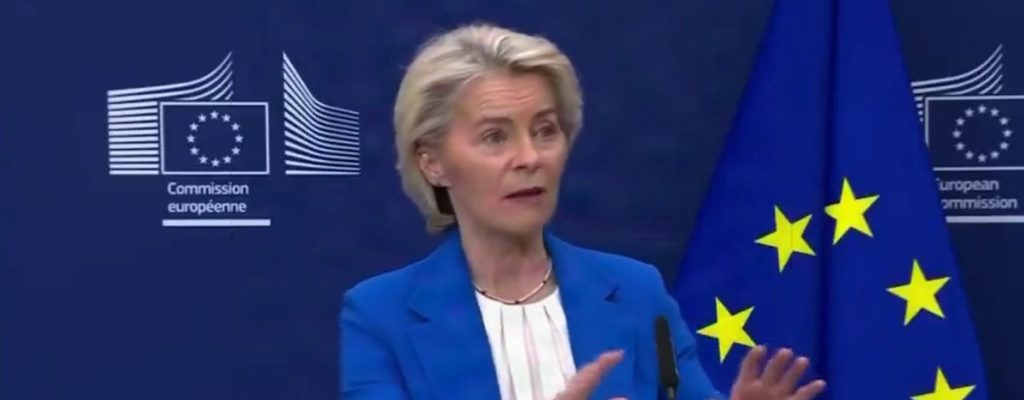
Ursula Gertrud von der Leyen (née Albrecht; born 8 October 1958) is a German politician and physician who has served as President of the European Commission since 2019. She served in the German federal government between 2005 and 2019, holding positions in Angela Merkel's cabinet, most recently as Federal Minister for Defence. She is a member of the centre-right Christian Democratic Union (CDU) and its affiliated European political party, the European People's Party (EPP). On 7 March 2024, the EPP elected her as its Spitzenkandidat to lead the campaign for the 2024 European Parliament elections. She was re-elected to head the Commission in July 2024.
Von der Leyen was born and raised in Brussels, Belgium, to German parents. Her father, Ernst Albrecht, was one of the first European civil servants. She was brought up bilingually in German and French, and moved to Germany in 1971 when her father became involved in German politics. She graduated from the London School of Economics in 1978, and in 1987, she acquired her medical licence from Hanover Medical School. After marrying fellow physician Heiko von der Leyen, she lived for four years in the United States with her family in the 1990s. After returning to Germany she became involved in local politics in the Hanover region in the late 1990s, and she served as a cabinet minister in the state government of Lower Saxony from 2003 to 2005.
In 2005, von der Leyen joined the federal cabinet, first as Minister for Family Affairs and Youth from 2005 to 2009, then taking on the role of Minister for Labour and Social Affairs from 2009 to 2013, and finally serving as Minister for Defence from 2013 to 2019, the first woman to do so. When she left office, she was the only minister to have served continuously in Merkel's cabinet since Merkel became chancellor. She served as a deputy leader of the CDU from 2010 to 2019, and was regarded as a leading contender to succeed Merkel as the chancellor of Germany and as the favourite to become the secretary general of NATO after Jens Stoltenberg. British defence secretary Michael Fallon described her in 2019 as "a star presence" in the NATO community and "the doyenne of NATO ministers for over five years". In 2023, she was again regarded as the favourite to take the role.
On 2 July 2019, von der Leyen was proposed by the European Council as the candidate for president of the European Commission. She was then elected by the European Parliament on 16 July; she took office on 1 December, becoming the first woman to hold the office. Her tenure has been marked by the COVID-19 pandemic, the European Green Deal, the Russo-Ukrainian war, as well as American threats to annex Greenland. In November 2022 she announced that her commission would work to establish an International Criminal Tribunal for the Russian Federation. The EU–US Agreement on Reciprocal, Fair, and Balanced Trade, announced in August 2025, exposed her to criticism from France and Germany.
On 18 July 2024, von der Leyen was re-elected as Commission President by the European Parliament with an absolute majority of 401 members of the European Parliament out of 720. Her absolute majority was strengthened by around 30 votes compared to her election in 2019. She was named the most powerful woman in the world by Forbes in 2022, 2023, 2024, and 2025.
Contents
Family and early life
Von der Leyen was born in 1958 in Ixelles, Brussels, Belgium, where she lived until she was 13 years old.
In 1971, she relocated to Sehnde in the Hanover region after her father had become CEO of the food company Bahlsen and involved in state politics in Lower Saxony.
In 1986, she married physician Heiko von der Leyen, a member of the von der Leyen family, which belonged to the German nobility and made its fortune as silk merchants. They have seven children, born between 1987 and 1999. Von der Leyen is Lutheran.
She lives with her family on a farm in Burgdorf near Hanover where they keep horses. She is a keen equestrian and has been involved in competitive horseriding.
Education and professional career
Von der Leyen moved to the Hanover Region in 1971 when her father entered politics to become minister-president of the state of Lower Saxony in 1976. In 1977, she started studying economics at the University of Göttingen. At the height of the fear of communist terrorism in West Germany, she fled to London in 1978 after her family was told that the Red Army Faction (RAF) was planning to kidnap her due to her being the daughter of a prominent politician. She spent more than a year in hiding in London, where she lived with protection from Scotland Yard under the name Rose Ladson to avoid detection and enrolled at the London School of Economics. A German diminutive of Rose, Röschen, had been her nickname since childhood, while Ladson was the name of her American great-grandmother's family, originally from Northamptonshire, who immigrated to Charleston, South Carolina in 1679, became wealthy landowners and slave traders of the Planter class, related to families of governors of the Province of Carolina. She said that she "lived more than she studied", and that London was "the epitome of modernity: freedom, the joy of life, trying everything" which "gave me an inner freedom that I have kept till today". She returned to Germany in 1979 but lived with a security detail at her side for several years.
In 1980, after three years of studying economics, she switched to medicine with a specialisation in gynaecology, at the Hannover Medical School, where she obtained her medical licence as a physician.
From 1988 to 1992, she worked as an assistant physician at the Women's Clinic of the Hannover Medical School. Upon completing her doctoral studies, she defended the thesis and graduated as a Doctor of Medicine in 1991. Following the birth of twins, she was a housewife in Stanford, California, from 1992 to 1996, while her husband was a faculty member of Stanford University, returning to Germany in 1996.
From 1998 to 2002, she taught at the Department of Epidemiology, Social Medicine and Health System Research at the Hanover Medical School. In 2001, she earned a Master of Public Health degree at the institution.
Plagiarism accusations
In 2015, researchers collaborating at the VroniPlag Wiki reviewed von der Leyen's 1991 doctoral dissertation and alleged that 43.5% of the thesis pages contained plagiarism and in 23 cases citations were used that did not verify claims for which they were given. Multiple notable German academics such as Gerhard Dannemann and Volker Rieble publicly accused von der Leyen of intended plagiarism. The Hannover Medical School conducted an investigation and concluded in March 2016 that while the thesis contains plagiarism, no intention to deceive could be proven.
The university decided not to revoke von der Leyen's medical degree. Critics questioned the independence of the commission that reviewed the thesis as von der Leyen personally knew its director from joint work for an alumni association. Various media outlets also criticised the decision for being non-transparent, not according to established rules, and failing to secure high academic standards.
Early political career
Ursula von der Leyen joined the CDU in 1990, and became active in local politics in Lower Saxony in 1996, shortly after she had returned to Germany after living in California. She was a member of the committee on social policy of CDU in Lower Saxony from 1996, and also became active in the association of medical doctors in the CDU party.
In the Lower Saxony Landtag, 2003–2005
Ursula von der Leyen was elected to the Parliament of Lower Saxony in the 2003 state election for Lehrte, the same constituency then-Chancellor Gerhard Schröder represented from 1986 to 1998. From 2003 to 2005 she was a minister in the state government of Lower Saxony, serving in the cabinet of Christian Wulff, with responsibility for social affairs, women, family, and health.
In 2003, von der Leyen was part of a group assigned by the then-opposition leader and CDU chairwoman Angela Merkel to draft alternative proposals for social welfare reform in response to Chancellor Gerhard Schröder's "Agenda 2010". The so-called Herzog Commission, named after its chairman, the former German president Roman Herzog, recommended a comprehensive package of reform proposals including, among other things, decoupling health and nursing care premiums from people's earnings and levying a monthly lump sum across the board instead.
Ahead of the 2005 federal elections, Angela Merkel chose Ursula von der Leyen to cover the family and social security portfolio in her shadow cabinet. In the negotiations to form a government following the election, von der Leyen led the CDU/CSU delegation in the working group on families; her co-chair from the SPD was Renate Schmidt.
In the Bundestag, 2005–2019
In 2005, Ursula von der Leyen was appointed Federal Minister of Family Affairs and Youth in the cabinet of Angela Merkel. On the 60th anniversary of the founding of Israel, von der Leyen participated in the first joint cabinet meeting of the governments of Germany and Israel in Jerusalem in March 2008.
At the federal election of 2009, von der Leyen was elected to the Bundestag, Germany's Parliament, representing the 42nd electoral district of Hanover, alongside Edelgard Bulmahn of the Social Democrats. In the negotiations to form a coalition government following the elections, she led the CDU/CSU delegation in the working group on health policy; her co-chair from the FDP was Philipp Rösler. She was reappointed as family minister, but on 30 November 2009 succeeded Franz Josef Jung as Federal Minister of Labour and Social Affairs.
During her time in office, von der Leyen cultivated the image of being the social conscience of the CDU and helped Merkel to move the CDU into the political centre-ground. In speaking out for increasing the number of childcare nurseries, for the introduction of a women's quota for listed companies' main boards, for gay marriage and a nationwide minimum wage, von der Leyen made enemies among the more traditionalist party members and won admirers on the left.
Von der Leyen also lobbied for lowering the barriers to immigration for some foreign workers, to fight shortages of skilled workers in Germany. In 2013, she concluded an agreement with the Government of the Philippines that was aimed at helping Filipino health care professionals to gain employment in Germany. A vital provision of the agreement is that the Filipino workers are to be employed on the same terms and conditions as their German counterparts.
Von der Leyen was initially considered the front-runner to be nominated by the ruling CDU/CSU parties for election as President of Germany in the 2010 presidential election, but Christian Wulff was eventually chosen as the parties' candidate. The news media later reported that Wulff's nomination came as a blow to Merkel, whose choice of von der Leyen had been blocked by the two parties' more conservative state premiers.
In November 2010, von der Leyen was elected (with 85% of the votes) as one of four deputies of CDU chairwoman Merkel, serving alongside Volker Bouffier, Norbert Röttgen and Annette Schavan. Later that month, she told the Bild am Sonntag newspaper that the CDU should consider establishing a formal voting process for choosing future candidates for Chancellor. In 2012, she was re-elected (with 69% of the votes) as one of Merkel's deputies as CDU chairwoman, this time serving alongside Bouffier, Julia Klöckner, Armin Laschet and Thomas Strobl.
President of the European Commission
2019
On 2 July 2019, von der Leyen was proposed by the European Council as their candidate for the office of President of the European Commission. On 16 July, her nomination was approved by the European Parliament with 383 to 327 votes. Germany abstained from the vote to nominate her. An article in The Guardian said that the reason for Germany's refusal to support her nomination in the European Council was that von der Leyen was considered divisive in her home country. She is the first woman to hold the office and the first German since the commission's first president, Walter Hallstein.
When she lived in Brussels, her little sister Benita-Eva died of cancer at the age of eleven and she remembered "the enormous helplessness of my parents" in view of the cancer. This inspired her to make cancer a focus of her commission.
At the press conference announcing her nomination, European Council President Donald Tusk noted von der Leyen's intention to retain Commission First-Vice-President Frans Timmermans during her administration. Timmermans has previously been one of the "lead candidates" (German: Spitzenkandidat) for the commission's presidency. As a candidate, she published a document entitled "My agenda for Europe", and was fêted for her commitment to "gender equality and gender mainstreaming" by at least one observer who sought to advance the "professional development of women in the field of international peace and security".
Following her nomination as a candidate for Commission president, the Commission provided her with a salary, office, and staff in Brussels to facilitate negotiations between the EU institutions as to her election. These arrangements were extended, to enable a smooth transition, during her period as president-elect, until the new College of Commissioners was confirmed by the European Parliament and took office in November. In light of her new role, von der Leyen resigned her seat in the German Bundestag on 31 July 2019.
Von der Leyen supported the proposed European Union–Mercosur free trade agreement, which would form one of the world's largest free trade areas. The fear is that the deal could lead to more deforestation of the Amazon rainforest as it expands market access to Brazilian beef.
Von der Leyen unveiled the new proposed EU Commission's structure (whom she deemed to be a "geopolitical" one) on 10 September 2019, renaming a number of posts of the College of Commissioners to make them sound less formal and more goal-oriented, including the controversial portfolio for "Protecting our European Way of Life", a vice-presidency responsible for the coordination of migration, security, employment and education policies. The later portfolio's name drew heavy criticism, as it was considered to carry a xenophobic message linking the protection of the "European Way of Life" to migration policies. The proposed structure for the college also saw the "unexpected" promotion of EPP's Valdis Dombrovskis to a role of executive vice-president, up to a number of three executive vice-presidencies, equalling the roles entrusted to Timmermans and Margrethe Vestager.
2020
In March 2020, von der Leyen's Commission turned down the idea of suspending the Schengen Agreement to introduce border controls around Italy, at that time the centre of the COVID-19 pandemic in Europe. The decision drew criticism from some European politicians. After some EU member states announced closure of their national borders to foreign nationals due to the COVID-19 pandemic, she said: "Certain controls may be justified, but general travel bans are not seen as being the most effective by the World Health Organization. Moreover, they have a strong social and economic impact, they disrupt people's lives and business across the borders." She condemned the US decision to restrict travel from the coronavirus-affected Europe to the United States.
Von der Leyen supported the EU's imposition of sanctions against Belarus after the security services violently cracked down on street protests in Minsk and elsewhere against the 26-year authoritarian rule under President Alexander Lukashenko. The protests took place after a disputed presidential election, which was contested by the opposition and designated by the EU as not free and fair. Sanctions were imposed after the Belarusian government diverted a civilian aircraft to seize an opposition figure, Roman Protasevich.
Greek prime minister Kyriakos Mitsotakis called for EU sanctions against Turkey (citing Belarus as precedent) over Turkey's incursions into Greek maritime zones in the eastern Mediterranean, including illegal drilling and the passage of the Oruç Reis, accompanied by a Turkish Navy ship, in Greek waters. Sanctions would require a unanimous decision of the EU Council of Ministers. While France and Austria fully backed Greece's position, Germany (which at the time held the rotating EU presidency) took a more ambiguous stance. Von der Leyen said that Turkey and Belarus are "two different situations".
2021
French-US and French-Australia relations suffered a period of tension in September 2021 due to fallout from the AUKUS defence pact between the US, the United Kingdom, and Australia. The security pact is directed at countering Chinese power in the Indo-Pacific region. As part of the agreement, the US agreed to provide nuclear-powered submarines to Australia. After entering into AUKUS, the Australian government cancelled an agreement that it had made with France for the provision of French conventionally powered submarines. Von der Leyen called the way France was treated "unacceptable" and demanded an explanation. The EU also demanded an apology from Australia.
Due to a combination of unfavourable conditions, which involved soaring demand of natural gas, its diminished supply from Russia and Norway to the European markets, and less power generation by renewable energy sources such as wind, water and solar energy, Europe faced steep increases in energy prices in 2021. Some critics blamed a record-breaking surge in energy prices on the European Commission's Green Deal, which aims to make the EU climate neutral by 2050. She said: "Europe today is too reliant on gas and too dependent on gas imports. The answer has to do with diversifying our suppliers ... and, crucially, with speeding up the transition to clean energy."
During the 2021 Israel–Palestine crisis, von der Leyen condemned "arbitrary attacks by Hamas against Israel" adding that "civilians on both sides must be protected".
In December 2021 von der Leyen expressed concern that one-third of the European population were not vaccinated: "EU nations should open a debate around making COVID-19 vaccinations mandatory because too many people still refuse to get shots voluntarily."
During the COVID-19 pandemic when European countries were scrambling for vaccines, Pfizer was able to close a deal worth €35 billion to provide 900 million doses of the Pfizer–BioNTech COVID-19 vaccine with an additional 900 million doses available for purchase. The deal was initially well-received, although a later low-range estimate according to Politico suggested that over 100 million doses worth approximately €4 billion were discarded, raising concerns about vaccine equity.
In April 2021, The New York Times reported that von der Leyen had exchanged electronic correspondence with Pfizer CEO Albert Bourla negotiating terms of sale of the COVID-19 vaccine to the European Union. Emily O'Reilly, the European Ombudsman, accused von der Leyen of "maladministration" for failure to disclose that correspondence upon a FOI request, and for claiming that the messages had disappeared, and for further claiming that the vaccine line item of the EU's budget was confidential.
2022
After the start of the Russian invasion of Ukraine in 2022, European Commission president Ursula von der Leyen said that Ukraine should become a member of the European Union, the Ukrainian people belong to the European family, but there is a long way to go and the war must end. On 8 April 2022, in the midst of the Russian invasion, von der Leyen travelled to Kyiv (which had seen open hostilities only days earlier) to lend her support to the beleaguered Volodymyr Zelenskyy and his countrymen. She visited the site of the Bucha massacre, tweeted: "Those responsible for the atrocities will be brought to justice. Your fight is our fight." and vowed she would work toward that country's accession to the EU. "Our goal is to present Ukraine's application to the council this summer." She was accompanied by Josep Borrell, who expressed "confidence that EU states would soon agree to his proposal to provide Ukraine with an additional €500 million to support the armed forces in their fight against the Russian army". On 4 May 2022, she announced the European Union would seek to ban all imports of Russian crude oil and petroleum products. She stated: "We must become independent from Russian oil, coal and gas."
At a 2022 Europe Day event to celebrate the conclusion of the Conference on the Future of Europe, von der Leyen stated her agreement with the report prepared by panels of randomly selected EU citizens, that the Union needed to move away from unanimous voting in the Council when it comes to foreign policy decisions. In a June Politico interview, she expressed that her views had been shaped by the slow pace of the Union in adopting sanctions against Belarus and Russia due to unanimity requirements. She has said the Union should not completely move away from unanimity.
In response to the Qatar corruption scandal at the European Parliament, von der Leyen called for the creation of a new ethics body to oversee the European Union.
In August 2022, she proclaimed the necessity of the EU emission trading system to reduce CO2 emissions.
On 18 July 2022 von der Leyen called Azerbaijan a reliable partner for energy supply, later signing an agreement with Azerbaijan government intended to diversify gas supplies in the context of the ongoing Russian-Ukraine war 2022. This sparked controversy when Azerbaijan attacked its neighbour Armenia just a few months later, and Azeri soldiers committed various documented atrocities including rapes and the murder of prisoners of war. Human rights activists claim that an EU president cannot condemn one dictator while embracing another, which was also expressed in the EU parliament by Martin Sonneborn.
2023
In February 2023, von der Leyen offered condolences to those who lost their lives in the Turkey-Syria earthquakes and wished a speedy recovery to the injured. Leyen also emphasised that the EU stood in solidarity with the Turkish and Syrian people.
In April von der Leyen issued a video statement celebrating Israel's 75th Independence Day, noting that "the Jewish People could finally build a home in the Promised Land", adding that "You have literally made the desert bloom".
In July 2023, she visited the Philippines and praised the improvement in human rights in the Philippines while meeting with Philippine president Bongbong Marcos.
In October 2023, von der Leyen condemned "the military operation by Azerbaijan against the Armenian population of Nagorno-Karabakh and reaffirmed the need to respect the sovereignty and territorial integrity of Armenia".
During the Gaza war, von der Leyen condemned the Hamas attack on Israel, calling it "terrorism in its most despicable form" and saying "Israel has the right to defend itself against such heinous attacks". She announced that humanitarian aid to Gaza would be tripled.
In December 2023, she visited Egypt and discussed the "strategic partnership" between the EU and Egypt with Egyptian president Abdel Fattah el-Sisi.
In May 2023 at the Beyond Growth conference in the European Parliament, von der Leyen criticised the current economic model's excessive focus on GDP figures, saying "a growth model centred on fossil fuels is simply obsolete" and "economic growth is not an end in itself". About an hour later, the European Commission presented its economic forecast which talked about GDP and inflation without presenting any other parameters. Her remarks were part of a debate in the European Union on the possibility of not exceeding planetary boundaries in a GDP-based economy.
In 2022, the European Union recorded the highest number of unauthorised migrant arrivals since 2016. Von der Leyen tried to strike a deal with Tunisia's authoritarian president Kais Saied, with a focus on stopping illegal migration from Tunisia to Italy. In September 2023, more than 120 boats carrying around 7,000 migrants from Africa arrived on the Italian island of Lampedusa within 24 hours. Italian prime minister Giorgia Meloni declared that she wrote to von der Leyen "to ask her to come with me to Lampedusa to personally realize the gravity of the situation we face, and to immediately accelerate the implementation of the agreement with Tunisia by transferring the agreed resources".
2024
In March 2024 von der Leyen was once again confirmed as the EPP's candidate for the Presidency of the European Commission. Opinion polls deemed her re-election as president very likely.
In April 2024, she praised the EU Asylum and Migration Pact as a "huge achievement for Europe". Countries where migrants first arrive will newly be able to relocate a total of up to 30,000 migrants per year to other EU member states. The Pact will institute a "mandatory solidarity mechanism". The Pact has been criticised by some right-wing politicians for not going far enough to prevent illegal immigration, such as missing provisions relating to migrant returns.
On 27 June 2024, the European Council nominated von der Leyen for a second term as President of the European Commission. On 18 July 2024, she was re-elected for a further five-year term after a secret ballot among MEPs at the European Parliament, winning 401 votes in favour compared to 284 against with 22 blank or invalid ballot papers.
In the fall of 2024, von der Leyen became an advocate for nuclear power, along with her party, CDU.
Promoting the European Green Deal and the green transition remained a priority for the second von der Leyen Commission.
2025
On 26 February 2025, the Commission announced a collection of measures backed by 100 billion euros ($104.94 billion) to support EU-made clean manufacturing, called the Clean Industrial Deal.
On 4 March 2025, von der Leyen announced the EU's €800 billion ($840 billion) defence investment plan "ReArm Europe". She suggested that the European Union might need to ease its fiscal rules regarding national debt to facilitate increased defence spending by member states.
In July 2025, Indonesian president Prabowo Subianto and von der Leyen reached a political agreement on the Indonesia-EU Comprehensive Economic Partnership Agreement (CEPA).
In July 2025, von der Leyen survived a vote of no confidence, with 360 MEPs against and 175 in favour. EPP, S&D, Renew Europe, Greens/EFA and parts of ECR supported her, While PfE, ESN, The Left and parts of ECR opposed her.
At the July 2025 EU-China summit in Beijing, Von der Leyen expressed multiple concerns regarding China's role in the deterioration of bilateral relations. She cited the growing trade imbalance—highlighting the EU's €305.8 billion deficit with China—as a result of industrial overcapacity and limited market access for European firms. Von der Leyen also criticised China's export controls and use of its dominant position in rare earths to undermine global competitors. Additionally, she identified China's ongoing ties with Russia amid the war in Ukraine as a "determining factor" in the future of EU-China relations and urged Beijing to use its influence to help end the conflict.
On 27 July 2025, von der Leyen and US president Donald Trump announced a new customs agreement between the EU and the United States, with 15% tariffs on European exports.
In November 2025 at COP 30 the European Commission led by von der Leyen helped launch the Open Coalition on Compliance Carbon Markets. 18 countries joined. The coalition aims to establish a global carbon market which can speed up emission reduction seven-fold.
2026
On 9 January 2026, during a historic visit to Damascus, von der Leyen met with Syrian president Ahmed al-Sharaa and announced a substantial financial assistance package of approximately €620 million, to be disbursed in 2026 and 2027. This visit marked a significant shift in EU-Syria relations following the fall of the Assad regime in late 2024. During her stay, von der Leyen described the ongoing clashes in Aleppo between the Syrian government and the Kurdish-led SDF as "worrying".
In January 2026, von der Leyen strongly condemned the violent crackdown on widespread anti-government protests in Iran. Responding to reports of escalating casualties, she characterised the situation as "horrifying."
Von der Leyen and the leaders of the Mercosur countries (Argentina, Brazil, Paraguay, and Uruguay) formally signed the EU–Mercosur free trade agreement on 17 January 2026, in Asunción, Paraguay. This historic event marked the culmination of over 25 years of negotiations aimed at establishing one of the world's largest free trade zones.
In January 2026, India and the European Union concluded a landmark India–European Union Free Trade Agreement, aimed at eliminating tariffs on over 90% of goods to strengthen economic and strategic ties. Described by von der Leyen as the "mother off [sic] all deals," the pact followed 18 years of negotiations and included a separate mobility and migration agreement.
At a nuclear energy summit in Paris on 10 March 2026, von der Leyen described Europe's reduction of nuclear power as a 'strategic mistake'. She stated that the subsequent reliance on imported fossil fuels had left the continent vulnerable to price surges, particularly exacerbated by the ongoing Iran war.
In June 2026, amid the Ukrainian conscription crisis, von der Leyen signalled plans to alter the terms of the Temporary Protection Directive, an emergency mechanism granting immediate protection to displaced persons fleeing the Russo-Ukrainian War. In a letter to bloc leaders, she emphasised that future extensions must not undermine Ukraine's self-defense capacity. Following these discussions, the European Commission formally proposed extending temporary protection until March 2028 while excluding newly arriving Ukrainian men aged 23 to 60 subject to mobilisation, a move requested by Kyiv to support its defence needs.
Other activities
Von der Leyen is a member of the German branch of the European Movement. She is, or has been, also a member of several boards of trustees:
Total E-Quality initiative, Member of the Board of Trustees
Mädchenchor Hannover, Member of the Board of Trustees
World Economic Forum (WEF), Member of the Board of Trustees (2016–2019)
World Economic Forum on the Middle East and North Africa, Co-chair (2017)
Munich Security Conference, Member of the Advisory Council (2013–2019)
2011 FIFA Women's World Cup, Member of the Board of Trustees (2010–2011)
Political views
Childcare and parental leave
Ursula von der Leyen assumed her office as Federal Minister for Family Affairs, Senior Citizens, Women and Youth in 2005. Amidst protest (particularly from the conservative wing of the CDU), she introduced the Child Advancement Act (Kinderförderungsgesetz), which reserved 4.3 billion euros for the creation of childcare structures throughout Germany.
Von der Leyen also introduced the German Elternzeit, a paid parental leave scheme. Following Scandinavian models, the scheme reserves two additional months for fathers who go on parental leave as well (Vätermonate in German). This part of the law, in particular, attracted protest from some German conservatives. Catholic Bishop Walter Mixa accused von der Leyen of turning women into "birthing machines". Meanwhile, Bavarian colleagues from von der Leyen's sister party, the CSU, complained that men did not need a "diaper-changing internship". Von der Leyen successfully influenced public opinion of her reforms with a 3-million-euro PR campaign, which was criticised for using public funds for political advocacy and for employing embedded marketing techniques.
Blocking internet child pornography
Ursula von der Leyen advocated the initiation of a mandatory blockage of child pornography on the Internet through service providers via a block list maintained by the Federal Criminal Police Office of Germany (BKA), thus creating the necessary infrastructure for extensive censorship of websites deemed illegal by the BKA.
These actions brought her the nickname "Zensursula", a portmanteau word blending the German word for censorship ("Zensur") and her given name ("Ursula"). The combination of a sensitive topic like child pornography and internet censorship is said to have caused a rising interest in the Pirate Party.
In July 2009, she referred to the problems of struggling against paedophile pornography on the internet as the responsible persons often use servers located in Africa or India, where, she said, "child pornography is legal". This claim was based on a 2006 study by the International Centre for Missing & Exploited Children. As child pornography is illegal in India, and the country has stricter rules about all pornography than Germany, she later expressed regret for citing an inaccurate study.
Von der Leyen was in charge of the request to ban and rate the Rammstein album Liebe ist für alle da by the Federal Review Board for Media Harmful to Minors.
Women board quota
In 2013, von der Leyen unsuccessfully campaigned for a statutory quota for female participation in the supervisory boards of companies in Germany, requiring company boards to be at least 20% female by 2018, rising to 40% by 2023.
German foreign policy
Von der Leyen is a proponent of a more assertive German foreign policy. One striking example was the decision in September 2014 to send arms to Kurdish and Iraqi security forces. This decision broke a longstanding taboo on Germany's dispatching of weapons to a conflict zone.
On the deteriorating relationship between Europe and Russia during the annexation of Crimea, she argued that "the reliance on a functioning business relationship with Europe is much, much bigger in Russia" and that sanctions should prod the oligarchs and Russian business. She also called for more significant NATO backing of the Baltic states during Russia's invasion of Crimea in 2014.
Von der Leyen has supported close security cooperation with Saudi Arabia. German opposition parties criticised Germany's defence plan with Saudi Arabia, which has been waging war in Yemen and was condemned for massive human rights violations. In 2016, von der Leyen caused controversy after she refused to wear a hijab while visiting Saudi Arabia. She said: "It annoys me when women are to be pushed into wearing the abaya."
In 2017 von der Leyen noted that "healthy democratic resistance of the younger generation" in Poland must be supported. In some Polish media, it was understood that she instigated opposition aimed to overthrow the allegedly anti-democratic and authoritarian PiS government; the statement was branded as scandalous. The Polish Foreign Minister made sarcastic comments about "Prussian tone of the Ode to Joy". The Polish Minister of Defence summoned the Germany military attache and demanded explanations. The German embassy in Warsaw and spokesman for the German defence ministry in Berlin issued conciliatory statements. The German media mostly ignored the incident; some acknowledged a "minor slip of the tongue" on the part of von der Leyen, yet also noted that German-Polish relations were "severely damaged".
Von der Leyen responded to Donald Trump's criticism of the Russian-backed Nord Stream 2—a pipeline for delivering natural gas from Russia to Germany—in an interview with the BBC: "We have an independent energy supply, we are an independent country, we are just diversifying."
European integration
In a 2011 interview with Der Spiegel, von der Leyen expressed her preference for "a united states of Europe—run along the lines of the federal states of Switzerland, Germany or the USA" which would capitalise on Europe's size by agreeing on core issues relating to finance, tax and economic politics.
With 2014 marking the centenary of the start of World War I, von der Leyen—in her capacity as defence minister—inaugurated a memorial for the Armistice Day in Ablain-Saint-Nazaire alongside French president François Hollande and North Rhine-Westphalia State Premier Hannelore Kraft, as well as British and Belgian officials.
In 2015, von der Leyen argued that a form of EU army should be a long-term goal. She also said that she was convinced about the goal of a combined military force, just as she was convinced that "perhaps not my children, but then my grandchildren will experience a United States of Europe". In March 2015, she and her counterparts from France and Poland, Jean-Yves Le Drian and Tomasz Siemoniak, revived a meeting format intended to promote cooperation between the three countries in crisis zones by holding their first meeting between the Weimar Triangle defence ministers since 2007.
Following the 2016 European Union membership referendum in the United Kingdom, she argued that the UK had "paralysed" European efforts to integrate security policy and "consistently blocked everything with the label 'Europe' on it". She has described Brexit as "a burst bubble of hollow promises". In an interview with The Guardian days after her election to succeed Jean-Claude Juncker as President of the European Commission, she stated that the withdrawal deal agreed between Theresa May and chief Brexit negotiator Michel Barnier would remain the basis of any future talks. She also stated that the EU should extend the Brexit deadline beyond 31 October 2019. In November 2019, at Paris Peace Forum, von der Leyen said that there is need for stable and responsible leadership in Europe and that the bloc must increase foreign policy budget spending by one-third.
On 7 September 2023, Ursula von der Leyen met the UAE president Mohammad bin Zayed in Abu Dhabi. The meeting included a discussion on the export of sanctioned goods through the Gulf state to Russia. She asked MbZ to be more cooperative and constructive in handling the issue. The EU expected the UAE to stop being a mediator supplying sanctioned goods to Russia. It had already sanctioned several Emirati entities that were alleged of directly supporting Russia's war.
Human rights in China
Von der Leyen and French president Emmanuel Macron raised the issue of human rights in China during their visit to China in April 2023, amid growing international criticism of China's repression of ethnic minorities, political dissidents, and civil society activists under the general secretaryship of Xi Jinping. They expressed their concerns over the situation in Xinjiang, where the Chinese government has detained an estimated one million Uyghurs and other Turkic Muslims in internment camps, subjected them to forced labour, surveillance, and abuse. They also urged China to respect the autonomy and freedoms of Hong Kong.
Same-sex marriage
When the Federal Constitutional Court ruled in favour of tax equality for same-sex couples in 2013, von der Leyen came forward in support of equal adoption rights, arguing, "I know of no study that says that children growing up in same-sex partnerships fare any differently than children who grow up in heterosexual marriages or partnerships." In June 2017, von der Leyen voted against her parliamentary group's majority and in favour of Germany's introduction of same-sex marriage.
Israel–Palestine
On the 75th anniversary of Israel's independence, von der Leyen referred to Israel as a "vibrant democracy" in the Middle East that made "the desert bloom". These remarks were criticised as racist by the foreign ministry of the Palestinian Authority.
In 2022, von der Leyen received an honorary doctorate degree from Ben-Gurion University of the Negev, Israel. During her acceptance speech, she addressed the rise of antisemitism and the challenges it poses to democracy, fighting antisemitism while fostering Jewish life, and the bond that Europe shares with Israel. In her speech at Ben-Gurion University Ursula von der Leyen stated that "Europe is the values of the Talmud," highlighting shared ethical foundations like personal responsibility, justice, and solidarity.
During the 2023 Gaza war, she was criticised by EU lawmakers and diplomats for supporting Israel and not calling for a ceasefire. On 13 October 2023, she visited Israel to express solidarity with the country. EU foreign policy chief Josep Borrell criticised her for the pro-Israeli stance she took on the trip which, he said, "has had a high geopolitical cost for Europe".
In October 2023, 841 EU staff signed a letter to von der Leyen criticising her stance on the conflict. It stated the commission was giving "a free hand to the acceleration and the legitimacy of a war crime in the Gaza Strip" and warned that the EU was "losing all credibility and the position as a fair, equitable and humanist broker". In May 2025, Francesca Albanese, UN special rapporteur for the Palestinian territories, suggested von der Leyen be charged for complicity in Israeli war crimes.
Environment
Von der Leyen promoted the European Green Deal. and the Open Coalition on Compliance Carbon Markets. She complained that, "Global markets are now flooded with cheaper Chinese electric cars, and their price is kept artificially low by huge state subsidies."
New world order
In March 2026, von der Leyen declared the traditional 'rules-based' international order finished, advocating for a more interest-driven and realistic EU foreign policy in response to rising global instability. Addressing the US-Israeli strikes on Iran, she argued 'no tears should be shed' for the Iranian regime, despite noting security risks to Europe. This rhetoric, particularly her dismissal of the rules-based framework, sparked significant criticism from several EU capitals and threats of a no-confidence motion from S&D lawmakers.
Honours
Foreign honours
Lithuania:
Grand Cross of the Order for Merits to Lithuania (2 March 2017)
Commander's Grand Cross of the Order of the Lithuanian Grand Duke Gediminas (9 February 2025)
Mali:
Commander of the National Order of Mali (4 April 2016)
Ukraine:
Order of Prince Yaroslav the Wise, 1st class (23 August 2022)
Order of Saint Panteleimon (25 January 2024)
Honorary degrees
2023 – Honorary Doctorate, Toulouse Capitole University
2022 – Honorary Doctorate, Ben-Gurion University of the Negev
Other awards
2019 – Forbes' list of the World's 100 Most Powerful Women, position 4
2020 – Forbes' list of the World's 100 Most Powerful Women, position 4
2020 – Global Citizen Prize for World Leader
2022 – BBC 100 Women
2022 – Global Goalkeeper Award, presented by the Bill & Melinda Gates Foundation's Goalkeepers program
2022 – Forbes' list of the World's 100 Most Powerful Women, position 1
2023 – Forbes' list of the World's 100 Most Powerful Women, position 1
2024 – Forbes' list of the World's 100 Most Powerful Women, position 1
2025 – Forbes' list of the World's 100 Most Powerful Women, position 1
Publications
Ursula von der Leyen, C-reaktives Protein als diagnostischer Parameter zur Erfassung eines Amnioninfektionssyndroms bei vorzeitigem Blasensprung und therapeutischem Entspannungsbad in der Geburtsvorbereitung, doctoral dissertation, Hannover Medical School, 1990
Ursula von der Leyen, Maria von Welser, Wir müssen unser Land für die Frauen verändern (in German). C. Bertelsmann Verlag, Munich, 2007. ISBN 978-3-570-00959-8.
Ursula von der Leyen, Liz Mohn, Familie gewinnt (in German). Verlag Bertelsmann Stiftung, Gütersloh, 2007. ISBN 978-3-89204-927-2.