James Bond (1986–1994)
Dalton had been considered for the role of James Bond several times. According to the documentary Inside The Living Daylights, the producers first approached Dalton in 1968 for On Her Majesty's Secret Service although Dalton himself in this same documentary claims the approach occurred when he was either 24 or 25 and had already done the film Mary, Queen of Scots (1971), so it has been speculated that it was more likely for Live and Let Die, the film in which Roger Moore made his debut as Bond after Sean Connery in Diamonds Are Forever. Dalton declined the offer and told the producers that he was too young for the role. In a 1987 interview, Dalton said, "Originally I did not want to take over from Sean Connery. He was far too good, he was wonderful. I was about 24 or 25, which is too young. But when you've seen Bond from the beginning, you don't take over from Sean Connery." In either 1979 or 1980, during pre-production of For Your Eyes Only he was approached again, but did not favour the direction the films were taking, nor did he think the producers were seriously looking for a new 007. As he explained, his idea of Bond was different. In a 1979 episode of the television series Charlie's Angels, Dalton played the role of Damien Roth, a millionaire playboy described by David Doyle's character as "almost James Bond-ian".
In August 1986, Dalton was approached to play Bond after Roger Moore had retired, but as Dalton would soon begin filming Brenda Starr he could do The Living Daylights only if the Bond producers waited six weeks. The producers were not willing to wait and offered the role to Pierce Brosnan. However, when news of Brosnan's hiring was leaked, the makers of television series Remington Steele, in which Brosnan starred, exercised their right to renew the series, and the offer to Brosnan was withdrawn. Having now completed the filming of Brenda Starr, Dalton was now available and he accepted the part of Bond for The Living Daylights.
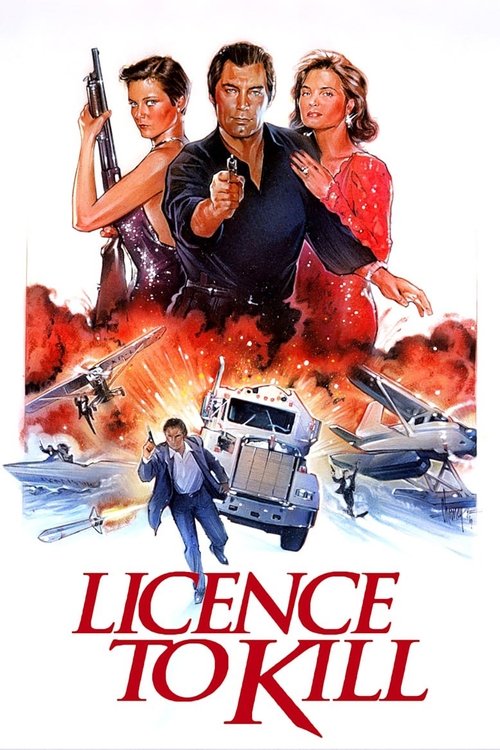
Dalton's first appearance as 007, The Living Daylights (1987), was critically successful, grossing more than either of the previous two Bond films with Moore (Octopussy (1983) and A View to a Kill (1985)) as well as contemporary box-office rivals such as Die Hard and Lethal Weapon. His second film, Licence to Kill (1989), although almost as successful as its predecessor in most markets, did not perform as well at the U.S. box office, in large part due to a lacklustre marketing campaign, whereby the title of the film was abruptly changed from Licence Revoked. The main factor for the lack of success in the U.S. was that it was released at the same time as the hugely successful Indiana Jones and the Last Crusade, Tim Burton's Batman, and Lethal Weapon 2, during the summer blockbuster season. In the United Kingdom, one of its critical markets, the film was also hampered by receiving a 15 certificate from the British Board of Film Classification, which severely affected its commercial success. Future Bond films, following the resolution of legal and other issues, were all released between 31 October and mid-December, in order to avoid the risk of a summer failure, as had happened to Licence to Kill.
With a worldwide gross of US$191 million, The Living Daylights became the fourth-most-successful Bond film at the time of its release. In 1998, the second Deluxe Edition of Bond's soundtracks was released. The Living Daylights was one of the first soundtracks to receive Deluxe treatment. The booklet/poster of this CD contains MGM's quote about The Living Daylights being the fourth-most-successful Bond film.
Since Dalton was contracted for three Bond films, the pre-production of his third film began in 1990, in order to be released in 1991. What was confirmed is that the story would deal with the destruction of a chemical weapons laboratory in Scotland, and the events would take place in London, Tokyo and Hong Kong. The film was cancelled due to legal issues between UA/MGM and Eon Productions, which lasted for four years.
The legal battle ended in 1993, and Dalton was expected to return as James Bond in the next Bond film, which later became GoldenEye. Since his contract had expired, negotiations with him to renew it took place. Dalton surprised everyone on 12 April 1994 with the announcement that he would not return as James Bond. At this time, he was shooting the miniseries Scarlett. Two months later, Brosnan, who had been hired to succeed Moore when Dalton had turned down the role in 1986, was announced as the new Bond. Dalton reflected in 2007, "I was supposed to make one more, but it was cancelled because MGM and the film's producers got into a lawsuit which lasted for five years. After that, I didn't want to do it anymore."
Dalton portrayed Bond in The Living Daylights (1987) and Licence to Kill (1989), the fifteenth and sixteenth entries in the franchise. Unlike Moore, who had played Bond as more of a light-hearted playboy, Dalton's portrayal of Bond was darker and more serious. Dalton pushed for renewed emphasis on the gritty realism of Ian Fleming's novels instead of fantasy plots and humour.
I think Roger was fine as Bond, but the films had become too much techno-pop and had lost track of their sense of story. I mean, every film seemed to have a villain who had to rule or destroy the world. If you want to believe in the fantasy on screen, then you have to believe in the characters and use them as a stepping-stone to lead you into this fantasy world. That's a demand I made, and Albert Broccoli agreed with me.
A fan of the literary character, often seen re-reading and referring to the novels on set, Dalton determined to approach the role and play truer to the original character described by Fleming. His 007, therefore, came across as a reluctant agent who did not always enjoy the assignments he was given, something seen on screen before, albeit obliquely, only in George Lazenby's On Her Majesty's Secret Service. In The Living Daylights, for example, Bond tells a critical colleague, Saunders, "Stuff my orders! ... Tell M what you want. If he fires me, I'll thank him for it." This was an element that appealed to Dalton when he read the script. In Licence to Kill, he resigns from the Secret Intelligence Service in order to pursue his own agenda of revenge.
Unlike Moore, who always seems to be in command, Dalton's Bond sometimes looks like a candidate for the psychiatrist's couch – a burned-out killer who may have just enough energy left for one final mission. That was Fleming's Bond – a man who drank to diminish the poison in his system, the poison of a violent world with impossible demands. ... His is the suffering Bond.
This approach proved to be a double-edged sword. Film critics and fans of Fleming's original novels welcomed a more serious interpretation after more than a decade of Moore's approach. However, Dalton's films were criticised for their comparative lack of humour. Dalton's serious interpretation was not only in portraying the character, but also in performing most of the stunts of the action scenes himself. His director, John Glen, commented "Tim is a very convincing James Bond. When he has a gun in his hand, you believe he really could kill someone. I don't think that was ever the case with Roger Moore."
Some modern critics have compared Dalton to Daniel Craig. In 2006, Gwladys Fouché of The Guardian wrote "while Connery was cool, and Brosnan brilliant, only Dalton could show the dark side of Fleming's fearless agent. ... [Bond producers] want Bond to be closer to the original Ian Fleming character. They want him to be grittier, darker and less jokey. What they really want, it seems, is to have Dalton back." Dalton himself has claimed that the Bond films starring Daniel Craig are "believable" in the way he wanted his own Bond films to be:
I came in under certain circumstances. The prevailing wisdom at the time – which I would say I shared – was that the series, whilst very entertaining, had become rather spoof-like. It was one-liners and raised eyebrows and it had become, let's say, too lighthearted. And the producer, Mr. Broccoli, felt that, and he wanted to try to bring it back to something more like its original roots with those Sean Connery films. I had loved them all, and I had loved the books.
... So that was the loose framework that we sort of embarked on, but then you find that nobody else wants to change it all! The studio doesn't want to change it, the people that work on it don't want to change it ... Everyone's happy with what they know. And everyone intellectually says, "Well, yes, we should, it was getting a bit stale, it was getting a bit this, that, and the other," but nobody actually wants to. So it wasn't as easy as one would hope. I mean, now they have. I think now, with Daniel [Craig], they have. But that was, what, almost 20 years later that they actually embarked on something more believable?
Of his time as Bond, Dalton recalled:
I should be careful what I say, because, of course, everyone is interested in Bond. It's almost like a bracket or a bubble in one's life. Everybody treats the idea of a Bond film different to anything else. I mean, journalists come knowing the story they want to write, whereas on a normal piece of work we're all discovering what to write about. We're discovering what we're acting. It's part of the creative process. But in a Bond movie? No. People know what they want to write about. And they know, really, what they want. Everyone's got an opinion, from the top of the studio down to the guy in the street. But you're sort of ... outside.
No one, no matter how well someone can communicate, can tell you – and I certainly can't really communicate accurately – what it is like to be the actor playing James Bond. The only actors who can are the other actors who've played the part. It's kind of astonishing, really. You are in kind of a bubble. It's real, it's valuable, it's exciting, and it can give great pleasure. And yet it's somehow unreal. No, forget the "unreal" bit. But it's somehow outside the normal course of what we all share in ... A fantastic experience. His time as Bond allowed him to work on projects that were of interest to him; "Hawks deals with the subject of extraordinary relevance: Why does it take a crisis to make you realize how bloody precious life is? Unfortunately, it's about cancer, which is a not a word the film business thinks of as being particularly commercial. Still, doing the first Bond film enabled me to get Hawks made. Doing the Bond film helped the O'Neill play find an audience. This is a commercial business. If you have a commercial success, you have enhanced viability."