Differences from the Wells novel
Caroline Blake has written that the film is very different from the original novel in its attitude toward religion, as reflected especially in the depiction of clergymen. "The staunchly secularist Wells depicted a cowardly and thoroughly uninspiring Curate, whom the narrator regards with disgust, with which the reader is invited to concur. In the film, there is instead the sympathetic and heroic Pastor Collins who dies a martyr's death, and the film's final scene in the church, strongly emphasizing the Divine nature of Humanity's deliverance, has no parallel in the original book."
Pal's adaptation has many other differences from H. G. Wells's novel. The closest resemblance is probably that of the antagonists. The Martians invade Earth for the same reasons as those stated in the novel. The state of Mars suggests that it is becoming unable to support life, leading to the Martians' decision to try to make Earth their new home. They land in the same way, by crashing to Earth. The novel's spacecraft, however, are large, cylindrical projectiles fired from the Martian surface from a cannon, instead of the film's meteorite-spaceships; but the Martians emerge from their craft in the same way, by unscrewing a large, round hatch. In the novel, the invaders are observed "feeding" on humans by fatally transfusing their captives' blood supply directly into Martian bodies through pipettes. There is later speculation about the Martians' eventually using trained human slaves to hunt down all remaining survivors after they conquer Earth. Early storyline hints at the aliens' vampirism were dropped. The Martians do not bring their fast-growing red weed with them, but they are defeated by Earth microorganisms, as in the novel.
The film's Martians bear no physical resemblance to those of the novel, who are described as bear-sized, roundish creatures with grayish-brown bodies, "merely heads", with quivering beak-like, V-shaped mouths dripping saliva. They have sixteen whip-like tentacles in two groupings of eight arranged on each side of their mouths and two large "luminous, disk-like eyes". Because of budget constraints, their film counterparts are short, reddish-brown creatures with two long, thin arms with three long, thin fingers with suction-cup tips. The Martian head is a broad "face" at the top-front of its broad-shouldered upper torso, with one large central eye with three distinctly colored lenses of red, blue, and green. A greatly enlarged brain projects behind the top of the body, glimpsed as a screaming Martian flees the wrecked farmhouse after being injured by Forrester. The Martians' lower extremities are never shown. Some speculative designs suggest three thin legs resembling their fingers, and others show them as bipeds with short, stubby legs with three-toed feet.
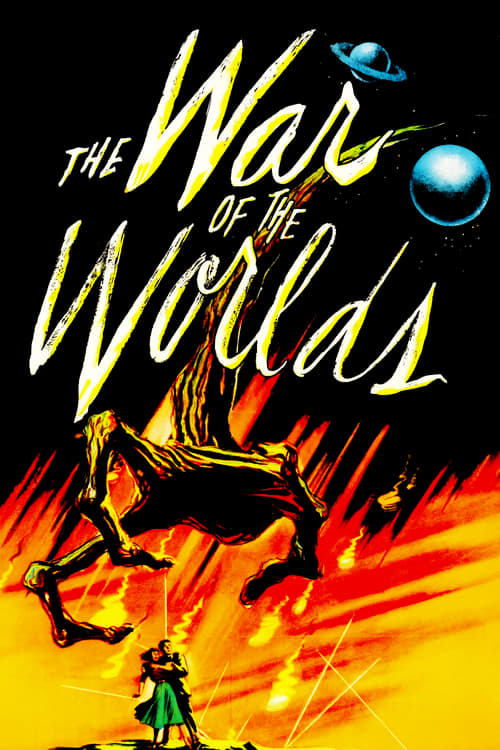
The film's Martian war machines are more like those of the book than they first seem. The novel's war machines are 10-story-tall fast-moving tripods made of glittering metal, each with a "brazen hood" atop the body, moving "to and fro" as the machine moves. A heat-ray projector on an articulated arm is connected to the front of each machine's main body. However, the film's war machines are shaped like manta rays, with a bulbous, elongated green window at the front, through which the Martians observe their surroundings. On top of the machine is the cobra-like head heat-ray attached to a long, narrow, goose-neck extension, which can fire in any direction. They can be mistaken for flying machines, but Forrester states that they are lifted by invisible legs. One scene when the first war machine emerges has faint traces of three "energy legs" beneath that leave three sparking traces where they touch the burning ground, so they are tripods, though they are never so called. Whereas the novel's machines have no protection against the British army and navy cannon fire, the film's war machines have a force field surrounding them, described by Forrester as a "protective blister".
The Martian weaponry is also partially unchanged. The heat-ray has the very same effect as that of the novel. However, the novel's heat-ray mechanism is briefly described as just a rounded hump when its silhouette rises above the landing crater's rim; it fires an invisible energy beam in a wide arc while still in the pit made by the first Martian cylinder after it crash-lands. The film's first heat-ray scene has a projector shaped like a cobra head with a single, red pulsing light, which likely acts as a targeting telescope for the Martians inside their war machine shaped like a manta ray. The novel describes another weapon, the "black smoke" used to kill all life; the war machines fire canisters containing a black smoke-powder through a bazooka-like tube accessory. When dispersed, this black powder is lethal to all life forms who breathe it. This weapon is replaced in the film by a Martian "skeleton beam" of green pulsing energy bursts fired from the wingtips of the manta-ray machines; these bursts break apart the sub-atomic bonds that hold matter together. These beams are used off-screen to obliterate several French cities.
The plot of the film is very different from the novel, which tells the story of a 19th-century writer (with additional narration in later chapters by his medical-student younger brother) who journeys through Victorian London and its southwestern suburbs while the Martians attack, eventually being reunited with his wife; the film's protagonist is a Californian scientist who falls in love with a former college student after the Martian invasion begins. However, certain points of the film's plot are similar to the novel, from the crash-landing of the Martian meteorite-ships to their eventual defeat by Earth's microorganisms. Forrester also experiences similar events to the book's narrator, with an ordeal in a destroyed house, observing an actual Martian up close, and eventually reuniting with Sylvia at the end of the story. The film has more of a Cold War theme with the atomic bomb against the invading enemy and the mass destruction that such a global war would inflict on humanity.