Production
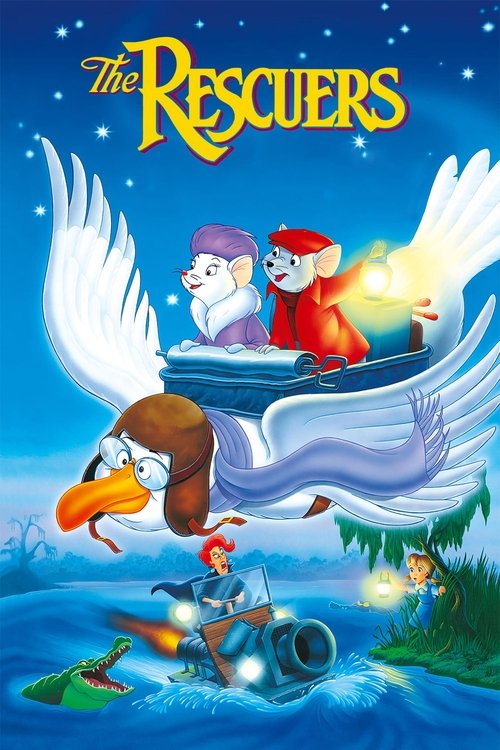
In 1959, the book The Rescuers by Margery Sharp had been published to considerable success. In 1962, Sharp followed up with a sequel titled Miss Bianca. That same year, the books were optioned by Walt Disney, who began developing an animated film adaptation. In January 1963, story artist Otto Englander wrote a story treatment based on the first book, centering on a Norwegian poet unfairly imprisoned in a Siberia-like stronghold known as the Black Castle. The story was revised with the location changed to Cuba, in which the mice would help the poet escape into the United States. However, as the story became overtly involved in international intrigue, Disney shelved the project as he was unhappy with the political overtones. In August 1968, Englander wrote another treatment featuring Bernard and Bianca rescuing Richard the Lionheart during the Middle Ages.
During the early 1970s, The Rescuers reentered development as a project for the young animators, led by Don Bluth, with the studio planning to alternate between full-scale "A pictures" and smaller, scaled-back "B pictures" with simpler animation. The animators had selected the most recent book, Miss Bianca in the Antarctic, to adapt from. The new story involved a King penguin deceiving a captured polar bear into performing in shows aboard a schooner, causing the unsatisfied bear to place a bottle that would reach the mice. Fred Lucky, a newly hired storyboard artist, was assigned to develop the story adaptation, alongside Ken Anderson. This version of the story was dropped, to which Lucky explained the Arctic setting "was too stark a background for the animators." Vance Gerry, also a storyboard artist, also explained director Wolfgang Reitherman "decided not to go with Fred Lucky's version. He said, "'It's too complicated. I want a simple story: A little girl gets kidnapped and the mice try to get her back, period.'" According to Burny Mattinson, he stated: "Our problem was that the penguin wasn't formidable or evil enough for the audience to believe he would dominate the big bear. We struggled with that for a year or so. We changed the locale to somewhere in America and it was now a regular zoo and we tried to come up with something with the bear in the zoo and needing to be rescued but that didn't work either."
In that version, the bear character was still retained, but was renamed Louie the Bear. Jazz singer Louis Prima was cast in the role and had recorded most of the dialogue and multiple songs that were composed by Floyd Huddleston. The writers also expanded the role of his best friend, Gus the Lion. Huddleston had stated, "It's about two animals. One is Louis Prima — he's the polar bear — and Redd Foxx is the lion ...Louis gets cornered into leaving and going to the South Pole where he can make himself a bigger star. But he gets homesick; he feels fooled. They send out little mice as 'rescuers'." By November 1973, the role of Louie the Bear had been heavily scaled back and then eliminated. In one version, the bear was meant to be Bernard and Bianca's connection to Penny. Gerry explained, "We developed the sequence where, while the two mice are searching for clues as to where Penny has been taken, they come across this bear who she had been friends with because the orphanage where Penny was living was near the zoo." In the final film, the idea was reduced to a simple scene where Bernard enters a zoo and hears a lion's roar that scares him away.
While promoting the release of Robin Hood (1973) in Europe, Reitherman stated: "I took Margery Sharp's books along and there was in there a mean woman in a crystal palace. When I got back I called some of the guys together and I said, 'We've got to get a villain in this thing.'" The villainess and her motive to steal a diamond was adapted from the Diamond Duchess in Miss Bianca. The setting was then changed to the bayous found in the Southern United States. By August 1973, the villainess was named the Grand Duchess with Phyllis Diller cast in the role. A month later, Ken Anderson began depicting Cruella de Vil, the villainess from One Hundred and One Dalmatians (1961), as the main antagonist of the film. Anderson had drawn several sketches of Cruella de Vil sporting alligator-leathered chic attire and sunglasses; one sketch depicted her wearing bell-bottom pants and platform shoes. However, several staff members such as animator Ollie Johnston stated it felt wrong to attempt a sequel for the character. Furthermore, Mattinson explained that Milt Kahl did not want to animate Cruella de Vil. "Milt, of course, was very strong against that, 'Oh, no no. We're gonna have a new character. I'm not gonna do Cruella'," Mattinson recalled, "Because he felt that Marc [Davis] had animated Cruella beautifully. He was not gonna go and take his character."
The new villain was named Madame Medusa, and her appearance was based on Kahl's then-wife, Phyllis Bounds (who was the niece of Lillian Disney), whom he divorced in 1978. This was Kahl's last film for the studio, and he wanted his final character to be his best. He was so insistent on perfecting Madame Medusa that he ended up doing almost all the animation for the character himself. The kidnapped child Penny was inspired by Patience, the orphan in the novel. The alligator characters Brutus and Nero was based on the two bloodhounds, Tyrant and Torment, in the novels. For the henchman, the filmmakers adapted the character, Mandrake, into Mr. Snoops. His appearance was caricatured from John Culhane, a journalist, who had been interviewing animators at the Disney studios. Culhane claimed he was practically tricked into posing for various reactions, and his movements were imitated on Mr. Snoops's model sheet. However, he stated, "Becoming a Disney character was beyond my wildest dreams of glory."
The writers had considered depicting Bernard and Bianca as married professional detectives, but decided that depicting them as novices in a new relationship was more compelling and romantic. For the supporting characters, a pint-sized swamp mobile for the mice—a leaf powered by a dragonfly—was created. As they developed the comedic potential of displaying his exhaustion through buzzing, the dragonfly grew from an incidental into a major character. Veteran sound effects artist and voice actor Jimmy MacDonald came out of retirement to provide the effects.
Additionally, the local swamp creatures were originally written as a dedicated home guard that drilled and marched incessantly. However, the writers rewrote them into a volunteer group of helpful little bayou creatures. Their leader, a singing bullfrog, voiced by Phil Harris, was cut from the film, as were lines characterizing muskrat Ellie Mae as their outspoken boss. For Bernard and Bianca's transportation, a pigeon was proposed (specifically one that would be catapulted, repurposing an unused gag from Robin Hood), until Johnston remembered a True-Life Adventures film featuring albatrosses and their clumsy take-offs and landings, leading him suggest that ungainly bird instead. A scene of the mice preparing for their adventure, with Bianca choosing outfits and Bernard testing James Bond-like gadgets, was cut for pacing. On February 13, 1976, co-director John Lounsbery died of a heart attack during production. Art Stevens, an animator, was then selected as the new co-director.