




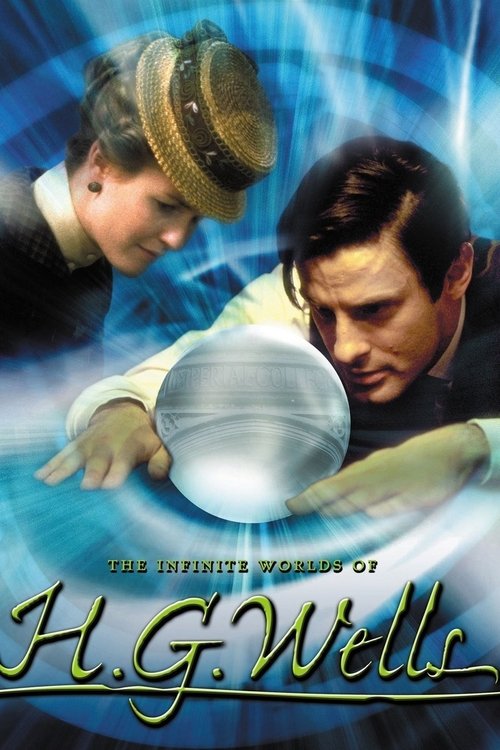
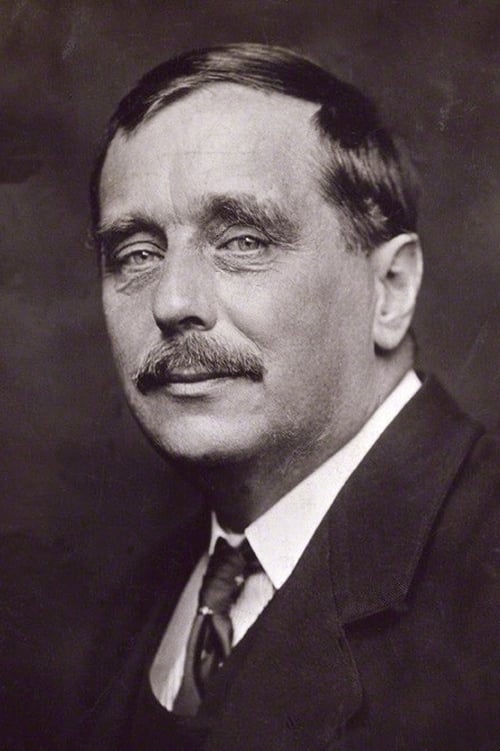











The Infinite Worlds of H. G. Wells is a four-hour television miniseries conceived by Nick Willing and released in 2001 by the Hallmark Channel. It is based on a number of short stories by H. G. Wells, and in some territories was titled The Scientist.
Contents
Structure and plot
Each episode adapts — and sometimes quite radically changes — two of Wells's short stories. The first episode adapts "The New Accelerator" and "The Queer Story of Brownlow's Newspaper." The second episode adapts "The Crystal Egg" and "The Remarkable Case of Davidson's Eyes," and the third, "The Truth About Pyecraft" and "The Stolen Bacillus". Each episode is written as if it were a "real" incident that Wells had investigated with his girlfriend, Jane Robbins, and as if it had served as an inspiration for a short story.
Each short story adaptation is presented as a flashback to 1893 within a frame story set in 1946, near to the end of Wells's life, when he is interviewed by members of a secret military research institute interested in his past exploits.
First episode
Ellen McGillvray, a young and promising American journalist, meets the famous science fiction writer H. G. Wells, to interview him. She has been sent by an acquaintance of his, Arthur, editor of the Sunday Chronicle. After an initial cold and annoyed approach, caused by the delay of the journalist, Wells begins narrating the adventures of his past, flanked by the famous prof. Cedric Gibberne, recently deceased. Ellen hopes that the interview gives a complete portrait of him, including his early academic years.
The New Accelerator
London 1893. The scene opens showing a pleasant bickering between Wells and Dr Jane Robbins, who has just started working at Imperial College London. This bickering continues through the halls of the university and leads Wells and Jane in a classroom where some teachers and some students gathered to attend a demonstration by prof. Gibberne on the relationship between the nervous system and electricity, through the use of an electrovoltaic spectrograph.
During the activation of the spectrograph, however, a frightening roar makes Gibberne and the assistant Whittaker literally fly a few meters from the desk where the experiment was in progress. At the same time the doors open and are literally unhinged.
Recovering from the accident, Gibberne notices the disappearance of the spectrograph. To this mystery is added the fact that the doors are unhinged in the opening directions, and not as they should be in the case of an explosion or an implosion (theory discarded thanks to Wells' observation); moreover, the windows have not suffered any damage.
Wells and Jane thus begin to investigate, finding clues that lead them to a surprising discovery: the existence of an "accelerating drug", invented by Mark Radcliffe, another professor at the university, which allows people, for a short period of time, to be faster than sound.
Found out the responsible for the accident that occurred to prof. Gibberne, Wells and Jane go to Radcliffe's laboratory, seeing him disappear before their eyes. It will be up to Wells and Gibberne to find out where Radcliffe has disappeared with his drug, facing a sad reality: perhaps the accelerating drug is not only a step forward for humanity, but also a sacrifice of one's existence.
Second episode
Wells takes from the inside of the trunk an oval-shaped object resembling a stone; according by Ellen, it is a crystalline substance of unknown origin weighing 13 3/4 ounces, resistant to any acid and any attempt to engrave with a diamond. Wells states that the stone, once upon a time, was of rare beauty, and not black and dull as it now appears.
The Crystal Egg
The scene shifts into a clear night, a drunken bum named Skinner with his dog wanders around what appears to be a field. Suddenly a fireball crashes not far from him, and at the moment of impact Skinner falls to earth beating his head and fainting.
In the morning, once awakened, Skinner, attracted by the dog's barking, approaches a huge crater, noticing a large meteorite on the bottom. As he descends into the crater, he hears his dog yelp, followed by several echoes; Skinner keeps calling his dog who seems to have vanished into thin air. Approaching the meteorite, he notices a stone inside that gives off a strong intermittent golden light; as he approaches further, the light seems to go out, becoming crystalline white.
The scene shifts to the university, where Jane meets the bizarre William Cave, according to her naturalist, in search of the vivarium. Jane accompanies him, and, after selling some frogs he had with him for a paltry sum, realises he is late. Leaving his business card with Jane, William runs away, terrified of being late with his wife Rosa.
Once the scene is moved back to Skinner, he is seen walking into an antique shop, hoping to sell the strange stone found in the crater. Entering the store Skinner finds himself having to negotiate the price with the despicable Mrs. Cave, William's greedy and mean wife, who gets the stone for a paltry sum.
At night William, awakened by Rosa's cat, who bursts into the bedroom of the couple terrified, goes to the shop, located downstairs, and notes with amazement that the egg gives off a strange whitish light. He also notes that that light appears to be stimulated by the Moon, whose glow enters in the room through a window.
Third episode
The episode starts immediately with a story about the origin of the liquid shown at the end of the second episode.
The Truth About Pyecraft
Albert Pyecraft, a fellow of a club of which also Wells is member, is a mathematics genius, despite working as a common teacher at a crammer directed by the cruel Mr. Jagger. Moreover, he is in love with Violet, a young maid who takes private classes with him, but he is extremely insecure due to his fatness.
A friend of him, Mark Pattison, on advice of a colleague, visits a shady pharmacist and obtains a miraculous cure for his baldness. Showing Albert the quick regrowth of his hair, he convinces him to get a similar potion to cure his fatness.
When Albert does not show up for work or at the club for two days, Wells goes to his place and finds him floating on the ceiling: his wish to "lose weight" has been interpreted too literally. Wells and Jane help Albert to walk again on the ground by putting lead in his clothes. Visiting the club, he finds Pattison hidden in the bathroom and victim of the same cure he requested: his hair keeps growing at high rate all over his body.
The day after, Wells and Jane accompany Albert to Oxford to compete for the Möbius prize. Albert, who forgot about the competition in the past days and is forced to improvise, regain his security when Violet enters the room, and deliver his lecture. At the end, Albert loses the competition but the committee offers him a professorship at Oxford; having finally found his courage, he asks Violet to marry him.
At the end, we see Gibberne trying without success to replicate the mysterious potion and Wells comforting Pattison that its effects should disappear soon. He then meets Jane in front of the university and ask her to marry him.
In the frame story, Whittaker wonders if the recipe of the potion might have been preserved, but Wells states that no good would have come of it. He then leaves the building together with Ellen and return at home. When Ellen inquires how can Wells be so sure that Jane was his true soulmate, he start to tell a last story, about what made them "scientifically certain" of each other's feelings.
Production
The filming was done as a full period costume drama, and also took full advantage of notable London locations. These included the London Underground, where scenes from Brownlow's Newspaper were shot at the disused Aldwych tube station.
Actual historical events and places
The miniseries' opening premise is that in 1893 Wells was scientifically untrained, and single. In reality he was neither of those things in 1893. He had studied Zoology and Geology at the Normal School of Science in London, gaining a second-class zoology degree in 1887, but failing the final geology examination. He then taught science in schools in Wrexham and London whilst studying to re-take both subjects, eventually gaining first-class honours in Zoology and second-class in Geology in 1890. He then secured a teaching post at the University Correspondence College, and in 1891 he married his cousin, Isabel Mary Wells. Wells began writing to supplement his teaching income, and in 1893 met Amy Catherine Robbins, one of his students. Disliking the name "Amy", he called her "Jane". In 1894 Wells left his wife to live with Jane, and they married later that year, after his divorce from Isabel.
At the opening of the miniseries Amy Robbins is instead called Jane Robbins and is shown to be a teacher of Biology, with Wells initially one of her two potential suitors — the other being a member of the college staff. Wells is portrayed as a single man, a jobbing journalist and aspiring fiction writer with just five stories to his name.
Anachronisms
Given the reference dates given to us during the various stories, it is assumed that the events narrated by the writer took place over a period of 7 years. These references are given by two elements:
At the beginning of the first episode, the setting year (1893) appears. Furthermore, Whittaker states that the accident happened in July.
At the end of the sixth chapter (1900), Jane confesses to her Wells that she is pregnant.
Despite this, some elements are anachronisms, both in reference to real events, and in reference to the evolution of the characters and their relationships.
The New Accelerator
The Imperial College of Science — where Jane Robbins is depicted as teaching — did not exist in 1893. In 1890 the Normal School of Science — where Wells had studied — became the Royal College of Science, which in 1907 was amalgamated with other institutions to form the Imperial College of Science and Technology.
The electrovoltaic spectrograph shown by Gibberne is none other than the mass spectrometer invented by Joseph John Thomson in 1912.
Prof. Gibberne talks to Wells about X-rays, while the first public announcement took place on December 28, 1895.
When they open a closet, Wells and Jane find hundreds of cans of food, including the Forest City Brand (1920) of the L. Allen & Sons Company founded in 1901.
The Queer Story of Brownlow's Newspaper
In the scene where Wells and Jane are having tea, the newspaper that is shown (Daily Graphic) bears the date Monday, September 18, 1893, the same day as the discovery of Mark Radcliffe's body in the first episode, while according to the story it is June 5, 1893.
Cast
Main cast
Tom Ward - H. G. Wells (stories 1-6, frame story)
Katy Carmichael - Jane Robbins (stories 1-6)
Eve Best - Ellen McGillvray (frame story)
Nicholas Rowe - Professor Cedric Gibberne (stories 1-6)
Matthew Cottle - Whittaker (stories 1-6)
Barry Stanton - Dean Frederick Masterman (stories 1,4,6)
Episodic cast
The New Accelerator:
Ray Coulthard - Mark Radcliffe
Brownlow's Newspaper:
Mark Lewis Jones - Arthur Brownlow
Robert Demeger - Frank Harris
The Crystal Egg:
Stephen Critchlow - William Cave
Tilly Vosburgh - Rosa Cave
The Remarkable Case of Davidson's Eyes:
Dominic Cooper - Sidney Davidson
Jeffry Wickham - Dr. Symonds
Mark Dexter - Atkins
The Truth About Pyecraft:
Michael Fitzgerald - Albert Pyecraft
Pip Torrens - Mark Pattison
Catherine Bailey - Violet
John Bennett - Mr. Jagger
Orlando Seale - Albert Einstein
Donald Douglas - Chairman at Praecentors
The Stolen Bacillus:
Nicholas Boulton - Thomas Keating
William Mannering - Harold
Hugh Dickson - Opposition MP
Vincent Franklin - War Minister (Henry Campbell-Bannerman)
DVD releases
A Region 2 DVD of the series in non-episodic form was released in the Netherlands in 2004 with the original English language soundtrack, and optional Dutch and French subtitles. A Region 1 DVD in episodic form was released in 2005. It was released in the UK in 2006.