Overview
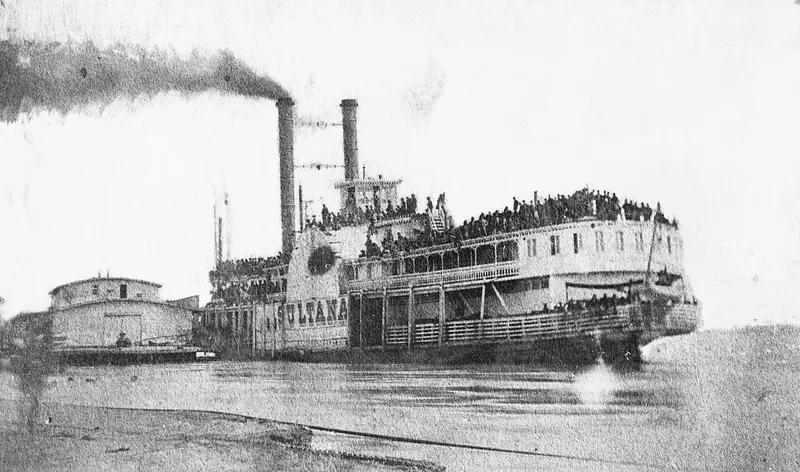
Sultana was a commercial side-wheel steamboat which exploded and sank on the Mississippi River on April 27, 1865, killing 1,167 people in what remains the worst maritime disaster in United States history.
Constructed of wood in 1863 by the John Litherbury Boatyard in Cincinnati, Ohio, Sultana was intended for the lower Mississippi cotton trade. The steamer registered 1,719 tons and normally carried a crew of 85. For two years, she ran a regular route between St. Louis and New Orleans and was frequently commissioned to carry troops during the American Civil War. Although designed with a capacity of only 376 passengers, she was carrying 2,128 when three of the boat's four boilers exploded and caused it to sink near Memphis, Tennessee. The disaster was overshadowed in the press by events surrounding the end of the Civil War, including the killing of President Abraham Lincoln's assassin John Wilkes Booth just the day before. No one was ever held accountable for the tragedy.
Construction
Sultana was launched on January 3, 1863, the fifth steamboat to bear the name. The vessel measured long, with a width at the beam, displaced , and had a draft. Her two side-mounted paddle wheels were driven by four fire-tube boilers. Introduced in 1848, they could generate twice as much steam per fuel load as conventional boilers. Each fire-tube boiler was long and in diameter and contained 24 flues which ran from the firebox to the chimney.
The power of the boilers came with risk - the water levels in the fire tubes had to be carefully maintained at all times. The areas between the many flues clogged easily, especially since dirty river water carried much sediment, and were difficult to clean. Dropping water levels could cause hot spots leading to metal fatigue, significantly increasing the risk of an explosion. Since most steamboats of the time were constructed of wood covered with paint and varnish, fires were a significant concern.
From Wikipedia (CC BY-SA 4.0).