Themes
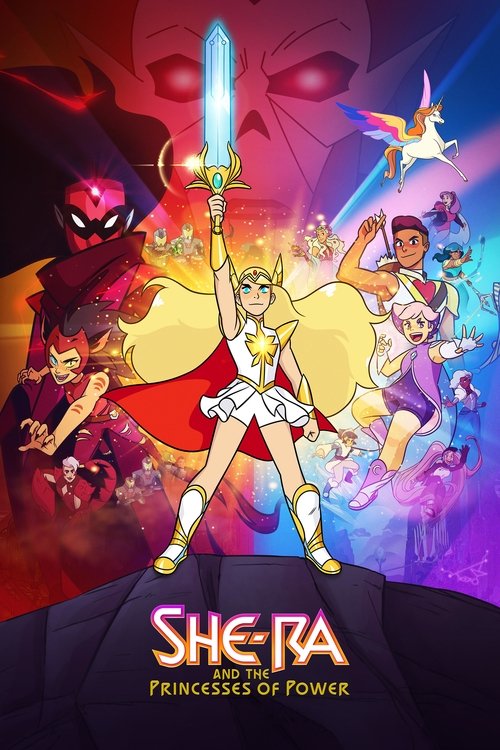
The first season of the serialized She-Ra reboot focuses on establishing the characters and their relationships in order to set up future seasons, initially by way of a "mission-of-the-week" plot to have the core cast of Adora and her close friends, Glimmer and Bow recruit princesses to their rebellion. While the core premise and characters of the original series were carried over, as well as many of its affectations (such as Adora's transformation catchphrase "For the honor of Grayskull!"), the reboot sets itself apart from the 1980s series by its almost entirely female cast. The characters were deliberately made to be diverse, both in appearance and in character traits. For instance, some characters range from good to "evil but understandable", "utterly amoral" or "full-blown hippie". He-Man, who in the original version was She-Ra's brother who "awakens her destiny", does not appear in the reboot, in order to set up She-Ra as a hero in her own right.
According to Stevenson, the show's thematic core is the relationships among its characters, which range from "wide-eyed love" to "heart-rending jealousy, crushes and infatuations". Reviewers particularly highlighted the convincing portrayal of the anti-hero Catra and her complicated "frenemy" relationship with Adora, which The Verge described as "the best animated antihero story since Avatar: The Last Airbender's Zuko". In addition, the series addresses such themes as abusive relationships and overcoming trauma, prejudice, isolationism (as exemplified, initially, by the princesses), colonization, imperialism, and genocide (a result of Hordak's planetary-scale warfare). There is a strong focus on the struggle to break free of sociopolitical indoctrination, explored mainly through the stories of Adora, Hordak, and Light Hope. The series also emphasizes the necessity of taking action no matter one's own power or circumstances; it portrays magic as fallible and dependent on its wielder's skill and determination—Adora's powers in particular are directly tied to her love for her friends. Despite this, Adora's main internal conflict stems from being told she must suppress her personal desires in order to be the hero Etheria needs. Finally, Horde Prime's regime in Season 5 contains elements reminiscent of fundamentalist Christianity, which Stevenson has noted are not meant to be criticisms of religion itself but rather the kind of leadership seen in extremist, cult-like organizations.
In June 2020, Stevenson said that Catra was a woman of color, saying he discussed her "being a brown Latina" when designing her, although this was not "explicitly, textually present in the show," Stevenson also expressed enthusiasm for fans interpreting Catra as representing Persian ethnicity.
Stevenson cited Steven Universe as a series that paved the way for She-Ra, saying his early conversations about queer relationships and characters in She-Ra were only possible because of Steven Universe. In another interview, he implied influence of Steven Universe on the show. He noted that the crew wanted to introduce Catra's pink lion Clawdeen, from the original She-Ra series, into his series, but decided to not do so because its design was "pretty much identical" to Steven Universe's Lion. As a result, he chose Melog as a "therapy animal" for Catra instead. Stevenson also noted the importance of featuring LGBTQ+ representation in kids animation, saying earlier shows made She-Ra's "range of queer representation" possible.
The show was also influenced by sci-fi in the 1970s and 1980s, paying homage to the original She-Ra: Princess of Power show, and Dungeons & Dragons. Stevenson called the show basically a D&D campaign, with Adora, Glimmer, and Bow falling into "specific classes in D&D." Additionally, Stevenson and the show's crew were strongly influenced by anime, especially those with magical girls.
The creators indicated prior to release that the series would provide LGBTQ representation. Tor.com commented that the series "reads as utterly queer in just about every aspect", with many characters coded as fluid in terms of gender or sexuality, and none as clearly heterosexual. Stevenson said that when a network executive asked what the rainbow in the climax of the first season's finale meant, he replied: "The gay agenda". In March 2021, Stevenson told Vanity Fair that early in the show's run there "had to be plausible deniability" around most queer relationships, but this changed once he got "positive, vocal support from fans of the show" who picked up on queer subtext and wanted more. This enabled Stevenson to sell executives on the idea that the "queer relationship between the two leads [was] to be the climax of the entire show."
The relationship between Adora and Catra has subtextual undercurrents of romantic tension from the beginning of the series, and concludes with a mutual confession of love and an on-screen kiss in the very last episode. The scene has been regarded as a revolutionary moment in the history of children's media and LGBT representation. Other reviews praised
the "queer romance" manifested by the Adora-Catra relationship and said that this slow-burn romance was a groundbreaking moment for TV.
The series features same-sex attraction and romance among secondary and side characters as well. Two of the princesses, Spinerella and Netossa, are a married couple, and their relationship receives more attention in a plot arc in the fifth season when Netossa must rescue her wife from the villain's mind control. An episode focusing on Bow, the male lead, explores his relationship with his two fathers Lance and George. Additionally, it is strongly implied that Scorpia, Catra's right-hand woman, has a crush on her and arranges pseudo-dates disguised as "side missions." Scorpia also mentions that the Horde soldier Kyle has a crush on his coworker, a humanoid lizard man named Rogelio, and ND Stevenson once tweeted that he envisions the two in a polyamorous relationship that involves their cohort Lonnie.
Adora's mentor Light Hope is a female artificial intelligence who, while generally devoid of emotion, felt genuine affection for the woman Mara. In August 2020, Stevenson elaborated on Twitter that Light Hope's feelings were romantic.
In addition to same-sex romance, the show also includes transgender characters. The fourth season introduces a minor antagonist named Double Trouble, who is referred to with the singular they pronoun. Double Trouble's voice actor is also non-binary. Additionally, character designer Ray Geiger said on Tumblr that the character Jewelstar (who presented as female in the original series but presents as male in an episode of the remake) is a transgender man, just like his voice actor, Alex Blue Davis. In the same post, Geiger also said that they designed Adora's friend Perfuma while envisioning her as a trans woman but never told anyone for fear of censorship.
In June 2021, Stevenson told Insider that while the show's staff had a "good number of trans and nonbinary crew," criticism from some of Double Trouble as a villain and a "nonbinary character whose gender nonconformity was conflated with...alienness," blindsided him, admitting he "might have done some things differently," had he known of this perspective. He also said this conversation was important because "it points to the limits of our imagination." Tobia also told the publication that non-binary representation on screen needs to reflect the diversity of the non-binary community and make a statement to viewers in the process.