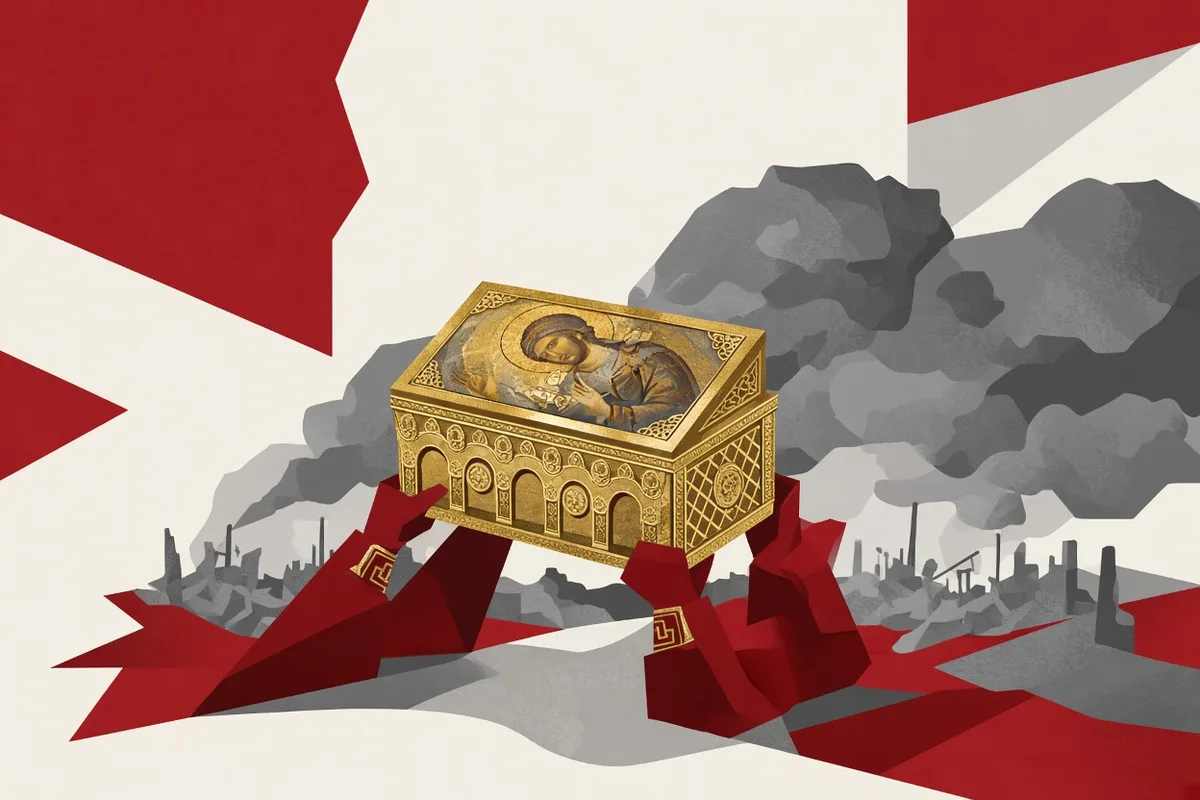
Post-Soviet era
Metropolitan Alexy (Ridiger) of Leningrad, ascended the patriarchal throne in 1990 and presided over the partial return of Orthodox Christianity to Russian society after 70 years of repression, transforming the ROC to something resembling its pre-communist appearance; some 15,000 churches had been re-opened or built by the end of his tenure, and the process of recovery and rebuilding has continued under his successor Patriarch Kirill. According to official figures, in 2016 the church had 174 dioceses, 361 bishops, and 34,764 parishes served by 39,800 clergy. There were 926 monasteries and 30 theological schools.
The Russian Church also sought to fill the ideological vacuum left by the collapse of Communism and even, in the opinion of some analysts, became "a separate branch of power".
In August 2000, the ROC adopted its Basis of the Social Concept and in July 2008, its Basic Teaching on Human Dignity, Freedom and Rights.
Under Patriarch Aleksey, there were difficulties in the relationship between the Russian Orthodox Church and the Vatican, especially since 2002, when Pope John Paul II created a Catholic diocesan structure for Russian territory. The leaders of the Russian Church saw this action as a throwback to prior attempts by the Vatican to proselytize the Russian Orthodox faithful to become Roman Catholic. This point of view was based upon the stance of the Russian Orthodox Church (and the Eastern Orthodox Church) that the Church of Rome is in schism, after breaking off from the Orthodox Church. The Roman Catholic Church, on the other hand, while acknowledging the primacy of the Russian Orthodox Church in Russia, believed that the small Roman Catholic minority in Russia, in continuous existence since at least the 18th century, should be served by a fully developed church hierarchy with a presence and status in Russia, just as the Russian Orthodox Church is present in other countries (including constructing a cathedral in Rome, near the Vatican).
There occurred strident conflicts with the Ecumenical Patriarchate, most notably over the Orthodox Church in Estonia in the mid-1990s, which resulted in unilateral suspension of eucharistic relationship between the churches by the ROC. The tension lingered on and could be observed at the meeting in Ravenna in early October 2007 of participants in the Orthodox–Catholic Dialogue: the representative of the Moscow Patriarchate, Bishop Hilarion Alfeyev, walked out of the meeting due to the presence of representatives from the Estonian Apostolic Orthodox Church which is in the jurisdiction of the Ecumenical Patriarchate. At the meeting, prior to the departure of the Russian delegation, there were also substantive disagreements about the wording of a proposed joint statement among the Orthodox representatives. After the departure of the Russian delegation, the remaining Orthodox delegates approved the form which had been advocated by the representatives of the Ecumenical Patriarchate. The Ecumenical See's representative in Ravenna said that Hilarion's position "should be seen as an expression of authoritarianism whose goal is to exhibit the influence of the Moscow Church. But like last year in Belgrade, all Moscow achieved was to isolate itself once more since no other Orthodox Church followed its lead, remaining instead faithful to Constantinople."
Canon Michael Bourdeaux, former president of the Keston Institute, said in January 2008 that "the Moscow Patriarchate acts as though it heads a state church, while the few Orthodox clergy who oppose the church-state symbiosis face severe criticism, even loss of livelihood." Such a view is backed up by other observers of Russian political life. Clifford J. Levy of The New York Times wrote in April 2008: "Just as the government has tightened control over political life, so, too, has it intruded in matters of faith. The Kremlin's surrogates in many areas have turned the Russian Orthodox Church into a de facto official religion, warding off other Christian denominations that seem to offer the most significant competition for worshipers. [...] This close alliance between the government and the Russian Orthodox Church has become a defining characteristic of Mr. Putin's tenure, a mutually reinforcing choreography that is usually described here as working 'in symphony'."
Throughout Patriarch Alexy's reign, the massive program of costly restoration and reopening of devastated churches and monasteries (as well as the construction of new ones) was criticized for having eclipsed the church's principal mission of evangelizing.
On 5 December 2008, the day of Patriarch Alexy's death, the Financial Times said: "While the church had been a force for liberal reform under the Soviet Union, it soon became a center of strength for conservatives and nationalists in the post-communist era. Alexei's death could well result in an even more conservative church."
On 27 January 2009, the ROC Local Council elected Metropolitan Kirill of Smolensk Patriarch of Moscow and All Rus′ by 508 votes out of a total of 700. He was enthroned on 1 February 2009.
Patriarch Kirill implemented reforms in the administrative structure of the Moscow Patriarchate: on 27 July 2011 the Holy Synod established the Central Asian Metropolitan District, reorganizing the structure of the church in Tajikistan, Uzbekistan, Kyrgyzstan and Turkmenistan. In addition, on 6 October 2011, at the request of the Patriarch, the Holy Synod introduced the metropoly (Russian: митрополия, mitropoliya), administrative structure bringing together neighboring eparchies.
Under Patriarch Kirill, the ROC continued to maintain close ties with the Kremlin enjoying the patronage of president Vladimir Putin, who has sought to mobilize Russian Orthodoxy both inside and outside Russia. Patriarch Kirill endorsed Putin's election in 2012, referring in February to Putin's tenure in the 2000s as "God's miracle". Nevertheless, Russian inside sources were quoted in the autumn 2017 as saying that Putin's relationship with Patriarch Kirill had been deteriorating since 2014 due to the fact that the presidential administration had been misled by the Moscow Patriarchate as to the extent of support for pro-Russian uprising in eastern Ukraine; also, due to Kirill's personal unpopularity he had come to be viewed as a political liability.
In 2018, the Moscow Patriarchate's traditional rivalry with the Patriarchate of Constantinople, coupled with Moscow's anger over the decision to grant autocephaly to the Ukrainian church by the Ecumenical Patriarch, led the ROC to boycott the Holy Great Council that had been prepared by all the Orthodox churches for decades.
The Holy Synod of the ROC, at its session on 15 October 2018, severed full communion with the Ecumenical Patriarchate of Constantinople. The decision was taken in response to the move made by the Patriarchate of Constantinople a few days prior that effectively ended the Moscow Patriarchate's jurisdiction over Ukraine and promised autocephaly to Ukraine, the ROC's and the Kremlin's fierce opposition notwithstanding.
While the Ecumenical Patriarchate finalised the establishment of the Orthodox Church of Ukraine on 5 January 2019, the ROC continued to claim that the only legitimate Orthodox jurisdiction in the country, was its branch. Under a law of Ukraine adopted at the end of 2018, the latter was required to change its official title so as to disclose its affiliation with the Russian Orthodox Church based in an "aggressor state". On 11 December 2019 the Supreme Court of Ukraine allowed the Ukrainian Orthodox Church of the Moscow Patriarchate (UOC-MP) to retain its name.
In October 2019, the ROC unilaterally severed communion with the Church of Greece following the latter's recognition of the Ukrainian autocephaly. On 3 November, Patriarch Kirill failed to commemorate the Primate of the Church of Greece, Archbishop Ieronymos II of Athens, during a liturgy in Moscow. Additionally, the ROC leadership imposed pilgrimage bans for its faithful in respect of a number of dioceses in Greece, including that of Athens.
On 8 November 2019, the Russian Orthodox Church announced that Patriarch Kirill would stop commemorating the Patriarch of Alexandria and all Africa after the latter and his church recognized the OCU that same day.
On 27 September 2021, the ROC established a religious day of remembrance for all Eastern Orthodox Christians which were persecuted by the Soviet regime. This day is the 30 October.
Metropolitan Onufriy of Kyiv, primate of the Ukrainian Orthodox Church (Moscow Patriarchate) (UOC-MP) called the war "a disaster" stating that "The Ukrainian and Russian peoples came out of the Dnieper Baptismal font, and the war between these peoples is a repetition of the sin of Cain, who killed his own brother out of envy. Such a war has no justification either from God or from people". He also appealed directly to Putin, asking for an immediate end to the "fratricidal war". In April 2022, after the Russian invasion, many UOC-MP parishes signaled their intention to switch allegiance to the Orthodox Church of Ukraine. The attitude and stance of Patriarch Kirill of Moscow to the war is one of the oft quoted reasons. The head of the Russian Orthodox Church in Lithuania, Metropolitan Innocent (Vasilyev), called Patriarch Kirill's "political statements about the war" his "personal opinion". On 7 March 2022, Aleksandrs Kudrjašovs, head of the Latvian Orthodox Church, condemned the Russian invasion of Ukraine.
On 27 February 2022, a group of 286 Russian Orthodox priests published an open letter calling for an end to the war and criticised the suppression of non-violent anti-war protests in Russia. On 6 March 2022, Russian Orthodox priest of Moscow Patriarchate's Kostroma Diocese was fined by Russian authorities for anti-war sermon and stressing the importance of the commandment "Thou shalt not kill". Some priests in the Russian Orthodox Church have publicly opposed the invasion, with some facing arrest under the Russian 2022 war censorship laws. In Kazakhstan, Russian Orthodox priest Iakov Vorontsov, who signed an open letter condemning the invasion of Ukraine, was forced to resign. Former Russian Orthodox priest Father Grigory Michnov-Vaytenko, head of the Russian Apostolic Church—a recognized religious organization founded by other dissident priests such as Father Gleb Yakunin—said that "The [Russian Orthodox] church now works like the commissars did in the Soviet Union. And people of course see it. People don't like it. Especially after February [2022], a lot of people have left the church, both priests and people who were there for years."
Patriarch Kirill has referred to the 2022 Russian invasion of Ukraine as "current events" and has avoided using terms like war or invasion, thereby complying with Russian censorship law. Kirill approves the invasion, and has blessed the Russian soldiers fighting there. As a consequence, several priests of the Russian Orthodox Church in Ukraine have stopped mentioning Kirill's name during the divine service. The Moscow patriarchate views Ukraine as a part of their "canonical territory". Kirill has said that the Russian army has chosen a very correct way.
Kirill sees gay pride parades as a part of the reason behind Russian warfare against Ukraine. He has said that the war is not physically, but rather metaphysically, important.
Following the Bucha massacre, Kirill said that his faithful should be ready to "protect our home" under any circumstances.
On 6 March 2022 (Forgiveness Sunday holiday), during the liturgy in the Church of Christ the Savior, he justified Russia's attack on Ukraine, stating that it was necessary to side with "Donbas" (i.e. Donetsk and Luhansk People's Republic), where he said there is an ongoing 8-year "genocide" by Ukraine and where, Kirill said, Ukraine wants to enforce gay pride events upon local population. Despite the holiday being dedicated to the concept of forgiveness, Kirill said there cannot be forgiveness without delivering "justice" first, otherwise it's a capitulation and weakness. The speech came under international scrutiny, as Kirill parroted President Putin's claim that Russia was fighting "fascism" in Ukraine. Throughout the speech, Kirill did not use the term "Ukrainian", but rather referred to both Russians and Ukrainians simply as "Holy Russians", also claiming Russian soldiers in Ukraine were "laying down their lives for a friend", referencing the Gospel of John.
On 9 March 2022, after the liturgy, he declared that Russia has the right to use force against Ukraine to ensure Russia's security, that Ukrainians and Russians are one people, that Russia and Ukraine are one country, that the West incites Ukrainians to kill Russians to sow discord between Russians and Ukrainians and gives weapons to Ukrainians for this specific purpose, and therefore the West is an enemy of Russia and God.
In a letter to the World Council of Churches (WCC) sent in March 2022, Kirill justified the attack on Ukraine by NATO enlargement, the protection of Russian language, and the establishment of the Orthodox Church of Ukraine. In this letter, he did not express condolences over deaths among Ukrainians.
Kirill participated in a Zoom video call with Pope Francis on 16 March 2022, of which Francis stated in an interview that Kirill "read from a piece of paper he was holding in his hand all the reasons that justify the Russian invasion."
Representatives of the Vatican have criticized Kirill for his lack of willingness to seek peace in Ukraine. On 3 April, the former Archbishop of Canterbury Rowan Williams said there was a strong case for expelling the Russian Orthodox Church from the WCC, saying, "When a Church is actively supporting a war of aggression, failing to condemn nakedly obvious breaches of any kind of ethical conduct in wartime, then other Churches do have the right to raise the question ... I am still waiting for any senior member of the Orthodox hierarchy to say that the slaughter of the innocent is condemned unequivocally by all forms of Christianity."
The Russian Orthodox St Nicholas church in Amsterdam, Netherlands, has declared that it is no longer possible to function within the Moscow patriarchate because of the attitude that Kirill has taken to the Russian invasion, and instead requested to join the Ecumenical Patriarchate of Constantinople.
The Russian Orthodox Church in Lithuania has declared that they do not share the political views and perception of Kirill and therefore are seeking independence from Moscow. Following the schism within the Russian Orthodox Diocese of Lithuania, the Ecumenical Patriarch of Constantinople established the Exarchate of the Ecumenical Patriarchate in Lithuania in 2023.
On 10 April 2022, 200 priests from the Ukrainian Orthodox Church (Moscow Patriarchate) released an open request to the primates of the other autocephalous Eastern Orthodox Churches, asking them to convene a Council of Primates of the Ancient Eastern Churches at the Pan-Orthodox level and try Kirill for the heresy of preaching the "Doctrine of the Russian world" and the moral crimes of "blessing the war against Ukraine and fully supporting the aggressive nature of Russian troops on the territory of Ukraine." They noted that they "can't continue to remain in any form of canonical subordination to the Moscow Patriarch", and requested that the Council of Primates "bring Patriarch Kirill to justice and deprive him of the right to hold the patriarchal throne."
When the Ukrainian Orthodox Church (Moscow Patriarchate) removed itself from the Moscow Patriarchate on 27 May 2022, Kirill claimed that the "spirits of malice" wanted to separate the Russian and Ukrainian peoples but they will not succeed. The Ukrainian church released a declaration in which it stated "it had adopted relevant additions and changes to the Statute on the Administration of the Ukrainian Orthodox Church, which testify to the complete autonomy and independence of the Ukrainian Orthodox Church." The church did not publish its new constitution. Although in this Ukrainian Orthodox Church clergymen now claims that 'any provisions that at least somehow hinted at or indicated the connection with Moscow were excluded' the Russian Orthodox Church ignores this and continues to include UOC-MP clerics in its various commissions or working groups despite these individuals not agreeing to this nor even wanting to be included.
Cardinal Kurt Koch, president of the Pontifical Council for Promoting Christian Unity, said that the patriarch's legitimization of the "brutal and absurd war" is "a heresy".
Kirill supported the mobilization of citizens to go to the front in Ukraine, he urged citizens to fulfill their military duty and that if they gave their lives for their country they will be with God in his kingdom.
North Macedonia and Bulgaria expelled senior members of the Russian Orthodox Church for acts contravening their national security in 2023, raising questions about the church using their position to spy and to spread Russian political propaganda. In 2023 Patriarch Bartholomew criticised the Russian church, which he says is teaching a "theology of war". "This is the theology that the sister Church of Russia began to teach, trying to justify an unjust, unholy, unprovoked, diabolical war against a sovereign and independent country—Ukraine." In January 2024, the senior priest of the Church of the Life-Giving Trinity in Ostankino, Moscow, was removed from his post for calling for peace.
During the World Russian People's Council headed and led by Kirill of late March 2024 a document was approved that stated that the Russian invasion of Ukraine was a "Holy War". The document stated that the war had the goal of "protecting the world from the onslaught of globalism and the victory of the West, which has fallen into Satanism". The document also stated that following the war "the entire territory of modern Ukraine should enter the zone of Russia's exclusive influence". This was to be done so "the possibility of the existence of a Russophobic political regime hostile to Russia and its people on this territory, as well as a political regime controlled from an external center hostile to Russia, should be completely excluded". The document also made reference to the "triunity of the Russian people" and it claimed that Belarusians and Ukrainians "should be recognised only as sub-ethnic groups of the Russians".
On August 20, 2024, the Verkhovna Rada of Ukraine banned the Russian Orthodox Church in Ukraine by adopting the Law of Ukraine "On the Protection of the Constitutional Order in the Sphere of Activities of Religious Organizations". Ukrainian religious organizations affiliated with the Russian Orthodox Church will be banned 9 months from the moment the State Service of Ukraine for Ethnopolicy and Freedom of Conscience issues the order, if this religious organization does not sever relations with the Russian Orthodox Church in accordance with Orthodox canon law. This prohibition did not extend to Eastern Orthodoxy in general, contrary to what some online claims asserted.