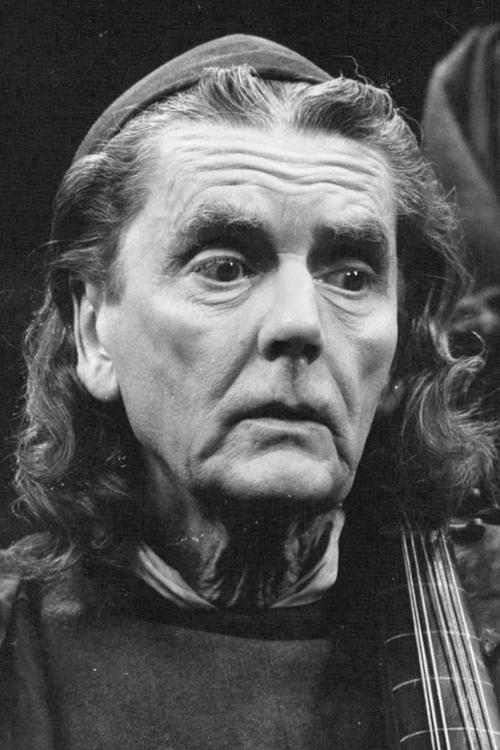
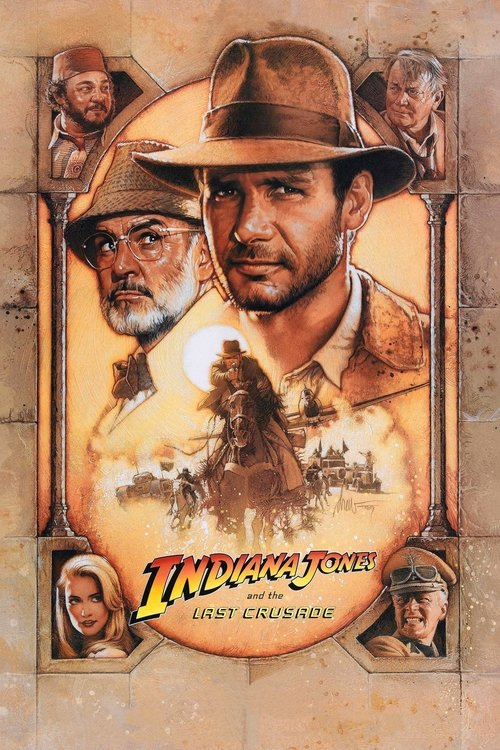
Robert Leadam Eddison, OBE (10 June 1908 – 14 December 1991) was a British actor, who despite his lengthy career as a classical stage actor, is probably most widely remembered in the role of the Grail Knight in Indiana Jones and the Last Crusade. He also played Merlin in the BBC television series The Legend of King Arthur, and the tragic ferryman in The Storyteller episode "The Luck Child".
Eddison was an award winning actor, known for his mellifluously resonant, baritone voice and long, lean 6 ft 3 in (1.91 m) figure. Throughout his 60-year career he was constantly in demand as an actor and worked with many of Britain's greatest stage actors, often during the early formative years of their careers, including Ian McKellen, Derek Jacobi and Maggie Smith.
Contents
Early life
Eddison was born in Yokohama, Japan, to Edwin Eddison and Hilda Muriel Leadham. He had a twin brother, Talbot Leadam Eddison, who later became a Rear Admiral in the Royal Navy and received the Distinguished Service Cross and The Most Honourable Order of the Bath. Another brother became a director of an engineering company, while the youngest brother was Roger Eddison.
From the age of five, Eddison knew that he wanted to be an actor. Both of his parents were members of the Yokohama Dramatic Club, where he often saw them both perform on stage. He recalls in his later memoir how "As they bent down to kiss me goodnight...the smell of the make-up and powder totally bewitched me. My father's make-up box had the same smell of spirit-gum and its effect on me was very potent".
His father was a civil engineer and died in 1917. Consequently, his mother decided to return to England with her four sons by way of British Columbia, Canada. It was here that Eddison along with his twin brother went to boarding school in Victoria for the next few years. After the Armistice in 1919, the family arrived back in England. Although his mother's family originally came from Leeds, she settled in Haywards Heath, Sussex.
Education
Eddison, aged 14, along with his three other brothers, were all educated at Charterhouse School. He was extremely disappointed to discover that there was no dramatic society, especially considering that its past alumni included such theatre luminaries as Johnston Forbes-Robertson, Cyril Maude, Richard Goolden and Max Beerbohm.
It was anticipated that he would follow in the footsteps of his maternal grandfather and paternal uncle and become a doctor, consequently yet uncertain, Eddison later studied at Trinity College, Cambridge where he read medicine. During his time there he developed his passion for acting and the theatre. He was a member of the ADC and of The Marlowe Society and from 1929 to 1930 served as President of the Cambridge Amateur Dramatics Club. As President, he later recalled how he shamefully blackballed Alastair Cooke due to "A very suspect Lancashire accent". During his time there he played Virginia alongside George Rylands in Coriolanus and as Beatrice opposite Michael Redgrave as Florindo in Goldoni's A Servant of Two Masters.
It was whilst at Cambridge that Eddison made his professional debut at the Festival Theatre, Cambridge in Lady Audley's Secret on 23 June 1930 opposite Flora Robson as Lady Audley. Eddison later said he viewed this as his first professional credit, however "In fact, I drew no salary, but a silver cigarette-case at the end of the ten weeks."
As a result of his passions evidently remaining elsewhere, Eddison later revealed that he "came down" without a degree, but "didn't think it mattered at all, but had my chosen profession failed me, I would probably not have felt in any way light-hearted."
Early career
In his early career, he spent a year at the Westminster Theatre, making his London debut in The Anatomist again with Flora Robson and Henry Ainley and directed by Tyrone Guthrie. He later spent a long period in weekly rep in Croydon. In 1934 he caught the attention of Ben Greet and until 1939 appeared in several productions, over the course of three seasons, at the Open Air Theatre, Regent's Park. He was seen and noted by Noël Coward whilst performing in a comedy titled Yes and No and later invited by Val Gielgud to appear in radio productions at the BBC.
During his varied career he played six seasons with the Old Vic. One of his first was taking over the roles of Le Beau and William from Alec Guinness with Edith Evans as Rosalind.
In 1938, and with war imminent, he "joined up" but soon temporarily postponed, in order to appear in as many plays as possible until he was truly needed. Consequently, in 1939, he was able to appear as Pericles and Oberon in Regent's Park. He was also free to accept an engagement from H.M. Tennent to appear alongside and in Noël Coward's This Happy Breed and his semi-autobiographical stage play Present Laughter in the part of Roland Maule. Eddison later recalled how "Sometimes in an actor's life there crops up a part that seems to be his own. Not often with me, but Roland Maule in 'Present Laughter' was one of them (and I think Noël meant it to be)". However the imminent productions were halted mid-rehearsal by the Second World War and to his regret he was not able to "create" Roland, this honour was given to James Donald. He did later appear in a revival in 1947, but in his own words "Some of the gilt was off the gingerbread." One of his last productions prior to leaving was Shakespeare's Romeo and Juliet in 1940, where he played Romeo opposite Pamela Brown's Juliet.
The war really exasperated him, as he had been due to appear in two sure-fire Coward hits in the West End, with a Broadway transfer expected. In 1940 he was called up to the Royal Navy, but officially became an enlisted man on 5 May 1941 and was trained at a naval establishment in Fareham, later moving barracks to Portsmouth. It was during a medical X-ray it was discovered that Eddison's heart was on the wrong side of his chest, but it was the view that if it had caused no trouble before that was no reason it should do now. He was drafted to HMS King George V at Rosyth. He soon rose through the ranks, being appointed a temporary sub-lieutenant in the Royal Naval Volunteer Reserve on 5 June 1942, and was sent to HMS King Alfred, which was a training depot for officers. As a result, he was now able to wear the uniform of an officer (he enjoyed the fact that it was tailor-made by Gieves). In 1943 he was promoted to temporary lieutenant and appointed to the aircraft carrier HMS Illustrious. Upon arriving on board he was greeted by another officer, Michael Hordern, who later also became an acclaimed actor. During his time there the ship was attacked by Kamikaze aircraft on Easter Day 1945. Eddison eventually spent three years aboard Illustrious, feeling very much "the man the Admiralty forgot" as appointments were usually only for two years.
Later career
In 1967 he was engaged to play The Player in Tom Stoppard's Rosencrantz and Guildenstern Are Dead in New York. The play opened in Washington, with Variety saying he was "superb", but after five performances he was replaced, an experience which left him feeling very wounded. "It seemed that the trouble was that I wasn't Graham Crowden" he would later remember.
In 1969, he developed a lifelong friendship with Ian McKellen whom he first met when they appeared in the since legendary double bill Prospect Theatre Company productions of Shakespeare's Richard II and Marlowe's Edward II, with McKellen playing both leading parts on alternate nights and Eddison playing Lightborn and the Duke of York respectively. Eddison won the 1970 Clarence Derwent Award for 'Best male in a supporting role' for his performance of Lightborn. He later recalled that "I was ashamed at how much I enjoyed playing Lightborn in Edward II (surely one of the best small parts in dramaturgy!)"
When being interviewed by McKellen's biographer he reminisced that "It was a wonderful time… At the Piccadilly Theatre there were always queues at the Box Office and the younger members of the cast got very excited and I thought, poor things, they have been deprived". Eddison loved being in the company and had "the greatest admiration and affection for Ian. The Duke of York was a dull part, really, but I loved playing it - and Richard Cottrell exercised his considerable persuasive powers [as director] on me to do this and Lightborn. I was quite happy to do that as I thought it was the only possible part for me - I couldn't really see myself as one of those Lancastrian barons."
In 1974, he was invited to join McKellen and Edward Petherbridge's democratically run Actor's Company. The aim of the Company, through majority decisions, meant that the collective company of actors would all choose the plays on a democratic basis and to alternate between leading and supporting parts. Eddison later stated "I was very touched when I was asked to join the company. I was so much older than all the others. But it was all the greatest fun, huge fun, though I did find the meetings endless and ghastly. I never knew what to say!"
During the season he played the title role in King Lear, a part he played to great acclaim. Upon being offered the part Eddison later remembered "I was very touched to be asked to play Lear. I had been to do a play at Colchester and on my return I found this note from the rest of the company offering me the part. I wept, amazingly, for I had always wanted to do the part."
Death
A lifelong smoker, and despite annually giving up smoking for Lent, Eddison died of bronchial pneumonia at a London hospital in 1991, aged 83.
Throughout his lengthy career, Eddison amassed an extensive personal collection of theatrical material. The collection included ceramics, architectural plans and drawings, and watercolours, prints, rare books and wax figures. The majority of the collection was built up following World War II, with acquisitions from well-known London dealers and from country outlets visited while on tour. It was regarded as "One of the finest collections of Georgian theatrical material in private hands, with a high proportion of the material being rare or unique and of national importance". Upon his death, the collection was later acquired by the Theatre Museum from the Executors of his estate as an acceptance in lieu of Inheritance Tax. His collection is now curated by the Victoria and Albert Museum.
He was later discovered to have written the beginnings of a memoir titled Majestic Service: An Autobiographical Memoir. The 22 pages were later published by the Society for Theatre Research in 1992.
Eddison was the great-uncle of the television presenter Dallas Campbell. Campbell later said "I remember sitting in the cinema as a ten-year-old in 1981 watching Harrison Ford in the first Indiana Jones film and immediately getting interested in archaeology. I was in my late teens when Uncle Bob was in the third film, The Last Crusade, and I was so proud of him. I remember going to the cinema and telling people he was my uncle, but nobody believed me."