Overview
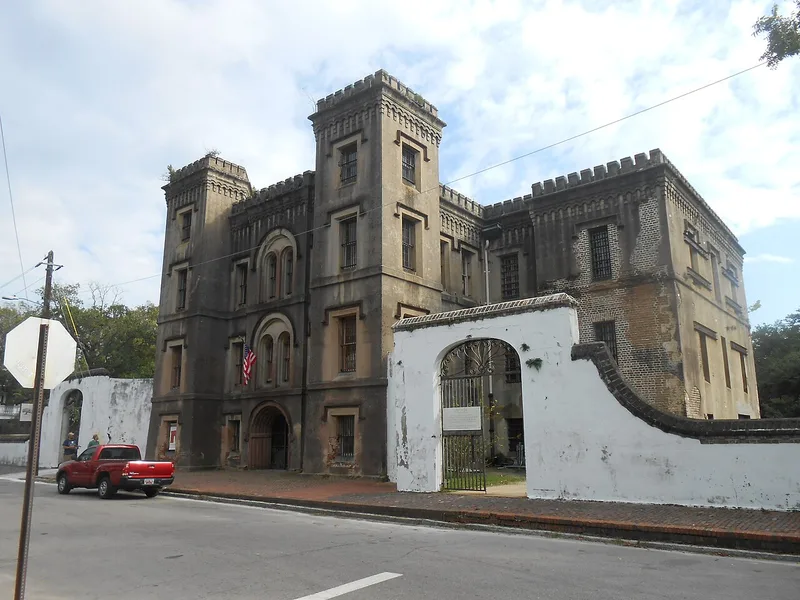
The Old Charleston Jail is a site of historical and architectural significance in Charleston, South Carolina. Operational between 1802 and 1939, it held many notable figures, among them Denmark Vesey, Union officers during the Civil War, high-seas pirates, and Lavinia Fisher. While it has become a popular tourist destination in recent years, it remains one of the most notable historic sites in Charleston that has not been the target of a comprehensive preservation and/or renovation effort. It is also commonly referred to as the Old City Jail by the people of Charleston, South Carolina.
History
The Old Charleston Jail was originally located on a four-acre parcel set aside for public use in 1680, at the time of Charleston's earliest settlement. Operating as the Charleston County Jail from 1802 until 1939, it housed Charleston's most infamous criminals, and Federal prisoners of war during the Civil War. When the Jail was constructed in 1802 it consisted of four stories, topped with a two-story octagonal tower. Charleston architects Barbot & Seyle were responsible for 1855 alterations to the building, including a rear octagonal wing, expansions to the main building and the Romanesque Revival details. This octagonal wing replaced a fireproof wing with individual cells, designed by Robert Mills in 1822, five years earlier than his notable Fireproof Building. The 1886 earthquake badly damaged the tower and top story of the main building, and these were subsequently removed.
The Old Jail housed a great variety of inmates. John and Lavinia Fisher, and other members of their gang, convicted of highway robbery in the Charleston Neck region were imprisoned here in 1819 to 1820. Some of the last 19th-century high-seas pirates were jailed here in 1822 while they awaited hanging. The Jail was active after the discovery of Denmark Vesey's planned slave revolt. Although the main trials were held elsewhere, four white men convicted of supporting the 1822 plot were imprisoned here. Tradition holds that Vesey spent his last days in the tower before being hanged, although no extant document indicates this. William Moultrie, General during the American Revolution and later Governor of South Carolina, allegedly spent a short time in debtor's prison at the Jail.
During the Civil War, Confederate and Federal prisoners of war were incarcerated here.
From Wikipedia (CC BY-SA 4.0).