




The National Baseball Hall of Fame and Museum is a history museum and hall of fame in Cooperstown, New York, operated by a private foundation. It serves as the central collection and gathering space for the history of baseball in the United States displaying baseball-related artifacts and exhibits, honoring those who have excelled in playing, managing, and serving the sport. The Hall's motto is "Preserving History, Honoring Excellence, Connecting Generations". Cooperstown is often used as shorthand (or a metonym) for the National Baseball Hall of Fame and Museum. The museum also established and manages the process for honorees into the Hall of Fame.
The Hall of Fame was established in 1939 by Stephen Carlton Clark, heir to the Singer Sewing Machine fortune. Clark sought to bring tourists to the village greatly decimated by the Great Depression, which reduced the local tourist trade, and Prohibition, which devastated the local hops industry. Clark constructed the Hall of Fame's building, which was dedicated on June 12, 1939. (His granddaughter, Jane Forbes Clark, is the current chairman of the board of directors.) The mythology that future Civil War hero Abner Doubleday invented baseball in Cooperstown in the 1830s was instrumental in the placement and early marketing of the Hall.
An expanded library and research facility opened in 1994. In 2002, the Hall launched Baseball as America, a traveling exhibit that toured ten American museums over six years. The Hall of Fame has since also sponsored educational programming on the Internet to bring the Hall of Fame to schoolchildren who might not visit. The Hall and Museum completed a series of renovations in spring 2005. The Hall of Fame also presents an annual exhibit at FanFest at the Major League Baseball All-Star Game.
Contents
Inductees
Among baseball fans, "Hall of Fame" means not only the museum and facility in Cooperstown, New York, but the pantheon of players, managers, umpires, executives, and pioneers who have been inducted into the Hall. The first five men elected were Ty Cobb, Babe Ruth, Honus Wagner, Christy Mathewson and Walter Johnson, chosen in 1936; roughly 20 more were selected before the entire group was inducted at the Hall's 1939 opening. As of January 2026, 354 people had been elected to the Hall of Fame, including 281 former professional players, 23 managers, 10 umpires, and 40 pioneers, executives, and organizers. 119 members of the Hall of Fame have been inducted posthumously, including four who died after their selection was announced. Of the 39 members primarily recognized for their contributions to Negro league baseball, 31 were inducted posthumously, including all 26 selected since the 1990s. The Hall of Fame includes one woman, baseball executive Effa Manley.
The newest members of the Hall of Fame as of January 20, 2026, are Carlos Beltrán, Andruw Jones, and Jeff Kent.
In 2019, former Yankees closer Mariano Rivera became the first player to be elected unanimously on the writers' ballot. Derek Jeter, Marvin Miller, Ted Simmons, and Larry Walker were to be inducted in 2020, but their induction ceremony was delayed by the COVID-19 pandemic until September 8, 2021. The ceremony was open to the public, as COVID restrictions had been lifted.
Selection process
Players are currently inducted into the Hall of Fame through election by either the Baseball Writers' Association of America (or BBWAA), or the Veterans Committee, which now consists of four subcommittees, each of which considers and votes for candidates from a separate era of baseball.
Five years after retirement, any player with 10 years of major league experience who passes a screening committee (which removes from consideration players of clearly lesser qualification) is eligible to be elected by BBWAA members with 10 years' membership or more who also have been actively covering MLB at any time in the 10 years preceding the election (the latter requirement was added for the 2016 election). From a final ballot typically including 25–40 candidates, each writer may vote for up to 10 players; until the late 1950s, voters were advised to cast votes for the maximum 10 candidates. Any player named on 75% or more of all ballots cast is elected. A player who is named on fewer than 5% of ballots is dropped from future elections. In some instances, the screening committee had restored their names to later ballots, but in the mid-1990s, dropped players were made permanently ineligible for Hall of Fame consideration, even by the Veterans Committee. A 2001 change in the election procedures restored the eligibility of these dropped players; while their names will not appear on future BBWAA ballots, they may be considered by the Veterans Committee. Players receiving 5% or more of the votes but fewer than 75% are reconsidered annually until a maximum of ten years of eligibility (lowered from fifteen years for the 2015 election).
Under special circumstances, certain players may be deemed eligible for induction even though they have not met all requirements. Addie Joss was elected in 1978, despite only playing nine seasons before he died of meningitis. Additionally, if an otherwise eligible player dies before his fifth year of retirement, then that player may be placed on the ballot at the first election at least six months after his death. Roberto Clemente set the precedent: the writers put him up for consideration after his death on New Year's Eve, 1972, and he was inducted in 1973.
The five-year waiting period was established in 1954 after an evolutionary process. In 1936 all players were eligible, including active ones. From the 1937 election until the 1945 election, there was no waiting period, so any retired player was eligible, but writers were discouraged from voting for current major leaguers. Since there was no formal rule preventing a writer from casting a ballot for an active player, the scribes did not always comply with the informal guideline; Joe DiMaggio received a vote in 1945, for example. From the 1946 election until the 1954 election, an official one-year waiting period was in effect. (DiMaggio, for example, retired after the 1951 season and was first eligible in the 1953 election.) The modern rule establishing a wait of five years was passed in 1954, although those who had already been eligible under the old rule were grandfathered into the ballot, thus permitting Joe DiMaggio to be elected within four years of his retirement.
Non-induction of banned players
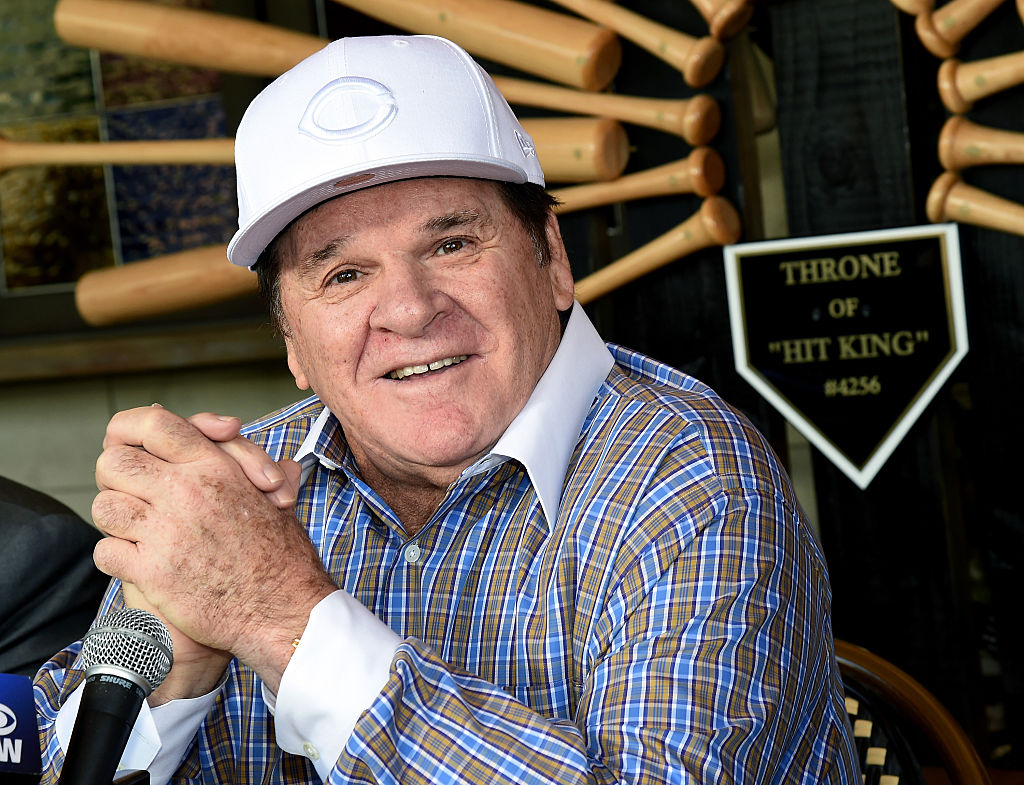
The selection rules for the Baseball Hall of Fame were modified to prevent the induction of anyone on Baseball's "permanently ineligible" list. Until they were removed from the list in 2025 the most prominent former players to be affected were Pete Rose and "Shoeless Joe" Jackson—many others have been barred from participation in MLB, but none have Hall of Fame qualifications on the level of Jackson or Rose. Jackson and Rose were both banned from MLB for life for actions related to gambling on games involving their own teams.
Jackson was determined to have cooperated with those who conspired to intentionally lose the 1919 World Series, and for accepting payment for losing, although his actual level of culpability is fiercely debated. The ensuing Black Sox Scandal led directly to baseball's Rule 21, prominently posted in every clubhouse locker room, which mandates permanent banishment from MLB for having a gambling interest of any sort on a game in which a player, manager or umpire is directly involved.
Rose voluntarily accepted a permanent spot on the ineligible list in return for MLB's promise to make no official finding in relation to alleged betting on the Cincinnati Reds when he was their manager in the 1980s. No credible evidence has ever emerged to support allegations that Rose bet against his team and/or that his betting influenced his managerial decisions, nevertheless, the betting constituted a clear violation of the aforementioned Rule 21. After years of denial, Rose admitted that he bet on the Reds in his 2004 autobiography My Prison Without Bars.
Before the ban was lifted in 2025, baseball fans were deeply split on the issue of whether Rose and/or Jackson (both deceased) should remain banned or have their punishments posthumously revoked. Writer Bill James, though he advocates Rose eventually making it into the Hall of Fame, compared the people who want to put Jackson in the Hall of Fame to "those women who show up at murder trials wanting to marry the cute murderer".
Changes to Veterans Committee process
The actions and composition of the Veterans Committee have been at times controversial, with occasional selections of contemporaries and teammates of the committee members over seemingly more worthy candidates.
In 2001, the Veterans Committee was reformed to comprise the living Hall of Fame members and other honorees. The revamped Committee held three elections, in 2003 and 2007, for both players and non-players, and in 2005 for players only. No individual was elected in that time, sparking criticism among some observers who expressed doubt whether the new Veterans Committee would ever elect a player. The Committee members, most of whom were Hall members, were accused of being reluctant to elect new candidates in the hope of heightening the value of their own selection. After no one was selected for the third consecutive election in 2007, Hall of Famer Mike Schmidt noted, "The same thing happens every year. The current members want to preserve the prestige as much as possible, and are unwilling to open the doors." In 2007, the committee and its selection processes were again reorganized; the main committee then included all living members of the Hall, and voted on a reduced number of candidates from among players whose careers began in 1943 or later. Separate committees, including sportswriters and broadcasters, would select umpires, managers and executives, as well as players from earlier eras.
In the first election to be held under the 2007 revisions, two managers and three executives were elected in December 2007 as part of the 2008 election process. The next Veterans Committee elections for players were held in December 2008 as part of the 2009 election process; the main committee did not select a player, while the panel for pre–World War II players elected Joe Gordon in its first and ultimately only vote. The main committee voted as part of the election process for inductions in odd-numbered years, while the pre-World War II panel would vote every five years, and the panel for umpires, managers, and executives voted as part of the election process for inductions in even-numbered years.
Further changes to the Veterans Committee process were announced by the Hall in July 2010, July 2016, and April 2022.
Per the latest changes, announced on April 22, 2022, the multiple eras previously utilized were collapsed to three, to be voted on in an annual rotation (one per year):
Players and managers with multiple teams
While the text on a player's or manager's plaque lists all teams for which the inductee was a member in that specific role, inductees are usually depicted wearing the cap of a specific team, though in a few cases, like umpires, they wear caps without logos. (Executives are not depicted wearing caps.) Additionally, as of 2015, inductee biographies on the Hall's website for all players and managers, and executives who were associated with specific teams, list a "primary team", which does not necessarily match the cap logo. The Hall selects the logo "based on where that player makes his most indelible mark."
Although the Hall always made the final decision on which logo was shown, until 2001 the Hall deferred to the wishes of players or managers whose careers were linked with multiple teams. Some examples of inductees associated with multiple teams are the following:
Frank Robinson: Robinson chose to have the Baltimore Orioles cap displayed on his plaque, although he had played ten seasons with the Cincinnati Reds and six seasons with Baltimore. Robinson won four pennants and two World Series with the Orioles and one pennant with Cincinnati. His second World Series ring came in the 1970 World Series against the Reds. Robinson also won an MVP award while playing for each team.
Catfish Hunter: Hunter chose not to have any logo on his cap when elected to the Hall of Fame in 1987. Hunter had success for both teams for which he played – the Kansas City/Oakland Athletics (his first ten seasons) and the New York Yankees (his final five seasons). Furthermore, both during and after his career he maintained good relations with both teams and their respective owners (Charles Finley and George Steinbrenner), and did not wish to slight either team by selecting the other.
Nolan Ryan: Born and raised in Texas, Ryan entered the Hall in 1999 wearing a Texas Rangers cap on his plaque, although he spent only five seasons with the Rangers, while raised in the Houston area and having longer and more successful tenures with the Houston Astros (nine seasons, 1980–88 and his record-setting fifth career no-hitter) and California Angels (eight seasons, 1972–79 and the first four of his seven career no-hitters). Ryan's only championship was as a member of the New York Mets in 1969. Ryan finished his career with the Rangers, reaching his 5,000th strikeout and 300th win, and throwing the last two of his no-hitters. He had personally chosen the Rangers due to these figures as well as because Texas encompasses the city of Houston, thereby representing both teams. Despite this, his biography on the Hall's website lists his primary team as the Angels. Ryan later took ownership of the Rangers when they were sold to his Rangers Baseball Express group in 2010. He sold his Rangers interest in 2013. From 2014 to 2019, Nolan was in the Astros' front office as a special assistant. In 2020 Ryan discontinued his executive role with the Astros. The minor-league team in which he has an ownership interest, the Round Rock Express of Round Rock, Texas outside of Austin, will be the AAA franchise of the Texas Rangers.
The museum
Sam Crane (who had played a decade in 19th century baseball before becoming a manager and sportswriter) had first approached the idea of making a memorial to the great players of the past in what was believed to have been the birthplace of baseball: Cooperstown, New York, but the idea did not muster much momentum until after his death in 1925. In 1934, the idea for establishing a Baseball Hall of Fame and Museum was devised by several individuals, such as Ford C. Frick (president of the National League) and Alexander Cleland, a Scottish immigrant who decided to serve as the first executive secretary for the Museum for the next seven years that worked with the interests of the Village and Major League Baseball. Stephen Carlton Clark (a Cooperstown native) paid for the construction of the museum, which was planned to open in 1939 to mark the "Centennial of Baseball", which included renovations to Doubleday Field. William Beattie served as the first curator of the museum.
According to the Hall of Fame, approximately 260,000 visitors enter the museum each year, and the running total has surpassed 17 million. These visitors see only a fraction of its 40,000 artifacts, 3 million library items (such as newspaper clippings and photos) and 140,000 baseball cards.
The Hall has seen a noticeable decrease in attendance since the mid-2010s. A 2013 story on ESPN.com about the village of Cooperstown and its relation to the game partially linked the reduced attendance with Cooperstown Dreams Park, a youth baseball complex about 5 miles (8.0 km) away in the town of Hartwick. The 22 fields at Dreams Park currently draw 17,000 players each summer for a week of intensive play; while the complex includes housing for the players, their parents and grandparents must stay elsewhere. According to the story,
Prior to Dreams Park, a room might be filled for a week by several sets of tourists. Now, that room will be taken by just one family for the week, and that family may only go into Cooperstown and the Hall of Fame once. While there are other contributing factors (the recession and high gas prices among them), the Hall's attendance has tumbled since Dreams Park opened. The Hall drew 383,000 visitors in 1999. It drew 262,000 last year.
First floor
Baseball at the Movies houses baseball movie memorabilia while a screen shows footage from those movies.
The Bullpen Theater is the site of daily programming at the museum (trivia games, book discussions, etc.) and is decorated with pictures of famous relief pitchers.
Inductee Row features images of Hall of Famers inducted from 1937 to 1939.
The Perez-Steele Art Gallery features art of all media related to baseball. Dick Perez served as an artist for various projects at the National Baseball Hall of Fame and Museum for 20 years, starting in 1981
The Plaque Gallery, the most recognizable site at the museum, contains induction plaques of all members. Since 2016, sculptor Tom Tsuchiya has been creating the bas-relief likeness plaques due to a commission from Matthews International.
The Sandlot Kids Clubhouse has various interactive displays for young children.
A theater area continually plays the popular Abbott and Costello routine "Who's on First?"
Scribes and Mikemen honors BBWAA Career Excellence Award and Ford C. Frick Award winners with a photo display and has artifacts related to baseball writing and broadcasting. Floor-to-ceiling windows at the Scribes and Mikemen exhibit face an outdoor courtyard with statues of Johnny Podres and Roy Campanella (representing the Brooklyn Dodgers 1955 championship team), and an unnamed All-American Girls Professional Baseball League player. A Satchel Paige statue was unveiled and dedicated during the 2006 Induction Weekend.
An Education Gallery hosts school groups and, in the summer, presentations about artifacts from the museum's collection.
Second floor
The Grandstand Theater features a 12-minute multimedia film. The 200-seat theater, complete with replica stadium seats, is decorated to resemble old Comiskey Park.
The Game is the major feature of the second floor. It is where the most artifacts are displayed. The Game is set up in a timeline format, starting with baseball's beginnings and culminating with the game we know today. There are several offshoots of this meandering timeline:
Taking The Field (19th century baseball)
Babe Ruth: His Life and Legend
The Souls of the Game: Voices of Black Baseball (the Museum's newest permanent exhibit documenting pre-Negro leagues history through the present day)
Diamond Dreams (women in baseball)
¡Viva Baseball! (a bilingual exhibit, in English and Spanish, that celebrates baseball in Latin America)
Whole New Ballgame opened in 2015 and is located in the Janetschek Gallery. This exhibit completes the timeline of baseball through the last 45 years into the game we know today. It features environmental video walls and new interactive elements to go along with artifacts from the Museum's collection.
The Today's Game exhibit holds objects donated to the Hall of Fame from the past year or two.
Third floor
Autumn Glory is devoted to post-season baseball and has, among other artifacts, a case of World Series rings from the 1900s to present.
Hank Aaron: Chasing the Dream
One for the Books tells the story of baseball's most cherished records through more than 200 artifacts. The exhibit allows fans to search records dating back through baseball history via an interactive Top Ten Tower while giving visitors a look at exciting moments throughout the years via a multimedia wall.
BBWAA awards: Replicas of various awards distributed by the BBWAA at the end of each season, along with a list of past winners.
A case dedicated to Ichiro Suzuki setting the major league record for base hits in a single season, with 262 in 2004, after George Sisler had held the record for 84 years with 257.
An inductee database touch-screen computer with statistics for every inductee.
Programs from every World Series.
Sacred Ground is devoted entirely to ballparks and everything about them, especially the fan experience and the business of a ballpark. The centerpiece is a computer tour of three former ballparks: Boston's South End Grounds, Chicago's Comiskey Park, and Brooklyn's Ebbets Field.
The Your Team Today exhibit is built like a baseball clubhouse, with 30 glass-enclosed locker stalls, one for each Major League franchise. In each stall there is a jersey and other items from the designated big league team, along with a brief team history.
Notable events
1982 unauthorized sales
A controversy erupted in 1982, when it emerged that some historic items given to the Hall had been sold on the collectibles market. The items had been lent to the Baseball Commissioner's office, gotten mixed up with other property owned by the Commissioner's office and employees of the office, and moved to the garage of Joe Reichler, an assistant to Commissioner Bowie Kuhn, who sold the items to resolve his personal financial difficulties. Under pressure from the New York Attorney General, the Commissioner's Office made reparations, but the negative publicity damaged the Hall of Fame's reputation, and made it more difficult for it to solicit donations.
2014 commemorative coins
In 2012, Congress passed and President Barack Obama signed a law ordering the United States Mint to produce and sell commemorative, non-circulating coins to benefit the private, non-profit Hall. The bill, H.R. 2527, was introduced in the United States House of Representatives by Rep. Richard Hanna, a Republican from New York, and passed the House on October 26, 2011. The coins, which depict baseball gloves and balls, are the first concave designs produced by the Mint. The mintage included 50,000 gold coins, 400,000 silver coins, and 750,000 clad (nickel-copper) coins. The Mint released them on March 27, 2014, and the gold and silver editions quickly sold out. The Hall receives money from surcharges included in the sale price: a total of $9.5 million if all the coins are sold.