Recent filmmaking career
Michael Arias' recent career has been focused primarily on directing.
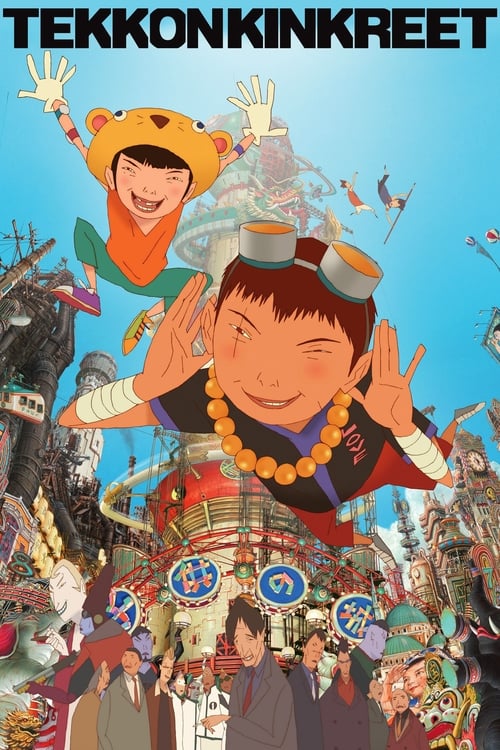
In 2003, while working on The Animatrix, Arias picked up Tekkonkinkreet again. Armed with an English-language screenplay penned by screenwriter Anthony Weintraub, and encouraged by mentor Morimoto, Arias moved forward with plans to revive Tekkon at Studio 4°C, with Animatrix collaborator and 4 °C president Eiko Tanaka producing and Arias directing.
The film was completed in August 2006 and premiered at the Tokyo International Film Festival soon thereafter.
Museum of Modern Art (MoMA) curator Barbara London named Tekkonkinkreet "Best Film of 2006" in her Art Forum roundup, and subsequently arranged for the film's North American premiere to be held at MoMA.
With his adaptation of Tekkonkinkreet, Arias, with Production Designer Shinji Kimura, had re-imagined the manga's Treasure Town as a chaotic pan-Asian hybrid, part Hong Kong, part Bombay, with futuristic and industrial elements densely layered over a foundation that borrowed much from images of Shōwa-era Tokyo. New York Times critic Manohla Dargis, in her review of Tekkonkinkreet, describes Treasure Town as "a surreal explosion of skewed angles, leaning towers, hanging wires, narrow alleys and gaudily cute flourishes that bring to mind a yakuza cityscape by way of a Hello Kitty theme park." Indeed, Tekkon's sumptuous art direction was widely praised, with Production Designer Kimura receiving the Best Art Direction award at the 2008 Tokyo International Anime Fair. Tekkon was further lauded, not only for Arias' innovative use of computer graphics techniques and seamless integration of digital and traditional animation, but also for the film's handmade, documentary-style approach to storytelling. After an early Tekkon screening at the Los Angeles Asian Pacific Film Festival, filmjourney.org editor Doug Cummings elaborated:
Arias' angles and compositions are uniformally [sic] inventive and striking, and most impressively, he incorporates a bevy of live action camera techniques: handheld framing, long tracking shots through corridors, rack focusing and shifting depths of field–that generate considerable immediacy and environmental realism (despite the obvious hand-drawn artifice). More than simple technological advances, these elements have long been untapped by feature animation due to their inability to be storyboarded – they're traditional luxuries of live action spontaneity. For all the accolades bestowed upon Alfonso Cuarón's digitally-composited tracking shots in Children of Men, Arias' techniques here are arguably greater achievements.
Though Tekkonkinkreet was considered a hit locally and generally well-received by critics and audiences worldwide (particularly in France, where author Taiyō Matsumoto's work is well known among manga readers), North American anime fans questioned Arias' filmmaking credentials and criticized his decidedly non-purist approach to adapting manga to anime (including his decision to work from Anthony Weintraub's English-language screenplay rather than a Japanese text). Online animation forum Animation Insider pointedly asked, "What in the hell does Michael Arias think he's doing?"
In defense of Weintraub's screenplay, Arias explained to readers of AniPages Daily, "He really got it right – the story of Treasure Town, the sense of doom, the action in Kiddie Kastle all fit together very seamlessly." Regarding Tekkonkinkreet's evident subversion of (so-called) traditional animation conventions, he added, "I wanted to do things differently.... Ōtomo once said to me and [chief animation director] Nishimi, 'if you're not doing things differently you shouldn't even bother'."
In the final analysis, Tekkonkinkreet remains a milestone in Japanese animation. It was awarded Japan's prestigious Ōfuji Noburō Award at home, and continued on to compete for two awards at the 57th Berlin International Film Festival and later win the 2008 Japan Academy Prize for Animation of the Year. The Guardian listed Tekkonkinkreet third in its roundup of the ten most underrated movies of the decade.
Summer 2007 was marked by the formalization of the long-standing relationship between Arias and the Japanese film distribution and production company Asmik Ace Entertainment. Arias is the first to join the roster of Asmik's artist management division.
Shortly after finishing publicity for Tekkonkinkreet, Arias began work writing and directing Hide and Seek (おっかけっこ, Okkakekko), one of fifteen 1-minute animated shorts comprising the NHK animation anthology Ani-kuri (アニクリ, Ani-kuri). Individual segments were streamed from the official Ani*Kuri15 website, and broadcast piecemeal starting in May 2007.
Arias created the film at Studio4°C, calling on animation prodigy Takayuki Hamada (one of Tekkon's lead animators) to design and animate characters. Other contributors to Arias' Ani*Kuri short include colorist Miyuki Itō, CG director Takuma Sakamoto, British electronic music composers Plaid, and Sound designer Mitch Osias, all Tekkonkinkreet alumni. Tekkon chief animation director Shōjirō Nishimi and production designer Shinji Kimura each directed his own Ani*Kuri segment, and other directors included Satoshi Kon, Mamoru Oshii, and Mahiro Maeda.
The entire collection of fifteen Anikuri shorts has since been released as a DVD-book set, featuring production detail, creator interviews, and storyboard and background artwork.
In 2007 Arias began work on Heaven's Door, a Japanese live-action feature film loosely based on the German hit Knockin' on Heaven's Door directed by Thomas Jahn and written by Jahn and actor Til Schweiger. Arias' adaptation features J-Pop heartthrob Tomoya Nagase and ingenue Mayuko Fukuda as unlikely comrades who flee the hospital where they first meet, and embark on a road-trip to reach the ocean and watch the sun set there in the short time they have left.
Heaven's Door marks the return of Arias' Tekkonkinkreet collaborators Min Tanaka (the voice of Tekkonkinkreet's "Suzuki"), composers Plaid, and Sound Designer Mitch Osias.
Heaven's Door was released in Japanese theaters on February 7, 2009, to mixed press and lukewarm box office, but was praised for its cast, music, cinematography, and sound design. Screen International correspondent Jason Gray concludes, "I think younger audiences will find the tragedy of Heaven´s Door palpable.... For someone like me who devoured American cinema of the early 70s, tearing up at films like Thunderbolt and Lightfoot, I might not be the best judge. Who knows, Heaven's Door may become the new Léon for the teen set here and regarded as a minor indie classic overseas."
On June 23, 2009, Japanese pay-per-view broadcaster WOWOW announced the upcoming on-air premiere of Arias' surreal short film Hope, featuring popular actress Juri Ueno as a struggling animator trapped overnight in an elevator.
Hope was penned by Arisa Kaneko, shot by Heaven's Door DP Takashi Komatsu, J.S.C., and features original score by Plaid and sound design by Mitch Osias.
The animation studio interiors were shot on location at Tokyo's Madhouse studios, while veteran production designer (and frequent Sōgo Ishii collaborator) Toshihiro Isomi created a rotating set for Miyuki's elevator on a Yokohama soundstage.
On November 27, 2014, Japanese broadcaster Fuji Television made public Arias' co-directing (with Takashi Nakamura) the feature-film adaptation of the late Project Itoh's dystopian sci-fi novel Harmony, recipient of a Philip K. Dick Award Special Citation in 2010. At the time of Fuji Television's statement, production was ongoing at Studio 4°C with the film slated for a 2015 theatrical release. Harmony was released in Japan on November 13, 2015, and internationally in the Spring of 2016. The film was praised for its innovative visuals and novel mixture of science fiction action and philosophical rumination, but at the same time criticized for its profusion of cerebral digressions.
In May 2018 Nippon Television announced a live-action television series adaptation of Keigo Shinzō's manga Tokyo Alien Bros., co-directed by Michael Arias and veteran dorama director Shintaro Sugawara and written by Shō Kataoka. NTV broadcast the series weekly beginning on July 23, 2018, and ending with the tenth and final episode on September 24, 2018. For director Arias Tokyo Alien Bros. marked both a return to live-action filmmaking and a reunion with frequent collaborators Plaid and director of photography Takashi Komatsu.