




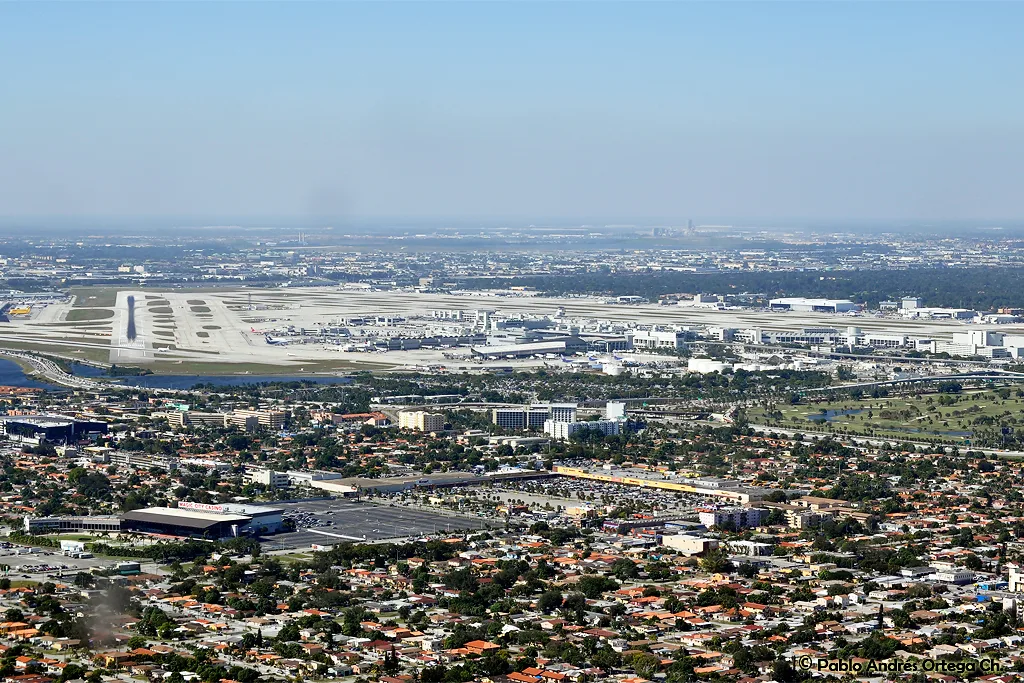

Miami International Airport (IATA: MIA, ICAO: KMIA, FAA LID: MIA), also known as MIA and historically as Wilcox Field, is the primary international airport serving Miami and its surrounding metropolitan area, in the U.S. state of Florida. It hosts over 1,000 daily flights to 195 domestic and international destinations, including most countries in Central and South America and the Caribbean. The airport is in an unincorporated area in Miami-Dade County, Florida, It is located approximately 6 miles (9.7 km) west-northwest of downtown Miami, adjacent to the cities of Miami and Miami Springs, and the village of Virginia Gardens. Nearby cities include Hialeah, Doral, and the census-designated place of Fontainebleau.
In 2021, Miami International Airport became the busiest international cargo airport in the U.S. and the busiest U.S. gateway for international passengers, surpassing John F. Kennedy International Airport in New York City. As of 2021, it is the 10th busiest airport in the U.S. with 17,500,096 passengers for the year. It is Florida's busiest airport by total aircraft operations and total cargo traffic. The airport is American Airlines' third-largest hub and serves as its primary gateway to Latin America and the Caribbean. Miami also serves as a focus city for Avianca, Frontier Airlines, and LATAM, both for passengers and cargo operations.
In 2024, MIA Airport served nearly 56 million passengers and saw 3 million tons of cargo passing through MIA, recording three consecutive record years for passenger volume and five straight years of cargo volume.
Miami International Airport covers 3,300 acres (1,300 ha). It is South Florida's main airport for long-haul international flights and a hub for the Southeastern United States with passenger and cargo flights to cities throughout the Americas, Europe, Africa, and Asia. It is the largest gateway between the U.S. and Central, South America and the Caribbean and one of the largest airline hubs in the nation.
Contents
History
In June 1928, Pan American Airways acquired 116 acres of land on NW 36th Street for the purpose of building a privately owned and operated international airport in Miami, Florida. The establishment of a commercial airport and of regularly scheduled international passenger airline service by Pan Am was a transformative event for the City of Miami. By September 1928, Pan Am had begun to operate regularly scheduled Air Mail service between Miami and Havana. On January 9, 1929, Pan American Airport, also known as Pan American Field, was officially dedicated at a ceremony that included the inauguration of a newly expanded route system to Nassau, Santiago (Cuba), Haiti, the Dominican Republic and San Juan, Puerto Rico. The ceremony was attended by thousands of residents, government officials, and aviation celebrities, who saw in the new airport the promise of a bright new future in international aviation for Miami. It was the first mainland airport in the United States to have international port of entry facilities. The passenger terminal building, designed by Delano & Aldrich of New York City, was the most advanced and luxurious in the country. Three hangars, two on the east and one on the west, provided housing and maintenance facilities for Pan Am's fleet of Sikorsky amphibian and Fokker aircraft.
During the first two years of its operation, it was from this busy airport that Pan American Airways pioneered U.S. international passenger aviation. By the end of 1930, for the first time in history, Pan Am had succeeded in establishing regularly scheduled Air Mail and passenger airline service from the U.S. to the West Indies, Caribbean, and Central and South America.
On April 1, 1930, a collaboration between Pan American and Eastern Air Transport (later to become known as Eastern Air Lines) was begun after Pan American Airport at NW 36th Street was designated as the first international field Post Office in the country. The announcement followed almost a year’s worth of efforts by the U.S. postal service to effect greater efficiencies in U.S. Air Mail delivery by coordinating the schedules of airlines involved in operating international and domestic Air Mail routes with railway connections to cities not served by airports.
On January 1, 1931, Eastern Air Transport inaugurated regularly scheduled passenger service from Miami to New York from Pan Am’s NW 36th Street Airport. It was another historic event, a collaboration between the two airlines that made Miami the clearing point for a coordinated airline passenger system that extended from as far north as Canada to the tip of South America. No other U.S. city could boast such a distinction.
American Airlines hub
Amid Eastern's turmoil, American Airlines CEO Robert Crandall sought a new hub in order to utilize new aircraft which AA had on order. AA studies indicated that Delta Air Lines would provide strong competition on most routes from Eastern's hub at Hartsfield–Jackson Atlanta International Airport in Atlanta, but that MIA had many key routes only served by Eastern. American Airlines announced that it would establish a base at MIA in August 1988. Lorenzo considered selling Eastern's profitable Latin America routes to AA as part of a Chapter 11 reorganization of Eastern in early 1989 but backed out in a last-ditch effort to rebuild the MIA hub. The effort quickly proved futile, and American Airlines purchased the routes (including the route authority between Miami and London then held by Eastern sister company Continental Airlines) in a liquidation of Eastern which was completed in 1990. Later in the 1990s, American transferred more employees and equipment to MIA from its failed domestic hubs at Nashville, Tennessee, and Raleigh–Durham, North Carolina. The hub grew from 34 daily departures in 1989 to 157 in 1990, 190 in 1992, and a peak of 301 in 1995, including long-haul flights to Europe and South America. Today Miami is American's largest air freight hub and is the main connecting point in the airline's north–south international route network.
In December 1992, South African Airways launched flights to Johannesburg via Cape Town using a Boeing 747. The company's codeshare agreement with American Airlines supported the route. The carrier later decided to codeshare with Delta Air Lines instead, which operated a hub in Atlanta. Consequently, South African replaced its Miami service with a flight to Atlanta in January 2000.
Concourse A was built on the northeast side of the terminal in 1995, and Concourse H was rebuilt in 1997. Concourse J was built in August 2007 along with an expansion of the terminal on the south side.
American began the development of the current North Terminal in the 1990s. Concourses B and C were demolished as part of the project with Concourse A becoming the eastern end of the expanded Concourse D. Although the terminal was originally scheduled to be completed in 2004, numerous delays arose in the construction process, and Miami-Dade County took over control of the project in 2005, at which time the project had a budget of $2.85 billion. The terminal was ultimately completed in 2011 and included Skytrain, an automated people mover system, as well as a wing for American Eagle commuter flights.
Other hub operations
Pan Am was acquired by Delta Air Lines in 1991, but filed for bankruptcy shortly thereafter. Its remaining international routes from Miami to Europe and Latin America were sold to United Airlines for $135 million as part of Pan Am's emergency liquidation that December. United's Latin American hub offered 24 daily departures in the summer of 1992, growing to 36 daily departures to 21 destinations in the summer of 1994, but returned to 24 daily departures in the summer of 1995 and never expanded further. United ended flights from Miami to South America, and shut down its Miami crew base, in May 2004, reallocating most Miami resources to its main hub in O'Hare International Airport in Chicago. United ceased all mainline service to Miami in 2005 with the introduction of its low-cost product Ted.
Iberia also established a Miami hub in 1992, positioning a fleet of DC-9 aircraft at MIA to serve destinations in Central America and the Caribbean. The hub took advantage of rights granted under the 1991 bilateral aviation agreement between the United States and Spain. During the 1990s, the airport had sterile international-to-international transit facilities in Concourse D (American, British, and Alitalia) and Concourse F (Iberia and four Central American carriers), and there were plans to establish a sterile corridor for international connecting passengers between six concourses. However, the September 11, 2001, attacks made it necessary for many foreigners to obtain a visa in order to transit the United States, and as a result, Iberia closed its hub in 2004, around the same time as United.
Future
MIA is projected to process 77 million passengers and 4 million tons of freight annually by 2040. To meet such a demand, the Miami-Dade Board of County Commissioners approved a $5 billion improvement plan to take place over 15 years, concluding in 2035. The comprehensive plan includes concourse optimization, construction of two on-site luxury hotels, the demolition of Concourse G, and expansion of the airport's cargo capacity.
Facilities
Terminals
Miami International Airport contains three terminals (North, Central, and South) and six concourses for a total of 131 gates. With the exception of Concourse G, all concourses contain gates to access U.S. Customs and Border Protection facilities.
Concourse D contains 51 gates. Opened in 1959 as Concourse 5. Combined with the former Concourse A and newly built gates on the sites of former Concourses B & C as part of the North Terminal Development Program, with construction completed in March 2013.
Concourse E contains 18 gates. Opened in 1959 as Concourse 4 and rebuilt in the 1980s. The satellite terminal opened in 1977.
Concourse F contains 19 gates. Opened in 1959 as Concourse 3 and rebuilt in the 1980s.
Concourse G contains 14 gates. Opened in 1959 as Concourse 2.
Concourse H contains 13 gates. Opened in 1961 as Concourse 1. Partially rebuilt in the late 1990s with construction completed in March 1998
Concourse J contains 15 gates. Opened in August 2007.
American operates three Admirals Clubs and one Flagship Lounge across Concourses D & E. Numerous other lounges exist across the airport as well, including an American Express Centurion Lounge located in Concourse D. The North Terminal (Concourse D) is for the exclusive use of American Airlines. The Central Terminal (Concourses E, F, and G) has varied uses; Concourse E is mainly used by American and its Oneworld partner airlines along with some Caribbean and Latin American airlines, and E's satellite terminal has a gate that can accommodate an Airbus A380. Concourses F and G are used by non-AA domestic and Canadian carriers and flights. The South Terminal (Concourses H and J) is the main non-Oneworld international terminal. Concourse H is largely used by Delta and non-Oneworld international carriers that send narrowbody planes largely from Central and the northern parts of South America, and some widebody flights; and Concourse J is used by most non-Oneworld international carriers that send widebody planes and is the main terminal at MIA for non-Oneworld transcontinental flights. Concourse J also has one gate that can accommodate an A380.
Ground transportation
Miami International Airport offers the MIA Mover, a free people mover system to transfer passengers between MIA terminals and the Miami Intermodal Center (MIC) that opened to the public on September 9, 2011. The MIC provides direct access from the airport to ground transportation (shuttle/bus/rail) as well as the Rental Car Center. A Metrorail station opened at the MIC on July 28, 2012; a Tri-Rail station followed on April 5, 2015. Plans for Amtrak to operate a station at the MIC were cancelled when it was discovered that the platform built for the service was too short for Amtrak trains. The platform now sits empty and closed, with no trains stopping at it.
The rental car center consolidates airport car rental operations at the MIC.
Miami International Airport has direct public transit service to Miami-Dade Transit's Metrorail and Metrobus networks; Greyhound Bus Lines and to the Tri-Rail commuter rail system. Metrorail operates the Orange Line train from Miami International Airport to destinations such as Downtown, Brickell, Health District, Coconut Grove, Coral Gables, Dadeland, Hialeah, South Miami, and Wynwood. It takes approximately 15 minutes to get from the airport to Downtown.
Miami-Dade Transit operates an Airport Flyer bus that connects MIA directly to South Beach.
MIA is served directly by Tri-Rail, Miami's commuter rail system. The station opened on April 5, 2015. Tri-Rail connects MIA to northern Miami-Dade, Broward, and Palm Beach counties. Tri-Rail directly serves points north such as Boca Raton, Deerfield Beach, Delray Beach, Fort Lauderdale, Hollywood, Pompano Beach and West Palm Beach.
Cargo yard
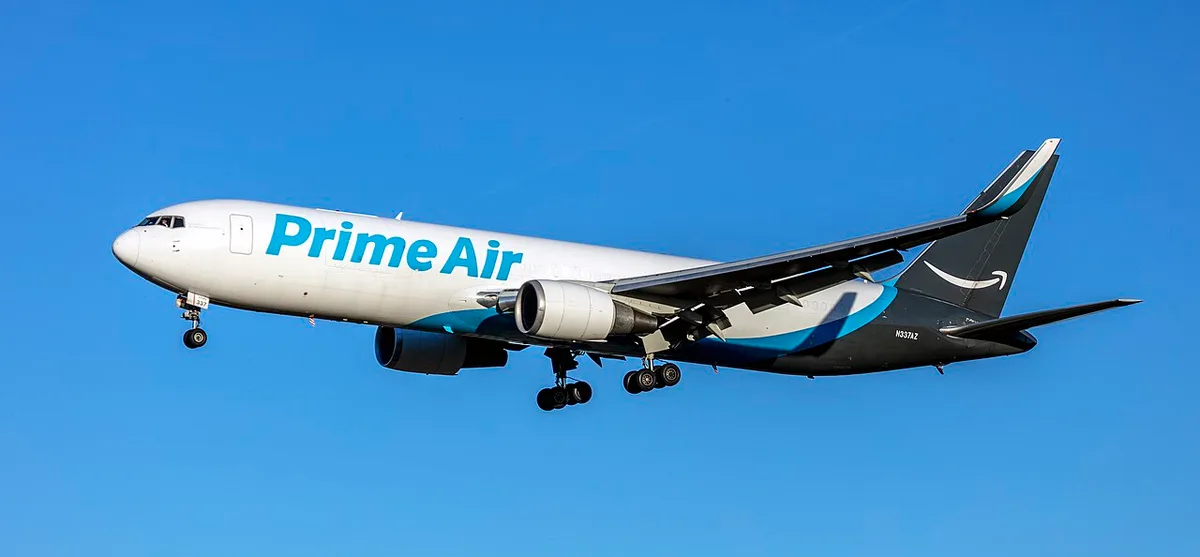
MIA has a number of air cargo facilities. The largest cargo complex is located on the west side of the airport, inside the triangle formed by Runways 12/30 and 9/27. Cargo carriers such as LATAM Cargo, Atlas Air, Amerijet International, and DHL operate from this area. The largest privately owned facility is the Centurion Cargo complex in the northeast corner of the airport, with over 51,000 m2 (550,000 sq ft) of warehouse space. FedEx and UPS operate their own facilities in the northwest corner of the airport, off of 36th Street. In addition to its large passenger terminal in Concourse D, American Airlines operates a maintenance base to the east of Concourse D, centered around a semicircular hangar originally used by National Airlines which can accommodate three widebody aircraft.
Airlines and destinations
Statistics
Accidents and incidents
On January 22, 1952, an Aerodex Lockheed Model 18 Lodestar on a test flight crashed after takeoff due to engine failure; all 5 occupants were killed.
On August 4, 1952, a Curtiss C-46 Commando on a ferry flight crashed on approach to MIA because of the failure of the elevator control system; all 4 occupants died.
On March 25, 1958, Braniff International Airways Flight 971, a Douglas DC-7 crashed 5 km (3.1 mi) WNW of MIA after attempting to return to the airport because of an engine fire crashing into an open marsh; 9 passengers out of 24 on board were killed.
On October 2, 1959, a Vickers Viscount of Cubana de Aviación was hijacked on a flight from Havana to Antonio Maceo Airport, Santiago by three men demanding to be taken to the United States. The aircraft landed at Miami International Airport.
On February 12, 1963, Northwest Airlines Flight 705, a Boeing 720, crashed into the Everglades while en route from Miami to Portland, Oregon, via Chicago O'Hare, Spokane, and Seattle. All 43 passengers and crew died.
On February 13, 1965, an Aerolíneas de El Salvador (AESA) Curtiss C-46 Commando, a cargo flight, had an engine failure shortly after takeoff and crashed into an automobile junkyard, killing both occupants.
On March 5, 1965, a Fruehaf Inc. Lockheed Model 18 Lodestar nosed down after takeoff due to elevator trim tab problems, and both occupants were killed.
On June 23, 1969, a Dominicana de Aviación Aviation Traders Carvair, a modified DC-4, en route to Santo Domingo was circling back to Miami International Airport with an engine fire when it crashed into buildings 1 mile (1.6 km) short of Runway 27. All 4 crewmembers aboard the Carvair and 6 on the ground were killed.
On April 14, 1970, an Ecuatoriana de Aviacion Douglas DC-7, a cargo flight, crashed after takeoff from MIA beyond the runway and slid 890 feet (270 m) before striking a concrete abutment; both occupants were killed.