




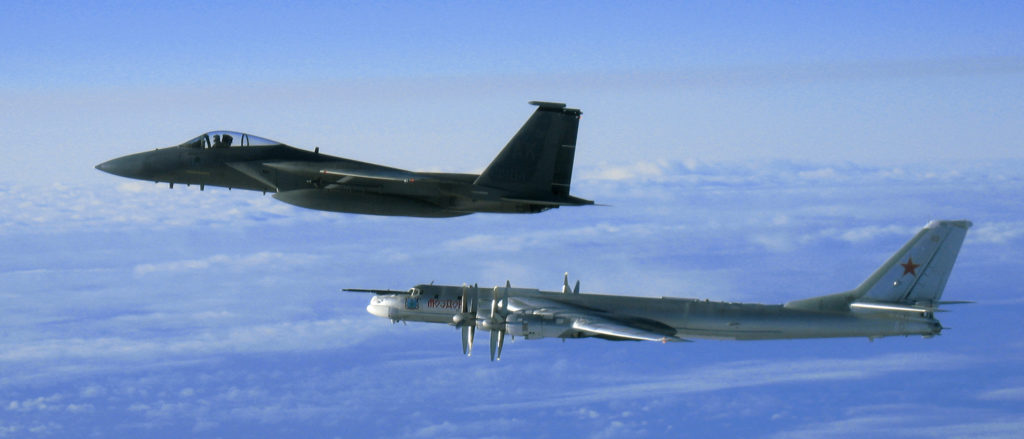
The McDonnell Douglas (now Boeing) F-15E Strike Eagle is an American all-weather multirole strike fighter derived from the McDonnell Douglas F-15 Eagle. Intended for the Dual-Role Fighter (DRF) program (initially called Enhanced Tactical Fighter), the F-15E was designed in the 1980s for long-range, high-speed interdiction without relying on escort or electronic-warfare aircraft. United States Air Force (USAF) F-15E Strike Eagles can be generally distinguished from other US Eagle variants by darker aircraft camouflage, conformal fuel tanks (CFTs) and LANTIRN pods mounted behind the engine intake ramps (although CFTs can also be mounted on earlier F-15 variants) and a tandem-seat cockpit.
Initially designed and manufactured by McDonnell Douglas, the F-15E first flew in 1986 and production continued under Boeing following the companies' merger in 1997. The aircraft became the USAF's primary strike fighter/interdictor starting near the end of the Cold War, gradually replacing the F-111 Aardvark. The Strike Eagle has been deployed for military operations in Iraq, Afghanistan, Syria, Libya, and Iran among others. During these operations, the strike fighter has carried out deep strikes against high-value targets and combat air patrols, and provided close air support for coalition troops. It has also been exported to several countries. The F-15E is expected to remain in USAF service until the 2030s. Enhanced versions of the design, called the F-15 Advanced Eagle, remain in production. As of 2026, the F-15E is USAF's most capable tactical nuclear weapon delivery aircraft, able to carry up to five B61 Mod 12 nuclear bombs.
Contents
Development
Origins
The McDonnell Douglas F-15 Eagle was introduced by the USAF to replace its fleet of McDonnell Douglas F-4 Phantom IIs. Unlike the F-4, the F-15 was designed for air superiority with little consideration for a ground-attack role; the F-15 Special Project Office opposed the idea of F-15s performing interdiction, giving rise to the phrase "Not a pound for air to ground."
Despite a lack of official interest, McDonnell Douglas had quietly included a basic secondary ground attack capability in the F-15's design since the beginning and worked on an F-15-derived interdictor fighter. The company envisaged the aircraft as a replacement for the General Dynamics F-111 and the remaining F-4s, as well as to augment the existing F-15s. In 1978, the USAF initiated the Tactical All-Weather Requirement Study, which looked at McDonnell Douglas's proposal and other options such as the purchase of further F-111Fs, and then the Enhanced Tactical Fighter program. The studies recommended the F-15E as the USAF's future strike platform. In 1979, McDonnell Douglas and Hughes began a close collaboration on the development of the F-15E's potential air-to-ground capabilities.
To assist in the F-15E's development, although not yet a program of record, McDonnell Douglas modified the second TF-15A prototype, AF serial number 71-0291, as a demonstrator. The aircraft, known as the Advanced Fighter Capability Demonstrator, first flew on 8 July 1980. It was previously used to test conformal fuel tanks (CFTs), initially designed for the F-15 under the designation "FAST Pack", with FAST standing for "Fuel and Sensor, Tactical. It was subsequently fitted with a Pave Tack laser designator targeting pod to allow the independent delivery of guided bombs. The demonstrator was displayed at the 1980 Farnborough Airshow.
Enhanced Tactical Fighter
In March 1981, the USAF announced the Enhanced Tactical Fighter program to replace the F-111. The program was later renamed the Dual-Role Fighter (DRF) competition, while the Advanced Tactical Fighter looked at more advanced concepts. The ETF concept envisioned an aircraft capable of launching deep air interdiction missions without requiring additional support by fighter escort or jamming. General Dynamics submitted the F-16XL, while McDonnell Douglas submitted the F-15E. The Panavia Tornado was also a candidate, but since the aircraft lacked a credible air-superiority fighter capability, coupled with the fact that it was not American-made, it was not seriously considered.
The DRF evaluation team, under the direction of Brigadier General Ronald W. Yates, ran from 1981 through 30 April 1983, during which the F-15E logged more than 200 flights, demonstrated a takeoff weight of more than 75,000 pounds (34 t), and validated 16 different weapons-carrying configurations. McDonnell Douglas, to assist 71-0291 in the evaluation, added to the program other F-15s, designated 78-0468, 80-0055, and 81-0063. The single-engined F-16XL was a promising design, which with its radically redesigned cranked-delta wing, greatly boosted performance; if selected, the single- and two-seat versions were to be designated F-16E and F-16F, respectively. On 24 February 1984, the USAF chose the F-15E; key factors in the decision were the F-15E's lower development costs compared to the F-16XL (US$270 million versus US$470 million), a belief that the F-15E had future growth potential, and possessing twin-engine redundancy. The USAF was initially expected to procure 400 aircraft, a figure later revised to 392.
Construction of the first three F-15Es started in July 1985. The first of these, 86-0183, made its maiden flight on 11 December 1986. Piloted by Gary Jennings, the aircraft reached a maximum speed of Mach 0.9 and an altitude of 40,000 feet (12,000 m) during the 75-minute flight. This aircraft had the full F-15E avionics suite and the redesigned front fuselage, but not the aft fuselage and the common engine bay for more powerful Improved Performance Engine (IPE) variants of the Pratt & Whitney F100 or General Electric F110. The latter was featured on 86-0184, while 86-0185 incorporated all the changes of the F-15E from the F-15. On 31 March 1987, the first officially completed F-15E made its first flight.
The first production F-15E was delivered to the 405th Tactical Training Wing, Luke Air Force Base, Arizona, in April 1988. Production continued into the 2000s with 236 produced for the USAF through 2001.
Upgrade programs and replacement
The F-15E was upgraded with the Raytheon AN/APG-82(V)1 Active Electronically Scanned Array (AESA) radar after 2007, and the first test radar was delivered to Boeing in 2010. It combines the processor of the APG-79 used on the F/A-18E/F Super Hornet with the antenna of the APG-63(V)3 AESA being fitted on the F-15C; it was named APG-63(V)4 until it received the APG-82 designation in 2009. The new radar is to be part of the F-15E Radar Modernization Program, which also includes a wideband radome (enabling operation on more radar frequencies) and environment control and electronic warfare improvements. In 2015, Boeing and BAE Systems were awarded contracts to comprehensively upgrade of the electronic warfare system of all USAF F-15s, including the F-15E, with the AN/ALQ-250 Eagle Passive/Active Warning Survivability System (EPAWSS). The first F-15E retrofitted with EPAWSS was delivered in 2022.
Having a sturdier airframe rated for 8,000 hours of service life or up to 16,000 hours with proper depot maintenance programs, twice the lifetime of earlier variants, the F-15E is expected to remain in service past 2025. As of December 2012, the USAF's F-15E fleet had an average age of 21 years and an average airframe flying time of 6,000 hours. In 2012, the USAF was reportedly considering future options, with no replacement for the F-15E being slated at that time.
The F-15E design would see some export success and Boeing continued developing upgrades for international customers. More radical upgrades to the air vehicle design resulted in the F-15 Advanced Eagle family that began with the F-15SA (Saudi Advanced) for the Royal Saudi Air Force, which first flew in 2013. It replaces the older hybrid electronic/mechanical system with a digital fly-by-wire control system that opens up two additional wing pylons and a revised wing structure for increased service life. The Advanced Eagle would have further developed variants with the F-15QA (Qatari Advanced) for the Qatar Emiri Air Force and the F-15EX Eagle II for the USAF. In FY 2020, USAF began procuring the F-15EX to replace the aging fleet of F-15C/D and supplement the F-22 Raptor to maintain air superiority fighter numbers, taking advantage of the existing export production line to quickly and affordably bring additional fighters into service; the F-15EX is also an option to replace the F-15E at a later time. Another choice is the F-35 Lightning II, set to replace other aircraft such as the F-16 Falcon; an F-35E variant was studied. Adding a second seat to the F-35 is complex and costly, especially to preserve its stealth profile; providing for greater range and payload would also be difficult tasks. Alternatively, the role could be covered by a combination of fighter and bomber aircraft, such as the B-21 Raider. The F-15E may also be replaced by a clean-sheet sixth-generation aircraft design.
ALASA
On 24 March 2014, Boeing won a $30.6 million contract from DARPA as part of the Airborne Launch Assist Space Access (ALASA) program. The goal of the program is to cut the cost of putting microsatellites into orbit by 66% through advances in launch systems. Under the 11-month contract, Boeing will build twelve 24 ft (7.3 m) launch vehicles, each with a payload capability up to 100 lb (45 kg). An ALASA vehicle is to be fitted under an F-15E, which will climb to 40,000 ft, then be released and fire its four engines to reach low-Earth orbit. Awarding the contract to Boeing would make use of the F-15E as the carriage vehicle, as previous design contracts had been given to Lockheed Martin to use the F-22 Raptor and Virgin Galactic to use their SpaceShip Two aircraft. DARPA had previously insisted they wanted to select an aircraft they would not need to modify heavily to carry and launch the ALASA payload. The project was terminated in late 2015.
Design
Overview
The F-15E's deep-strike mission is a radical departure from the original intent of the F-15 since it was designed as an air-superiority fighter under the mantra "not a pound for air-to-ground." The basic airframe, however, proved versatile enough to produce a very capable strike fighter. The F-15E, while designed for ground attack, retains the air-to-air lethality of the F-15, and can defend itself against enemy aircraft.
The F-15E prototype was a modification of the two-seat F-15B. Despite its origins and retaining the same aerodynamic shape, it includes significant structural changes as well as more powerful engines. The aft fuselage was designed to incorporate the more powerful engines with advanced engine bay structures and doors, which incorporate superplastic forming and diffusion bonding technologies. The back seat is equipped for a weapon systems officer (WSO, pronounced "wizzo") to work the air-to-ground avionics via multiple screens; these view the radar, electronic warfare, or thermographic cameras, monitor aircraft or weapons status and possible threats, select targets, and use an electronic moving map to navigate. Two hand controls are used to select new displays and to refine targeting information; displays can be moved from one screen to another using a menu of display options. Unlike previous two-place jets (e.g. the F-14 Tomcat and Navy variants of the F-4), whose back seat omitted flying controls, the F-15E's back seat is equipped with its own stick and throttle so the WSO can take over flying, albeit with reduced visibility.
For extended range, the F-15E is fitted with two conformal fuel tanks (CFTs) that hug the fuselage to produce lower drag than conventional underwing/underbelly drop tanks. They carry 750 U.S. gallons (2,800 L) of fuel, and house six weapons hardpoints in two rows of three in tandem. Unlike conventional drop tanks, CFTs cannot be jettisoned, thus increased range is a trade-off for increased drag and weight compared to a "clean" configuration.
Avionics
The tactical electronic warfare system (TEWS) integrates all countermeasures on the craft: radar warning receivers, radar jammer, radar and chaff/flare dispensers are all tied to the TEWS to provide comprehensive defense against detection and tracking. This system includes an externally mounted ALQ-131 ECM pod which is carried on the centerline pylon when required. The MIDS Fighter Data Link Terminal, produced by BAE Systems, improves situational awareness and communications capabilities via the Link 16 datalink. The TEWS was replaced by the AN/ALQ-250 EPAWSS digital electronic warfare suite beginning in 2022; EPAWSS replaces all TEWS components with lighter and more capable digital ones for increased performance.
The AN/APG-70 radar allows crews to detect ground targets from longer ranges; one feature is that, after a sweep of a target area, the crew may freeze the air-to-ground map then switch to air-to-air mode to scan for aerial threats. During air-to-surface weapon delivery, the pilot is capable of detecting, targeting, and engaging air-to-air targets while the WSO designates ground targets. Under the Radar Modernization Program, the APG-70 has been replaced by the AN/APG-82(V)1, which combines the AESA antenna from the AN/APG-63(V)3 with the processor from the AN/APG-79(V) as well as new Radio Frequency Tunable Filters and cooling system; APG-82(V)1 flight tests began in January 2010 and the radar achieved initial operational capability in 2014.
Its inertial navigation system uses a laser gyroscope to continuously monitor the aircraft's position and provide information to the central computer and other systems, including a digital moving map in both cockpits. The F-15E is commonly equipped with LANTIRN system pods for its interdiction role. Mounted externally under the engine intakes, the LANTIRN system allows the aircraft to fly at low altitudes, at night, and in any weather conditions, to attack ground targets with a variety of precision-guided and unguided weapons. The LANTIRN system gives the F-15E exceptional accuracy in weapons delivery day or night and in poor weather, and consists of two pods attached to the exterior of the aircraft. At night, the video picture from the LANTIRN can be projected on the head-up display (HUD), producing an infrared image of the ground. The digital, triple-redundant Lear Siegler aircraft flight control system permits coupled automatic terrain following, enhanced by a ring-laser gyro inertial navigation system.
The AN/AAQ-13 navigation pod contains a terrain-following radar which allows the pilot to safely fly at a very low altitude following cues displayed on a HUD; it also can be coupled to the autopilot to provide "hands off" terrain-following capability. This pod also contains a forward-looking infrared system which is projected on the HUD, typically used during nighttime or low-visibility operations. The nav pod is installed beneath the right engine intake. The targeting pod contains a laser designator and a tracking system that mark an enemy for destruction as far away as 10 mi (16 km). Once tracking has started, targeting information is automatically handed off to infrared homing air-to-surface missiles or laser-guided bombs. The targeting pod is mounted beneath the left engine intake; configurations may be either the AN/AAQ-14, AN/AAQ-28(V) Litening, or the AN/AAQ-33 Sniper.
Engines
The engines used on early aircraft are the same as on previous F-15 variants, the Pratt & Whitney F100-PW-220 each producing 23,770 lbf (105.7 kN) of thrust in afterburner. However, owing to the increased weight from strike payloads and CFTs, the F-15E was designed with a common engine bay that could accept more powerful Improved Performance Engine (IPE) variants. Later batches feature the F100-PW-229 IPE with 29,160 lbf (129.7 kN) of thrust each. Saudi Arabian and Israeli aircraft were also ordered and equipped with the F100-229 engines.
While the F-15E had also been flight tested with the General Electric F110-GE-129 with 29,500 lbf (131.2 kN) of thrust, the South Korean F-15K would be the first variant to adopt it in service. The F-15K would have two different engine types; the first batch are powered by F110-129 engines, while the second batch are powered by F100-229 engines. In 2008, Saudi Arabia decided to re-engine their F-15S fleet with the F110-129 engines, which also enables commonality with their F-15SA fleet. The Singapore Air Force equipped their F-15SG fleet with F110-129 engines.
Operational history
United States
The F-15E was first delivered to the U.S. Air Force operational units in 1988. The F-15E reached initial operational capability on 30 September 1989 at Seymour Johnson Air Force Base in North Carolina with the 4th Tactical Fighter Wing, 336th Tactical Fighter Squadron. As of 2026, the F-15E is USAF's most capable tactical nuclear weapon delivery aircraft, able to carry up to five B61 Mod 12 nuclear bombs.
The F-15E was deployed in response to Iraq's invasion of Kuwait in August 1990 for Operation Desert Shield. The 336th Tactical Fighter Squadron flew to Seeb Air Base in Oman to begin training exercises in anticipation of an Iraqi attack on Saudi Arabia; in December, the 335th and 336th squadrons relocated to Prince Sultan Air Base in Saudi Arabia, closer to Iraq's border. At the start of Operation Desert Storm, 24 F-15Es launched an attack on five fixed Scud installations in western Iraq on 17 January 1991. Missions against Scud sites continued through that night with a second strike of 21 F-15Es. At night-time, F-15Es flew hunter missions over western Iraq, searching for mobile SCUD launchers. By conducting random bombings in suspected areas, it was hoped to deter the Iraqis from setting up for a Scud launch.
On the war's opening night, an F-15E failed to hit a MiG-29 with an AIM-9 Sidewinder; other F-15Es also unsuccessfully engaged this lone MiG-29, which was eventually brought down by a missile of unknown origin. On 18 January, during a strike against a petrol oil and lubricant plant near Basrah, an F-15E was lost to enemy fire, killing both pilot and WSO. F-15E crews described this mission as the most difficult and dangerous of the war as it was heavily defended by SA-3s, SA-6s, SA-8s and Rolands as well as by anti-aircraft artillery. Two nights later, a second and final F-15E was downed by an Iraqi SA-2; the crew survived and evaded capture for several days and made contact with coalition aircraft, but a rescue was not launched due to security issues over an airman who failed to identify himself with proper codes. The Iraqis later captured both airmen.
F-15Es destroyed 18 Iraqi jets on the ground at Tallil air base using GBU-12s and CBU-87s. On 14 February, an F-15E scored its only air-to-air kill of the war: a Mil Mi-24 helicopter. While responding to a request for help by US Special Forces, five Iraqi helicopters were spotted. The lead F-15E of two, via its FLIR, acquired a helicopter in the process of unloading Iraqi soldiers, and released a GBU-10 bomb. The F-15E crew thought the bomb had missed its target and were preparing to use a Sidewinder when the helicopter was destroyed. The Special Forces team estimated that the Hind was roughly 800 feet (240 m) over the ground when the 2,000 lb (910 kg) bomb hit its target. As another Coalition bombing operation had commenced, the F-15Es disengaged from combat with the remaining helicopters.
Israel
The F-15I is operated by the Israeli Defense Force/Air Force No 69 Squadron, succeeding the F-4 Phantom II. It is used akin to a strategic bomber due to its long range, high munition capacity and advanced systems.
After the Gulf War in 1991, in which Israeli towns were attacked by SCUD missiles based in Iraq, the Israeli government decided a long range strike aircraft was needed, issuing a Request for Information (RFI). In response, Lockheed Martin offered a version of the F-16 Fighting Falcon, while McDonnell Douglas offered both the F/A-18 Hornet and the F-15E. On 27 January 1994, the Israeli government announced their intention to buy 21 modified F-15Es, designated F-15I. On 12 May 1994, the US Government authorized the purchase of up to 25 F-15Is by Israel. In November 1995, Israel ordered four extra F-15Is; 25 were built from 1996 to 1998. Some of the air-to-air missiles aircraft can carry: the AIM-9L, Rafael Python 4 and the Rafael Python 5 infrared-homing missiles; and the AIM-7 Sparrow and the AIM-120 AMRAAM radar-guided missiles. In 1999, Israel announced its intention to procure more fighters and that a possible contender was the F-15I. However, the contract went to the F-16I.
Saudi Arabia
In November 2009, Royal Saudi Air Force (RSAF) F-15s, along with Saudi Tornados, performed air raids amid the Houthi insurgency in north Yemen. It was the RSAF's first military action over hostile territory since Operation Desert Storm. In October 2010, Saudi Arabia requested 84 F-15SA (Saudi Advanced) fighters, upgrading of its existing F-15S fleet to F-15SA standard, and related equipment and weapons through a Foreign Military Sale (FMS). On 29 December 2011, the U.S. signed a $29.4 billion contract to sell 84 F-15SAs, as well as the F-15S upgrades. In June 2012, an FMS contract for 68 F-15S to F-15SA modification kits was placed with Boeing; the upgraded aircraft are designated the F-15SR. On 20 February 2013, the maiden flight of the first new-build F-15SA occurred.
On 26 March 2015, Saudi F-15Ss, along with other Arab coalition assets, started striking targets in Yemen as part of the Saudi Arabian-led intervention in Yemen, called Operation Decisive Storm. Opposing a joint force composed of former Houthi rebels and Yemeni Army forces, the strikes, at least initially, were met by ineffective anti-aircraft fire that reportedly only caused damage when falling to the ground. Early strikes were aimed at air defense sites, Army HQs, military airports, ballistic missiles depots, and launchers. During these attacks, a Saudi F-15S crashed into the Gulf of Aden after circling over the sea; its two pilots ejected safely and were recovered from the sea by a USAF HH-60G rescue helicopter; Arab coalition reports claimed enemy fire was not involved, while Houthi and Iranian sources claimed they had shot it down. On 8 January 2018, a RSAF F-15S was reportedly shot down by a Houthi surface-to-air missile; a Houthi-released video shows the F-15 increasing speed and releasing decoy flares before being struck by a projectile and apparently suffering major damage. On 9 January 2018, the Houthi media, Al-Masirah, announced that the F-15 had been damaged but did not crash.
On 21 March 2018, Houthi rebels released a video allegedly showing a RSAF F-15 being hit in Saada province by an R-27 air to air missile adapted for surface to air use. As in the video of the previous similar hit recorded on 8 January, the target, while clearly hit, seems not falling to the ground when the video stops. Saudi forces confirmed the hit, while saying the jet safely landed at a Saudi base. Saudi sources confirmed the incident involved a surface-to-air missile being launched at the jet from inside Saada airport.
Variants
F-15E variants
Two-seat all-weather long-range strike and ground-attack aircraft for the USAF. A total of 236 were built from 1985 to 2001.
The F-15I is operated by the Israeli Air Force where it is known as the Ra'am (רעם – "Thunder"). It is a dual-seat ground attack aircraft powered by two Pratt & Whitney F100-PW-229 engines, and is based on the F-15E.
The F-15I has featured different avionic systems from the USAF F-15E to meet Israeli requirements and also due to export restictions relating the resolution of the APG-70 system. Initially, Sharpshooter targeting pods designed for IAF F-16s were fitted for nighttime strikes but were less capable than the LANTIRN pods used on USAF F-15Es. Israel later bought 30 LANTIRN pods. The F-15Is initially lacked Radar Warning Receivers; Israel installed its own Elisra ASPS electronic warfare suite with a new central computer and embedded GPS/INS system. All sensors can be slaved to the Display and Sight Helmet (DASH) helmet-mounted sight, providing both crew members a means of targeting which the F-15E lacks. The F-15I uses the APG-70I radar; its terrain mapping capability can locate targets difficult to spot while under adverse weather conditions and can detect large airliner-sized targets at 150 nautical miles (170 mi; 280 km), and fighter-sized targets at 56 nmi (64 mi; 104 km); it has degraded resolution one-third below the original APG-70. In January 2016, Israel approved F-15I upgrades such as structural changes, an AESA radar, updated avionics, and new weapons.
The F-15K Slam Eagle (Korean: F-15K 슬램 이글) is a derivative of the F-15E, operated by the Republic of Korea Air Force. Several major components were outsourced to South Korean companies under an offset agreement, wherein South Korea was responsible for 40% of production and 25% of assembly. The fuselage and wings are supplied by Korea Aerospace Industries, flight control actuator by Hanwha Corporation, electronic jammer and radar warning receiver by Samsung Thales, head-up display, airborne communication system, and radar by LIG Nex1, and engines by Samsung Techwin under license before final assembly at Boeing's St. Louis facility.
In 2002, ROKAF selected the F-15K for its F-X fighter program, during which the F-15K, the Dassault Rafale, the Eurofighter Typhoon and Sukhoi Su-35 were evaluated. A total of 40 aircraft were ordered, deliveries began in 2005. On 25 April 2008, a second batch of 21 F-15Ks were ordered, worth 2.3 trillion Korean won (US$2.3 billion). This second batch differs from first batch aircraft in having Pratt & Whitney F100-PW-229 (EEP) engines, license-produced by Samsung Techwin, for commonality with the KF-16 fleet. ROKAF had received 50 F-15Ks by June 2011. ROKAF expects the F-15K to be in service until 2060.
F-15 Advanced Eagle variants
The F-15 Advanced Eagle represents a more substantial upgrade baseline over previous models in that it has a new fly-by-wire control system and wing structure that enables two additional underwing weapons hardpoints (increasing the number from nine to eleven). Additional enhancements include the option of a large area display cockpit, the Raytheon AN/APG-82(V)1 or APG-63(V)3 AESA radar, General Electric F110-129 engines, digital Joint Helmet-Mounted Cueing Systems for pilot and WSO, and a digital electronic warfare system among other enhancements. Advanced Eagle variants include the F-15SA (Saudi Advanced), F-15QA (Qatari Advanced), F-15EX Eagle II, and F-15IA (Israeli Advanced).
Proposed variants
Proposed single-seat F-15E variant for Saudi Arabia. Later preliminarily assigned to F-15SGs.
A F-15G Wild Weasel was a proposed two-seat version to replace the F-4G Wild Weasel in the suppression of enemy air defenses (SEAD) role. The F-15G was studied in 1986. A proposed modification to F-15Cs for the SEAD role was studied in 1994–95, but F-16Cs were modified to perform this role instead.
The F-15H Strike Eagle (H for Hellas) was a 1990s proposed export version of F-15E for Greece, which was selected by the Greek Ministry of Defence and the Hellenic Air Force, but the government chose new F-16s and Mirage 2000-5s instead.
The F-15SE Silent Eagle was a proposed variant with fifth generation fighter features, such as internal weapons carriage and radar-absorbent material. The Silent Eagle featured conformal weapons bays (CWB) to hold weapons internally instead of conformal fuel tanks, the twin vertical tails are canted outward 15 degrees to reduce radar cross section; the majority of the CWB's area is for weapons storage, a minority is used for fuel storage. The F-15SE was optimized for air-to-air missions, lacking all-aspect stealth features for missions inside areas protected by ground-based anti-aircraft systems. The first production F-15E, s/n "86-0183", was modified to become a Silent Eagle demonstrator. It first flew in July 2010 with a left-side conformal weapons bay, and successfully launched an AMRAAM missile from the CWB in July 2010. Potential customers were Saudi Arabia, Israel, Japan, and South Korea; however the Saudis chose to procure the less ambitious F-15SA which became the first F-15 Advanced Eagle variant, while Israel, Japan, and South Korea selected the F-35. Some of the proposed F-15SE features were carried over to the F-15 Advanced Eagle family.
The F-15GSE was a 2006 proposal for a space strike version of the F-15E, for attacking satellites. It was to be an unmanned remotely-piloted variant, carrying a 3-stage-to-orbit solid rocket ASAT missile on its back between the twin-tails.
Operators
Israel
Israeli Air Force – 25 F-15I aircraft in use as of January 2014
69 Squadron – Hatzerim AFB
Republic of Korea
Republic of Korea Air Force – 59 F-15Ks in service in 2019. Sequentially, 40 and 21 units were delivered, of which two units crashed.
11th Fighter Wing (제11전투비행단), based at Daegu
102nd Fighter Squadron
122nd Fighter Squadron
110th Fighter Squadron
Saudi Arabia
Royal Saudi Air Force – 70 F-15S Eagles in service as of January 2014
No. 3 Wing RSAF – King Abdulaziz Air Base
No. 92 Squadron RSAF
No. 5 Wing RSAF – King Khalid Air Base
No. 6 Squadron RSAF
No. 55 Squadron RSAF
Singapore
Republic of Singapore Air Force – 40 F-15SGs
142 Squadron "Gryphon"
149 Squadron "Fighting Shikra"
United States
United States Air Force – 219 F-15Es in operation as of April 2019
Specifications (F-15E)
Data from USAF F-15E Flight Manual (TO 1F-15E-1), USAF fact sheet, Davies, and BoeingGeneral characteristics
Crew: 2 (pilot and weapon systems officer)
Length: 63 ft 9.6 in (19.446 m)
Wingspan: 42 ft 9.6 in (13.045 m)
Height: 18 ft 6 in (5.64 m)
Wing area: 608 sq ft (56.5 m2)
Airfoil: root: NACA 64A006.6; tip: NACA 64A203
Empty weight: 34,600 lb (15,694 kg) or 38,990 lb (17,690 kg) with CFTs
Max takeoff weight: 81,000 lb (36,741 kg)
Fuel capacity: 12,915 lb (5,858 kg) internal, 22,267 lb (10,100 kg) with CFTs, 34,162 lb (15,496 kg) with CFTs and 3× 600-gallon (2,270 L) external fuel tanks
Powerplant: 2 × Pratt & Whitney F100-PW-220 afterburning turbofan, 14,590 lbf (64.9 kN) thrust each dry, 23,770 lbf (105.7 kN) with afterburner(or 2 × F100-PW-229, thrust: 17,800 lb dry (79 kN); 29,160 lb (129.7 kN) with afterburner each)
Performance
Maximum speed: Mach 2.5, 1,650 mph (2,655 km/h) at high altitude
Mach 1.2, 800 kn (921 mph; 1,482 km/h) at low altitude
Combat range: 687 nmi (791 mi, 1,272 km) air interdiction
Ferry range: 2,100 nmi (2,400 mi, 3,900 km) with conformal fuel tanks and three external fuel tanks