References to other works
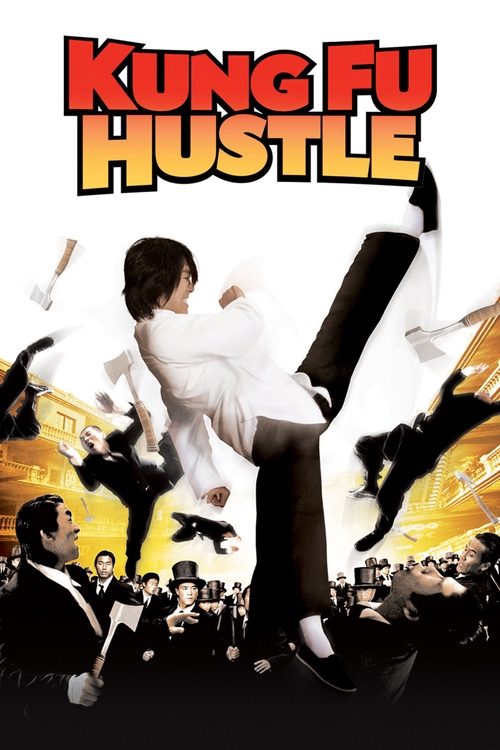
Kung Fu Hustle makes references to a wide range of films, animated cartoons, wuxia novels, anime and other sources.
The Crocodile Gang leader says, "No one shows in the movie theater on Sunday. I will rather do any business than the movie business", before he was ambushed by the Axe Gang. In reality, the Crocodile Gang leader is played by Feng Xiaogang, a well-known movie director in China.
The housing arrangement of the Pigsty Alley is similar to that of a 1973 Hong Kong film, The House of 72 Tenants. A possible real world reference for Pigsty Alley is "Kowloon Walled City" in Hong Kong, a former slum in central Hong Kong.
There are two references to Chow's previous hit film, Shaolin Soccer: When Sing arrives at Pigsty Alley, he plays skilfully with a soccer ball, then says, "You're still playing football?". The second reference is the scene in which a clerk beats Sing up on a bus. The clerk also appeared in Shaolin Soccer as the leader of an opposing team who used hidden weapons to beat up the Shaolin soccer team.
When Sing challenges a boy in the Pigsty Alley, Sing calls him "The Karate Kid", a reference to the 1984 film of the same name. During the altercation between Sing and the hairdresser, the hairdresser states, "Even if you kill me, there will be thousands more of me!". This is a reference to a famous quote made by Lu Haodong, a Chinese revolutionary in the late Qing dynasty.
The scene in which Sing is chased by the Landlady as he flees from the Alley is a homage to Wile E. Coyote and the Road Runner, characters in the Looney Tunes cartoons, even including the pursuer's (the Landlady's) ill fate. During the opening scene in which the leader of the Crocodile Gang is killed by Brother Sum of the Axe Gang, in the background a poster for the 1939 film Le Jour Se Lève is visible. In the scene in which Sing robs the ice cream vendor, a poster for the 1935 film Top Hat is in the background. As Sing arrives at the door to the Beast's cell in the mental asylum, he hallucinates a large wave of blood rushing from the cell door, similar to a scene in The Shining. The Landlady says at one point, "Tomorrow is another day", which is a line from the 1936 novel Gone with the Wind and its 1939 film adaptation.
A major element of the plot is based on the Famous wuxia film series Palm of Ru Lai (如來神掌), released in 1964. Sing studied the fighting style used in Palm of Ru Lai ("Buddhist Palm style"), from a young age and used it at the end of Kung Fu Hustle. In reality, the Buddhist Palm fighting style does not leave palm-shaped craters and holes on impact. Instead, the user delivers powerful punches using his palm. The Beast's name in Chinese, Huoyun Xieshen (火雲邪神; Evil Deity of the Fiery Cloud), and the fight with the Landlady and her husband are also references to the Palm of Ru Lai, in which a mortally wounded master strikes the patterns of his art's final techniques into a bell so that his apprentice can learn from it. Kung Fu Hustle also contains direct references to characters from Louis Cha's wuxia novels. For example, the landlord and landlady refer to themselves as Yang Guo and Xiaolongnü, the names of characters in Cha's The Return of the Condor Heroes, when they met the Beast.
References to gangster films are also present. The boss of the Axe Gang, Brother Sum (琛哥) is named after Hon Sam / Hon Sum (韓琛), the triad boss played by Eric Tsang in Infernal Affairs. The Harpists imitate The Blues Brothers, wearing similar hats and sunglasses at all times. When they are flattered by the Axe Gang advisor, one of them answers, "Strictly speaking we're just musicians", similar to a line by Elwood Blues.
When Donut dies, he says, "In great power lies great responsibility", a reference to 2002's Spider-Man, said by Uncle Ben before his death. Additionally, in that scene, the Landlady says, "Like Donut said, everyone has his reasons", a reference to Jean Renoir's 1939 film The Rules of the Game. Afterwards, with his dying breath, Donut gets up, grabs the Landlord by the shirt and utters in English, "What are you prepared to do?", a nod to Sean Connery's character Jim Malone in Brian De Palma's 1987 film The Untouchables.
The dialogue that the Beast says while negotiating with the Axe Gang for killing the Landlady and Landlord—"... then young friend, I will make an offer you cannot refuse" it is a reference of the dialogue from the movie of 1972s The Godfather. Also, the Landlady's comment to Brother Sum—"We brought a gift you cannot refuse" is an obvious parody of the same, to which Sum replies (in the dubbed version of the film), "Ha! With the Beast on our side, we shall see for whom the bell tolls", a reference to the titular 1943 film.
The final fight between Sing (who has been reborn into "the one", which pays homage to Bruce Lee by wearing his costume in Enter the Dragon and using his fighting style) and the hundreds of gangsters imitates the fight between Neo and hundreds of Agent Smiths in The Matrix Reloaded. The scene in which the Beast prompts an Axe member to punch him harder is reminiscent of a similar scene in Raging Bull, with Robert De Niro's character prompting Joe Pesci's character.
The last scene, in which the beggar tries to sell martial arts manuals, refers directly to the greatest skills in Louis Cha's Condor Trilogy (Nine Yang Manual, "Yiyang Finger", and "Eighteen Subduing Dragon Palms"), "Thousand Hand Divine Fist", and The Smiling, Proud Wanderer ("Nine Swords of Dugu"). The scene in which the landlady confronts Brother Sum in the back of his car is a homage to Bruce Lee in this from the movie of 1972s Way of the Dragon, where she cracks her knuckles and gives a quick upper nod to the mafia boss, telling him to back off.
According to Raechel Dumas, Kung Fu Hustle transforms traditional martial arts cinema into a globally consumable spectacle through parody, fantasy, and visual excess. The film incorporates recognizable conventions from wuxia fiction and Hong Kong kung fu films—including legendary masters, secret martial arts manuals, and supernatural fighting techniques—while simultaneously exaggerating and reinterpreting them through Stephen Chow’s comic style. As a result, these references function as both homage to and parody of martial arts traditions.