


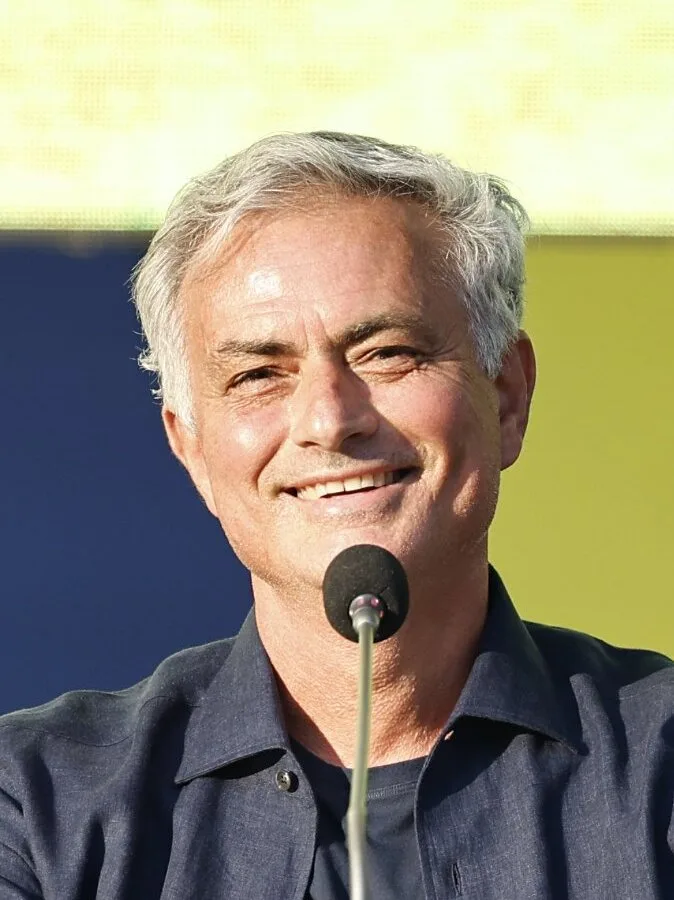
José Mário dos Santos Mourinho Félix (European Portuguese pronunciation: [ʒuˈzɛ moˈɾiɲu]; born 26 January 1963) is a Portuguese professional football manager and former player who is the head coach of La Liga club Real Madrid. Nicknamed "The Special One", he is one of the most decorated managers of all time. Mourinho has won league championships in four countries, is one of only seven managers to have won the European Cup with two clubs, and is the only manager to have won all three current UEFA club competitions.
After an uneventful career as a midfielder in the Portuguese leagues, Mourinho retired from playing aged 24 and moved into coaching. He was first an interpreter for Bobby Robson at Sporting CP and Porto, before gaining success as an assistant at Barcelona under Robson and his successor, Louis van Gaal. After brief managerial stints at Benfica and União de Leiria, Mourinho returned to Porto in 2002, winning two Primeira Liga titles, the Taça de Portugal, the UEFA Cup and the UEFA Champions League. That success earned him a move to Chelsea in 2004, where he won two Premier League titles, an FA Cup, and two League Cups in three seasons, before departing in 2007 amid reports of disagreements with owner Roman Abramovich.
In 2008, Mourinho joined Italian club Inter Milan. He led them to the Serie A title in his first season, before winning a continental treble—Serie A, the Coppa Italia and the UEFA Champions League—in 2010, a first in history for an Italian club. Later that year, he was crowned the inaugural FIFA World Coach of the Year. Mourinho then moved to Real Madrid in Spain, where he won the La Liga title in 2011–12, breaking several domestic records for points, goals scored, and wins in a season. He rejoined Chelsea in 2013, winning another league title and League Cup, but was dismissed in 2015 after a poor run of results.
Mourinho was appointed manager of Manchester United in 2016 and of Tottenham Hotspur in 2019, but both tenures ended acrimoniously. At Manchester United, he won the Community Shield, League Cup and UEFA Europa League in his first season. At Tottenham, he led the team to a League Cup final. He managed Roma from 2021 to 2024, winning the inaugural UEFA Europa Conference League in his first season. This was Roma's first European title and their first trophy since 2008. The achievement made Mourinho the first manager to win a major European competition with four different clubs and the third to win all UEFA club competitions. After spells at Fenerbahçe and a return to Benfica, he returned to Real Madrid in July 2026.
Mourinho was named Portuguese Coach of the Century by the Portuguese Football Federation (FPF) in 2015. Due to his tactical knowledge, charismatic and controversial personality, and a reputation for prioritising results over attractive football, he has drawn comparisons—from both admirers and critics—with Argentine manager Helenio Herrera.
Contents
Early life and education
Mourinho was born in 1963 into a large middle-class family in Setúbal, Portugal, as the son of goalkeeper José Manuel Mourinho Félix, who was known by the name Félix Mourinho, and primary school teacher Maria Júlia Carrajola dos Santos. His father played football professionally for Vitória de Setúbal and Belenenses, earning one cap for Portugal in 1972, and later worked as a football manager and the club director of Vitória de Setúbal. His mother was raised by her uncle Mário Lêdo, who came to control the Setúbal sardine canning industry under António de Oliveira Salazar's Estado Novo and funded the construction of Vitória's Estádio do Bonfim in 1953–1961. Following the regime's downfall in the Carnation Revolution, Lêdo's assets were nationalised during the short-lived Ongoing Revolutionary Process in 1975, but he kept a mansion in Aires near Palmela, where Mourinho grew up with his parents.
Education
Mourinho failed in the subject of mathematics during the final year of secondary school and this prevented him from finishing high school in time to enroll at the physical education college as was his wish. After finishing secondary school in the special examination period of September, his mother enrolled him in a private business school because there were no vacant seats for him in the physical education college and his mother believed business school would bring him to a more successful career path. Mourinho dropped out of business school on his first day, deciding he would rather focus on sport, and chose to attend the Instituto Superior de Educação Física (ISEF) of the Technical University of Lisbon to study physical education. He was taught there by his mentor Manuel Sérgio, the ex-chairman and deputy director of Belenenses (1975–77), whose humanist approach to kinesiology he later cited as formative. After Mourinho concluded his education in ISEF, he attended coaching courses held by the English and Scottish Football Associations. In this period of his life, former Scotland manager Andy Roxburgh took note of the young Portuguese's drive and attention to detail. Mourinho sought to redefine the role of coach in football by mixing coaching theory with motivational and psychological techniques.
Playing career
Mourinho wanted to follow in his father's footsteps and joined the Belenenses youth team. Graduating to the senior level, he left the club in 1980 to sign for Rio Ave, where he played for the reserve team, and in 1981, was joined by his father, who was named first team manager. There, he struck up a prolific partnership with veteran striker Mário Reis. According to former teammate Baltemar Brito (who would become an assistant to Mourinho early on his managerial career), the duo scored around 100 goals, with Mourinho netting forty-seven times. In addition to playing for the reserves, Mourinho was usually tasked with scouting other teams for his father. He was rarely selected by his father, but he made his debut for the club in the third round of the Taça de Portugal, in a 2–1 extra time win over Salgueiros. On the final day of the campaign against champions-elect Sporting CP, a defender was injured in the pre-match warm up, so he was told to get changed. Club president José Maria Pinho, fearing the threat of nepotism, overruled the decision to do so; the incident saw the pair leave to join Belenenses in the summer. Mourinho mostly spent the season playing for the reserve team, and he played for the first team in the second round of the Taça de Portugal against Clube Desportivo de Vila Franca, an amateur club from Vila Franca do Campo, São Miguel Island, Azores. With Belenenses 8–0 up at half-time, Mourinho came on as a second-half substitute and scored a hat-trick as the team won 17–0, which remains the club's biggest ever victory in the tournament. When his father returned to Rio Ave, Mourinho did not go with him and continued to play in the lower levels of the Portuguese football league system, first with Sesimbra, and then for Comércio e Indústria, where he finished his career. At the latter club, he was captain of the team and would save the life of a teammate who had gotten trapped in a car that had caught fire. Mourinho decided that he lacked the requisite pace and power to become a professional and chose to focus on becoming a football coach instead.
Coaching career
After leaving his job as a physical education school teacher, Mourinho looked for a path into professional football management in his hometown and became youth team coach at Vitória de Setúbal in the early 1990s. Later, he accepted the position of assistant manager at Estrela da Amadora, then was a scout at Ovarense. Then, in 1992, an opportunity arose to work as a translator for a top foreign coach: Bobby Robson had been appointed as the new manager of Lisbon club Sporting CP and needed an English-speaking local coach to work as his interpreter. His presentation was on 7 July, alongside president Sousa Cintra, manager Robson and Manuel Fernandes.
Mourinho began discussing tactics and coaching with Robson in his interpreting role. Robson was sacked by the club in December 1993. When Porto appointed him as their head coach, Mourinho moved with him, continuing to coach and interpret for players at the new club. The Porto team, consisting of players like Ljubinko Drulović, Domingos, Rui Barros, Jorge Costa and Vítor Baía, went on to dominate Portuguese football the following years. With Robson as head coach and Mourinho as his assistant, Porto reached the 1993–94 UEFA Champions League semi-finals and won the 1993–94 Taça de Portugal, the 1994–95 and 1995–96 Portuguese championship, and the 1994, 1995 and 1996 Portuguese Super Cup, the latter with a 5–0 victory over arch-rivals Benfica, in what proved to be Robson's last game at Porto, earning Robson the nickname "Bobby Five-O" in Portugal.
After two years at Porto, the duo moved again, joining Barcelona in 1996. Mourinho gradually became a prominent figure of the club's staff by translating at press conferences, planning practice sessions and helping players through tactical advice and analyses of the opposition. Robson and Mourinho's styles complemented each other: the Englishman favoured an attacking style, while Mourinho covered defensive options, and the Portuguese's love of planning and training combined with Robson's direct man-management. The Barcelona attack was led by a prime Ronaldo – whom Mourinho regards as the best player post-Diego Maradona. The partnership was fruitful and Barcelona finished the season by winning the European Cup Winners' Cup, the Copa del Rey and Supercopa de España. Robson moved clubs the following season but this time Mourinho did not follow, as Barcelona were keen to retain him as assistant manager. The two remained good friends and Mourinho later reflected on the effect Robson had had upon him:
One of the most important things I learnt from Bobby Robson is that when you win, you shouldn't assume you are the team, and when you lose, you shouldn't think you are rubbish.
Managerial career
Benfica
The chance to become a top-tier manager arrived in September 2000 when Mourinho was appointed as the replacement for Benfica manager Jupp Heynckes after the fourth week of the Primeira Liga.
When I spoke with Van Gaal about going back to Portugal to be an assistant at Benfica, he said: "No, don't go. Tell Benfica if they want a first-team coach you will go; if they want an assistant you will stay."
The Benfica hierarchy wanted to appoint Jesualdo Ferreira as the new assistant coach, but Mourinho refused and picked Carlos Mozer, a retired Benfica defender, as his right-hand man instead. Mourinho was highly critical of Ferreira, whom he had first encountered as his teacher at ISEF and later lambasted the veteran coach by stating, "This could be the story of a donkey who worked for 30 years but never became a horse."
Only weeks after being given the job at Benfica, Mourinho's mentor, Bobby Robson, offered him the assistant manager's role at Newcastle United. Such was Robson's desperation for Mourinho to join him he offered to step down after two years in charge and hand over the reins to Mourinho. Mourinho turned the offer down and said he knew Robson would never step down at the club he loved.
Mourinho and Mozer proved a popular combination, enjoying a 3–0 win against rivals Sporting CP in December. Their reign appeared to be at risk after Benfica's election turned against club president João Vale e Azevedo and the newly elected Manuel Vilarinho said that he would instate ex-Benfica player Toni as his new coach. Although Vilarinho had no intention of firing him immediately, Mourinho used the victory over Sporting to test the president's loyalty and he asked for a contract extension. Vilarinho refused the demand and Mourinho resigned from his position immediately. He left the club on 5 December 2000 after just nine league games in charge. Upon later reflection, Vilarinho rued his poor judgement and expressed his frustration at losing Mourinho:
[Put me] back then [and] I would do exactly the opposite: I would extend his contract. Only later I realised that one's personality and pride cannot be put before the interest of the institution we serve.
União de Leiria
Mourinho found a new managerial post in July 2001 with União de Leiria. During his time at União de Leiria, the team was on a run contesting places as high as third and fourth. After a 1–1 draw against Santa Clara on 20 January 2002, Mourinho recorded eight matches unbeaten in the league (six wins, two draws) since 25 November 2001. At this time the team was in fourth place, one point ahead of Porto, one point behind Benfica and six points behind the top of the league table. Mourinho's successes at Leiria did not go unrecognised and he caught the attention of larger Portuguese clubs.
Porto
Mourinho was then chosen by Porto to replace Octávio Machado on 23 January 2002. At this time, Porto was in fifth place in the Liga (behind Sporting CP, Boavista, União de Leiria and Benfica), had been eliminated from the Taça de Portugal and was in last place in their UEFA Champions League second group stage. Mourinho guided the team to third place that year after a strong 15-game run (including 11 wins) and gave the promise of "making Porto champions next year".
He quickly identified several key players as the backbone of what he believed would be a perfect Porto team: Vítor Baía, Ricardo Carvalho, Costinha, Deco, Dmitri Alenichev and Hélder Postiga. He recalled captain Jorge Costa after a six-month loan to Charlton Athletic. Signings from other clubs included Nuno Valente and Derlei from União de Leiria; Paulo Ferreira from Vitória de Setúbal; César Peixoto from Belenenses; Pedro Emanuel from Boavista; and Edgaras Jankauskas and Maniche, who both had been out of contract at Benfica.
In 2003, Mourinho won his first Primeira Liga with a 27–5–2 record, 11 points clear of Benfica, the team he quit two years earlier. The total of 86 points out of the possible maximum of 102 was a Portuguese record, until the 2015–16 season won by Benfica (88 points), since the rule of three points per win was introduced. Mourinho also won the Taça de Portugal, beating Leiria, a club he previously managed, in the final, and Celtic in UEFA Cup final, both in May 2003.
The following season witnessed further successes: he led Porto to victory in the one-match Portuguese Super Cup, beating Leiria 1–0. They lost the UEFA Super Cup 1–0 to Milan, with Andriy Shevchenko scoring the only goal. The team was dominant in the Primeira Liga and finished the season with a perfect home record, an eight-point advantage and a 27-match unbeaten run that ran from the start of the season until early April, when they lost to Gil Vicente. They secured the title five weeks before the end of the season. Porto lost the 2004 Taça de Portugal Final to Benfica in May 2004, but two weeks later, Mourinho won a greater prize: the UEFA Champions League, with a 3–0 win over Monaco in Germany. The club had eliminated Manchester United, Lyon and Deportivo de La Coruña and their sole defeat of the competition came against Real Madrid in the group round.
In the first leg between Manchester United and Porto, United manager Alex Ferguson confronted Mourinho after Roy Keane received a red card for stamping on Vítor Baía. In the second leg at Old Trafford, Porto were on the verge of an away-goals defeat when Costinha scored in the 89th minute to win the tie. Mourinho flamboyantly celebrated the goal by leaving his dugout, punching the air as he sprinted down the sideline near to his celebrating players. Mourinho's Porto win over Ferguson's United was a preview of his move to the Premier League managing Chelsea, where the two men would enjoy a competitive but respectful relationship. In 2005, after Chelsea clinched the Premier League title, Ferguson had his players form a guard of honour at Chelsea's next game at Old Trafford, a favour that Mourinho returned in 2007 at Stamford Bridge, after Ferguson's squad were confirmed league champions.
Chelsea
On 2 June 2004, Mourinho moved to Chelsea on a three-year contract, after a £1.7 million compensation package was agreed with Porto, making him the first Portuguese manager in the Premier League. In a press conference upon joining the English side, Mourinho spoke on Chelsea's credentials, stating: "We have top players and, sorry if I'm arrogant, we have a top manager", before adding,
Please don't call me arrogant, but I'm European champion and I think I'm a special one.
This comment resulted in the media dubbing him "The Special One", and his braggadocio was widely recognised during his early managerial career. Mourinho recruited his backroom staff from Porto, consisting of assistant manager Baltemar Brito, fitness coach Rui Faria, chief scout André Villas-Boas and goalkeeping coach Silvino Louro. He retained Steve Clarke, a long-serving former player at Chelsea, who had also performed an assistant managerial-type role under previous managers at the club. In terms of spending, Mourinho carried on where his predecessor Claudio Ranieri left off, as, bankrolled by Roman Abramovich, he spent in excess of £70 million in transfer fees on players such as Tiago (£10 million), Michael Essien (£24.4 million), Didier Drogba (£24 million), Mateja Kežman (£5.4 million), Ricardo Carvalho (£19.8 million) and Paulo Ferreira (£13.3 million).
Under Mourinho, Chelsea built on the potential developed in the previous season. By early December, they were at the top of the Premier League table and had reached the knock-out stages of the Champions League. He secured his first trophy by winning the League Cup against Liverpool 3–2 (AET) in Cardiff. Towards the end of the match, Mourinho was escorted from the touchline after putting his finger to his mouth in the direction of Liverpool fans, as a response to taunts directed towards him whilst Liverpool were leading.
Chelsea met Barcelona in the Champions League round of 16, a highly contested match where the Blues lost away in the first leg 2–1 but advanced on aggregate, winning at home 4–2. In the quarter-finals against Bayern Munich, Mourinho who was banned from attending the stadium, waited in the dressing room before the match to talk to his players, then he hid in a laundry basket to leave the stadium. Chelsea were knocked out of the competition by a controversial goal in the semi-finals by eventual winners Liverpool. Under Mourinho, Chelsea secured their first top-flight domestic title in 50 years, setting a string of English football records in the process, including the most points ever achieved in the Premier League (95) and the fewest goals conceded (15).
Inter Milan
On 2 June 2008, Mourinho was appointed the successor of Roberto Mancini at Inter Milan on a three-year contract and brought along with him much of his backroom staff who had served him at both Chelsea and Porto. He chose Giuseppe Baresi, a former Inter player and ex-head coach of their youth academy, as his assistant. He spoke solely in Italian in his first press conference as Inter boss, claiming to have learnt it "in three weeks". Mourinho stated that he only intended to make a few major signings in the summer. By the end of the transfer window, he had brought three new players to the side: Brazilian winger Mancini (€13 million), Ghanaian midfielder Sulley Muntari for a reported €14 million and Portuguese winger Ricardo Quaresma for a cash/player exchange fee of €18.6 million plus young Portuguese midfielder Pelé.
In his first season as Inter head coach, Mourinho won the Supercoppa Italiana, beating Roma on penalties, and finished top of Serie A. Inter were eliminated 2–0 on aggregate by Manchester United in the first knock-out round of the Champions League, and he also failed to win the Coppa Italia, losing 3–1 on aggregate to Sampdoria in the semi-finals. As UEFA was beginning to push the larger clubs in top leagues to play more homegrown players, Mourinho regularly played 18-year-old Italian forward Mario Balotelli and promoted academy defender Davide Santon to the first team permanently, installing an Italian contingent into a team previously composed of mostly foreign players. Both teenagers played a part in the Scudetto-winning season and played enough games to earn their first senior trophy.
Despite his domestic successes in winning the Scudetto by a 10-point margin, Mourinho's first season in Italy was viewed as disappointing by some Inter fans, as the club failed to improve on the performances of his predecessor Roberto Mancini in the Champions League. Inter put in a series of lacklustre group stage performances that included a shock 1–0 home loss to Panathinaikos and an away draw with Cypriot minnows Anorthosis Famagusta. Inter qualified for the knockout stages of the Champions League but failed to make it to the quarter-finals after being defeated by Manchester United.
On 16 May 2009, Inter mathematically won the Serie A title after runners-up Milan lost to Udinese. This loss left the Nerazzurri seven points above their crosstown rivals with only two games remaining. They would eventually finish 10 points clear of Milan.
Real Madrid
On 28 May 2010, it was confirmed that Mourinho would take over from Manuel Pellegrini at the Santiago Bernabéu. On 31 May 2010, Mourinho was unveiled as the new head coach of Real Madrid after signing a four-year contract, and became the eleventh coach at the club in the previous seven years. Mourinho was appointed sporting manager as well as first-team coach, and he was referred to as a Galáctico, a term more often used for star players instead of coaches.
Prior to Mourinho's arrival, Real Madrid had underperformed, despite paying record transfer fees for Galácticos such as Kaká and Cristiano Ronaldo. Their 2009–10 season was marked by disappointments such as Alcorconazo, a shock 2009–10 Copa del Rey round of 32 defeat to Segunda División B team Alcorcón, and elimination from the Champions League by Lyon in the round of 16, though they finished second in La Liga with a club record 96 points. By the end of the transfer window, after the 2010 FIFA World Cup, Mourinho had brought four new players to the squad: the Germans Sami Khedira (€13 million) and Mesut Özil (€15 million), Portuguese defender Ricardo Carvalho (€8 million) and Argentine winger Ángel Di María (€25 million plus €11 million on incentives).
On 29 August 2010, Real Madrid drew 0–0 at Mallorca in Mourinho's first La Liga game as coach. When asked about all the missed opportunities against Levante in La Liga and Auxerre in the Champions League, Mourinho said, "One day some poor rival is going to pay for the chances we've missed today." The following match at the Bernabéu ended with a 6–1 victory over Deportivo de La Coruña. The following league games confirmed Mourinho's statement, defeating Málaga 4–1 and Racing Santander 6–1.
On 29 November 2010, Mourinho's Madrid were defeated in his first El Clásico encounter against Barcelona. The match, held in Camp Nou, ended 5–0 to the hosts, with Real Madrid director Florentino Pérez regarding it the worst game in the history of Real Madrid. Sporting director Jorge Valdano also criticised Mourinho for his "inability to bring a major correction to the game" and "not leaving his bench for the [majority] of the match". When asked by a media reporter, Mourinho refused to call the loss a humiliation.
On 30 November 2010, Mourinho was fined £33,500 for appearing to instruct Xabi Alonso and Sergio Ramos to attempt to receive a tactical second yellow card in the 4–0 Champions League win against Ajax. He was also banned for two Champions League matches. On 22 December 2010, Mourinho won a match by the widest margin in his career, winning 8–0 against Levante, also of La Liga, in the first leg of their quarter-final of the Copa del Rey.
Return to Chelsea
On 3 June 2013, Chelsea appointed Mourinho as manager for the second time, on a four-year contract. Mourinho told Chelsea TV, "In my career I've had two great passions – Inter and Chelsea – and Chelsea is more than important for me." "It was very, very hard to play against Chelsea, and I did it only twice which was not so bad." "Now I promise exactly the same things I promised in 2004 with this difference to add: I'm one of you." On 10 June 2013, Mourinho was officially confirmed as Chelsea manager for the second time at a press conference held at Stamford Bridge.
Mourinho's first competitive game back in charge of Chelsea ended in a 2–0 home victory against Hull City on 18 August 2013. On 30 August Mourinho faced defending UEFA Champions League winners Bayern Munich in the UEFA Super Cup, which was his second as a manager. Despite taking the lead Chelsea lost to Bayern on penalties as Romelu Lukaku saw his decisive penalty getting saved by Bayern keeper Manuel Neuer. Following the loss to Pep Guardiola's Bayern Munich he said, "They take the cup and the best team lost. Even with ten men we played fantastically. Pride is OK but we lost."
On 29 January 2014, following a 0–0 draw at home to West Ham United, Mourinho described the Hammers as playing "19th century football", saying, "This is not the best league in the world, this is football from the 19th century", and, "The only [other] thing I could bring was a Black and Decker to destroy the wall." In March, recognizing his contributions to the club, Mourinho was given share number 1 by the Chelsea Pitch Owners Association which owns the Stamford Bridge freehold.
On 19 April 2014, Mourinho suffered his first ever home league defeat as Chelsea manager in a 2–1 loss to Sunderland at Stamford Bridge. He consistently played down Chelsea's title chances throughout the season and referred to it as a transitional season, slowly moulding his squad and most significantly dropping (and eventually selling) Chelsea's player of the year of the two previous seasons, Juan Mata. Chelsea went on to finish third in the 2013–14 Premier League, four points behind champions Manchester City, and was eliminated in the semi-finals of the 2013–14 Champions League by Atlético Madrid.
Chelsea started their 2014–15 Premier League campaign with a 3–1 victory against Burnley on 18 August at Turf Moor. This match marked the first competitive action for new signings Diego Costa, Cesc Fàbregas and Thibaut Courtois, the latter starting in goal after a three-year loan spell at Atlético Madrid. Didier Drogba also made his return appearance to the Chelsea squad, coming off the bench in the second half.
Manchester United
On 27 May 2016, Mourinho signed a three-year contract with Manchester United, with an option to stay at the club until at least 2020. On 7 August 2016, Mourinho won his first trophy, the FA Community Shield, beating reigning Premier League champions Leicester City 2–1. Mourinho was victorious in his first Premier League game as United boss, winning 3–1 away to AFC Bournemouth on 14 August 2016.
On 11 September 2016, Mourinho lost his first Manchester derby as a manager in a 2–1 defeat to Manchester City; this was also his eighth loss against his longtime rival manager, former Barça and Bayern Munich manager Pep Guardiola.
On 23 October 2016, Mourinho made his first visit back to Chelsea with Manchester United since leaving in December 2015. The match ended in a 4–0 defeat which left them six points off the top of the table. Mourinho won his second Manchester derby as a manager on 26 October 2016 in a 1–0 victory at Old Trafford in the EFL Cup. Juan Mata scored the only goal of the game in the 54th minute, with the victory being Mourinho's fourth against Guardiola (four wins, six draws, eight losses).
Following the charges made by the FA over Mourinho's comments about referee Anthony Taylor, Mourinho once again got into trouble with a referee on 29 October when he was sent to the stands by Mark Clattenburg during the 0–0 home draw against Burnley. On 29 January 2017, despite a 2–1 second leg loss away to Hull City, Mourinho's United reached the final of the EFL Cup by virtue of a 3–2 aggregate win. Manchester United won 3–2 over Southampton in the EFL Cup Final at Wembley. With the victory, he became the first United manager to win a major trophy in his debut season.
On 24 May 2017, Manchester United won the Europa League courtesy of a 2–0 win over Ajax. This was Mourinho's second major trophy of his first season as Manchester United manager. It also maintained his 100% record of winning every major European Cup final as a manager.
Mourinho strengthened his side further in the summer of 2017, with the signings of Belgian striker Romelu Lukaku, defender Victor Lindelöf and midfielder Nemanja Matić. United made a strong start to the season before a difficult winter schedule widened the gap between them and city rivals Manchester City.
Tottenham Hotspur
On 20 November 2019, Mourinho was appointed as the manager of Tottenham Hotspur on a four-year contract, replacing the sacked Mauricio Pochettino.
On 23 November 2019, Mourinho managed his first match with Tottenham Hotspur in a 3–2 away win against West Ham United. He later sparked media attention on 26 November 2019, when he claimed that ball boy Callum Hynes 'assisted' Spurs' second goal in a 4–2 win over Olympiacos in the Champions League. In the Champions League round of 16, Tottenham Hotspur lost both matches to be defeated 0–4 on aggregate against RB Leipzig.
Mourinho recorded his 300th win in English football when Tottenham beat West Ham United 2–0 on 23 June 2020. He secured his first ever win as a manager at St James' Park on 15 July 2020 when Tottenham defeated Newcastle by a scoreline of 3–1. Mourinho finished his first season with Tottenham Hotspur at sixth position in the Premier League.
On 4 October 2020, Mourinho managed Tottenham Hotspur to a 6–1 win against his former club Manchester United at Old Trafford. A 2–0 victory over Arsenal on 6 December 2020 put Tottenham on top of the Premier League and meant Mourinho was only the club's second manager to win his first two North London derbies. A last-minute 2–1 defeat to Liverpool at Anfield saw them drop to second place, three points off the top.
On 10 February 2021, Tottenham were knocked out of the FA Cup, losing 5–4 after extra time to Everton in the quarter-finals; this was the first time since 2010 that a José Mourinho-led team had conceded five goals in a match. On 23 February 2021, Tottenham lost 1–0 to Chelsea, marking the first time in his career that Mourinho had lost two consecutive home games. On 18 March, Tottenham lost 3–0 to Dinamo Zagreb after extra time in the second leg of the 2020–21 UEFA Europa League round of 16, being eliminated from the competition 3–2 on aggregate.
On 19 April 2021, Mourinho was sacked by Tottenham Hotspur after 17 months in charge of the club, days before the EFL Cup Final against Manchester City. This marked the first time Mourinho had departed a club without winning a trophy since 2002. He was replaced by former Tottenham player Ryan Mason as interim manager.
Roma
On 4 May 2021, Mourinho was appointed head coach of Roma from the start of the 2021–22 season, replacing compatriot Paulo Fonseca.
In his first transfer window at Roma, Mourinho brought in several significant signings in the summer. His first move in the transfer market was the permanent signing of Atalanta defender Roger Ibañez for a fee of €8m on 1 July. He also identified some areas in which the team required improvement, leading Roma to sign Portuguese goalkeeper Rui Patrício (€11.5 million), Uruguayan defender Matías Viña (€13 million) and two strikers: Uzbek Eldor Shomurodov (€17.5 million) and English Tammy Abraham (€40 million). To offset this spending, and to adhere to UEFA Financial Fair Play regulations, Mourinho sanctioned the departure of several players, including first-team players Juan Jesus, Edin Džeko, Pedro, and Javier Pastore, while also incorporating academy players into the first team such as Pietro Boer, Edoardo Bove and Nicola Zalewski, with the latter replacing Leonardo Spinazzola, after he ruptured his Achilles tendon during the UEFA Euro 2020.
On 19 August 2021, Mourinho managed his first match with Roma in a 2–1 away win against Trabzonspor in the first leg of the UEFA Europa Conference League play-off round. Three days later, he made his return to Serie A, after eleven years, managing a 3–1 home victory over Fiorentina at Stadio Olimpico. On 26 August, Mourinho secured qualification for the Europa Conference League, after overseeing a 3–0 home win against Trabzonspor in the play-off second leg. Mourinho reached 1,000 games as a manager in a 2–1 win against Sassuolo on 12 September 2021. On 26 September against Lazio, Roma lost 2–3, and Mourinho became the first Roma manager to lose his first Serie A Roma's derby since Luis Enrique in 2011. On 21 October, in a Conference League game against Bodø/Glimt, Roma suffered a humiliating 1–6 defeat, marking the first time that one of Mourinho's sides conceded 6 goals in a single match; Mourinho blamed the defeat on 'not having a very good squad'.
Ten days later against Milan, Mourinho suffered his first home defeat in league games in Italy; before this match, he was unbeaten in 43 consecutive games matches.
On 4 December, against Inter, Roma was defeated 3–0, marking was the first time in Mourinho's career that one of his teams was 3–0 down at half-time; he said after the match that Inter 'are stronger than Roma in normal conditions; in non-normal conditions, they are much stronger'. In order to reinforce the team for the second part of the season, in the winter transfer window, Roma signed Ainsley Maitland-Niles and Sérgio Oliveira, both on loan from Arsenal and Porto, respectively. On 20 March 2022, Mourinho won his first Derby della Capitale after managing a 3–0 win over Lazio.
Fenerbahçe
On 1 June 2024, Turkish side Fenerbahçe confirmed that Mourinho had officially begun negotiations with the club over their head coach role. The following day, he was officially unveiled as the club's new manager and presented to the fans during a special ceremony at the Şükrü Saracoğlu Stadium. During the team's 1–1 draw with Manchester United in the Europa League, he received a red card by protesting for a second-half penalty, which both the referee and VAR denied. The club finished second place in the Süper Lig, behind Galatasaray. In his first season, Mourinho failed to achieve a victory against the league's traditional rivals, suffering two defeats and one draw in three matches against Galatasaray, while also losing both encounters against Beşiktaş.
Before the beginning of the 2025–26 season, Mourinho expected himself to stay at Fenerbahçe for the season. However, following Fenerbahçe's loss to Benfica in the 2025–26 Champions League play-off round, he was sacked on 29 August 2025. This dismissal marked the seventh time Mourinho had been sacked by a club, rather than resigning or leaving by mutual consent.
Return to Benfica
On 18 September, Mourinho signed a two-year contract with Benfica, returning to the club after 25 years. Mourinho's return came with pressure, as Benfica was in a difficult moment domestically and in Europe, and he was expected to immediately stabilise the team and make them competitive again, following a shock 3–2 home defeat to Qarabağ in their opening Champions League league phase match. He managed his first win back with the club in a 3–0 away win over AVS.
Despite remaining unbeaten in the league, by January 2026, Benfica was 10 points behind league leaders Porto and exited both domestic cups. After losing to Braga 3–1 in the Taça da Liga semi-final on 8 January, he publicly criticised the players' mentality, forcing the squad to stay at the Benfica Campus afterwards. A week later, Benfica were also knocked out of the Taça de Portugal by Porto in the quarter-finals, losing 1–0 away. In the Champions League, Mourinho guided Benfica to one of their worst run's in the competition, after losing three consecutive matches to Chelsea, Newcastle United and Bayer Leverkusen, leaving them tied last place in the standings. After picking up wins against Ajax away and Napoli at home, Benfica qualified to the knockout play-offs in 24th place on goal difference, on 28 January, following a 4–2 victory in their final league-phase match, against Real Madrid, secured by a stoppage-time goal from goalkeeper Anatoliy Trubin. In the knockout phase play-offs, he faced Real Madrid once again, with Benfica being eliminated 3–1 on aggregate.
He concluded the 2025–26 season undefeated in the league, yet his club finished third and qualified for the Europa League second qualifying round. Towards the end of the campaign, Mourinho was linked to a possible return to Real Madrid for the next season, after they were going through a crisis of results. He claimed that his priority was to continue the project at Benfica rather than leave after only a short period, but the decision was going to be made by Benfica's President Rui Costa. On 9 June, Benfica announced to the Portuguese Securities Market Commission (CMVM) that Mourinho would leave the club after reaching an agreement with Real Madrid, which paid his €15 million release clause.
Return to Real Madrid
On 11 June 2026, Real Madrid announced the reappointment of Mourinho as head coach after 13 years on a three-year deal. His contract would begin on 13 July 2026, the first day of pre-season.
Manager profile
Tactics
Mourinho has been noted for his tactical prowess, game management, and adaptability to different situations. Teams under Mourinho's management typically demonstrate great defensive awareness as well as a quick transition ability through midfield, in particular down the flanks. A feature of his teams is playing with three or more central midfielders, as Mourinho has stressed midfield superiority as crucial in winning. As Porto manager, Mourinho employed a diamond 4–4–2 formation, with his midfield – consisting of Costinha or Pedro Mendes as defensive midfielder; Maniche and Dmitri Alenichev as wide central midfielders; and Deco on the tip – acting as a cohesive unit rather than a collection of individuals, providing Porto with midfield superiority while allowing the full-backs to move forward. Defensively, the team played with a high defensive line and were known for their fitness and use of heavy pressing high up the pitch.
During his first two years at Chelsea, Mourinho employed a fluid 4–3–3 formation, having Claude Makélélé play the role of deep-lying midfielder. This gave Chelsea a three-against-two midfield advantage over most English teams playing 4–4–2 at the time, and helped Chelsea win Premier League titles. Mourinho explained:
Look, if I have a triangle in midfield – Claude Makélélé behind and two others just in front – I will always have an advantage against a pure 4–4–2 where the central midfielders are side by side. That's because I will always have an extra man. It starts with Makelele, who is between the lines. If nobody comes to him he can see the whole pitch and has time. If he gets closed down it means one of the two other central midfielders is open. If they are closed down and the other team's wingers come inside to help, it means there is space now for us on the flank, either for our own wingers or for our full-backs. There is nothing a pure 4–4–2 can do to stop things.
Andrei Shevchenko's signing forced Mourinho to switch to a 4–1–3–2 for 2006–07. At Inter, he won his first Serie A title alternating between a 4–3–3 and diamond, and in his second season, the signings of Samuel Eto'o, Diego Milito, Wesley Sneijder and Goran Pandev, along with Motta, enabled him to play 4–2–3–1, after using a 4–3–1–2 formation with little success in Europe, despite being effective domestically. In this formation, striker Eto'o was used out of position as a left-winger, and the 4–2–3–1 effectively became a pure 4–5–1 without the ball; the tactical switch proved to be effective as Inter went on to win the treble that season.
Reception
Since the self proclamation in 2004, Mourinho is often nicknamed "The Special One". He is widely regarded by several players and coaches to be one of the best managers of his generation and one of the greatest ever managers. In 2010, Pep Guardiola described Mourinho as "probably the best coach in the world". Pundit Nicky Bandini praised Mourinho for his ability to motivate his players and a create a united team environment during Inter's 2009–10 treble winning season, noting that throughout the course of the season playmaker Sneijder went as far to say that he would "kill and die" for Mourinho, views which were later also echoed by the club's former striker Ibrahimović, who had worked under Mourinho the previous season, while Dejan Stanković instead said that he "would have thrown [himself] into a fire" for his manager. Eto'o also praised Mourinho for his player management skills during their time at the club together, describing him as a "unique" head coach, who "...perfectly understood every player and the sentiments of the Inter fans. He knew how to combine these two things, he was perfect." Chelsea midfielder Frank Lampard has stated that Mourinho is the best manager he has ever worked for.
A plethora of Mourinho's tactical decisions have been met with criticism. Throughout his career, he has sometimes been accused of playing defensive, dull football to grind out results. In 2011, Morten Olsen concluded that he doesn't "like his persona or the way he plays football negatively". Additionally, Johan Cruyff stated that same year, "Mourinho is a negative coach. He only cares about the result and doesn't care much for good football." Mourinho, along with his compatriot Cristiano Ronaldo, is credited with inspiring changing fortunes of Portuguese football in the 2010s and 2020s.
Media attention and controversies
Chelsea
Following a Champions League tie between Chelsea and Barcelona in March 2005, Mourinho accused referee Anders Frisk and Barcelona coach Frank Rijkaard of breaking FIFA rules by having a meeting at half-time. Mourinho said that this biased the referee and caused him to send off Chelsea striker Didier Drogba in the second half. Frisk stated that Rijkaard had tried to speak to him but said that he had sent him away. The situation intensified when Frisk began to receive death threats from angered fans, causing the referee to retire prematurely. UEFA referees chief Volker Roth labelled Mourinho an "enemy of football", although UEFA distanced themselves from the comment. After an investigation of the incident, Mourinho was given a two-match touchline ban for his behaviour and both Chelsea and the manager were fined by UEFA, though the body confirmed that it did not hold Mourinho personally responsible for Frisk's retirement.
On 2 June 2005, Mourinho was fined £200,000 for his part in the meeting with then Arsenal full-back Ashley Cole in January of that year. The pair had met to discuss transfer terms while Cole was still under contract to Arsenal, which was in breach of the Premier League rules. His fine was later reduced to £75,000 after a hearing in August. Later that year, he labelled Arsenal manager Arsène Wenger "a voyeur" after being irked at what he saw as the latter's apparent obsession with Chelsea. Wenger was furious with the remark and considered taking legal action against Mourinho. The animosity died down, and the two managers made peace after Mourinho admitted that he regretted making the comment. In February 2014, Mourinho referred to Wenger as a "specialist in failure".
Inter Milan
On 3 June 2008, during the press conference introducing him as new Inter manager, Mourinho spoke almost perfect Italian. When asked about how he would see players like Frank Lampard or Michael Essien in Italian Serie A, Mourinho realised that this was a way of making him speak about Chelsea players, something he had refused to do in previous questions. Consequently, he replied "Ma io non sono pirla!" (Milanse Italian for "I'm not stupid!").
After Inter defeated Catania 2–1 on 13 September 2008, the opponents' CEO Pietro Lo Monaco resented the fact that Mourinho had underlined Inter's superiority in the match, especially by saying that he could have played in goal for Inter. Lo Monaco stated: "Mourinho andrebbe preso a bastonate sui denti" (Italian for "Mourinho should be beaten on his teeth"). Lo Monaco later clarified that he did not mean to encourage violence, but that it was just a way of saying that Mourinho should shut up. When asked about Lo Monaco's statements, Mourinho replied that he did not know him, saying that he only knew other Monacos such as the principality, or Bayern Munich, known in Italy as Bayern Monaco.
On 9 November 2008, after Inter defeated Udinese 1–0 via a late Julio Ricardo Cruz goal, Mourinho had a discussion with the journalist Mario Sconcerti. As the Portuguese manager had underlined on the day before that he was collecting more points during his first Serie A campaign with Inter compared to Roberto Mancini's first season, basically with the aim of defending his work, which media considered below expectations, Sconcerti invited Mourinho to avoid comparisons with the Italian manager, who could not respond directly. An annoyed Mourinho replied to Sconcerti asking for honest comparisons and emphasising once again that he was doing better than Mancini.
On 20 December 2008, after Maicon scored the late winning goal in a difficult away match against Siena, which ended 2–1, Mourinho wildly ran in front of the tiers reserved to Inter supporters to celebrate, hugging the Brazilian himself. In the post-match interview, the journalist Maurizio Pistocchi showed his surprise for Mourinho's behaviour, which he considered exaggerated and possibly a lack of respect to Siena supporters. The Portuguese manager replied that he was used to that, recalling his iconic celebration in Old Trafford in the second leg of the Champions League round of 16 against Manchester United in 2004, when his team eventually won.
Real Madrid
In a 2010–11 Champions League match at Ajax in November 2010, late in the match when Real Madrid were leading 4–0, two Real Madrid players received late second yellow cards related to time-wasting. The result of this meant they were suspended for the final group match even though Madrid would come first in the group, but would benefit by entering the round of 16 without any accumulated yellow cards. It was suggested after an investigation by UEFA that this was a deliberate ploy under Mourinho's instruction via two players in a substitution. As a result, UEFA charged Mourinho along with the four related players with improper conduct regarding the dismissals. Although Mourinho denied the allegations, he was fined £33,500 and received a one-match Champions League ban.
On 17 August 2011, in the final of the 2011 Supercopa de España, Mourinho was seen gouging the eye of Barcelona's assistant coach Tito Vilanova during a brawl at the end of the game. After the game, Mourinho did not comment on the incident except to claim that he did not know who "Pito" Vilanova was, with "pito" being Spanish slang for penis.
Manchester United
The Football Heritage speech was made by Mourinho on 16 March 2018, during a press conference after his Manchester United side lost to Sevilla in the UEFA Champions League. The 2–1 loss was the first time that Manchester United lost to Sevilla in European competition. During his 12-minute speech, Mourinho made various remarks and criticised the management of Manchester United, implying that a club's success stems from the calibre of players they sign. Mourinho defended his record of Champions League success in a subsequent press conference before an FA Cup tie against Brighton & Hove Albion.
On 23 October 2016, while Mourinho's Manchester United was trailing 4–0 against Chelsea at Stamford Bridge, Chelsea manager Antonio Conte waved up the home crowd, urging them to make more noise to support the team. At the end of the match, Mourinho shook Conte's hand and whispered into his ear, with media reports claiming Mourinho had accused Conte of trying to humiliate United with his actions. Both managers refused to confirm or deny the report, but Conte disputed claims that he was trying to antagonise Mourinho. Chelsea midfielder Pedro supported Conte, claiming Mourinho's reaction was out of context. The two managers continued to trade insults in January 2018, with Conte calling Mourinho "a little man".
Roma
On 26 September 2021, after a loss to Lazio, Mourinho blamed the VAR and the referee for the result. On 24 October, in a goalless draw against Napoli, Mourinho was sent off due to frequent protests against the referee. On 31 October against Milan, the Giallorossi coach was fined €10,000 for his "ironic and disrespectful" conduct towards the match official after the final whistle.
On first of December, Roma lost an away game against Bologna. Angry about the referee's decisions, Mourinho confronted him after the match to discuss the match incidents. After the match, Mourinho gave a quick press statement in which he advised Roma's attacker Nicolò Zaniolo to leave Serie A, hinting on presumed unfair treatment by the referees, Mourinho himself was given a yellow card for frequent protests.
On 5 February 2022, the referee disallowed a final minute goal for Roma against Genoa due to a supposed foul by Tammy Abraham, Mourinho said about the incident "If that is a foul, the game is not the same. You have to change the name of football." On 19 February against Hellas Verona, Mourinho was red-carded again after kicking the ball and making a telephone gesture toward the referee. Mourinho reportedly told the referee "Juventus sent you". He was given a two-match touchline ban by the Italian FA and fined 20,000 Euros following the incident.
On 28 February 2023, Mourinho got yet another red card two minutes into the second half during a 2–1 loss to Cremonese, where he was supposedly spoken to and provoked by the fourth official in a disrespectful manner, which resulted in him having the reaction that had him penalised. He said he went to find the official after the game, but he "appears to have forgotten [what he said]". He was given a two-game ban and fined 10,000 euros for the incident.
Fenerbahçe
On 8 November 2024, Mourinho received a 1-game suspension for comments made at a press conference regarding the Süper Lig. Mourinho was quoted attacking the league by asking "Nobody abroad wants to watch the Turkish league. Who wants to watch this Turkish league abroad?” he said. “Why should they see this? It’s too grey, it’s too dark, smells bad." During the press conference, Mourinho also claimed that referees in Turkey are biased, saying that "It’s more difficult because we play against our opponents…but we play against the system, and to play against the system is the most difficult thing."
On 25 February 2025, following a 0–0 draw between Mourinho's Fenerbahçe and rival Galatasaray, Galatasaray announced that they had initiated criminal proceedings against comments they claimed to be racist statements. During the post-game press conference, Mourinho had praised Slovenian head referee Slavko Vinčić, stating that he told a Turkish referee "If you are the referee...would be a disaster. When I say him, I say the general tendency." Later in the conference, he praised Vinčić for an incident which occurred involving centre back Yusuf Akçiçek; "I have to thank the referee because with a Turkish referee after the big dive and the first minute and their bench jumping like monkeys on top of the kids." After the incident, former professionals such as Didier Drogba, Michael Essien and William Gallas voiced their support for Mourinho on their social media accounts. Mourinho received 4 games suspension and £35,000 fine for his comments about Turkish referees, which had been cut to 2 games and £12,200 fine.
On 2 April 2025, Mourinho grabbed the nose of Galatasaray's manager Okan Buruk after Fenerbahçe lost 2–1 in the quarter-final at Şükrü Saracoğlu Stadium in Istanbul.
Benfica
After the first leg of Benfica's Champions League knockout phase play-off with Real Madrid, during which Real forward Vinícius Júnior was allegedly racially abused by Benfica's Gianluca Prestianni, Mourinho criticised Vinícius for his exuberant celebration of his winning goal, describing it as "stupid", and appeared to blame him for previous incidents of racism he had endured, stating that "There is something wrong because it happens in every stadium... A stadium where Vinícius plays, something happens, always". In addition, when asked what he had said to Vinícius in a conversation during the match, he said that "I told him the biggest person in the history of this club was Black (referring to Eusébio)... This club, the last thing that it is, is racist". Mourinho was criticised for his comments by the anti-racist football campaign group Kick It Out, who described them as gaslighting, and former Real Madrid midfielder Clarence Seedorf, who suggested that "He’s saying (racist abuse is) OK when Vinícius provokes you... and I think that is very wrong".
As a media personality
Mourinho signed up to cover the 2018 FIFA World Cup as an analyst on RT. In 2019, he began hosting a show on the RT network called On the Touchline with José Mourinho which covered the 2019 UEFA Champions League. In August 2019, Mourinho joined UK broadcaster Sky Sports as a pundit on their Premier League coverage.
In collaboration with DAZN, in 2019 Mourinho appeared in The Making Of series, a 3 part documentary which relives the significant games that helped define football's greatest modern icons. Mourinho was involved in the 2020 Amazon Prime sports docuseries All or Nothing: Tottenham Hotspur (narrated by Tom Hardy) during his spell managing the club.
In October 2022, Mourinho's famous phrase "park the bus" was added to the Oxford English Dictionary. Mourinho had used this phrase to describe Tottenham Hotspur's negative, defensive tactics following a 0–0 draw with his Chelsea side in 2004, stating "they brought the bus and left the bus in front of the goal as we say in my country".
Personal life
Mourinho met his wife Matilde "Tami" Faria, born into a wealthy family in Portuguese Angola during the Angolan War of Independence and repatriated after the decolonisation, when they were teenagers in Setúbal, Portugal, and the couple married in 1989. Their first child, a daughter, was born in 1996, and they had their first son four years later. The children attended St Peter's International School, a private boarding institution in Palmela, until 2007. Mourinho celebrated his daughter's wedding to the joint venture partner of Winkworth CEO's younger brother in 2024 at the family estate of Quinta de Catralvos in Azeitão. Mourinho, whilst dedicated to football, describes his family as the centre of his life and has said that the "most important thing is my family and being a good father." He was selected as the New Statesman Man of the Year 2005 and was described as a man devoted to both his family and his work.
Mourinho has also been a part of social initiatives and charity work, helping with a youth project, bringing Israeli and Palestinian children together through football and donating his lucky jacket to Tsunami Relief, earning £22,000 for the charity. Since his appointment in 2014, he acts as a Global Ambassador of the United Nations' World Food Programme. His political views, which he does not publicly express, are believed by journalists to be strongly right-wing. Mourinho is a paternal cousin of the Socialist Party politician and former Portuguese secretary of state Ricardo Mourinho Félix, whose political commitments he said he did not share.
Widely known for his strong personality, refined dress sense, and quirky comments at press conferences, Mourinho has experienced fame outside of football circles, featuring in European advertisement campaigns for Samsung, American Express, Braun, Jaguar and Adidas, amongst others. An unauthorised biography of Mourinho by journalist Joel Neto, titled O Vencedor – De Setúbal a Stamford Bridge (2004; English translation as Mourinho: The True Story, 2005), was a best seller in Portugal. Mourinho unsuccessfully attempted to prevent the book from being published. An official biography by Luís Lourenço, the president of Vitória de Setúbal in 2008–09, who completed a thesis on Mourinho's leadership at the Catholic University of Portugal, appeared in 2010 under the title Mourinho, a Descoberta Guiada, with prefaces from Manuel Sérgio for the Portuguese edition and from the CEO of the Portuguese healthcare company Luz Saúde Isabel Vaz for the Brazilian edition; Lourenço had already published José Mourinho: Made in Portugal in the UK in 2004.
Managerial statistics
As of 12 September 2026
Honours
Assistant manager
Porto
Primeira Divisão: 1994–95, 1995–96
Taça de Portugal: 1993–94
Supertaça Cândido de Oliveira: 1994
Barcelona
La Liga: 1997–98, 1998–99
Copa del Rey: 1996–97, 1997–98
Supercopa de España: 1996
European Cup Winners' Cup: 1996–97
UEFA Super Cup: 1997
Manager
Porto
Primeira Liga: 2002–03, 2003–04
Taça de Portugal: 2002–03
Supertaça Cândido de Oliveira: 2003
UEFA Champions League: 2003–04
UEFA Cup: 2002–03
Chelsea
Premier League: 2004–05, 2005–06, 2014–15
FA Cup: 2006–07
Football League Cup: 2004–05, 2006–07, 2014–15
FA Community Shield: 2005
Inter Milan
Serie A: 2008–09, 2009–10
Coppa Italia: 2009–10
Supercoppa Italiana: 2008
UEFA Champions League: 2009–10
Real Madrid
La Liga: 2011–12
Copa del Rey: 2010–11
Supercopa de España: 2012
Manchester United
EFL Cup: 2016–17
FA Community Shield: 2016
UEFA Europa League: 2016–17
Roma
UEFA Europa Conference League: 2021–22
Others
Grand Officer of the Order of Prince Henry
Doctor Honoris causa – for his accomplishments in football from Lisbon Technical University
Records
Guinness World Records
Former record holder for most points achieved in a Premier League season (95 points)
Youngest manager to reach 100 Champions League games (49 years 12 days)
Most games unbeaten at home in the Premier League (77)
Fewest goals conceded in a Premier League season (15 goals)
Longest football unbeaten home run by a manager (9 years)
Others
Most Champions League titles with different clubs (two)