James Francis Cagney Jr. (; July 17, 1899 – March 30, 1986) was an American actor and dancer. On stage and in film, he was known for his consistently energetic performances, distinctive vocal style, and deadpan comic timing. He won acclaim and major awards for a wide variety of performances.
Cagney is remembered for playing multifaceted tough guys in films such as The Public Enemy (1931), Taxi! (1932), Angels with Dirty Faces (1938), The Roaring Twenties (1939), City for Conquest (1940) and White Heat (1949), finding himself typecast in the early years of his career. He was able to negotiate dancing opportunities in his films and ended up winning the Academy Award for his role of George M. Cohan in the musical Yankee Doodle Dandy (1942). In 1999, the American Film Institute ranked him eighth on its list of greatest male stars of the Golden Age of Hollywood. Orson Welles described him as "maybe the greatest actor who ever appeared in front of a camera".
After making his debut in 1919, he spent several years in vaudeville as a dancer and comedian and played his first major acting role in 1925. Al Jolson was sufficiently impressed by his performance in 1929's Penny Arcade that he bought the rights to it, securing Cagney's part in the Warner Bros. adaptation of the play. This marked the beginning of a lengthy, albeit turbulent association with the studio.
Cagney's fifth film, The Public Enemy, became one of the most influential gangster movies of the period. He became one of Hollywood's leading stars and one of Warner Bros.' biggest contracts at the time. In 1938, he received his first Academy Award nomination for Best Actor for his subtle portrayal of the tough guy/man-child Rocky Sullivan in Angels with Dirty Faces. He was nominated a third time in 1955 for Love Me or Leave Me with Doris Day. Cagney retired from acting and dancing in 1961. He came out of retirement 20 years later for a part in the movie Ragtime (1981), mainly to aid his recovery from a stroke.
Cagney walked out on Warner Bros. twice over the course of his career, each time returning on much improved personal and artistic terms. In 1935, he sued Warner for breach of contract and signed with Edward L. Alperson's independent company Grand National Pictures. In 1942, he established his own production company, Cagney Productions, before returning to Warner seven years later. In reference to Cagney's refusal to be pushed around, Jack L. Warner called him "the Professional Againster". Cagney also made numerous USO troop tours before and during World War II and served as president of the Screen Actors Guild for two years.
Contents
Early life
James Francis "Jimmy" Cagney Jr. was born in 1899 on the Lower East Side of Manhattan in New York City. His biographers disagree as to the actual location: either on the corner of Avenue D and 8th Street, or in a top-floor apartment at 391 East 8th Street, the address that is on his birth certificate. His father, James Francis Cagney Sr. (1875–1918), was of Irish descent. At the time of his son's birth, he was a bartender and amateur boxer, although on Cagney's birth certificate, he is listed as a telegraphist. His mother was Carolyn Elizabeth (née Nelson; 1877–1945); her father was a Norwegian ship's captain, and her mother was Irish.
Cagney was the second of seven children, two of whom died within months of their births. He was sickly as an infant—so much so that his mother feared he would die before he could be baptized. He later attributed his poor health to the poverty his family endured. The family moved twice while he was still young, first to East 79th Street, and then to East 96th Street. He was confirmed at St. Francis de Sales Roman Catholic Church in Manhattan; his funeral service would eventually be held in the same church.
The red-haired, blue-eyed Cagney graduated from Stuyvesant High School in New York City in 1918, and attended Columbia College, where he intended to major in Art. He also took German and joined the Student Army Training Corps, but he dropped out after one semester, returning home upon the death of his father during the 1918 flu pandemic.
Cagney held a variety of jobs early in his life: junior architect, copy boy for the New York Sun, book custodian at the New York Public Library, bellhop, draughtsman, and night doorkeeper. He gave all his earnings to his family. While Cagney was working for the New York Public Library, he met Florence James, who helped him into an acting career. Cagney believed in hard work, later stating, "It was good for me. I feel sorry for the kid who has too cushy a time of it. Suddenly he has to come face-to-face with the realities of life without any mama or papa to do his thinking for him."
He started tap dance as a boy (a skill that eventually contributed to his Academy Award) and was nicknamed "Cellar-Door Cagney" after his habit of dancing on slanted cellar doors. He was a good street fighter, defending his older brother Harry, a medical student, when necessary. He engaged in amateur boxing, and was a runner-up for the New York state lightweight title. His coaches encouraged him to turn professional, but his mother would not allow it. He also played semi-professional baseball for a local team, and entertained dreams of playing in the Major Leagues.
Career
1919–1930: Early career
In 1919, while Cagney was working at Wanamaker's Department Store, a colleague saw him dance and informed him about a role in the upcoming production Every Sailor. It was a wartime play in which the chorus was made up of servicemen dressed as women that was originally titled Ever Sailor. Cagney auditioned for the chorus, although considering it a waste of time, as he knew only one dance step, the complicated Peabody, but he knew it perfectly. This was enough to convince the producers that he could dance, and he copied the other dancers' moves and added them to his repertoire while waiting to go on. He did not find it odd to play a woman, nor was he embarrassed. He later recalled how he was able to shed his own naturally shy persona when he stepped onto the stage: "For there I am not myself. I am not that fellow, Jim Cagney, at all. I certainly lost all consciousness of him when I put on skirts, wig, paint, powder, feathers and spangles."
Had Cagney's mother had her way, his stage career would have ended when he quit Every Sailor after two months; proud as she was of his performance, she preferred that he get an education. Cagney appreciated the $35 a week he was paid, which he later remembered as "a mountain of money for me in those worrisome days." In deference to his mother's concerns, he got a job as a brokerage house runner. This did not stop him from looking for more stage work, however, and he went on to audition successfully for a chorus part in the William B. Friedlander musical Pitter Patter, for which he earned $55 a week. (He sent $40 to his mother each week.) So strong was his habit of holding down more than one job at a time, that he also worked as a dresser for one of the leads, portered the casts' luggage, and understudied for the lead. Among the chorus line performers was 20-year-old Frances Willard "Billie" Vernon; they married in 1922.
The show began Cagney's 10-year association with vaudeville and Broadway. The Cagneys were among the early residents of Free Acres, a social experiment established by Bolton Hall in Berkeley Heights, New Jersey.
Pitter Patter was not hugely successful, but it did well enough to run for 32 weeks, making it possible for Cagney to join the vaudeville circuit. He and Vernon toured separately with a number of different troupes, reuniting as "Vernon and Nye" to do simple comedy routines and musical numbers. "Nye" was a rearrangement of the last syllable of Cagney's surname. One of the troupes Cagney joined was Parker, Rand, and Leach, taking over the spot vacated when Archie Leach—who later changed his name to Cary Grant—left.
1930–1935: Warner Bros.
Playing opposite Cagney in Maggie the Magnificent was Joan Blondell, who starred again with him a few months later in Marie Baumer's new play, Penny Arcade. While the critics panned Penny Arcade, they praised Cagney and Blondell. Al Jolson, sensing film potential, bought the rights for $20,000. He then sold the play to Warner Bros., with the stipulation that they cast Cagney and Blondell in the film version. Retitled Sinners' Holiday, the film was released in 1930, starring Grant Withers and Evalyn Knapp. Joan Blondell recalled that when they were casting the film, studio head Jack Warner believed that she and Cagney had no future, and that Withers and Knapp were destined for stardom. Cagney was given a $500-a-week, three-week contract with Warner Bros.
In the film, he portrayed Harry Delano, a tough guy who becomes a killer but generates sympathy because of his unfortunate upbringing. This role of the sympathetic "bad" guy was to become a recurring character type for Cagney throughout his career. During filming of Sinners' Holiday, he also demonstrated the stubbornness that characterized his attitude toward the work. He later recalled an argument he had with director John Adolfi about a line: "There was a line in the show where I was supposed to be crying on my mother's breast... [The line] was 'I'm your baby, ain't I?' I refused to say it. Adolfi said 'I'm going to tell Zanuck.' I said 'I don't give a shit what you tell him, I'm not going to say that line.'" They took the line out.
Despite this outburst, the studio liked him, and before his three-week contract was up—while the film was still shooting—they gave Cagney a three-week extension, which was followed by a full seven-year contract at $400 a week. However, the contract allowed Warners to drop him at the end of any 40-week period, effectively guaranteeing him only 40 weeks' income at a time. As he did when he was growing up, Cagney shared his income with his family. Cagney received good reviews, and immediately played another colorful gangster supporting role in The Doorway to Hell (1930) starring Lew Ayres. The film was a financial hit, and helped to cement Cagney's growing reputation. He made four more movies before his breakthrough role.
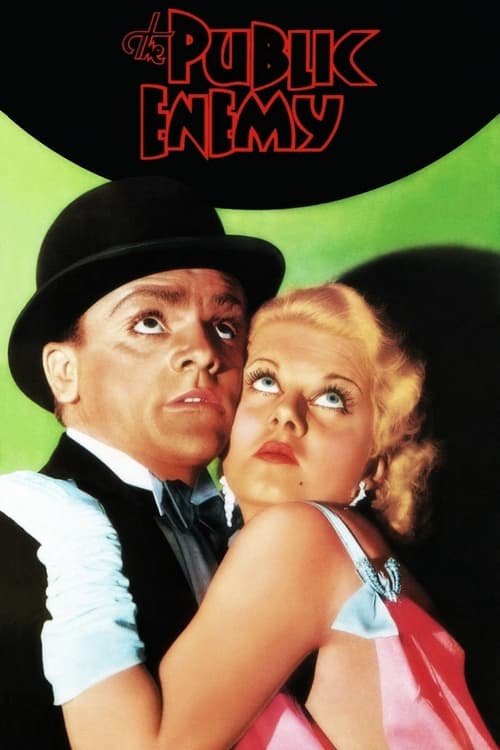
Warner Brothers' succession of gangster movie hits, in particular Little Caesar with Edward G. Robinson, culminated in the 1931 film The Public Enemy. Due to the strong reviews he had received in his short film career, Cagney was cast as nice-guy Matt Doyle, opposite Edward Woods as Tom Powers. However, after the initial rushes, the actors switched roles. Years later, Joan Blondell recalled that a few days into the filming, director William Wellman turned to Cagney and said "Now you're the lead, kid!" "Jimmy's charisma was so outstanding", she added. The film cost only $151,000 to make, but it became one of the first low-budget films to gross $1 million.
1936–1937: Independent years
Cagney spent most of the next year on his farm, and went back to work only when Edward L. Alperson of Grand National Pictures, a newly established, independent studio, approached him to make movies for $100,000 a film and 10% of the profits. Cagney made two features for Grand National: the crime drama Great Guy (1936) with Cagney as a federal inspector, and the musical Something to Sing About (1937) with Cagney as a bandleader and dancer. He received good reviews for both.
Cagney might have continued with Grand National but the studio, having spent lavishly on the Cagney films, couldn't recoup the production costs. Grand National usually made low-budget features for small, neighborhood theaters, and the Cagney films proved too expensive for the intended market. Grand National had acquired a promising story property from author Rowland Brown, Angels with Dirty Faces, for $30,000. Cagney was slated to star in the film version but, with the studio in financial trouble, the project went no further. Cagney took the script to Warner Bros., which bought it from Grand National and filmed it in 1938.
Cagney also became involved in political causes, and in 1936, agreed to sponsor the Hollywood Anti-Nazi League. Unknown to Cagney, the League was in fact a front organization for the Communist International (Comintern), which sought to enlist support for the Soviet Union and its foreign policies.
The courts eventually decided the Warner Bros. lawsuit in Cagney's favor. He had done what many thought unthinkable: taking on the studios and winning. Not only did he win, but Warner Bros. also knew that he was still their foremost box office draw and invited him back for a five-year, $150,000-a-film deal, with no more than two pictures a year. Cagney also had full say over what films he did and did not make. Additionally, William Cagney was guaranteed the position of assistant producer for the movies in which his brother starred.
Cagney had demonstrated the power of the walkout in holding the studios to their word. He later explained his reasons, saying, "I walked out because I depended on the studio heads to keep their word on this, that, or other promise, and when the promise was not kept, my only recourse was to deprive them of my services." Cagney himself acknowledged the importance of the walkout for other actors in breaking the dominance of the studio system. Normally, when a star walked out, the time he or she was absent was added onto the end of an already long contract, as happened with Olivia de Havilland and Bette Davis. Cagney, however, walked out and came back to a better contract. Many in Hollywood watched the case closely for hints of how future contracts might be handled.
1938–1942: Return to Warner Bros.
Cagney's two films of 1938, Boy Meets Girl and Angels with Dirty Faces, both costarred Pat O'Brien. The former was a fast-paced farce with a Hollywood theme, with Cagney and O'Brien playing for laughs, and received mixed reviews. Warner Bros. had allowed Cagney his change of pace, but was anxious to get him back to playing tough guys, which was more lucrative.
Cagney starred as Rocky Sullivan, a gangster fresh out of jail and looking for his former associate, played by Humphrey Bogart, who owes him money. While revisiting his old haunts, he runs into his old friend Jerry Connolly, played by O'Brien, who is now a priest concerned about the Dead End Kids' futures, particularly as they idolize Rocky. After a messy shootout, Sullivan is eventually captured by the police and sentenced to death in the electric chair. Connolly pleads with Rocky to "turn yellow" on his way to the chair so the Kids will lose their admiration for him, and hopefully avoid turning to crime. Sullivan refuses, but on his way to his execution, he breaks down and begs for his life. It is unclear whether this cowardice is real or just feigned for the Kids' benefit. Cagney himself refused to say, insisting he liked the ambiguity. The film is regarded by many as one of Cagney's finest, and garnered him an Academy Award for Best Actor nomination for 1938. He lost to Spencer Tracy in Boys Town. Cagney had been considered for the role, but lost out on it due to his typecasting. (He also lost the role of Notre Dame football coach Knute Rockne in Knute Rockne, All American to his friend Pat O'Brien for the same reason.) Cagney did, however, win that year's New York Film Critics Circle Award for Best Actor.
His earlier insistence on not filming with live ammunition proved to be a good decision. Having been told while filming Angels with Dirty Faces that he would be doing a scene with real machine gun bullets (a common practice in the Hollywood of the time), Cagney refused and insisted the shots be added afterwards. As it turned out, a ricocheting bullet passed through exactly where his head would have been.
During his first year back at Warner Bros., Cagney became the studio's highest earner, making $324,000. He starred with George Raft in the smash hit Each Dawn I Die, an extremely entertaining prison movie that was so successful at the box office that it prompted the studio to offer Raft an important contract in the wake of his departure from Paramount. In addition, Cagney made The Oklahoma Kid, a memorable Western with Humphrey Bogart as the black-clad villain. Cagney completed his first decade of movie-making in 1939 with The Roaring Twenties, his first film with Raoul Walsh and his last with Bogart. After The Roaring Twenties, it would be a decade before Cagney made another gangster film. Cagney again received good reviews; Graham Greene stated, "Mr. Cagney, of the bull-calf brow, is as always a superb and witty actor". The Roaring Twenties was the last film in which Cagney's character's violence was explained by poor upbringing, or his environment, as was the case in The Public Enemy. From that point on, violence was attached to mania, as in White Heat. In 1939 Cagney was second to only Gary Cooper in the national acting wage stakes, earning $368,333.
1942–1948: Independent again
Cagney announced in March 1942 that his brother William and he were setting up Cagney Productions to release films through United Artists. Free of Warner Bros. again, Cagney spent some time relaxing on his farm in Martha's Vineyard before volunteering to join the USO. He spent several weeks touring the US, entertaining troops with vaudeville routines and scenes from Yankee Doodle Dandy. In September 1942, he was elected president of the Screen Actors Guild.
Almost a year after its creation, Cagney Productions produced its first film, Johnny Come Lately, in 1943. While the major studios were producing patriotic war movies, Cagney was determined to continue dispelling his tough-guy image, so he produced a movie that was a "complete and exhilarating exposition of the Cagney 'alter-ego' on film". According to Cagney, the film "made money but it was no great winner", and reviews varied from excellent (Time) to poor (New York's PM).
Following the film's completion, Cagney went back to the USO and toured US military bases in the UK. He refused to give interviews to the British press, preferring to concentrate on rehearsals and performances. He gave several performances a day for the Army Signal Corps of The American Cavalcade of Dance, which consisted of a history of American dance, from the earliest days to Fred Astaire, and culminated with dances from Yankee Doodle Dandy.
The second movie Cagney's company produced was Blood on the Sun. Insisting on doing his own stunts, Cagney required judo training from expert Ken Kuniyuki and from Jack Halloran, a former policeman. He continued to study judo for some time after the film was finished. His use of actual judo throws and holds in the movie has been noted as the first appearance of eastern martial arts in Western film. The Cagneys had hoped that an action film would appeal more to audiences, but it fared worse at the box office than Johnny Come Lately. At this time, Cagney heard of young war hero Audie Murphy, who had appeared on the cover of Life magazine. Cagney thought that Murphy had the looks to be a movie star, and suggested that he come to Hollywood. Cagney felt, however, that Murphy could not act, and his contract was loaned out and then sold.
While negotiating the rights for his third independent film, Cagney starred in 20th Century Fox's 13 Rue Madeleine for $300,000 for two months of work. The wartime spy film was a success, and Cagney was keen to begin production of his new project, an adaptation of William Saroyan's Broadway play The Time of Your Life. Saroyan himself loved the film, but it was a commercial disaster, costing the company half a million dollars to make; audiences again struggled to accept Cagney in a nontough-guy role.
1949–1955: Back to Warner Bros.
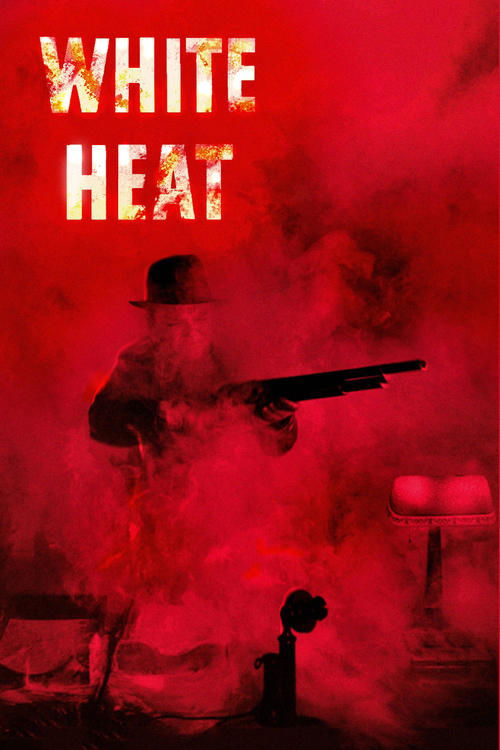
Cagney's portrayal of Cody Jarrett in the 1949 film White Heat is one of his most memorable. Cinema had changed in the 10 years since Walsh last directed Cagney (in The Strawberry Blonde), and the actor's portrayal of gangsters had also changed. Unlike Tom Powers in The Public Enemy, Jarrett was portrayed as a raging lunatic with few if any sympathetic qualities. In the 18 intervening years, Cagney's hair had begun to gray, and he developed a paunch for the first time. He was no longer a dashing romantic commodity in precisely the same way he obviously was before, and this was reflected in his performance. Cagney himself had the idea of playing Jarrett as psychotic; he later stated, "it was essentially a cheapie one-two-three-four kind of thing, so I suggested we make him nuts. It was agreed so we put in all those fits and headaches."
Cagney's final lines in the film – "Made it, Ma! Top of the world!" – was voted the 18th-greatest movie line by the American Film Institute. Likewise, Jarrett's explosion of rage in prison on being told of his mother's death is widely hailed as one of Cagney's most memorable performances. Some of the extras on set actually became terrified of the actor because of his violent portrayal. Cagney attributed the performance to his father's alcoholic rages, which he had witnessed as a child, as well as someone that he had seen on a visit to a mental hospital.
The film was a critical success, though some critics wondered about the social impact of a character that they saw as sympathetic. Cagney was still struggling against his gangster typecasting. He said to a journalist, "It's what the people want me to do. Some day, though, I'd like to make another movie that kids could go and see." However, Warner Bros., perhaps searching for another Yankee Doodle Dandy, assigned Cagney a musical for his next picture, 1950's The West Point Story with Doris Day, an actress he admired.
His next film, Kiss Tomorrow Goodbye, was another gangster movie, which was the first by Cagney Productions since its acquisition. While compared unfavorably to White Heat by critics, it was fairly successful at the box office, with $500,000 going straight to Cagney Productions' bankers to pay off their losses. Cagney Productions was not a great success, however, and in 1953, after William Cagney produced his last film, A Lion Is in the Streets, a drama loosely based on flamboyant politician Huey Long, the company came to an end.
1955–1961: Later career
In 1955 Cagney replaced Spencer Tracy on the Western film Tribute to a Bad Man for Metro-Goldwyn-Mayer. He received praise for his performance, and the studio liked his work enough to offer him These Wilder Years with Barbara Stanwyck. The two stars got on well; they had both previously worked in vaudeville, and they entertained the cast and crew off-screen by singing and dancing.
In 1956 Cagney undertook one of his very rare television roles, starring in Robert Montgomery's Soldiers From the War Returning. This was a favor to Montgomery, who needed a strong fall season opener to stop the network from dropping his series. Cagney's appearance ensured that it was a success. The actor made it clear to reporters afterwards that television was not his medium: "I do enough work in movies. This is a high-tension business. I have tremendous admiration for the people who go through this sort of thing every week, but it's not for me."
The following year, Cagney appeared in Man of a Thousand Faces, in which he played a fictionalized version of Lon Chaney. He received excellent reviews, with the New York Journal American rating it one of his best performances, and the film, made for Universal, was a box office hit. Cagney's skill at mimicry, combined with a physical similarity to Chaney, helped him generate empathy for his character.
Later in 1957, Cagney ventured behind the camera for the first and only time to direct Short Cut to Hell, a remake of the 1941 Alan Ladd film This Gun for Hire, which in turn was based on the Graham Greene novel A Gun for Sale. Cagney had long been told by friends that he would make an excellent director, so when he was approached by his friend, producer A. C. Lyles, he instinctively said yes. He refused all offers of payment, saying he was an actor, not a director. The film was low budget, and shot quickly. As Cagney recalled, "We shot it in twenty days, and that was long enough for me. I find directing a bore, I have no desire to tell other people their business".
In 1959 Cagney played a labor leader in what proved to be his final musical, Never Steal Anything Small, which featured a comical song and dance duet with Cara Williams, who played his girlfriend.
For Cagney's next film, he traveled to Ireland for Shake Hands with the Devil, directed by Michael Anderson. Cagney had hoped to spend some time tracing his Irish ancestry, but time constraints and poor weather meant that he was unable to do so. The overriding message of violence inevitably leading to more violence attracted Cagney to the role of an Irish Republican Army commander, and resulted in what some critics would regard as the finest performance of his final years.
1961–1986: Later years and retirement
Cagney remained in retirement for 20 years, conjuring up images of Jack L. Warner every time he was tempted to return, which soon dispelled the notion. After he had turned down an offer to play Alfred Doolittle in My Fair Lady, he found it easier to rebuff others, including a part in The Godfather Part II. He made few public appearances, preferring to spend winters in Los Angeles, and summers either at his Martha's Vineyard farm or at Verney Farms in New York. When in New York, Billie Vernon and he held numerous parties at the Silver Horn restaurant, where they got to know Marge Zimmermann, the proprietress.
Cagney was diagnosed with glaucoma and began taking eye drops, but continued to have vision problems. On Zimmermann's recommendation, he visited a different doctor, who determined that glaucoma had been a misdiagnosis, and that Cagney was actually diabetic. Zimmermann then took it upon herself to look after Cagney, preparing his meals to reduce his blood triglycerides, which had reached alarming levels. Such was her success that, by the time Cagney made a rare public appearance at his American Film Institute Life Achievement Award ceremony in 1974, he had lost 20 pounds (9.1 kg) and his vision had improved. Charlton Heston opened the ceremony, and Frank Sinatra introduced Cagney. So many Hollywood stars attended—said to be more than for any event in history—that one columnist wrote at the time that a bomb in the dining room would have ended the movie industry. In his acceptance speech, Cagney lightly chastised the impressionist Frank Gorshin, saying, "Oh, Frankie, just in passing, I never said 'MMMMmmmm, you dirty rat!' What I actually did say was 'Judy, Judy, Judy!'"—a joking reference to a similar misquotation attributed to Cary Grant.
While at Coldwater Canyon in 1977, Cagney had a minor stroke. After he spent two weeks in the hospital, Zimmermann became his full-time caregiver, traveling with Billie Vernon and him wherever they went. After the stroke, Cagney was no longer able to undertake many of his favorite pastimes, including horseback riding and dancing, and as he became more depressed, he even gave up painting. Encouraged by his wife and Zimmermann, Cagney accepted an offer from the director Miloš Forman to star in a small but pivotal role in the film Ragtime (1981).
This film was shot mainly at Shepperton Studios in Surrey, England, and on his arrival at Southampton aboard the Queen Elizabeth 2, Cagney was mobbed by hundreds of fans. Cunard officials, who were responsible for security at the dock, said they had never seen anything like it, although they had experienced past visits by Marlon Brando and Robert Redford.
Personal life
In 1920, Cagney was a member of the chorus for the show Pitter Patter, where he met Frances Willard "Billie" Vernon. They married on September 28, 1922, and the marriage lasted until his death in 1986. Frances Cagney died in 1994. In 1940 they adopted a son whom they named James Francis Cagney III, and later a daughter, Cathleen "Casey" Cagney. Cagney was a very private man, and while he was willing to give the press opportunities for photographs, he generally spent his personal time out of the public eye.
Cagney's son died from a heart attack on January 27, 1984, in Washington, D.C., two years before his father's death. James III had become estranged from him, and they had not seen or talked to one another since 1982. Cagney's daughter Cathleen was also estranged from her father during the final years of his life. She died on August 11, 2004.
As a young man, Cagney became interested in farming – sparked by a soil conservation lecture he had attended – to the extent that during his first walkout from Warner Bros., he helped to found a 100-acre (0.40 km2) farm in Martha's Vineyard. Cagney loved that no paved roads surrounded the property, only dirt tracks. The house was rather run-down and ramshackle, and Billie was initially reluctant to move in, but soon came to love the place as well. After being inundated by movie fans, Cagney sent out a rumor that he had hired a gunman for security. The ruse proved so successful that when Spencer Tracy came to visit, his taxi driver refused to drive up to the house, saying, "I hear they shoot!" Tracy had to go the rest of the way on foot.
In 1955, having shot three films, Cagney bought a 120-acre (0.49 km2) farm in Stanfordville, Dutchess County, New York, for $100,000, from show-business and Army veteran Lanny Ross. Cagney named it Verney Farm, taking the first syllable from Billie's maiden name and the second from his own surname. He turned it into a working farm, selling some of the dairy cattle and replacing them with beef cattle. He expanded it over the years to 750 acres (3.0 km2). Such was Cagney's enthusiasm for agriculture and farming that his diligence and efforts were rewarded by an honorary degree from Florida's Rollins College. Rather than just "turning up with Ava Gardner on my arm" to accept his honorary degree, Cagney turned the tables upon the college's faculty by writing and submitting a paper on soil conservation.
Political views
In his autobiography, Cagney wrote that as a young man, he had no political views, as he was typically more concerned with the source of his next meal. However, the emerging labor movement of the 1920s and 1930s soon forced him to take sides. The first version of the National Labor Relations Act was passed in 1935, and growing tensions between labor and management fueled the movement. Fanzines in the 1930s, however, described his politics as "radical".
This somewhat exaggerated view was enhanced by Cagney's public contractual wranglings with Warner Bros., his decision to join the Screen Actors Guild in 1933 and his involvement in the revolt against the so-called "Merriam tax", a method of funneling studio funds to politicians. During the 1934 Californian gubernatorial campaign, studio executives would "tax" their actors, automatically taking a day's pay from their biggest earners, ultimately sending nearly half a million dollars to the gubernatorial campaign of Frank Merriam. Cagney (as well as Jean Harlow) publicly refused to pay and Cagney even threatened that, if the studios took a day's pay for Merriam's campaign, he would donate a week's pay to Upton Sinclair, Merriam's opponent in the race.
Cagney supported political activist and labor leader Thomas Mooney's defense fund but was repelled by the behavior of some of Mooney's supporters at a rally. Around the same time, he gave money for a Spanish Republican Army ambulance during the Spanish Civil War, which he attributed to being "a soft touch". This donation enhanced his liberal reputation. He also became involved in a "liberal group...with a leftist slant" along with Ronald Reagan. However, when he and Reagan saw the direction in which the group was heading, they resigned on the same night.
Cagney was accused of being a communist sympathizer in 1934, and again in 1940. The accusation in 1934 stemmed from a letter that police found from a local communist official that alleged that Cagney would bring other Hollywood stars to meetings. Cagney denied this, and Lincoln Steffens, husband of the letter's writer, supported this denial, asserting that the accusation stemmed solely from Cagney's donation to striking cotton workers in the San Joaquin Valley. William Cagney claimed that the donation was the root of the charges in 1940. Cagney was cleared by U.S. Representative Martin Dies Jr. on the House Un-American Activities Committee.
Death
Cagney died of a heart attack at his Dutchess County farm in Stanford, New York on Easter Sunday 1986 at the age of 86. A funeral mass was held at St. Francis de Sales Roman Catholic Church in Manhattan. The eulogy was delivered by his close friend President Ronald Reagan. His pallbearers included boxer Floyd Patterson, dancer Mikhail Baryshnikov (who had hoped to play Cagney on Broadway), actor Ralph Bellamy and director Miloš Forman. Governor Mario M. Cuomo and mayor Edward I. Koch also attended the service.
Cagney was interred in a crypt in the Garden Mausoleum at Cemetery of the Gate of Heaven in Hawthorne, New York.
Honors and legacy
Cagney won the Academy Award in 1943 for his performance as George M. Cohan in Yankee Doodle Dandy.
For his contributions to the film industry, Cagney was inducted into the Hollywood Walk of Fame in 1960 with a motion pictures star located at 6504 Hollywood Boulevard.
In 1974, Cagney received the American Film Institute's Life Achievement Award. Charlton Heston, in announcing that Cagney was to be honored, called him "one of the most significant figures of a generation when American film was dominant, Cagney, that most American of actors, somehow communicated eloquently to audiences all over the world ... and to actors as well."
He received the Kennedy Center Honors in 1980, and a Career Achievement Award from the U.S. National Board of Review in 1981. In 1984, Ronald Reagan awarded him the Presidential Medal of Freedom.
On October 21, 1981, Cagney threw out the ceremonial first pitch of the second game of the 1981 World Series.
In 1999, the United States Postal Service issued a 33-cent stamp honoring Cagney.
Cagney was among the most favored actors for director Stanley Kubrick and actor Marlon Brando, and was considered by Orson Welles to be "maybe the greatest actor to ever appear in front of a camera." Warner Bros. arranged private screenings of Cagney films for Winston Churchill.
On May 19, 2015, a new musical celebrating Cagney, and dramatizing his relationship with Warner Bros., opened off-Broadway in New York City at the York Theatre. Cagney, The Musical then moved to the Westside Theatre until May 28, 2017.