Production
During the spring and summer of 1951, I Love Lucy moved into production. Oppenheimer, Pugh, and Carroll began fine-tuning the premise of the show and writing the series' first scripts. The trio chose to adapt many storylines for television using the backlog of episodes of My Favorite Husband. In addition, the series' ensemble cast and crew were assembled. Arnaz retained his orchestra, which was used in the series' musical numbers and to score the show's background and transitional music. Arnaz's childhood friend Marco Rizo arranged the music and played the piano for the show, while Wilbur Hatch conducted the orchestra.
After Philip Morris signed on to sponsor the show, two problems that would ultimately change the fate of I Love Lucy arose. Ball and Arnaz had originally decided that the series would air biweekly, like The George Burns and Gracie Allen Show. Philip Morris, however, was insistent that the show air weekly, thus diminishing the possibility of Ball continuing her film career alongside a television show. Another problem lay in the fact that Philip Morris wanted the series to originate from New York rather than Hollywood. At the time, most television shows were produced from New York and broadcast live for eastern and Midwest audiences. West Coast viewers were able to view live programs only through low-quality kinescopes, which derived their images by using a 35 mm or 16 mm film camera to record the show from a television monitor.
Although the pilot film shown to Philip Morris had been a kinescope, the sponsor did not want the lucrative East Coast market, accustomed to quality broadcasts, to see a low-quality kinescope film. Owing to the impending birth of their first child, both Ball and Arnaz insisted on staying in Hollywood and producing the show on film, something a few Hollywood-based series had begun to do. Both CBS and Philip Morris initially balked at the idea, because of the higher cost that filming the show would incur, and acquiesced only after the couple offered to take a $1,000-a-week pay cut in order to cover the additional expense. In exchange, Ball and Arnaz demanded, and were given, 80% ownership in the I Love Lucy films (the other 20% went to Oppenheimer, who then gave 5% to Pugh and 5% to Carroll). Shooting the show on film, however, would require that Ball and Arnaz become responsible for producing the series themselves. Union agreements at the time stipulated that any production filmed in a studio use film studio employees. CBS staff were television and radio employees and thus fell under different union agreements. Thus, Arnaz reorganized the company he created to manage his orchestra bookings and used it as the corporation that would produce the I Love Lucy shows. The company was named Desilu, from the combination of both of their first names, Desi and Lucille.
Though some television series were already being filmed in Hollywood, most used the single-camera format familiar from movies, with a laugh track added to comedies to simulate audience response. Ball wanted to work in front of a live audience to create the kind of comic energy she had displayed on radio. The idea of a film studio that could accommodate an audience was a new one for the time, as fire safety regulations made it difficult to allow an audience in a studio. Arnaz and Oppenheimer found the financially struggling General Service Studios located on Las Palmas Avenue in Hollywood. Studio owner Jimmy Nasser was eager to accommodate the Desilu company and allowed them, with the financial backing of CBS, to renovate two of his studios so that they could accommodate an audience and be in compliance with local fire laws.
Another component to filming the show came when it was decided to use three 35 mm film cameras to simultaneously film the show. The idea had been pioneered by Jerry Fairbanks, and it had been used on the live anthology series The Silver Theater and the game show Truth or Consequences. Ralph Edwards's assistant Al Simon was hired by Desilu to help perfect the new technique for the series. The process lent itself to the Lucy production as it eliminated the problem of requiring an audience to view and react to a scene three or four times in order for all necessary shots to be filmed. Multiple cameras would also allow scenes to be performed in sequence, as a play would be, which was unusual at the time for filmed series. Retakes were rare and dialogue mistakes were often left in the episodes.
Ball and Arnaz enlisted the services of Karl Freund, a cinematographer who had worked on such films as Metropolis (1927), Dracula (1931), The Good Earth (1937), and DuBarry Was a Lady (1943) (which also starred Ball), as well as directed The Mummy (1932), to be the series cinematographer. Although at first Freund did not want anything to do with television, it was the personal plea of the couple that convinced him to take the job.
Freund was instrumental in developing a way to uniformly light the set so that each of the three cameras would pick up the same quality of image. Freund noted that a typical episode (20–22 min.) was shot in about 60 minutes, with one constant concern being the shades-of-gray contrast in the final print, as each stage of transmission and broadcast would exaggerate the contrast. Freund also pioneered flat lighting, in which everything is brightly lit to eliminate shadows and the need for endless relighting. This mindfulness of contrasts led to sets and props being prepared in monochrome shades: "This knowledge of the contrast secret is revealed in the decor of the sets. They are painted in various shades of grey. Props likewise follow the ethical demands of correct contrast, as do the wardrobes of the players. Even newspapers, when they are to appear in a scene, are tinted grey."
Audience reactions were live, which created a more authentic laugh than the canned laughter used on most filmed sitcoms of the time. Regular audience members were sometimes heard from episode to episode, and Arnaz's distinctive laugh could be heard in the background during scenes in which he did not perform, as well as Ball's mother, DeDe, whose distinctive "uh oh" could be heard in many of the episodes. In later years, CBS would devise a laugh track from several I Love Lucy audiences and use them for canned laughter on shows done without a live audience.
I Love Lucy's pioneering use of three cameras led to it becoming the standard technique for the production of most sitcoms filmed in front of an audience. Single-camera setups remained the technique of choice for sitcoms that did not use audiences. This led to an unexpected benefit for Desilu during the series' second season when it was discovered that Ball was pregnant. Not being able to fulfill the show's 39-episode commitment, both Desi and Oppenheimer decided to rebroadcast popular episodes of the series' first season to help give Ball the necessary rest she needed after she gave birth, effectively allowing fewer episodes to be filmed that season. Unexpectedly, the rebroadcasts proved to be ratings winners, effectively giving birth to the rerun, which would later lead to the profitable development of the rerun syndication market.
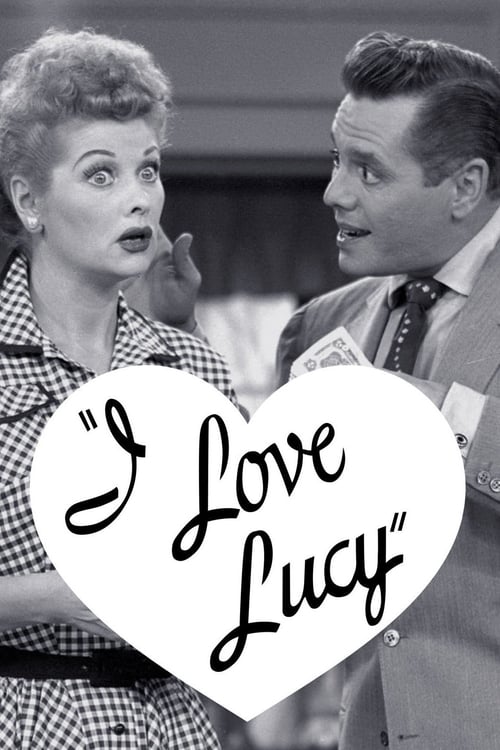
The show's original opening and commercial bumpers were animated caricatures of Ball and Arnaz. They were designed and animated by MGM character designer, and future "Flintstones" cartoonist, Gene Hazelton (1917–2005) and were produced under a contract that producer William Hanna had secured privately. The program sponsor, Philip Morris cigarettes, was incorporated into many of these sequences, so when I Love Lucy went into repeats, the sponsor material was replaced by the now-familiar heart logo. However, Hazelton's original animation survives and can be seen in the DVD boxed set as originally presented.
Desilu Productions, jointly owned by Ball and Arnaz, would gradually expand to produce and lease studio space for many other shows. For seasons 1 and 2 (1951–1953), Desilu rented space and filmed I Love Lucy at General Service Studios, which eventually became known as Hollywood Center Studios. In 1953, it leased the Motion Picture Center at 846 Cahuenga Blvd. in Hollywood, renaming it Desilu Studios, to shoot seasons 3–6 (1953–1957) of I Love Lucy. After 1956, it became known as Desilu-Cahuenga Studios to avoid confusion with other acquired Desilu locations. In an effort to keep up with the studio's growth, and need for additional sound stages, Arnaz and Ball purchased RKO Radio Pictures from General Tire in 1957 for over $6 million, effectively owning the studio where they had started as contract players. Desilu acquired RKO's two studio complexes, located on Gower Street in Hollywood and in Culver City (now part of the Paramount lot and Culver Studios respectively), along with the Culver City back lot nicknamed "Forty Acres". The sale was achieved by the duo selling their ownership of the once-thought-worthless I Love Lucy films back to CBS for over four million dollars.
In 1962, two years after their marriage dissolved, Ball bought out Arnaz's shares of Desilu, becoming the studio's sole owner. She eventually sold off Desilu in 1967 to Gulf+Western, owners of Paramount Pictures. After the sale, Desilu-Cahuenga became a private production company and was known as Ren-Mar Studios until 2010, when it was acquired by the Red Digital Cinema Camera Company and renamed Red Studios Hollywood.