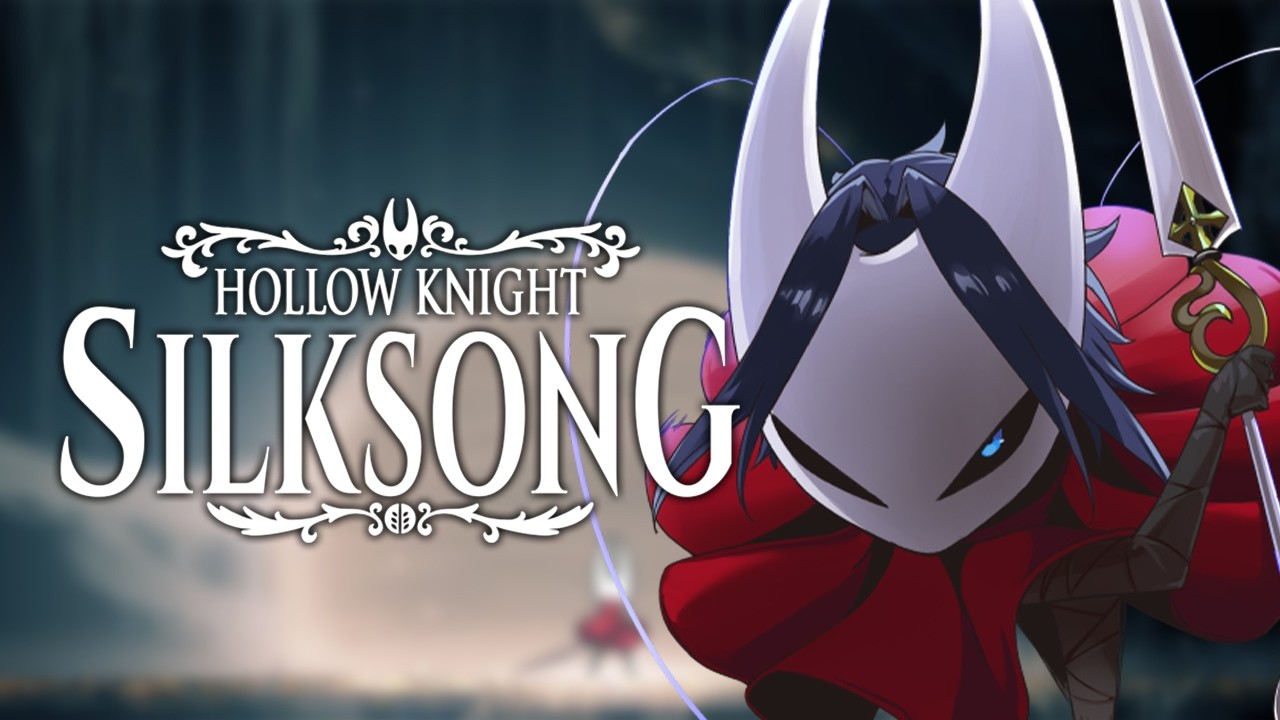



Hollow Knight: Silksong is a 2025 Metroidvania game developed and published by Australian independent developer Team Cherry. The sequel to Hollow Knight (2017), the story follows Hallownest's former princess-protector, Hornet—a major secondary character in Hollow Knight—after she is captured and transported to the unfamiliar land of Pharloom. Gameplay sees the player navigating through the large, interconnected areas of this kingdom, where they must battle enemies, traverse platforming challenges, and complete quests using various skills, tools, and movement mechanics.
Originally planned as downloadable content making Hornet playable in Hollow Knight, funded as a stretch goal during the game's 2014 Kickstarter campaign, the project grew in scope over time, prompting Team Cherry to announce in February 2019 that it would instead become a full standalone sequel. Following a delay past a 2023 release window, Silksong was released on 4 September 2025 for Linux, macOS, Nintendo Switch, Nintendo Switch 2, PlayStation 4, PlayStation 5, Windows, Xbox One, and Xbox Series X/S. It will be supported with free expansions, with the first scheduled for 2026.
Silksong received acclaim for its graphics, soundtrack, story, world design, and gameplay, though opinions on its high difficulty were mixed. The game had sold over seven million copies by mid-December 2025, with millions more playing on Xbox Game Pass.
Contents
Gameplay
Hollow Knight: Silksong's gameplay is similar to its predecessor Hollow Knight, featuring 2D platforming and combat. Some changes are made from the original, such as the player character moving more acrobatically and healing faster. Side-quests (called "Wishes") are tracked in a menu. These quests are provided by non-player characters or found at quest boards.
Equippable "Tools" are divided into three categories: blue and yellow Tools are passive and support-oriented, while red Tools are typically offensive weapons. Red Tools are manually activated and have a limited number of charges which must be replenished with Shell Shards, an in-game currency, at Benches. Hornet is limited in how many Tools of each colour she can equip, with her maximum capacity modified when changing between different gameplay styles, known as "Crests". In addition to their varying tool makeups, the speed and range of Hornet's attack move-set differs between Crests. Each Crest also possesses a unique mechanic, such as boosting damage dealt if hits are avoided or allowing for tools to be replenished without resting at a Bench.
When attacking enemies or interacting with certain objects and locations, Hornet adds "Silk" to her reservoir. Silk can be used for healing, with three hit points (called "Masks") recovered in a single heal. Silk can also be expended to use "Silk Skills", additional attacks which are unlocked by locating remnants of the Weavers and their society when progressing through the game. Tools, Crests and Silk Skills can be adjusted when sitting at Benches, which also serve as a source of healing and act as respawn points after all hit points are lost.
Throughout the game, Hornet also unlocks different movement options that expand her mobility and aid in combat. These include a grappling hook-like "Clawline", a "Drifter's Cloak" that catches wind currents and allows Hornet to travel upward when over updrafts or fall slowly, wall climbing ("Cling Grip"), and a vertical leap that launches her upward with her Needle ("Silk Soar").
Plot
Premise
Silksong takes place after the events of Hollow Knight and continues the story of Hornet in the kingdom of Pharloom. Pharloom is a ruined religious kingdom afflicted by the "Haunting", a madness that afflicts bugs and reanimates their corpses through Silk. Hornet, a descendant of the Weavers, is captured by a group of veiled bugs to be brought to Pharloom.
Synopsis
Hornet escapes her captors and falls into the Moss Grotto. She finds that her captors were adherents of the Citadel, a supposedly holy institution located at Pharloom's summit that attracts numerous pilgrims. Hornet decides to ascend to the Citadel to uncover the reason behind her capture. During her journey, Hornet meets various pilgrims and NPCs, however, in the Deep Docks, Hornet encounters Lace, a being strung entirely of silk. Lace attempts to stop Hornet from reaching the citadel, but, after being defeated, flees to the citadel, allowing Hornet to continue.
As the game progresses, it is revealed that the Weavers were spider-like bugs ascended by Grand Mother Silk, a godlike being. Initially believing themselves to be divine descendants, they served Grand Mother Silk before rebelling upon discovering that they would never be the true gods of the kingdom. The Weavers trapped and lulled her to sleep within the Cradle, but over time she was able to exert her influence on other bugs, causing the Haunting. Some of the Weavers left Pharloom for the kingdom of Hallownest, one of whom named Herrah eventually giving birth to Hornet.
Hornet eventually gains access to the Citadel and reaches the Cradle, where she battles and defeats Lace. Lace is revealed to be another creation of Grand Mother Silk, and is disillusioned by her origins, believing her existence to be unnatural. After this encounter, Hornet faces Grand Mother Silk herself. The fight can either end with Hornet defeating the deity and binding her power, thus becoming Pharloom's new monarch, or a parasite within Hornet consuming both of them.
Alternatively, if Hornet has fulfilled most wishes and completed various other key objectives, she may work with the Caretaker, the keeper of a shrine-turned sanctuary in the Citadel, to craft a Soul Snare, a trap capable of destroying Grand Mother Silk; this is the only way to access the third and final Act of the game. After the Caretaker sets the trap, Hornet restrains Grand Mother Silk during the battle and activates it, only to discover it is a portal connected to the Void. The Void ensnares and drags Grand Mother Silk through the portal. The deity attempts to drag Hornet through with her, but Lace saves Hornet out of spite for her mother, and is dragged into the Void instead.
After waking up, Hornet finds Pharloom to have been brought to an apocalyptic state. Grand Mother Silk and Lace were brought to the bottom of the Abyss, the deepest part of Pharloom, and are trapped in a cocoon beneath a sea of Void. Due to Grand Mother Silk's resistance, Void travels along the threads previously created by the haunting, infusing Haunted enemies with Void. Hornet deduces that the strain of these threads will soon cause Pharloom to collapse. She confers with the Caretaker, who is revealed to be part of a group of spellcasting bugs known as Snail Shamans, and theorises that Grand Mother Silk is resisting the Void to save Lace. To reach her, Hornet works with the Shamans to retrieve a Void-warding flower called the Everbloom from her memories by seizing the hearts of fallen rulers.
Development and release
Hollow Knight: Silksong was primarily developed by Team Cherry's three members: Co-founders Ari Gibson and William Pellen were the co-directors, with Gibson additionally providing most of the game's art, and Jasmine Vine served as the Technical Director. Marketing and publishing was handled by contractor Matthew "Leth" Griffin, while Christopher Larkin returned to compose the soundtrack.
Development timeline
Hollow Knight: Silksong spawned from a Kickstarter stretch goal met during Hollow Knight's 2014 Kickstarter. During the campaign, the goal for a "Playable Hornet" was met; Team Cherry planned for it to be released as downloadable content (DLC) for Hollow Knight. Initially, Team Cherry's plan for the DLC was for it to introduce a character swapping mechanic for the base game, or a separate small "sub-chapter", but their ideas transitioned into introducing a "new land", with a major reason being that Hornet's height made her difficult to use as a player character in Hollow Knight's world of Hallownest. During this early development, the DLC grew "too large and too unique to stay a DLC", leading them to decide to make it a standalone game around 2017.
In July 2017, Team Cherry created the first known sketch for Silksong's world of Pharloom, then known as "Loomland". It featured early concepts of areas that remained in the final game, such as Greymoor and the Marrow (Boneforest), alongside ones that were later scrapped or reworked. The Citadel, then known as the "City of Song", the central location of Silksong's narrative, existed in this original concept map. Throughout the rest of 2017 and 2018, Team Cherry continued expanding Silksong's map and developed the game while also working on Hollow Knight's announced final expansion, Godmaster, which released in August 2018.
On 14 February 2019, Team Cherry announced Silksong for Nintendo Switch and PC in a trailer, with a developer diary video sharing more information. The developers released an update in March 2019, sharing descriptions and images of characters set to appear in Silksong. They thanked the game's fans for supporting them regarding the announcement of the sequel. Silksong was playable during E3 2019, at the Nintendo booth, and a Nintendo Treehouse livestream additionally showed off the game. Post-E3, Team Cherry released a blog post, which overviewed the area "Greymoor", noting it as one of the biggest areas they ever created; the post also explained further gameplay details. In December 2019, Team Cherry posted another blog post, containing a two-track preview of the soundtrack, composed by Christopher Larkin, as well as an update on the total number of enemies developed (which was 165 at the time), with a focus on a trio, described as "members of a scholarly suite."
In early 2020, during development, Seth Goldman, a Hollow Knight fan with cancer, met Team Cherry multiple times through the Marty Lyons Foundation. Gibson and Pellen offered him to create a character design and name, which Team Cherry implemented in-game as Shrine Guardian Seth, a boss character. In June of that year, Team Cherry marketing and publishing director Matthew "Leth" Griffin began a series of riddles in Discord that revealed non-player characters and short videos of Silksong once solved; these riddles continued into July. One of the characters revealed was Shrine Guardian Seth. In December, an issue of the Edge magazine that featured Silksong as the cover story released; it contained multiple screenshots, gameplay information, and quotes from Gibson and Pellen about the game and its development.
Development vision and philosophy
Team Cherry's original vision for the standalone Silksong title involved a smaller world than that of Hollow Knight and a quest system to encourage revisiting areas, but the map greatly expanded during development. They were also not attempting to "create a more difficult sequel", with Pellen stating in 2020 that "they're hoping for it to be a comparable test of skill to Hollow Knight". Despite this goal, Team Cherry made more enemies deal two points of damage when compared to Hollow Knight—two-fifths of Hornet's starting health—which Pellen stated was in order to have the player "spend more time at either full health or almost dead, [with] the gameplay ... snapping between these states." They decided to make Hornet's heal faster and stronger than the Knight's to combat this.
Since Hornet is "faster and more skillful than the Knight", Team Cherry believed that "the base level enemy had to be more complicated, more intelligent". To alleviate this, their vision was for "[players to] have ways to mitigate the difficulty via exploration, or learning, or even [circumvent] the challenge entirely, rather than getting stonewalled." Traditional difficulty options and sliders were excluded since they felt that "not giving the player an out to fiddle with things" helped players "focus" on finding ways to circumvent challenge, with mitigation methods being added throughout development.
They also thought this helped them focus on making challenges fair, with Gibson stating in a post-release interview: "I feel like limiting it in that way [...] means when we’re making it, we don’t have an out either. We have to be quite considerate about that stuff". Pellen further explained that, due to excluding difficulty options, "when you’re thinking about what the player’s options are, and how they might react to the world, you’re not thinking about them backing out to the options and changing the world [..] all of your thinking is in the world itself rather than on a meta level", which he enjoyed.
Gibson and Pellen describe Silksong's development philosophy as being a "controlled scope creep", with Gibson stating in 2020 "the way we approach these games ... is that they are just a web of ideas, and notions", and Pellen adding "with destinations that we're comfortable with not knowing what they are for a while – just building up or down to them." Gibson described the development of Silksong as "enjoyable" and "very satisfying". He and Pellen both recounted in August 2025 that they could have continued expanding the game but forced themselves to stop in order to avoid delaying its release further than necessary. According to Gibson, due to their development style, "ideas turn into something that exist[s] in the game [quickly]", which he described as "very satisfying."
Reception
Pre-release
The playable Silksong demo at E3 2019 received critical praise. IGN writer Tom Marks liked "its combat and movement even more than the original", and said "Silksong has the potential to be even better than the original." Ozzie Mejia of Shacknews praised the "tremendous amount of detail in the environments and in the backgrounds". Writing for Game Informer, Matt Miller prematurely called Silksong a "worthy sequel", stating "the portion of Hornet's adventure on display maintains the tradition of excellence established by the original." Nintendo World Report writer Melanie Zawodniak praised the speed in which Hornet could traverse vertically, as she believed such movement was "a bit too sluggish in Hollow Knight." Despite the short play-time, the demo made her certain that "Team Cherry [is] putting just as much of their skill and passion into the project as [in] their debut title".
The demo at Gamescom 2025 was given similar praise. Writing for Destructoid, Adam Newell called the demo "stunningly beautiful with its lush visuals and animations", and stated that he was "hooked from the start." GamesRadar+ writer Josh West stated "there's an attention to detail in its visual and audio design that's scintillating to experience. The play itself is smooth, Hollow Knight's occasional sharp edges sanded down to ensure that movement and motion is the star." Writing for Game Informer, Wesley LeBlanc stated "if what I played today is any indication, Silksong will follow in [Hollow Knight's] steps – I really enjoyed what I played."
As of late August 2025, Silksong was on roughly 5.2 million Steam users' wishlists, by far the most-wishlisted game on the service at the time.
Due to its lengthy development, fans would often hope for Silksong news to appear at game showcases. After repeated no-shows, the fans eventually would consider this hope illogical, and used clown imagery to signify this, with the most popular images being edited screenshots and fan art of Hollow Knight, showing its protagonist wearing a clown wig and nose.
On 16 January 2021, the YouTube fan channel Daily Silksong News began tracking and reporting updates on the game's status every day, leading to nearly 1,700 uploads. Almost every video consists of the script, "Today is [date]. This is [host name], your host for today bringing you your daily Silksong news. There has been no news to report for Silksong today. This has been your daily news for Silksong for today, [date]." Only 48 videos reported news prior to the game's release on day 1,693. The channel's main host, Araraura, was interviewed by PC Gamer writer Harvey Randall, and WIRED writer Megan Farokhmanesh. Many videos were also guest hosted by other social media personalities.
Post-release
Hollow Knight: Silksong received "universal acclaim" according to review aggregator website Metacritic. OpenCritic reported that 97% of critics recommended the game.
Several critics felt that the game was a worthy sequel to the original and praised its larger, more ambitious scope, while others appreciated the low price point for such an expansive title. The art design of Silksong was positively received by critics, with many describing it as beautifully crafted. Likewise, Ashley Schofield of Video Games Chronicle noted the game as having gorgeous layering and intricately placed background details throughout, which she said gave Pharloom a strong sense of scale and depth. The game's soundtrack was also well received, with Christian Donlan of Eurogamer describing it as "haunted, playful, and endlessly beckoning", and Simon Fitzgerald of Push Square noting its ability to create the proper mood for a range of different situations. For its story, Tom Marks of IGN praised Silksong's writing as being consistently strong throughout. Will Bedingfield of NME regarded Hornet's "sharp, amusingly standoffish dialogue" as much more compelling compared to the original game's silent protagonist. Similarly, Marks of IGN called her an excellent hero that had a notably different tone from the original. Schofield of Video Games Chronicle described the elements of characterisation and humour given to NPCs during side-quests as highlights of the game's writing.
Reviewers noted the quicker, more nimble nature of Hornet during gameplay as compared to Hollow Knight's protagonist. Will Bedingfield of NME described her as "slashing her needle in bouncy flourishes", while Ashley Schofield of Video Games Chronicle complimented the sense of fluidity and exactness in Hornet's controls. The game's world was praised for being highly detailed and rewarding to explore. Critics such as Tyler Colp of PC Gamer appreciated how the world design contextualised the broader narrative and how its details incentivised exploration. Additionally, the world's boss battles were received positively by Oscar Taylor-Kent of GamesRadar+, who described them as being universally well-designed with a range of different fight structures.
Critics considered Silksong to be a more difficult game than its predecessor. Some elements of its difficulty were particularly contentious, such as the long "runbacks" to return to bosses, increased enemy damage as compared to Hollow Knight, scarcity of currency, and the difficulty of using Hornet's diagonal "pogo" ability, especially for platforming sections. Some reviewers appreciated how the difficulty gave the game "character", integrated the gameplay with the story and world, and provided a sense of mastery when overcoming the challenges of the game. Others, like Ashley Schofield of Video Games Chronicle, considered the difficulty tiring and demoralizing, feeling it inhibited the feeling of exploration. Reviewers were also more mixed on the game's side-quests, some of which were praised for their world-building while others were criticized as "uninspired" and "monotonous".